The short answer: the CASABREWS CM5418 is the best espresso machine under $200 for most people, the Flair Neo Flex makes the most real espresso of anything here for about $119, and the Nespresso Essenza Mini is the honest pick if you want convenience over craft. What you have to accept at this price is that every electric machine under $200 makes espresso with training wheels — pressurized baskets that forgive a weak grinder but cap the ceiling. Prices and specs checked 2026-10-13. Prices vary by retailer; where sources disagreed we used the manufacturer’s current price.
Disclosure: we are an independent research desk and earn no commission on anything here. Vendor links on this page are plain links to manufacturer and retailer pages — no affiliate tracking. See our disclosure policy for how we stay independent.
We are a research desk, not a test lab: we synthesize owner reports, forum threads, published measurements, reviews, and teardowns rather than claiming hands-on testing we have not done.
First principles: what $200 actually buys in an espresso machine
Espresso is a constrained extraction problem: water at about 90 to 94°C must pass through a compacted puck of finely ground coffee at about 9 bars of pressure, evenly enough to extract the good compounds without channeling. Holding those two conditions steady costs money — precise temperature control, pressure limited by a calibrated OPV, and a grinder fine enough to build the puck. A $200 budget cannot buy all three, so every machine here deletes a different one:
- The pressurized-basket machines (CM5418, Stilosa, 3700 Essential) keep the electric convenience and fake the pressure. Dual-wall (pressurized) baskets create back-pressure artificially, so the pump’s 15 or 20 bars get squeezed down into something that looks like espresso and tastes better than drip coffee. What they cannot do is reward a better grinder — the ceiling is baked in.
- The manual lever (Flair Neo Flex) keeps real pressure and deletes the electricity. Your arm is the pump, so the extraction is genuinely at espresso pressure with a real puck — but there is no heat source and no steam, and you must supply the grinder and the effort.
- The capsule machine (Essenza Mini) keeps convenience and deletes the entire extraction. The coffee is pre-ground and sealed in capsules; the machine cannot make better espresso than the capsule contains, and it cannot make worse.
That is the real shape of this price band: not five versions of one thing, but three different bets about what to keep. If you want to understand the mechanism before you shop, our espresso machine types guide and the pressurized vs non-pressurized baskets explainer go deeper.
What the $200 ceiling forces you to choose
Thermoblock versus small boiler. The CM5418 and 3700 Essential heat water on demand through a thermoblock: heat-up in under a minute, small footprint, and lower cost. The Stilosa uses a small stainless steel boiler that takes longer to heat but holds temperature more steadily once hot. Neither has PID control except the current CM5418 units, which CASABREWS has added PID temperature control, a pressure gauge, and pre-infusion to — a meaningful update at $139.99.
The grinder question splits this band in two. With pressurized baskets, pre-ground coffee works, and a grinder can wait — that is the whole point of the design. With the Neo Flex’s bottomless portafilter, a true espresso grinder is mandatory; pre-ground coffee will not build the resistance a lever needs. Read our why espresso needs a grinder guide before deciding which side you are on.
Steam is thin everywhere here. Every electric machine in this band makes steam from the same heater that brews, so steaming is a pause-then-steam affair with limited reserve. The manual Neo Flex makes no steam at all. If lattes are your daily drink, the cheapest real answer is still a bigger budget — see our best espresso machines under $500.
Durability is the known risk. This is the price band where machines are bought and replaced rather than repaired. The Stilosa has the longest service history here; the CASABREWS models and the Flair carry one-year warranties, and Flair’s modular manual design has fewer parts to fail than any electric machine at this price.
Comparison table
Prices and specs checked 2026-10-13. Prices vary by retailer; where sources disagreed we used the manufacturer’s current price.
| Machine | Typical price | Type | Heating | Portafilter | Steam | Tank | Best for |
|---|---|---|---|---|---|---|---|
| CASABREWS CM5418 | $139.99 | Semi-auto electric | Thermoblock | 51mm, pressurized | Manual wand | 1.0L | Most people; fullest features |
| De’Longhi Stilosa (EC260) | $149.95 | Semi-auto electric | Stainless steel boiler | 51mm, pressurized | Manual frother | 1L | Proven reliability; simple workflow |
| Flair Neo Flex | About $119 | Manual lever | Boiled water (none) | Bottomless 2-in-1 | None | N/A | Real espresso on a tight budget |
| CASABREWS 3700 Essential | About $110 street ($129.99 list) | Semi-auto electric | Thermoblock | 51mm, pressurized | Manual wand | 43.9 oz | Tightest budget for a semi-auto |
| Nespresso Essenza Mini | $149.99 | Capsule | Thermoblock | Capsule | None (Aeroccino separate) | 0.6L | Convenience over craft |
The five machines, in depth
1. CASABREWS CM5418 — best for most people
The CM5418 wins this band on specification density. A 20-bar Italian pump, pre-infusion, a pressure gauge on the front panel, and — on current production units — PID temperature control, which is normally a $300-plus feature. The 51mm portafilter ships with pressurized baskets, the 1350W thermoblock heats in under a minute, and the steam wand is a proper manual wand, not a panarello frother. At 5.9 inches wide it is genuinely compact, and the 1.0L tank is removable.
The honest caveats: pressurized baskets only, so the espresso ceiling is the design, not your skill; the PID-and-gauge updates appear on current units and early stock may differ; and CASABREWS is a young brand with a thin service-parts ecosystem compared to De’Longhi. At $139.99 on the CASABREWS site (we also found it at Home Depot and Walmart at the same price), it is the machine that gives you the most to work with while you learn.
2. De’Longhi Stilosa (EC260) — the honest pick
The Stilosa is the machine we recommend in the same role in our under-$500 roundup, and it belongs here too: stainless steel boiler, 15-bar pump, pressurized 51mm baskets, ESE pod compatibility, and a manual milk frother for $149.95. It has none of the CM5418’s instrumentation — no gauge, no PID, no pre-infusion — but it has something no other machine here has: a decade-plus of owners confirming it keeps working. The boiler takes 10 to 15 minutes to be genuinely ready, the included plastic scoop-tamper should be replaced immediately, and the pucks come out wet without a solenoid valve. None of that is a surprise at $149.95, and none of it stops it from making better coffee than it has any right to.
3. Flair Neo Flex — best real espresso
The Neo Flex is the only machine here that extracts real espresso, and it does it for about $119 by deleting everything electric. Your arm is the pump, so pressure is genuinely at espresso levels, and the included bottomless 2-in-1 portafilter plus flow-control portafilter give you both the forgiving path (restricted exit port builds pressure for you) and the real path (bottomless, you build it). The relaunched version adds an integrated pressure gauge and a thin-walled brew cylinder that needs no preheating — genuine workflow improvements. Dose is 12 to 18g, yield up to about 45ml.
The costs are real: no steam at all, you heat the water on a kettle, and the bottomless portafilter path demands an espresso-capable grinder — our grinder budget guide puts that at $150 to $250, which is the Neo Flex’s hidden price. But if you already own the grinder, nothing electric under $200 extracts like this. See also our manual machine roundup for the full lever family.
4. CASABREWS 3700 Essential — cheapest semi-automatic
The 3700 Essential is the CM5418 with the instrumentation stripped back: 20-bar pump, thermoblock, pressurized 51mm baskets, manual steam wand, and a 43.9 oz tank in a 5.7-inch-wide body. Street price hovers around $110 (we found $109.99 current, against a $129.99 list), which makes it the cheapest way to get a genuine semi-automatic workflow — dose, distribute, tamp, pull — under $200. The trade-offs versus the CM5418 are the missing pressure gauge and pre-infusion, a smaller color range at the price, and owner reports of post-shot dripping. If the $30 difference to the CM5418 matters, this is a fine machine; if it does not, the gauge and pre-infusion are worth it.
5. Nespresso Essenza Mini — the easiest cup
The Essenza Mini is the only honest answer for people who want espresso-like coffee with zero learning curve: 19-bar capsule extraction, heats in about 25 seconds, two programmable cup sizes (espresso and lungo), a 0.6L tank, and a footprint of 8.4cm wide — the smallest machine here. At $149.99 it costs more per cup than any machine on this list (capsules run about $0.70 to $1.00 each), and it cannot be improved by skill or upgraded by grinder. We include it because for some buyers, “push a button, get a decent shot” is the whole job. Pair it with an Aeroccino frother for milk drinks. If capsule math bothers you, that is the signal you are actually a Flair person.
How to choose among the five
- You want the most machine for the money: CM5418. The gauge, pre-infusion, and PID are real advantages at $139.99.
- You want the one that keeps working: Stilosa. Boilers and brand longevity beat features at this price.
- You already own an espresso-capable grinder and want real espresso: Flair Neo Flex. Nothing else here extracts like it.
- Your budget is absolute and you want the semi-automatic ritual: 3700 Essential at about $110 street.
- You will not learn dial-in and just want a decent shot: Essenza Mini. Pay the capsule tax and skip the ritual.
What to budget beyond the sticker
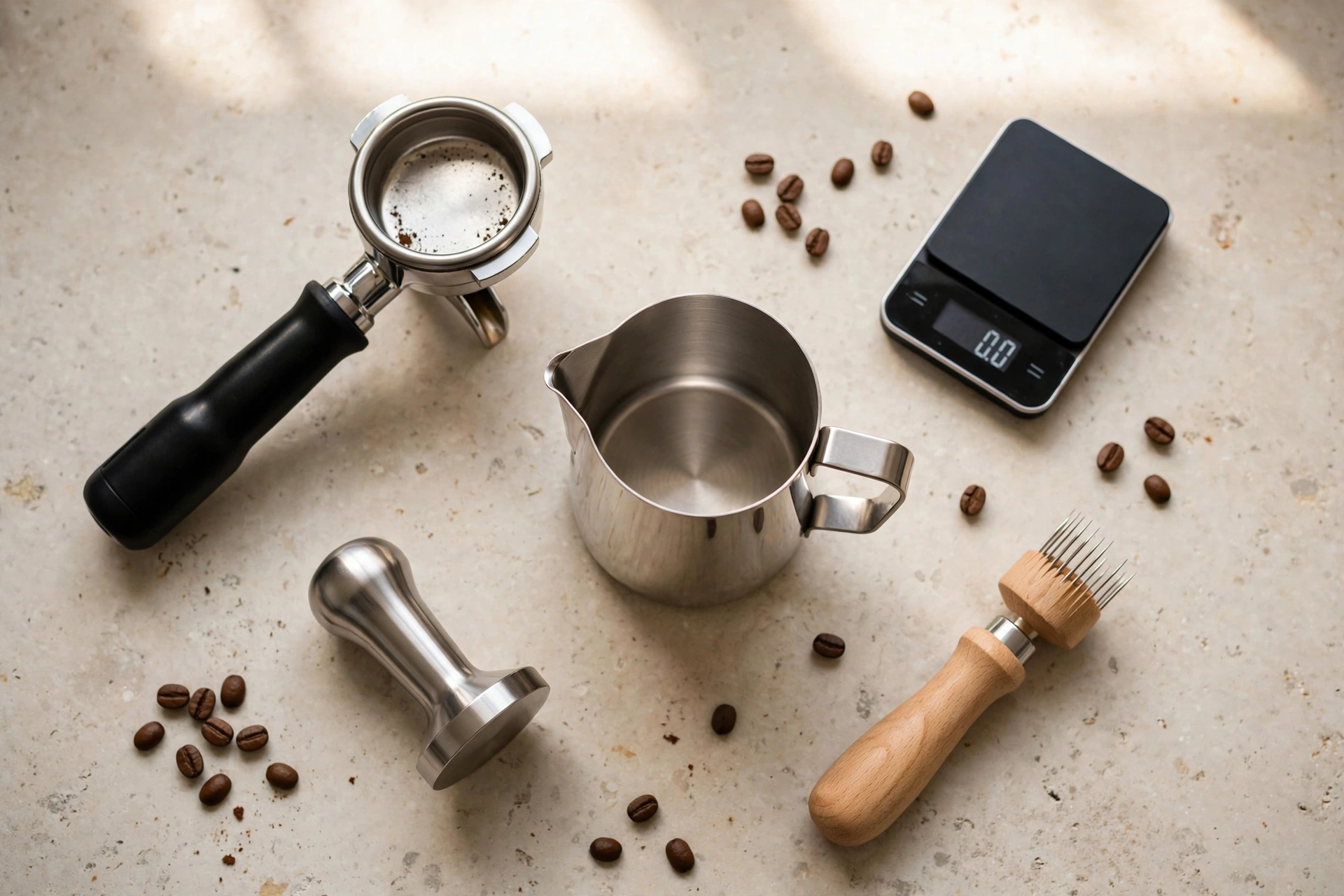
Every semi-automatic here needs a proper tamper (about $20 to $40 — the included ones are placeholders) and a 0.1g scale (about $15 to $25). The pressurized electrics work with pre-ground coffee, so the grinder can wait; the Neo Flex cannot function without one. Capsule buyers should do the per-cup math: a daily shot on the Essenza Mini costs about $250 to $350 a year in capsules, which is the machine’s real price. And if your total budget can stretch to $300 or $500, the Breville Bambino line in our under-$500 roundup is the first tier where electric machines make real espresso — that is where the training wheels come off.