The short answer: every espresso machine does the same three jobs — heat water to 90–94°C, build ≈9 bars of pressure, and deliver it evenly through the coffee. The types differ only in who does the work: you, the machine, or a sealed pod. Manual levers hand you full control; semi-automatics split the labor; super-automatics do everything; capsules trade quality for convenience. Here’s how to pick based on how much of the process you actually want to own.
The one mechanism underneath all of them
Strip away the marketing and every machine on this list is a variation on the same physics: hot water + pressure + a puck of fine coffee, 25–30 seconds. The differences that matter aren’t about the coffee — they’re about control, consistency, and effort:
- Control — how many variables can you adjust (grind, dose, temperature, pressure, shot length)?
- Consistency — how repeatable is a good shot once you find it?
- Effort — how much technique, cleanup, and attention does each cup demand?
No type wins all three. That’s the entire buying decision, and everything below is just elaboration.
The six types, from most to least hands-on
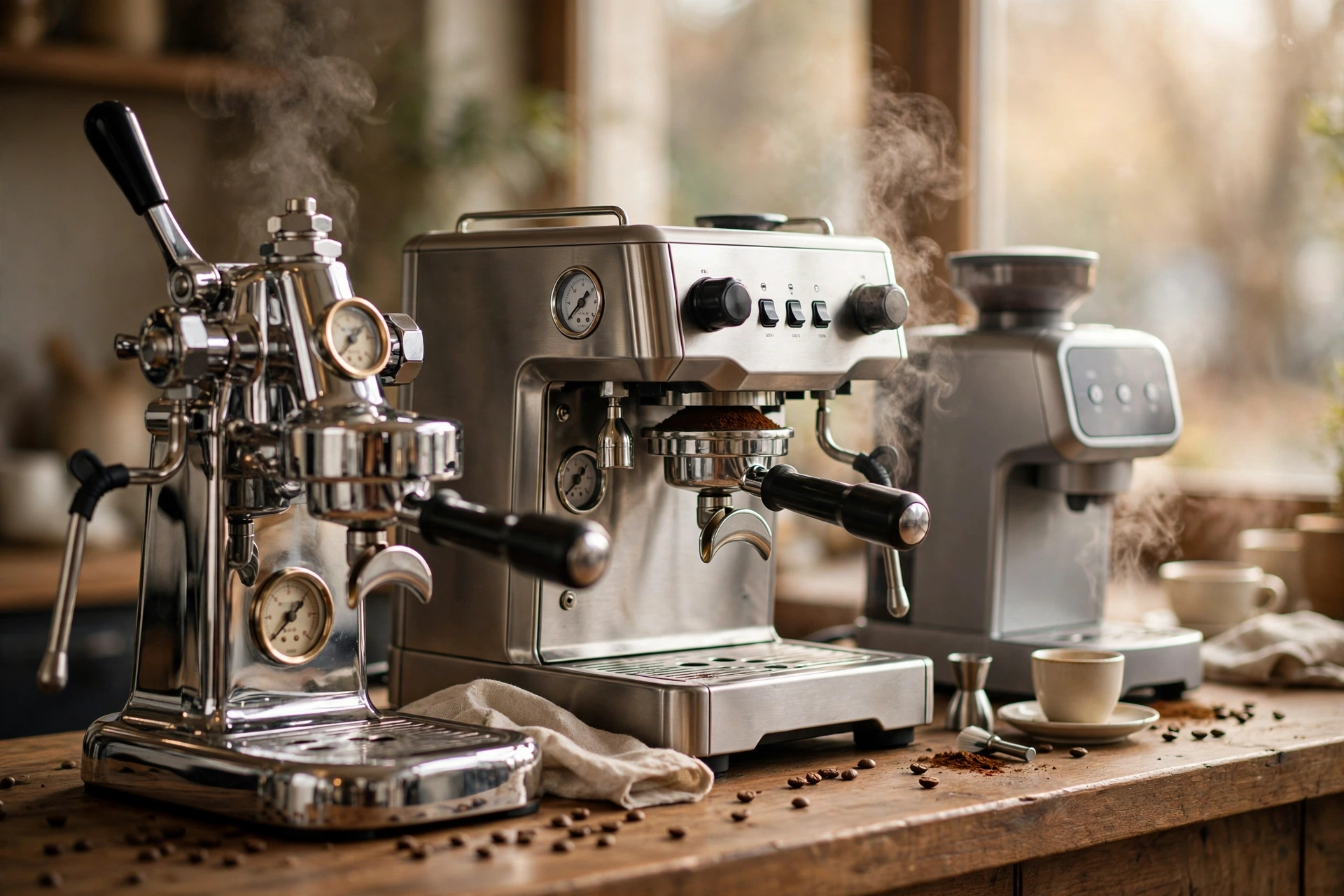
Manual lever. You pull a lever that drives a piston, generating pressure by hand (or by spring). Nothing is automated except the heater. This gives you something no pump machine offers cheaply: a live pressure profile — you can start gentle, ramp up, and ease off at the end of the shot, which skilled users turn into remarkable sweetness. The price is technique, physical effort, and slow workflow. One or two great shots a morning; not a machine for entertaining.
Semi-automatic. An electric pump builds the pressure; you handle grinding, dosing, tamping, and deciding when to stop the shot. The machine owns temperature and pressure stability — the two things humans are bad at — and you own everything that determines flavor. This is why it’s the default recommendation: it automates exactly the parts worth automating and leaves you the parts worth learning.
Automatic. Identical hardware to a semi-automatic, plus volumetric dosing — it stops the shot at a programmed water volume by itself. You lose the skill (and the feel) of stopping a shot by taste and timing, and gain push-button repeatability. Sensible if multiple people use the machine and nobody wants to learn shot timing.
Super-automatic. Grinder, brewer, and milk frother in one box: press a button, get a cappuccino. The built-in grinder and fixed brew chamber remove nearly every variable — which is both the appeal and the ceiling. Shot quality tops out below a decent semi-automatic setup because you can’t meaningfully adjust grind quality, dose, or extraction. What you buy is convenience and consistency, and for many households that’s the right trade.
Capsule / pod. Pre-ground coffee in a sealed pod, pierced and brewed under pressure at the touch of a button. The coffee was ground weeks or months ago, the dose is fixed and small, and you control nothing — but the workflow is 30 seconds with no cleanup and no grinder to buy. The honest framing: good-enough espresso, priced per cup well above whole-bean brewing.
Moka pot (stovetop). Included because it comes up constantly: a moka pot makes strong, concentrated coffee — but at ≈1.5 bars, not 9. It’s not espresso by the mechanism’s own definition. It’s also delicious, costs almost nothing, and deserves its place. Just don’t buy one expecting espresso.
Head-to-head comparison
| Type | You control | Learning curve | Typical price range | Best for | The catch |
|---|---|---|---|---|---|
| Manual lever | Everything, including pressure profile | Steep | $400–$3,000+ | Hobbyists chasing the best possible shot | Slow, physical, unforgiving |
| Semi-automatic | Grind, dose, tamp, shot timing | Moderate | $300–$2,000+ | Most home baristas — best quality per dollar | You must buy a real grinder separately |
| Automatic | Grind, dose, tamp (not shot length) | Gentle | $400–$2,000+ | Households sharing one machine | One less skill learned, slightly less flexibility |
| Super-automatic | Drink selection, basically | None | $500–$3,000+ | Convenience-first milk-drink households | Quality ceiling; expensive to repair |
| Capsule / pod | Nothing | None | $100–$300 (machine) | Offices, dorms, minimal-effort caffeine | Highest cost per cup; waste; fixed quality |
| Moka pot | Grind, heat, timing | Gentle | $30–$70 | Strong coffee on a tiny budget | Not espresso — different drink entirely |
Two patterns worth noticing. First, price ranges overlap heavily — a $500 semi-automatic and a $500 super-automatic are not the same purchase. The semi-auto at that price is a serious machine held back only by your grinder; the super-auto at that price is convenience with training wheels. Second, the grinder line in the semi-automatic row isn’t a footnote: budget roughly as much for the grinder as for the machine at the entry level, because the machine can’t compensate for a grinder that can’t grind fine or evenly enough.
How to actually choose: three questions
1. How much of the ritual do you want? Be honest. If the idea of weighing coffee, timing shots, and tasting the difference sounds like a hobby you’ll love — semi-automatic (or lever, if you’re ambitious). If it sounds like a chore you’ll abandon in a month — super-automatic or capsule. The best machine is the one you’ll still be using in a year, and most abandoned espresso setups are semi-automatics bought by people who wanted super-automatics.
2. Milk drinks or straight shots? Milk forgives a lot — a slightly imperfect shot disappears under steamed milk, which is why super-automatics thrive on cappuccino households. Straight espresso drinkers notice everything, which pushes toward semi-automatic or lever, where you can actually dial the shot in.
3. What’s the real budget — including the grinder? A $400 semi-automatic with a $200 espresso-capable grinder will outperform a $700 super-automatic in the cup, every time. But a $400 semi-automatic with pre-ground supermarket coffee will lose to a capsule machine. The machine type decision and the grinder decision are really one decision: the system makes the espresso, not the box.
The honest bottom line
For most people who care enough to read a comparison like this, the answer is a semi-automatic plus a genuinely espresso-capable grinder — it automates the physics you’re bad at (temperature, pressure) and leaves you the craft you’re capable of learning (grind, dose, timing), with the highest quality ceiling per dollar. Choose super-automatic when convenience is the actual requirement, not a guilty preference — there’s nothing wrong with wanting a button. Choose capsules when the alternative is no espresso setup at all. And whatever you pick, remember the mechanism underneath: hot water, pressure, a good puck, 25–30 seconds. The type just decides who does which part.
A note on the upgrade path
One more pattern worth knowing: espresso upgrades are rarely about replacing the machine type. The typical progression is grinder first (the single biggest jump in cup quality), then accessories that fix puck prep (a better basket, a scale, a distribution tool), and only then the machine itself — usually toward better temperature stability rather than a different type. People who start on capsules and catch the bug almost always land on a semi-automatic next, not a super-automatic: once you’ve tasted what a dialed-in shot can do, the desire for control tends to win over the desire for convenience. Buy for where you’ll be in a year, not just where you are today.