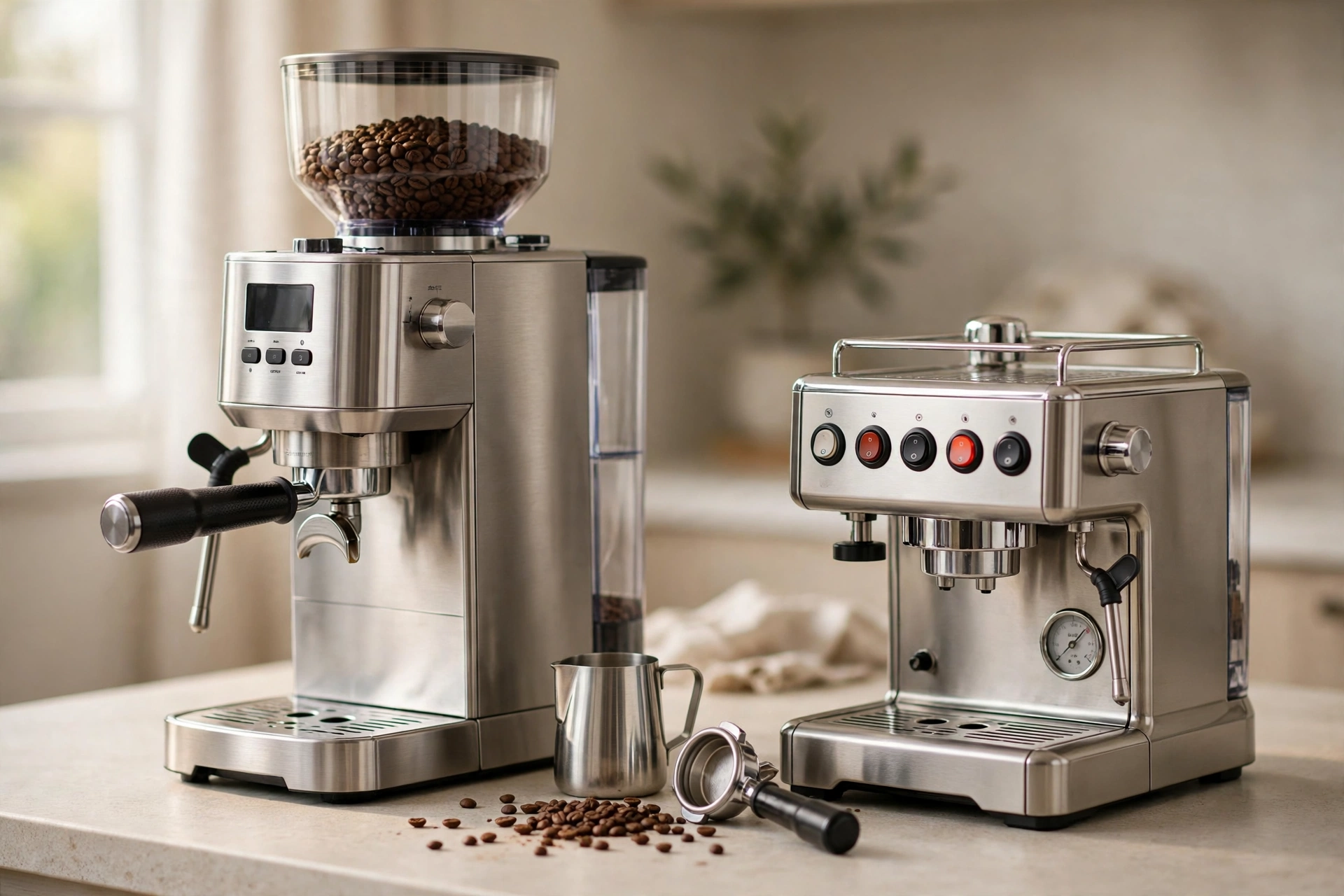
The short answer: buy the Breville Barista Express if you want one box that makes espresso this weekend; buy the Gaggia Classic Pro E24 if you want a platform you will still be upgrading in five years. Both setups cost ≈$700 all-in — the Breville at $699.95 with its grinder built in, the Gaggia at $499 plus ≈$200 for a capable separate grinder. The money is nearly identical; what differs is where it goes, and what each machine asks you to learn. Prices and specs checked 2026-11-03.
Disclosure: we are an independent research desk and earn no commission on anything here. This page contains no affiliate links. See our disclosure policy for how we stay independent.
We are a research desk, not a test lab: we synthesize manufacturer specifications, owner reports, and published reviews rather than claiming hands-on testing we have not done.
First principles: same budget, opposite allocations
Strip away the branding and this comparison is a resource-allocation problem. A home espresso setup needs four things: a grinder fine and consistent enough for espresso, water held at a stable temperature, 9 bars of pressure, and a way to steam milk. The Breville spends its budget integrating all four into one appliance with training wheels — a grinder, PID control, a pressure gauge, and pressurized baskets that forgive a grind that is slightly off. The Gaggia spends its budget on fewer, heavier-duty parts — a brass boiler, a 58mm commercial group, a 3-way solenoid valve — and leaves the grinder, the temperature management, and the learning to you.
That is why the usual “which is better” framing fails. The Breville optimizes for the first six months: faster learning, fewer purchases, fewer ways to go wrong. The Gaggia optimizes for year two onward: a standard-size portafilter with an ocean of accessories, a modding community that has added PID controllers and pressure gauges to this exact chassis for decades, and no integrated component whose failure takes down the rest. Your answer depends on which time horizon you are buying for.
Comparison table
Prices and specs checked 2026-11-03. Prices vary by retailer; where sources disagreed we used the manufacturer’s current list price.
| Spec | Breville Barista Express (BES870XL) | Gaggia Classic Pro E24 |
|---|---|---|
| Current price (bare machine) | $699.95 | $499 (list $549) |
| Built-in grinder | Yes — stainless conical burr, 16 settings, 1/2 lb hopper, grinds into the portafilter | No — needs a separate espresso-capable grinder |
| Complete-setup cost | $699.95 | ≈$699 with a ≈$200 grinder (e.g. $499 + $199.95) |
| Portafilter | 54mm stainless steel | 58mm stainless steel (commercial standard) |
| Heating | ThermoCoil with digital PID temperature control | Single brass boiler, no PID (temperature surfing) |
| Heat-up | Ready in under a minute | A few minutes to full temperature |
| Pump / extraction pressure | 15-bar pump, low-pressure pre-infusion, 9-bar extraction design | 15-bar pump, factory 9-bar OPV (North American E24) |
| Pressure gauge | Yes, front-panel analog gauge | No (a popular owner mod) |
| Steam wand | Manual 360° swivel wand | Commercial-style professional wand, two-hole tip |
| Brew then steam? | Yes — single boiler system, brew first, then steam | Yes — single boiler, brew first, then steam |
| Solenoid valve | Not the headline feature | 3-way solenoid valve — dry pucks, portafilter removes immediately |
| Water tank | 67 oz, removable, with filter | 72 oz, removable |
| Baskets included | Single and dual wall (pressurized and non-pressurized) | Commercial-style baskets; no pressurized training wheels |
| Power | 1600 W | 1450 W |
| Weight | ≈22 lb | 18.7 lb |
| Warranty | 1 year limited | 2 years |
| Made in | Designed in Australia | Designed and built in Italy |
The grinder question decides more than the machine does
The single biggest difference is not on either spec sheet’s brewing section — it is whether a grinder is in the box.
The Breville’s built-in grinder is its best argument and its biggest compromise. Sixteen stepped settings grind directly into the portafilter with dose control, so a beginner goes from whole beans to a shot without a second purchase, a second countertop footprint, or a second learning curve. The compromise is resolution: 16 steps across the whole range means the step between “choked” and “gushing” can fall between two settings, and the grinder cannot be upgraded without replacing the machine. If it breaks, the whole machine is affected. For a beginner on pressurized baskets, none of this bites — the basket forgives the step size. For an enthusiast on non-pressurized baskets chasing a new coffee, it eventually does.
The Gaggia forces a separate grinder, and that is a feature disguised as a cost. A dedicated grinder like the Baratza Encore ESP (see our Encore ESP vs Opus comparison) offers a dedicated fine range the Breville’s built-in unit cannot match, and it can be replaced or upgraded independently of the machine. The Gaggia’s 58mm portafilter also means the grinder you buy serves the commercial standard — the same baskets, tampers, and distribution tools used on machines costing many times more. The cost is real, though: ≈$200 on top of the machine, plus counter space, plus learning two devices instead of one.
The parity math matters. Gaggia $499 + Encore ESP $199.95 ≈ $699 — the Breville’s list price to the dollar. Anyone comparing “$499 versus $700” without the grinder is comparing a machine against a setup.
Heating and temperature: PID versus surfing
Both machines heat water one job at a time — neither brews and steams simultaneously — but they manage temperature very differently.
The Breville holds your hand. Its ThermoCoil with digital PID control delivers water at a set temperature and purges after steaming to reset it, so shot-to-shot temperature is consistent without technique. Combined with the pressure gauge, a beginner can see what is happening: gauge in the espresso range, temperature handled. The trade is thermal mass — a ThermoCoil heats fast (under a minute) but holds less heat than a boiler, so back-to-back milk drinks require more patience.
The Gaggia asks you to learn its rhythm. The E24’s brass boiler — larger inside than the old aluminum boiler (3.68 oz versus 2.5 oz) and more than twice as heavy — gives better thermal stability and steam than its predecessor, but there is no PID and no gauge. Owners learn temperature surfing: timing the shot against the boiler’s heating cycle, listening for the thermostat click. It is a skill, and it is the Gaggia’s steepest learning curve after grinding. The payoff is that the boiler’s mass, once understood, is forgiving in a different way — and the modding community sells PID kits that bolt onto this exact machine when you are ready.
Neither approach is “more accurate” in the abstract. PID is more consistent for a beginner; a surfed brass boiler is consistent enough for an experienced owner and leaves the upgrade path open.
Pressure and extraction: both land at 9 bar, by different routes
Nine bars is the industry-standard extraction pressure, and both machines get there — but buyers of older Gaggia stock should read this section twice.
The Breville’s 15-bar pump feeds a low-pressure pre-infusion stage that gently expands the puck before full pressure, with extraction designed around 9 bar. It is a set-and-forget system: the pre-infusion and the gauge do the thinking.
The current Gaggia Classic Pro E24 ships in North America with a 9-bar OPV (over-pressure valve) fitted at the factory, so it also extracts at 9 bar out of the box. This is a genuine change from older Classic Pro stock, which shipped with a higher-pressure valve (around 12 bar in some markets) that pushed water through too fast and dulled shots — the famous “OPV mod” was owners fixing that themselves in about ten minutes. If you buy a new E24, the mod is already done. If you buy used or old stock, check the valve before you buy. Either way, the Gaggia’s 3-way solenoid valve is a real daily advantage the Breville does not headline: it releases pressure from the group head after the shot, leaving a dry puck that knocks out cleanly instead of a soupy mess.
Portafilter size: 54mm convenience versus 58mm ecosystem
This looks like a minor spec. It is not — it determines everything you will buy for the machine afterward.
The Breville’s 54mm portafilter is a proprietary-ish size: accessories exist, but the selection is narrower and Breville-flavored. The Gaggia’s 58mm portafilter is the commercial standard, shared with café machines and nearly every prosumer home machine. Precision baskets, bottomless portafilters, tampers, dosing funnels, and distribution tools are made for 58mm first and in the widest variety. Our Gaggia Classic Pro vs Rancilio Silvia comparison covers the same ecosystem argument against a different rival, and our Gaggia Classic Pro vs Bambino Plus piece shows where the 58mm platform sits against Breville’s smaller machine.
For a buyer who will never buy an accessory beyond a tamper, this is a tie. For a buyer who will eventually want a bottomless portafilter, a precision basket, and a better tamper, the Gaggia’s ecosystem is a durable advantage that compounds with every purchase.
Milk steaming: faster versus friendlier
If lattes and cappuccinos are the main drink, both wands get there — with different learning curves.
The Gaggia’s commercial-style wand with a two-hole tip is the stronger steamer once learned: faster, more powerful, and capable of genuine microfoam for latte art. The cost is technique — a powerful wand punishes bad jug position faster, and the single boiler means waiting for steam temperature after brewing.
The Breville’s manual 360° wand is easier to position (the ball joint moves anywhere) and more forgiving for a beginner, but slower to steam the same milk. Its dedicated hot water outlet is a small convenience the Gaggia answers through the steam wand itself.
Neither machine steams while brewing. If back-to-back milk drinks for a household are the daily routine, both machines will frustrate eventually — that is a dual-boiler or heat-exchanger job, covered in our dual-boiler machines roundup.
Build, longevity, and the modding gap
The Gaggia is a steel-framed machine from a line in production since 1991, with commercial-grade components and an owner community that has documented nearly every repair and upgrade: PID kits, pressure gauges, OPV adjustments, low-profile drip trays, better steam wands. A broken Gaggia is usually a repaired Gaggia, and its 2-year warranty is the longer of the two.
The Breville is a modern integrated appliance in brushed stainless steel, and its complexity is the trade: more features in one body means more that can fail, and a grinder failure affects the whole machine. Its 1-year limited warranty is shorter, and there is no comparable owner-modding ecosystem — you use the machine Breville built, not the machine you evolve.
One note for shoppers: Gaggia has since added the Classic Up, which puts PID and pre-infusion on the E24 platform. That is a different, pricier machine, not a reason to discount the E24 — but if PID is non-negotiable and you still want the Gaggia platform, compare the Up before deciding.
The verdict
- Buy the Breville Barista Express if you want a complete espresso setup in one box, you are learning, and your priority is good shots this month with minimal extra purchases. The built-in grinder, PID, pressure gauge, and pressurized baskets remove the most common beginner failure modes in a single purchase. Accept that the grinder cannot be upgraded separately and that the machine’s ceiling arrives sooner.
- Buy the Gaggia Classic Pro E24 if you already own (or will buy) a capable grinder, you enjoy learning technique, and you want the machine with the higher ceiling: 58mm commercial standard, brass boiler, 3-way solenoid, and a modding community that keeps the platform current. Accept the learning curve — temperature surfing, manual dosing, no gauge — as the price of that ceiling.
- Either way, budget the complete setup, not the bare machine. The honest comparison is $699.95 all-in Breville versus ≈$699 Gaggia-plus-grinder. At equal money, the question is never “which is cheaper” but “do you want convenience now or a platform later?” For wider context, our machines for beginners roundup places both against the field, how to dial in espresso covers the routine both machines demand, and is PID worth it explains the temperature-control trade in depth.