
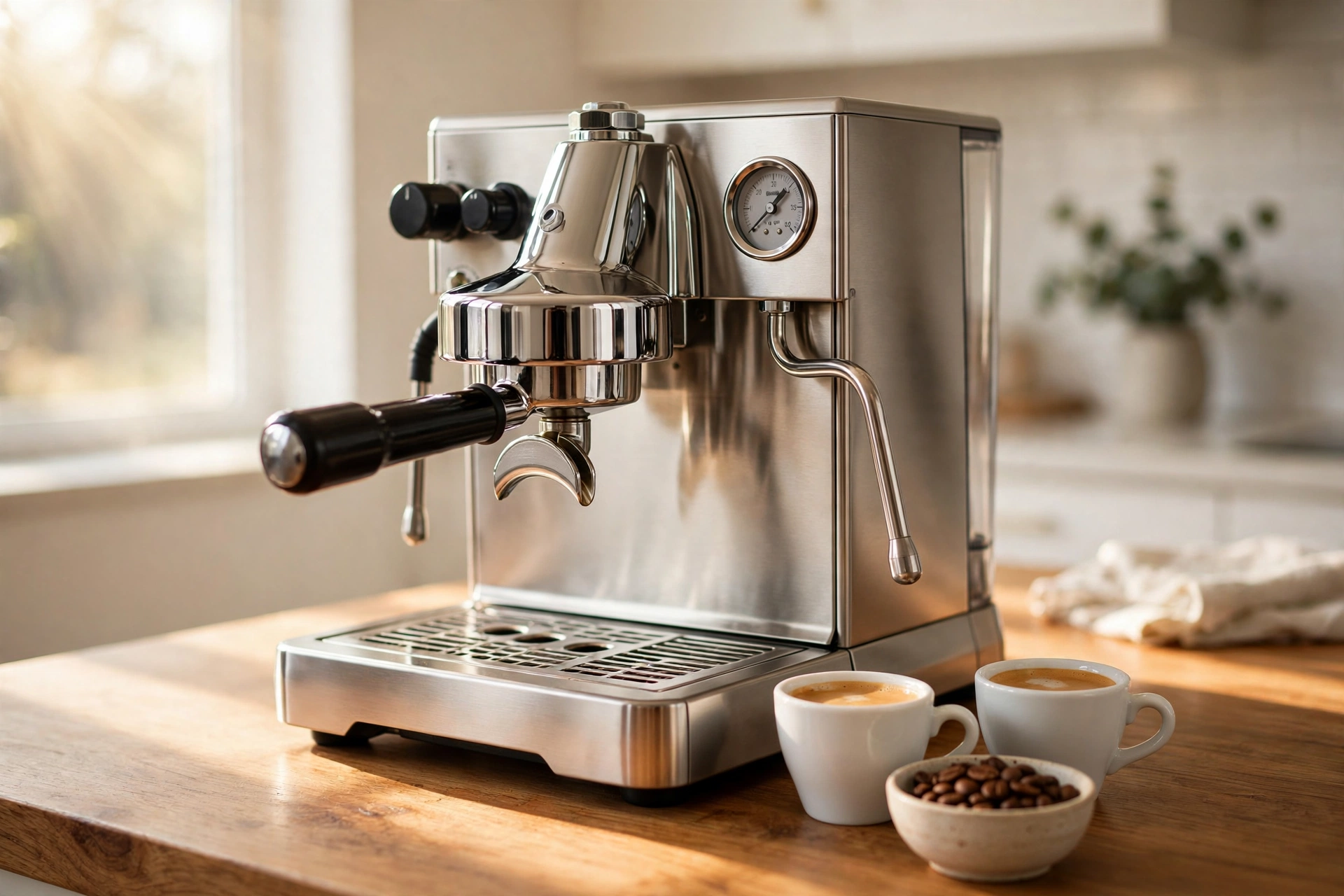
The short answer: the Lelit Victoria is the best espresso machine under $1,500 for espresso quality per dollar, the Breville Barista Touch Impress is the easiest path to daily milk drinks, and the Philips 5500 LatteGo is the best one-touch super-automatic. What changes at this price is not extraction — every machine here pulls at about 9 bars with PID-held temperature — but how much of the ritual the machine does for you, and how programmable the parts you keep become. Prices and specs checked 2026-10-15. Prices vary by retailer; where sources disagreed we used the manufacturer’s current price.
Disclosure: we are an independent research desk and earn no commission on anything here. Vendor links on this page are plain links to manufacturer and retailer pages — no affiliate tracking. See our disclosure policy for how we stay independent.
We are a research desk, not a test lab: we synthesize owner reports, forum threads, published measurements, reviews, and teardowns rather than claiming hands-on testing we have not done.
First principles: what $1,500 actually buys
Espresso is still the same constrained extraction problem at $1,500 as it is at $500: water at about 90 to 94°C must pass through a compacted puck of finely ground coffee at about 9 bars, evenly, without channeling. The machines in our under-$1,000 roundup already satisfy those three conditions. So what does the next $500 buy? Not better physics — it buys the removal of friction, in three distinct lanes:
- The prosumer lane (Profitec Go, Lelit Victoria). The money buys instrumentation: PID temperature you set to the roast, a brew-pressure gauge, an adjustable OPV, programmable pre-infusion. None of these make the puck; they make the puck’s mistakes visible and correctable. This lane is for the buyer who wants to learn espresso, not skip it.
- The automation lane (Breville Barista Touch Impress). The money buys the removal of beginner failure modes: auto-dosing, assisted tamping, hands-free milk texturing, a three-second heat-up. The machine does the repetitive parts so the user does not have to be good at them yet — or ever.
- The one-touch lane (Philips 5500, De’Longhi Dinamica Plus). The money buys menu breadth: twenty to twenty-four drinks from whole beans at a button press, multiple saved profiles, self-cleaning milk systems. The comparison here is not against other espresso machines — it is against the cafe down the street.
Those lanes never cross-shop each other. A buyer deciding between the Victoria and the Dinamica Plus has not yet decided what they actually want mornings to feel like; that decision matters more than any specification on this page.
What the $1,000 to $1,500 step actually buys
Below $1,000, PID control and pressure instrumentation were features some machines had and some did not. In this band they are the baseline for the prosumer lane: both single boilers here are PID-controlled with gauges and shot timers, and both take full 58mm commercial-pattern portafilters — the cheapest accessory ecosystem in home espresso.
Pre-infusion becomes programmable. The Victoria’s display lets you set bloom time and duration; the Profitec Go answers with an externally adjustable OPV and a brew-pressure gauge so you can see grind errors mid-shot. Different instruments, same insight: at this price you are expected to steer.
The all-in-one reaches its most automated form. The Barista Touch Impress is what the under-$1,000 Brevilles point toward: the same ThermoJet speed and PID, plus the Impress puck system that measures puck depth and auto-corrects the next dose, tamping with about 10 kg of assisted pressure and a 7-degree finishing twist. Newer revisions add cold brew and cold espresso presets. The caveat has not changed: the 54mm portafilter system and the bundled grinder are still lock-in, and the list price is now $1,499.95 — right at this band’s ceiling — though street prices hold at $1,199.95.
Super-automatics grow up. The Philips 5500 (20 hot and iced recipes, four user profiles, the two-part LatteGo milk system that rinses in seconds) and the Dinamica Plus (24 recipes, 3.5-inch color touchscreen, self-cleaning LatteCrema carafe) are appliances in a way the prosumer machines are not. You do not dial them in; you select a profile.
Above this band sits a wall, not a slope. True dual boilers start at $1,599.95 — simultaneous brew and steam with independent PIDs is the one capability no machine here offers, which is why our dual boiler roundup is the natural next step rather than an incremental upgrade.
Comparison table
Prices and specs checked 2026-10-15. Prices vary by retailer; where sources disagreed we used the manufacturer’s current price.
| Machine | Typical price | Type | Heating | Grinder / Portafilter | Milk | Tank | Best for |
|---|---|---|---|---|---|---|---|
| Lelit Victoria (PL91T) | $999.95 | Semi-auto, single boiler | 0.3L brass, PID | 58mm | Manual wand | 2.5L | Espresso quality per dollar |
| Profitec Go | $1,199 | Semi-auto, single boiler | 0.4L insulated brass, PID | 58mm | Manual wand | 2.8L | Tinkerers; fastest heat-up |
| Breville Barista Touch Impress (BES881) | $1,499.95 list, $1,199.95 street | Semi-auto all-in-one | ThermoJet thermocoil, PID | 30-setting grinder, 54mm | Auto MilQ hands-free | 2L | Easiest daily milk drinks |
| Philips 5500 Series LatteGo (EP5544/90) | About $1,099.95 list | Super-automatic | Thermoblock | Ceramic burr, 12 settings | LatteGo, one-touch | 1.8L | One-touch convenience; quiet |
| De’Longhi Dinamica Plus (ECAM38085SB) | $1,499.95 list | Super-automatic | Thermoblock | Steel conical, 13 settings | LatteCrema carafe, one-touch | 1.8L | Most drinks at the cap |
The five machines, in depth
1. Lelit Victoria (PL91T) — best espresso quality per dollar
The Victoria is the cheapest way into a genuinely programmable prosumer workflow. The 0.3L brass boiler runs under PID control, and the LCC OLED display is the star of the machine: set brew temperature to the roast, program pre-infusion time and bloom, run a shot timer, get low-water warnings and auto-backflush reminders. A backlit manometer shows live brew pressure, so grind mistakes are visible in real time. The 58mm group takes the full commercial-pattern accessory ecosystem — the cheapest tampers, baskets, and distribution tools in home espresso — and the 2.5L tank is generous.
Seattle Coffee Gear listed $999.95 when we checked, in stock; Majesty Coffee listed $999. That makes it the least expensive machine here and, for straight espresso, arguably the best-specified: no other machine under $1,000 of machine price combines PID, programmable pre-infusion, a manometer, and a 58mm group. The costs are the familiar single-boiler ones: heat-up is about six minutes, brew and steam cannot happen together, and there is no grinder — budget $200 to $350 for one, which still lands the setup below the Breville’s list price. Note for the patient: Lelit unveiled a Victoria3 at World of Coffee in mid-2026 with electronic flow control, first of its kind in a Lelit single boiler, at roughly a €300 upcharge — in Europe now, not yet at US retailers. Buy the Victoria when you want the highest espresso ceiling per dollar and enjoy steering the shot yourself.
2. Profitec Go — the tinkerer’s single boiler
The Go answers the Victoria with instrumentation of a different kind: PID temperature control with a shot-timer display, a brew-pressure gauge on the front panel, and — the part no other machine here has — an externally adjustable OPV, so you can set brew pressure yourself without opening the case. The 0.4L insulated brass boiler is the largest single boiler here, heat-up runs five to eight minutes with a fast-heat cycle, and the 2.8L top-access tank means refills are infrequent. The 58mm portafilter, 3-way solenoid valve, and stainless chassis are proper prosumer hardware.
Whole Latte Love and Clive Coffee both listed $1,199 when we checked — up from the $999 launch price, which is worth knowing when older reviews quote the old number. Seattle Coffee Gear does not carry it. Against the Victoria you trade the LCC’s guided programming for the gauge and the adjustable OPV: the Go assumes you want to experiment with pressure, not just set a pre-infusion timer. There is no flow control (Profitec’s flow device is E61-only and incompatible with the Go’s ring group), and like the Victoria it needs a separate grinder. Also incoming: a Profitec Go 2.0 was announced at the same June 2026 show with an OLED display, timed brew buttons, programmable on/off, and selectable pre-infusion — on sale in Europe and Australia now, not yet in the US. Buy the Go when you want the fastest heat-up and the most adjustable brew pressure of any single boiler here.
3. Breville Barista Touch Impress (BES881) — easiest daily milk drinks
The Touch Impress is the most automated semi-automatic you can buy under $1,500. The Impress puck system is the headline: intelligent auto-dosing measures puck depth and corrects the next dose, and the assisted tamp applies about 10 kg of pressure with a 7-degree barista twist when you pull the lever — the two most common home failure modes, deleted. Underneath is familiar Breville hardware: ThermoJet heating to extraction temperature in about three seconds, PID control, low-pressure pre-infusion, a 30-setting conical burr grinder dosing into the portafilter, and a touchscreen with saved drink profiles. The Auto MilQ system textures milk hands-free with settings for dairy, soy, almond, and oat, temperature adjustable from 104 to 167°F across eight texture levels — the lowest-friction path to milk drinks of the four manual/semi-automatic options here. Newer revisions add cold brew and cold espresso presets.
The pricing needs care: Breville’s list is now $1,499.95, up from $1,199.95, but Seattle Coffee Gear, Best Buy, and Crate & Barrel all still sell it at $1,199.95 street — shop the street price. The compromises mirror the under-$1,000 Brevilles at higher stakes: the 54mm portafilter system has a smaller accessory aftermarket than 58mm, the bundled grinder still has a ceiling, and there is no simultaneous brew and steam. If you want an integrated grinder plus automation at this budget, see our machines with grinder roundup for the full all-in-one family. Buy the Touch Impress when you want the machine to handle dose, tamp, and milk so you do not have to.
4. Philips 5500 Series LatteGo (EP5544/90) — best one-touch super-automatic
The 5500 is the machine for households that want espresso at a button press with no learning curve and minimal cleanup. The current version — a late-2025 refresh that doubled the menu — offers 20 hot and iced one-touch recipes, four saved user profiles, and the LatteGo milk system: two parts, no tubes, cyclonic frothing, rinsing in seconds, which is the least annoying milk cleanup of any super-automatic. The 100% ceramic burr grinder (12 settings) runs quieter than steel — Philips claims about 40% quieter brewing with a Quiet Mark certification — and AquaClean filtration promises up to 5,000 cups between descalings.
The list sits at about $1,099.95, and street prices vary more here than for any other machine in this roundup, so compare retailers before buying. The honest trade-offs of the one-touch lane apply: you cannot adjust brew pressure or OPV, the thermoblock heats fast but offers no temperature programming worth the name, and a super-automatic will never reward a better grinder because you cannot upgrade it. Against the Dinamica Plus you give up the color touchscreen and some drink count in exchange for the quieter ceramic grinder and the two-part milk system. Buy the 5500 when the household wants push-button espresso with the least maintenance — it is the simplest machine here to live with.
5. De’Longhi Dinamica Plus (ECAM38085SB) — most machine at the cap
The Dinamica Plus is the largest preset menu under $1,500: 24 one-touch and customizable recipes on a 3.5-inch color touchscreen, with four user profiles so the household stops redialing. The LatteCrema Hot milk carafe froths automatically with three foam settings and a self-cleaning cycle, the steel conical burr grinder offers 13 settings, and the 1.8L tank and carbon water filter round out the appliance package. List is $1,499.95 — exactly at this band’s ceiling — though street prices dip well below; a recent October sale saw about $930.
One naming trap to avoid: the current US SKU is the ECAM38085SB (the 2025 refresh with 24 recipes and four profiles). The older silver ECAM37095S is effectively superseded in the US, and the Connected TI variant — the only one with the Coffee Link app — is discontinued, so do not buy expecting app control on the current model. Against the Philips you get more drinks, a real touchscreen, and a foam dial the LatteGo lacks; you pay for it in noise and in list price. Buy the Dinamica Plus when menu breadth and a color touchscreen are what the household will actually use twice a day.
How to choose among the five
- You want the best espresso for the money and enjoy the ritual: Lelit Victoria, plus a $200 to $350 grinder. PID, pre-infusion programming, manometer, and a 58mm group for $999.95 is the value peak of this roundup.
- You want to experiment with brew pressure and heat up fast: Profitec Go. The gauge and externally adjustable OPV are instruments the Victoria does not give you; accept the $1,199 price and the incoming Go 2.0 as context.
- You want the machine to handle dose, tamp, and milk: Breville Barista Touch Impress at the $1,199.95 street price. The Impress puck system plus Auto MilQ is the least-friction semi-automatic path here.
- You want push-button espresso with the least cleanup: Philips 5500 LatteGo. Twenty recipes, four profiles, and a milk system that rinses in seconds — the simplest machine to live with.
- You want the biggest menu and a color touchscreen at the ceiling: De’Longhi Dinamica Plus ECAM38085SB. Twenty-four drinks and four profiles for $1,499.95 list; check the street price before paying it.
What to budget beyond the sticker
The two prosumer machines need the most on top: an espresso-capable burr grinder (about $200 to $350 — see our grinder budget guide), a proper 58mm tamper (about $20 to $40; the included tampers are placeholders), and a 0.1g scale (about $15 to $25). The Victoria plus a mid-range grinder lands at about $1,250 all-in — still under the Touch Impress list. The Breville needs only the scale and fresh beans; the super-automatics need only beans and, eventually, AquaClean or De’Longhi filters. Every machine here benefits from fresh beans bought weekly and filtered water — the cheapest upgrades in espresso, at any price.
The ceiling above this band is real but narrow: $1,599.95 buys the Breville Dual Boiler and the one thing nothing here can do — brew and steam simultaneously. Until the household needs that, the choice in this band is workflow, not extraction: programmable single boilers for the engaged, assisted automation for the busy, and one-touch menus for the household that just wants the drink.