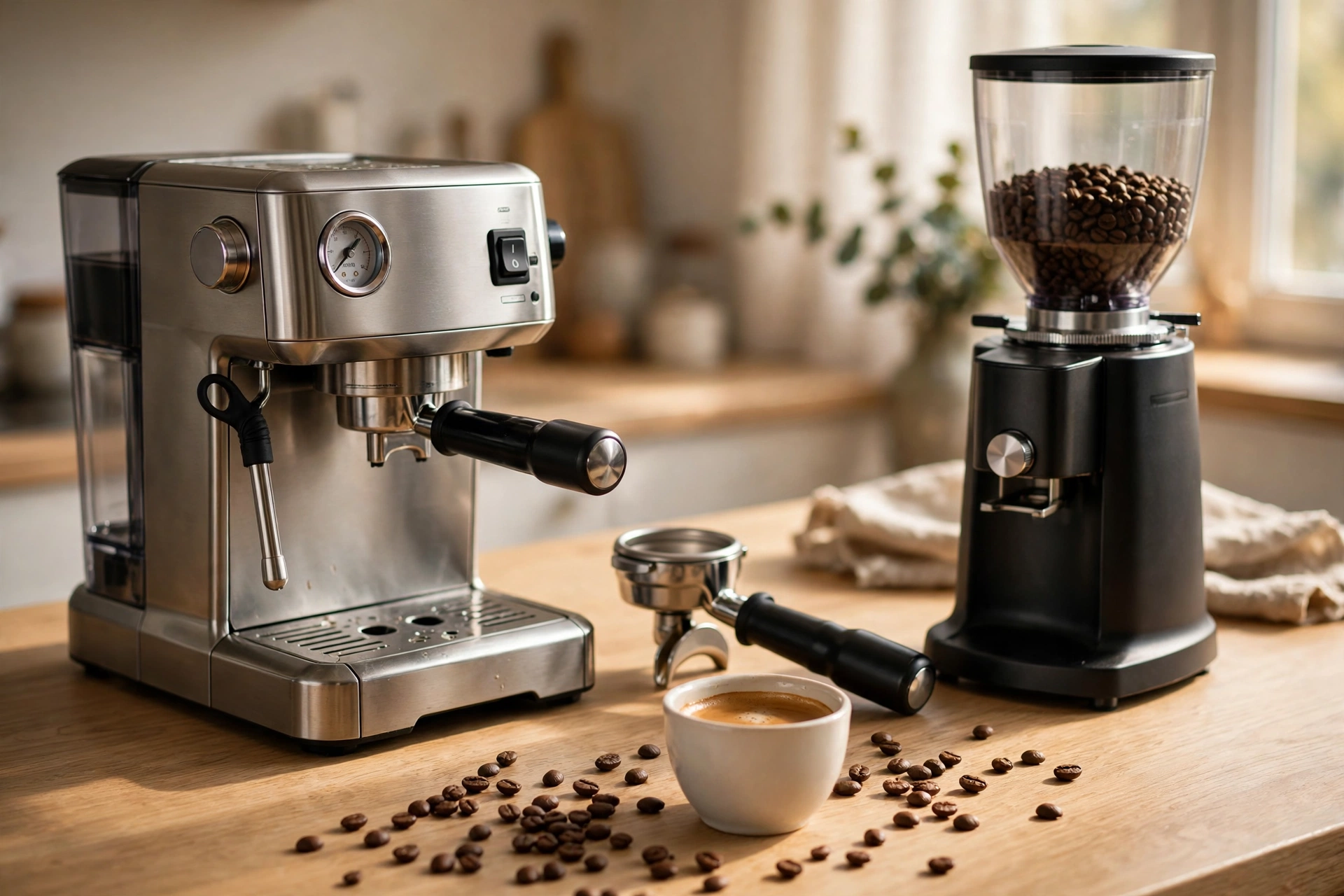
The short answer: the Breville Bambino with the Baratza Encore ESP is the best espresso machine and grinder combo for most people at about $500, the Gaggia Classic Pro E24 with the same grinder is the best value for the tinkerer at about $700, and the Rancilio Silvia with the Eureka Mignon Specialita is the enthusiast pick at about $1,545. Every combo below is a machine and a separate grinder bought as a pair — not a machine with a grinder built in, which is a different category with different trade-offs, covered in our roundup of the best espresso machines with grinders. Prices and specs checked 2026-10-25. Prices vary by retailer; where sources disagreed we used the manufacturer’s current price.
Disclosure: we are an independent research desk and earn no commission on anything here. Vendor links on this page are plain links to manufacturer and retailer pages — no affiliate tracking. See our disclosure policy for how we stay independent.
We are a research desk, not a test lab: we synthesize owner reports, forum threads, published measurements, reviews, and teardowns rather than claiming hands-on testing we have not done.
First principles: why the pair matters more than either half
Espresso is a constrained extraction problem: water at about 90 to 94°C must pass through a compacted puck of finely ground coffee at about 9 bars, evenly, without channeling. Four conditions decide whether that happens — particle size and distribution, dose consistency, temperature stability, and pressure at the puck — and the pair splits them two and two. The grinder owns the first two; the machine owns the last two. That split is why the pairing decision is the whole game: a $1,500 machine fed by a $120 grinder loses to a $500 machine fed by a $400 grinder, every time, because the grinder’s two conditions are the ones that fail first and fail silently.
Three mechanisms decide whether a pairing works:
- Burr geometry sets the ceiling. Conical burrs (Encore ESP, Niche Zero) produce a bimodal particle distribution — a mix of fines and boulders — that is forgiving and full-bodied. Flat burrs (DF64 Gen 2, Specialita) produce a tighter, more uniform distribution that rewards precise puck preparation with clarity. Neither is strictly better; the mistake is pairing a grinder whose burrs cannot resolve the machine’s basket. A 58mm commercial basket with a non-pressurized single-wall filter exposes grind inconsistency that a pressurized basket forgives.
- Adjustment resolution decides whether you can dial in. Espresso lives in a window a few microns wide. The Encore ESP’s espresso range moves 9 microns per step — fine enough for a beginner on pressurized baskets. The DF64 Gen 2 and Niche Zero are stepless, so you can land between any two settings. The Specialita’s micrometric dial is stepless too, with a touchscreen that times the dose. Stepped grinders are faster to use; stepless grinders are more precise. The pairing question is which your machine’s basket demands.
- Portafilter size is the compatibility check. The Breville combos run 54mm portafilters; the Gaggia, Rancilio, and Profitec run 58mm. The Encore ESP ships with a 54mm dosing cup and a 58mm adapter ring, which is why it pairs cleanly with the Bambino and acceptably with the Gaggia. The DF64 Gen 2 and Niche Zero dose into a cup or a dosing funnel, so they fit either size — one reason they cost more.
The budget rule that falls out of all five pairings: the grinder should be roughly a third of the combined price. At $500 the grinder is $200; at $900 it is $399; at $1,545 it is $549. Integrated machines break this rule — their built-in grinder is roughly a sixth of the price — which is exactly why a separate grinder is the upgrade that matters most.
Comparison table
Prices and specs checked 2026-10-25. Prices vary by retailer; where sources disagreed we used the manufacturer’s current price.
| Combo | Machine | Grinder | Combined price | Best for |
|---|---|---|---|---|
| Bambino + Encore ESP | Breville Bambino BES450 | Baratza Encore ESP | ≈ $500 | Best overall; cheapest honest entry |
| Gaggia Classic Pro E24 + Encore ESP | Gaggia Classic Pro E24 | Baratza Encore ESP | ≈ $700 | Best value for the tinkerer |
| Bambino Plus + DF64 Gen 2 | Breville Bambino Plus BES500 | Turin DF64 Gen 2 | ≈ $900 | Best small-kitchen upgrade |
| Silvia + Specialita | Rancilio Silvia | Eureka Mignon Specialita | ≈ $1,545 | Enthusiast classic |
| Pro 300 + Niche Zero | Profitec Pro 300 | Niche Zero | ≈ $2,500 | Prosumer endgame |
The five combos, in depth
1. Breville Bambino + Baratza Encore ESP — best overall, ≈ $500
The Bambino is $299.95 at Breville and Abt; the Encore ESP is $199.95 at Seattle Coffee Gear, Coffee Bros, and 1st in Coffee. Combined: $499.90. This is the cheapest pairing in which neither half is the obvious bottleneck, and the fit between the two is unusually clean: the ESP ships with a 54mm dosing cup made for the Bambino’s 54mm portafilter, so grounds transfer with almost no mess, and its first 20 settings are a dedicated espresso range at 9 microns per step — fine enough to dial in on the Bambino’s single-wall basket once you are ready for it.
The Bambino brings the ThermoJet heater (about 3-second heat-up, PID temperature control), low-pressure pre-infusion, and a manual steam wand that can texture milk for latte art. The ESP brings 40mm conical M2 steel burrs, a quick-release burr for cleaning, and a hopper that holds about 300g — a genuine daily-driver grinder, not a placeholder. The honest limits: the ESP is stepped, so some beans will sit between two settings; and the Bambino’s thermoblock means brewing and steaming are sequential, not simultaneous. Neither limit matters at this price. Buy this combo when you want real espresso for the price of a month of café visits, with an upgrade path that starts at the grinder, not the machine.
2. Gaggia Classic Pro E24 + Baratza Encore ESP — best value for the tinkerer, ≈ $700
The Classic Pro E24 is $499 at Whole Latte Love — the current 2024 revision of the Classic Pro, and the one to buy now: the previous generation listed at $399 to $449 and is now largely out of stock at major retailers. The Encore ESP is $199.95. Combined: $698.95.
The Gaggia is the machine you buy when you intend to learn the craft rather than just drink the result: a 58mm commercial portafilter, a three-way solenoid valve that dries the puck for clean knock-out, a 15-bar pump, and a 72 oz tank, in a steel chassis that owners modify for decades — PID kits, pressure-spring swaps, and shower-screen upgrades are all documented in forum threads. The ESP is the starter grinder here, not the destination: its stepped adjustment and 40mm conical burrs are adequate on the Gaggia’s pressurized basket and workable on the single-wall basket, but they are the first thing you will outgrow. That is the point of this pairing — the machine is a ten-year purchase and the grinder is a two-year one, and the $200 you save against the next combo is the grinder upgrade fund. Buy this combo when you want a machine you will still own in a decade and you are willing to learn temperature surfing and puck preparation to earn it. Our Gaggia Classic Pro vs Rancilio Silvia comparison covers the machine in depth.
3. Breville Bambino Plus + Turin DF64 Gen 2 — best small-kitchen upgrade, ≈ $900
The Bambino Plus is $499.95 at Breville; the DF64 Gen 2 is $399 in stock at Turin Grinders (a $354 preorder batch exists, but the in-stock price is the honest one). Combined: $898.95.
This is the pairing for the buyer who has outgrown the entry tier in one specific way: the grinder. The DF64 Gen 2 is a single-dose grinder with 64mm flat burrs and stepless adjustment — the first grinder in this roundup whose burr geometry can resolve light roasts and single origins, and whose near-zero retention means the 18g you weigh in is the 18g you get out. Against the Encore ESP you trade the hopper workflow for a bellows and a scale, and you gain a flat-burr clarity the conical ESP cannot reach. The Bambino Plus adds the automatic milk wand over the base Bambino — three temperature settings and three texture levels, hands-free — which is why this combo, not the base Bambino, is the one for the household that drinks mostly milk drinks. The footprint stays small: the Bambino Plus is 7.5 inches wide and the DF64 is a single-dose tower, so the pair fits where a 58mm machine and a hopper grinder would not. Buy this combo when you already know you like espresso, you drink milk drinks daily, and you want flat-burr grind quality without the prosumer machine price. Our DF64 vs Niche Zero comparison covers the grinder’s trade-offs in detail.
4. Rancilio Silvia + Eureka Mignon Specialita — enthusiast classic, ≈ $1,545
The Silvia is $995 at Seattle Coffee Gear; the Specialita is $549 at Clive Coffee and 1st in Coffee (Coffee Bros lists $649 — the $549 figure is the one two retailers agree on). Combined: $1,544.
This is the pairing the forums have recommended for twenty years, and the mechanism has not changed: a single-boiler machine with a commercial 58mm group and a steam wand that can texture milk properly, paired with a grinder whose 55mm flat burrs, stepless micrometric adjustment, and touchscreen timed dosing remove the grinder from the list of variables entirely. The Specialita is also one of the quietest grinders in this roundup — a real consideration at 6 a.m. — and its timed dosing stays consistent shot to shot, which is what the Silvia’s manual workflow needs from its partner. The Silvia’s honest limit is thermal: a single boiler means temperature surfing between brewing and steaming, and milk drinks are sequential. The Specialita’s honest limit is retention of roughly 1 to 2 grams in the chute — negligible if you use the same beans daily, noticeable if you switch beans every morning. Buy this combo when you want the classic enthusiast setup: a machine and grinder that will both still be in service in ten years, with the grinder already at the level the machine deserves. Our Gaggia Classic Pro vs Rancilio Silvia comparison explains why the Silvia costs twice the Gaggia.
5. Profitec Pro 300 + Niche Zero — prosumer endgame, ≈ $2,500
The Pro 300 is $1,799 at Whole Latte Love; the Niche Zero is £549 direct from Niche Coffee in the UK, about $700 at current exchange rates before shipping — Niche sells direct only, with a US plug included, so there is no US retailer price to quote. Combined: about $2,499.
This is the pairing where both halves stop being compromises. The Pro 300 is the least expensive dual boiler with PID control in a 10-inch-wide chassis, with a shot timer on the display and the build quality — copper and braided stainless lines, a vibration-isolated pump — of machines costing twice as much. Simultaneous brew and steam ends the single-boiler queue that every cheaper combo here lives with. The Niche Zero is the single-dose benchmark: 63mm conical burrs, a genuinely straight-through grind path with near-zero retention, and a stepless dial that moves between espresso and filter settings without hunting for click-stops. Against the DF64 Gen 2 you trade flat-burr clarity for conical forgiveness and a far more refined workflow — no bellows, a tactile toggle switch, a lid that flips open. The $700 grinder on a $1,799 machine is the same one-third split as the $500 combo, which is the point: the ratio holds because the physics does not change with price. Buy this combo when you want to stop upgrading — the dual boiler and the single-dose grinder are the last two purchases in their categories for most home baristas. Our under-$2,000 roundup covers the Pro 300 against the other dual boilers and heat exchangers in its band.
How to choose among the five
- You want real espresso for the least money: Bambino + Encore ESP. About $500, and the only combo here where the grinder was designed for the machine’s portafilter.
- You want a machine to keep for a decade and a grinder to upgrade later: Gaggia Classic Pro E24 + Encore ESP. About $700, with the deepest modification community in home espresso.
- You drink milk drinks daily and want flat-burr grind quality: Bambino Plus + DF64 Gen 2. About $900, the smallest footprint in the roundup, and the first stepless grinder.
- You want the classic enthusiast setup: Silvia + Specialita. About $1,545, quiet, commercial 58mm hardware, and a grinder that will not be the bottleneck.
- You want to stop upgrading: Pro 300 + Niche Zero. About $2,500, simultaneous brew and steam, and the single-dose benchmark grinder.
What to budget beyond the combo
Every combo here needs the same small gear: a proper tamper matched to the portafilter (54mm for the two Breville combos, 58mm for the rest — $20 to $40), a 0.1g scale ($15 to $25), and filtered water. The DF64 Gen 2 and Niche Zero are single-dose grinders, so add a small scale habit to the workflow; the Encore ESP and Specialita hold a hopper of beans and dose on demand. Total setup cost beyond the combo lands at about $50 to $75 — small against every tier here, and the difference between a combo that works and a combo that frustrates. See our grinder budget guide and our full setup-cost breakdown before you buy.
The honest summary: the combo is the unit of purchase, not the machine. A grinder at roughly a third of the total, burrs matched to the basket, and a portafilter size the grinder can actually dose into — get those three right and the tier you choose is a matter of budget and patience, not of cup quality. Get them wrong and no machine in this roundup can save the shot.