
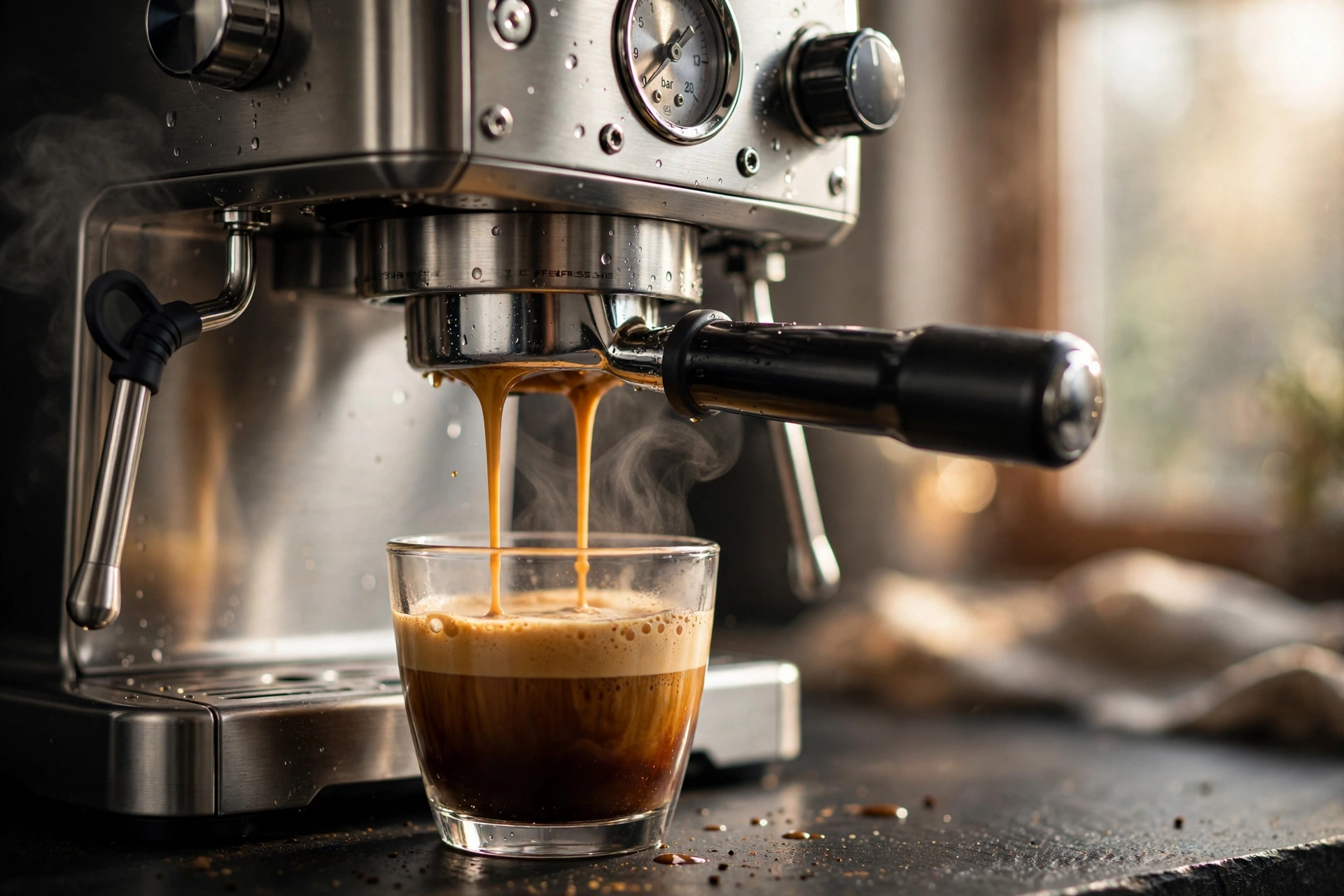
The short answer: the Breville Barista Touch is the best espresso machine under $1,000 for most people, the Breville Barista Pro is the best value with a grinder built in, and the Lelit Anna PID is the best prosumer single-boiler for the money. What the extra budget above $500 actually buys is not higher pressure — every machine here extracts at about 9 bars — but control: PID temperature management, a grinder you do not have to buy separately, and portafilter standards that make accessories cheap. Prices and specs checked 2026-10-03. Prices vary by retailer; where sources disagreed we used the manufacturer’s current price.
We are a research desk, not a test lab: we synthesize owner reports, forum threads, published measurements, reviews, and teardowns rather than claiming hands-on testing we have not done.
First principles: what $1,000 has to solve
Espresso is a constrained extraction problem. Hot water must pass through a compacted puck of finely ground coffee evenly enough to dissolve the desirable compounds without over-extracting bitter ones or under-extracting sour ones. Three conditions decide the result, and each machine below is a different way of paying for them:
- Temperature stability. Water at about 90 to 94°C, the same on shot three as on shot one. A PID controller is a feedback loop that holds the target instead of cycling above and below it; a thermostat alone lets temperature swing and forces temperature surfing — flushing water to guess where you are.
- Pressure at the puck. About 9 bars during extraction. The 15-bar or 19-bar figure on the box is the pump maximum; an over-pressure valve (OPV) does the real work of capping brew pressure. Without a sensible OPV setting, water forces channels through weak spots in the puck and leaves most of the coffee untouched.
- Even resistance from the puck. Dose, distribution, and tamp create the resistance. This is the grinder’s job and the user’s hands, not the boiler’s — which is why the under-$1,000 question is really two questions: machine plus separate grinder, or all-in-one with the grinder built in.
Everything else — boiler versus thermoblock, 54mm versus 58mm, touchscreen versus lever switches — is a trade-off in service of those three conditions.
What the $500 to $1,000 step actually buys
Under $500 you choose which compromise to live with. Between $500 and $1,000, three upgrades become available, and no machine here offers all three at once:
An integrated grinder (the three Brevilles). Building a conical burr grinder into the chassis removes a $150 to $350 separate purchase and shortens the workflow to one box and one plug. The cost is lock-in: when you outgrow the bundled grinder, you replace the whole machine, and the 54mm Breville basket system has a smaller aftermarket than the 58mm commercial standard.
PID control as standard (four of the five). The Breville trio and the Lelit Anna hold brew temperature electronically. Only the Rancilio Silvia still relies on a thermostat, which is why it is the one machine here that rewards an owner willing to temperature-surf or add a PID later.
Commercial-pattern hardware (Rancilio, Lelit). A 58mm (Silvia) or 57mm (Anna) portafilter, a brass boiler with real thermal mass, a 3-way solenoid valve for dry pucks, and a steel frame built to be opened and repaired. You trade heat-up speed — minutes instead of seconds — for a decade-long platform and cheap, standard accessories.
The grinder math governs the total. For the Silvia and Anna, add the grinder before comparing sticker prices: Anna at about $700 plus a $250 grinder lands at about $950 all-in, against the Barista Touch at $999.95 list. Compare setup cost, not machine cost.
Comparison table
Prices and specs checked 2026-10-03. Prices vary by retailer; where sources disagreed we used the manufacturer’s current price.
| Machine | Typical price | Heating | Portafilter | Temperature control | Steam | Tank | Best for |
|---|---|---|---|---|---|---|---|
| Breville Barista Touch (BES880) | $999.95 list, $799.95 street | ThermoJet thermocoil | 54mm | PID | Automatic, adjustable temp and texture | 67 oz (about 2L) | Most people; automatic milk and saved drinks |
| Breville Barista Pro (BES878) | $849.95 | ThermoJet thermocoil | 54mm | PID | Manual 4-hole wand | 67 oz (about 2L) | Best value all-in-one; learn milk properly |
| Breville Barista Express Impress (BES876) | $799.95 list, $649.95 street | Thermocoil | 54mm | PID | Manual wand | 67 oz (about 2L) | Assisted dosing and tamping in one box |
| Rancilio Silvia | $995 | Single brass boiler 0.3L | 58mm | Thermostat, no PID | Manual commercial wand | 2L | Repairable Italian platform; straight shots |
| Lelit Anna PID (PL41TEM) | $699.95 | Single brass boiler 250 ml | 57mm | PID with display | Manual multidirectional wand | 2.7L | Prosumer control for the least money |
The five machines, in depth
1. Breville Barista Touch (BES880) — best for most people
The Touch is the Barista platform with the remaining beginner failures automated. The ThermoJet system reaches extraction temperature in about 3 seconds, digital PID control holds water temperature steady shot to shot, and low-pressure pre-infusion wets the puck gently before the pump ramps to about 9 bars — reducing channeling while your distribution is still imperfect.
Two systems justify the price. The integrated conical burr grinder offers 30 settings and doses directly into the 54mm portafilter, and the automatic steam wand textures milk hands-free with adjustable temperature and texture, then purges itself. The touchscreen stores up to eight personalized drinks, so each household member saves a profile instead of redialing. Single and dual-wall baskets are included, a solenoid valve leaves dry pucks, and the 67 oz tank is generous for the footprint. Breville lists $999.95; Seattle Coffee Gear listed $799.95 when we checked on 2026-10-03. The compromises: no simultaneous brew and steam, modest steam reserve for back-to-back milk drinks, and grinder lock-in if you later step up. For most households it is the machine least likely to frustrate in month one or feel limiting in year two.
2. Breville Barista Pro (BES878) — best value all-in-one
The Pro keeps the Touch’s extraction hardware and returns milk to your hands. Same ThermoJet heat-up in about 3 seconds, same PID control and pre-infusion, same 54mm portafilter with both basket types — but the interface is an LCD with grind and shot animations instead of a touchscreen, and the steam wand is a manual 4-hole wand with noticeably more power than the smaller Breville wands. That wand is the point: if you drink flat whites daily, learning to texture milk on a capable manual wand beats automatic foam you cannot adjust.
The integrated grinder provides 30 settings with dose control, volumetric shot programming covers one and two cups, and the tank holds 67 oz. At $849.95 at Amazon and in Seattle Coffee Gear’s comparison when we checked — about $150 below the Touch at list — the Pro is the pick when you want the Breville speed and PID without paying for milk automation you intend to outgrow. The trade-offs mirror the Touch: thermoblock steam pacing and a bundled grinder with a ceiling.
3. Breville Barista Express Impress (BES876) — assisted tamping, lowest street price
The Impress attacks a different failure: inconsistent dosing and tamping. Its Intelligent Dosing system measures puck depth and auto-corrects the next dose, and the Impress Puck System tamps with a consistent about 10 kg of pressure finished with a 7-degree twist when you pull the lever. For households where two people alternate mornings, that repeatability matters more than any boiler specification.
Underneath is familiar hardware: Thermocoil heating with PID control delivering water at about 93°C, low-pressure pre-infusion followed by 9-bar extraction, a 25-setting conical burr grinder, a 54mm portafilter, manual microfoam wand, and a 67 oz tank. Breville lists $799.95; Seattle Coffee Gear and Coffee Machine Depot listed $649.95 when we checked on 2026-10-03 — the cheapest entry here to an integrated-grinder setup with genuine temperature control. Milk stays manual, the chassis is the widest of the Breville trio at about 13 inches, and the grinder has five fewer settings than the Pro and Touch. Choose it when puck consistency, not milk automation, is your bottleneck.
4. Rancilio Silvia — the repairable Italian platform
The Silvia is the opposite bet from the Brevilles: commercial architecture and steel over speed and software. The single brass boiler of 0.3L, 58mm portafilter and group, 3-way solenoid valve, and stainless frame are scaled-down cafe hardware made to be opened, descaled, and repaired for a decade or more, backed by one of the deepest owner communities in home espresso.
What $995 does not buy is temperature electronics. Control is by thermostat, without PID or pre-infusion programming, so shot temperature swings more than the other four machines and rewards temperature surfing or a later PID retrofit. The single boiler imposes the brew, wait for steam temperature, steam, wait to cool rhythm, and heat-up is measured in minutes. Seattle Coffee Gear listed $995 when we checked. Budget a real 58mm tamper and an espresso-capable grinder on top. Owners keep Silvias for ten years precisely because everything that wears is replaceable — buy it if longevity and straight espresso matter more than morning speed.
5. Lelit Anna PID (PL41TEM) — prosumer control for the least money
The Anna is where prosumer features reach their lowest price here. A 250 ml brass boiler under PID control with a front display lets you set brew temperature to the roast instead of guessing, a manometer shows live brew pressure so grind errors are visible mid-shot, and the 3-way solenoid valve dries the puck for a clean knock-out. The LELIT57 group takes 57mm baskets and Lelit barista tools, the multidirectional steam wand handles milk and hot water, and the 2.7L tank is the largest in this roundup.
Majesty Coffee listed $699.95 when we checked; Image Coffee listed $599.95. At either price it undercuts every Breville while offering the strongest temperature control per dollar — but there is no grinder, the plastic tamper in the box should be replaced immediately, and the 57mm ecosystem, while shared across Lelit’s range, is narrower than 58mm. Pair it with a $200 to $350 grinder and the all-in cost still lands below the Barista Touch, with a higher long-term ceiling and a slower, more deliberate workflow.
How to choose among the five
- You want the fewest bad mornings and automatic milk: Barista Touch. Saved drink profiles and hands-free texturing are features you will use twice a day.
- You want Breville speed but intend to learn milk properly: Barista Pro. The 4-hole manual wand teaches the real skill, and it costs less than the Touch.
- Your shots are inconsistent because dose and tamp vary: Barista Express Impress. Assisted tamping deletes the most common home variable, at the lowest street price here.
- You want a machine to keep and repair for a decade, mostly for straight espresso: Rancilio Silvia, plus a real tamper and grinder. Accept temperature surfing as part of the ritual.
- You want PID control and a pressure gauge without Breville lock-in: Lelit Anna PID, plus a grinder. The strongest control-per-dollar setup under $1,000.
What to budget beyond the sticker
Only the three Breville machines can make espresso alone on day one. The Silvia and Anna each require an espresso-capable burr grinder (about $200 to $350) to use their non-pressurized baskets — pressurized baskets and pre-ground coffee are a starting ramp, not a destination. Every setup needs a 0.1g scale (about $15 to $25) and fresh beans bought weekly. For the Anna, add a proper 57mm tamper (about $20 to $40) on day one.
Meet the three conditions — water at about 90 to 94°C held steady, about 9 bars at the puck, and an even fine grind — and any of these five makes cafe-quality espresso. Under $1,000 the choice is workflow, not extraction ceiling: seconds-fast thermoblock automation, or boiler mass and standard parts you can service for years.