The short answer: the Barista Express and Barista Touch pull the same espresso; the Touch is the faster, more automated milk machine. The same extraction chain sits inside both boxes — integrated conical burr grinder, 54mm portafilter, low-pressure pre-infusion, 9-bar extraction through a 15-bar pump, PID temperature control. What the extra money buys is ThermoJet 3-second heat-up, a touchscreen with 8 customisable drinks, hands-free Auto MilQ milk texturing, 30 grind settings against 16, and a second year of warranty. If milk drinks are the daily default and you want the machine to do more of the work, the Touch earns the premium. If you drink mostly espresso or americanos, or you want to learn the craft, buy the Express and keep the difference. Prices and specs checked 2026-10-29. Prices vary by retailer; where sources disagreed we used the manufacturer’s current list price.
Disclosure: we are an independent research desk and earn no commission on anything here. Vendor links on this page are plain links to manufacturer and retailer pages — no affiliate tracking. See our disclosure policy for how we stay independent.
We are a research desk, not a test lab: we synthesize manufacturer specifications, owner reports, forum threads, and published reviews rather than claiming hands-on testing we have not done.
First principles: one extraction chain, two workflows
An all-in-one espresso machine does four jobs in sequence: grind, dose, extract, steam. The extraction job — the one that decides how the coffee tastes — is decided by grind fineness, dose, water temperature, and pressure. On that side these two machines are the same machine: same burr type, same 54mm portafilter and ≈18g dose, same pre-infusion, same 9-bar extraction, same PID control. Nothing about the shot differs, and no interface upgrade can change that, because the interface never touches the coffee.
The jobs that do differ are the ones around the shot: how fast the water gets hot, how the grind is adjusted, how the drink is selected, and who textures the milk. Those are workflow differences, not quality differences — and workflow is exactly what the premium prices.
One shared limitation matters more than any single difference: neither machine brews and steams at the same time. Both heat water on demand through a single heating system, so making a latte is sequential — pull the shot, then steam the milk (or vice versa), with a purge in between. If your household makes four milk drinks back to back every morning, that is the real bottleneck, and neither machine removes it; only a dual-boiler machine does.
Comparison table
Prices and specs checked 2026-10-29 from Breville’s published product pages, cross-checked against retailer spec tables and current retailer prices; retailer prices vary.
| Spec | Breville Barista Express (BES870) | Breville Barista Touch (BES880) |
|---|---|---|
| List price | $749.95 | $999.95 |
| Street price when checked | ≈$699.95 (Amazon, Best Buy) | $999.95 (Abt, Best Buy, Whole Latte Love) |
| List-price gap | — | ≈$250 |
| Heating | Thermocoil with PID | ThermoJet with PID |
| Heat-up | ≈30 seconds | 3 seconds |
| Temperature control | Digital PID | Digital PID |
| Grinder | Integrated conical burr, dose control | Integrated conical burr, dose control |
| Grind settings | 16 | 30 |
| Portafilter | 54mm stainless, single + dual-wall baskets | 54mm stainless, single + dual-wall baskets |
| Pump / extraction | 15-bar pump, 9-bar extraction | 15-bar pump, 9-bar extraction |
| Pre-infusion | Low-pressure pre-infusion | Low-pressure pre-infusion |
| Interface | Buttons and dials, pressure gauge, volumetric 1 & 2 cup | Touchscreen, 8 customisable drinks |
| Milk texturing | Manual steam wand | Auto MilQ hands-free + manual mode |
| Milk settings | None — manual only | Temperature 40–75°C, 8 texture levels |
| Water tank | 67 oz (2L) | 67 oz (2L) |
| Bean hopper | ≈0.5 lb | ≈0.5 lb |
| Hot water | Dedicated outlet | Via touchscreen drink menu |
| Auto purge after steam | Yes | Yes — wand purges automatically |
| Dry puck feature | Yes | Not listed |
| Tamping | Manual, integrated tamper + Razor tool | Manual, integrated tamper + Razor tool |
| Warranty | 1 year | 2 years |
| Grinder included | Yes (both) | Yes (both) |
Heating: thermocoil against ThermoJet
Both machines heat water on demand — there is no boiler sitting at temperature all day, which is why both are ready far faster than a traditional boiler machine. The difference is how quickly the heating element itself reaches extraction temperature.
The Express’s thermocoil is a coil of water pipe embedded in a heated block: effective and proven, but the block needs roughly 30 seconds to warm up and stabilise. The Touch’s ThermoJet is a newer on-demand design that reaches extraction temperature in 3 seconds. In practice the gap is one small wait per session, not per drink — once either machine is warm, it stays ready. It matters most to the person who wants a coffee the moment they walk into the kitchen, and least to someone who grinds and doses first anyway, since dosing takes longer than either heat-up.
The shared point is the one buyers miss: fast heat-up is not simultaneous brewing and steaming. Both machines still do one job at a time, and both need a purge after steaming so the next shot starts at brew temperature rather than steam temperature. The Express purges automatically after steam; the Touch’s wand purges itself the same way.
Grinder: 16 steps against 30
Both grinders are integrated stainless conical burrs that dose directly into the portafilter — same burr type, same workflow, same ≈0.5 lb hopper. The difference is adjustment granularity: 16 steps on the Express, 30 on the Touch.
Step count is not grind quality. What it buys is resolution: when a new bag of beans lands between two Express settings — one choking the shot past 35 seconds, the next running fast and sour — the Touch is more likely to have a setting in between. That window is narrowest for light roasts, which extract stubbornly and punish coarse steps. For medium and dark roasts, the most common home coffees, the Express’s 16 steps are usually enough, and the dual-wall (pressurised) baskets included with both machines forgive a slightly off grind while you are learning.
One honest caveat: step counts are not comparable across brands, since step sizes differ. Within this pair, from the same manufacturer, the comparison is fair — the Touch genuinely adjusts finer.
Milk: manual wand against Auto MilQ
This is the difference the premium exists for, and it mirrors the Bambino versus Bambino Plus split at a lower price point: the same manual-versus-automatic milk question, one tier up.
The Express’s manual wand is a commercial-style steam wand you operate yourself: hold the pitcher, find the angle, listen for the tearing sound, stop at temperature by feel or thermometer. Done well it makes genuine microfoam for latte art, and learning it is the skill that transfers to any machine. Done badly it makes bubbly, scorched milk — and the learning period is measured in weeks.
The Touch’s Auto MilQ wand textures hands-free: place the jug, pick a temperature between 40°C and 75°C and one of 8 texture levels, and the machine stops itself. The same milk comes out the same way every morning, before anyone in the house is fully awake. It also offers a manual mode, so the automation can be bypassed — but a buyer who plans to steam manually from day one is paying for a feature they will not use, and should buy the Express instead.
For straight-espresso and americano drinkers this entire section is moot. For a household making two lattes every morning, it is the whole decision.
Interface: pressure gauge against touchscreen
The Express gives you buttons, dials, volumetric 1 and 2 cup programming — and a pressure gauge. That gauge is the Express’s secret teaching tool: it shows, in real time, whether the shot is extracting in the right pressure range. Too high and the grind is too fine or the dose too heavy; too low and the opposite. It is the fastest diagnostic a beginner has, and it is why the Express has survived as a learning machine since 2013.
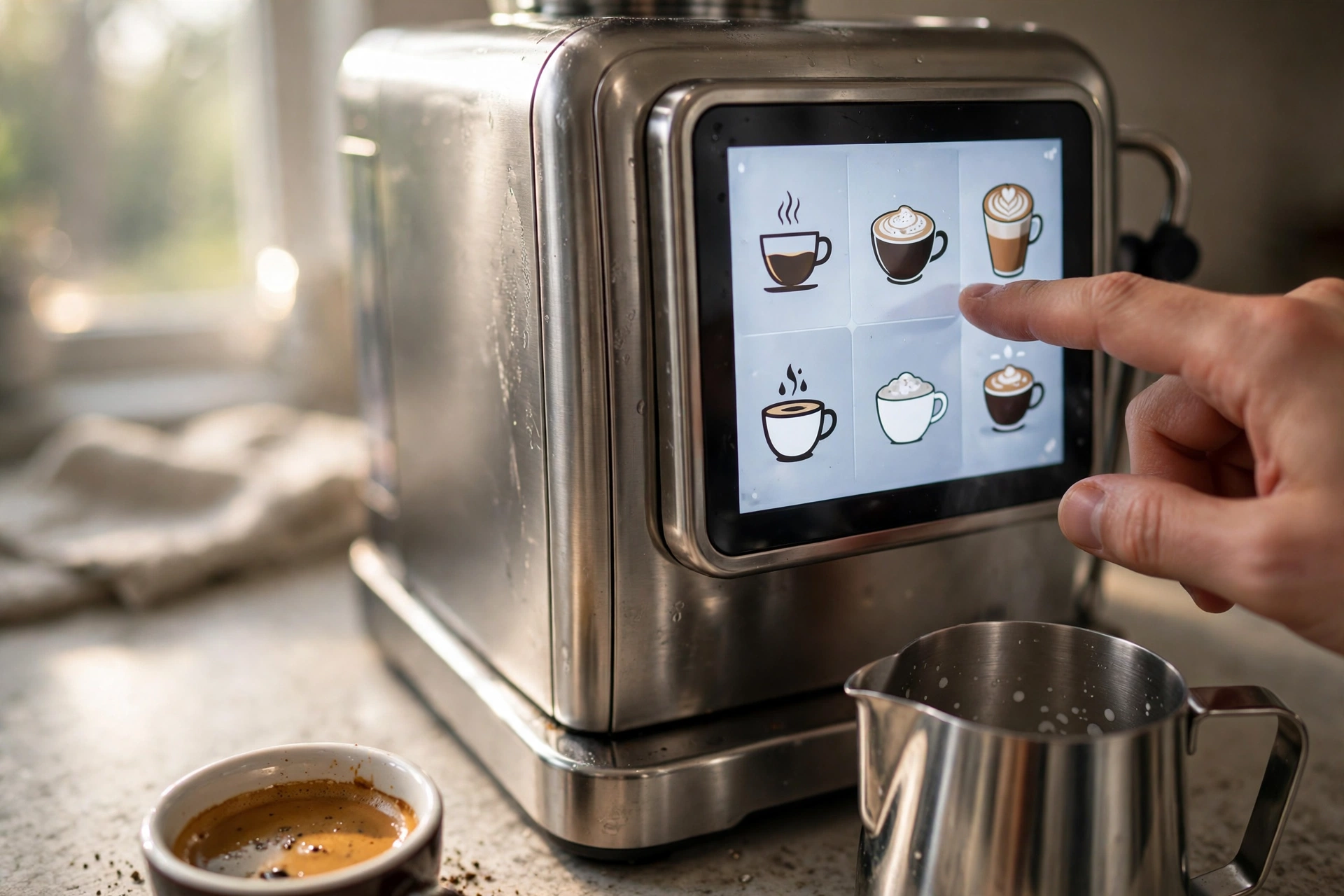
The Touch replaces all of that with a touchscreen: swipe, pick a drink, adjust strength, milk temperature and texture, and save up to 8 custom drinks for repeat one-tap brewing. What it gains in household convenience — a partner or teenager can make their usual without learning anything — it loses in feedback: there is no gauge to read when a shot runs wrong, only taste and timing. Beginners who want to understand espresso will learn faster on the Express; households that want consistent drinks with no learning curve will be happier with the Touch.
Do not confuse the Touch with the Touch Impress
This comparison is about the Barista Touch, model BES880, at $999.95. Breville also sells the Barista Touch Impress, model BES881, from $1,499.95, which adds the Impress Puck System — intelligent dosing with assisted tamping and a 7° barista twist finish — plus a larger preset menu. Similarly, the Barista Express Impress (BES876) adds assisted tamping to the Express. Several published comparisons quote a $400–$750 gap for “Express vs Touch” because they are quietly pricing an Impress model against the base Express. Compare model numbers, not names: BES870 against BES880 is a ≈$250 gap; anything wider means an Impress has slipped into the comparison.
Price and value
At list price the gap is $250: $749.95 against $999.95. At street prices when checked — ≈$699.95 for the Express, $999.95 for the Touch — the real-world gap is about $300, because the Express is discounted more often and more deeply than the Touch. If the gap ever widens past ≈$400, check whether the Touch listing is actually a Touch Impress before concluding the Touch got more expensive.
Framed against what each adds: the Touch’s premium buys faster heat-up, a touchscreen with saved drinks, hands-free milk, finer grind steps, and a second warranty year. None of it improves the shot. The value question is therefore a household question, not a quality question — and the answer is in who makes the coffee most mornings, and what is in their cup.
The verdict
- Buy the Barista Touch if milk drinks are the daily default, more than one person makes coffee and wants their drink saved, you value 3-second heat-up and hands-free milk over learning the craft, or the two-year warranty matters to you.
- Buy the Barista Express if you drink mostly espresso or americanos — you get the identical shot for less — or you want to learn espresso properly, with the pressure gauge as your teacher and the manual wand as your practice.
- Buy neither if you need to brew and steam simultaneously for a multi-drink household rush — that needs a dual-boiler machine, and neither of these is one. Our dual-boiler roundup covers that tier.
- Check the model number before paying. BES870 against BES880 is this comparison. BES881 (Touch Impress) is a different, more expensive machine — and if that is what you actually want, it should be compared on its own merits, not smuggled into this price gap.
Both machines pull the same excellent espresso for the class. The Touch does not make better coffee — it makes mornings easier, more consistent, and more hands-free. Pick based on who is making the coffee and how much of the work you want done for you, because that is the entire difference.
Sources checked 2026-10-29: Breville’s Barista Touch (BES880) and Barista Express (BES870) product pages; Best Buy, Abt, and Whole Latte Love listings for the Touch at $999.95; Amazon and Best Buy listings for the Express (list $749.95, street ≈$699.95); Breville’s Barista Touch Impress (BES881) page for the $1,499.95 Impress distinction. Plain links: Barista Touch at Whole Latte Love, Barista Touch at Best Buy, Barista Express at Amazon.