The short answer: the Breville Barista Express Impress is the best espresso machine with a grinder for most people, the original Barista Express is the best value, and the Barista Touch Impress is the best choice if you want milk handled for you. What separates the five machines below is not whether the grinder is built in, since all of them grind, but how each handles dose consistency, tamping, heat, and steam inside one footprint. Prices and specs checked 2026-10-03. Prices vary by retailer; where sources disagreed we used the manufacturer’s current price.
We are a research desk, not a test lab: we synthesize owner reports, forum threads, published measurements, reviews, and teardowns rather than claiming hands-on testing we have not done. That matters here, because integrated-grinder failure modes only show up after months of daily use.
First principles: what a machine with a grinder actually has to do
Espresso is a constrained extraction problem. Hot water must pass through a compacted puck of finely ground coffee evenly enough to dissolve the desirable compounds without washing through cracks or stalling against a puck ground too fine. Four conditions decide whether that happens, and an integrated machine has to satisfy all four inside one box:
- Particle size and distribution. The puck’s resistance comes from the coffee itself. Too coarse and water rushes through, leaving the shot sour and thin. Too fine and the pump cannot push water through at all. An even distribution matters as much as the average size: a mix of dust and boulders channels, because water takes the path of least resistance and leaves most of the puck untouched.
- Dose consistency. Resistance scales with how much coffee is in the basket. Two grams of variation shot to shot moves the extraction as much as a grind adjustment does. This unglamorous variable decides whether your second shot tastes like your first.
- Temperature stability. Water at about 90 to 94°C, delivered the same way on shot three as on shot one.
- Pressure at the puck. About 9 bars during extraction, reached gently. Low-pressure pre-infusion wets the puck first so it swells and seals, then the pump ramps up. The 15-bar figure on the box is the pump’s maximum; an over-pressure valve sets the brew pressure.
A separate machine and grinder let you optimize each condition independently and upgrade whichever one becomes the bottleneck. An integrated machine couples them: the grinder shares a chassis with a heating system that warms the beans above it, shares the footprint that limits burr size, and shares the purchase, so when one side reaches the end of its life you replace both. In exchange you get one footprint, one warm-up, and a workflow measured in seconds. Whether that trade is good depends on how well the manufacturer managed the coupling, and that is what the five picks below are ranked on.
What integration forces you to choose
The grinder ceiling. Every integrated grinder here is a stepped conical burr unit sized to fit beside a brew group: a narrower usable range than a dedicated grinder, more grounds retained in the chute, and burrs that are replaceable in principle but rarely replaced in practice. Medium and medium-dark roasts dial in comfortably. Light roasts, which need finer grinds and resist extraction, expose the ceiling fastest.
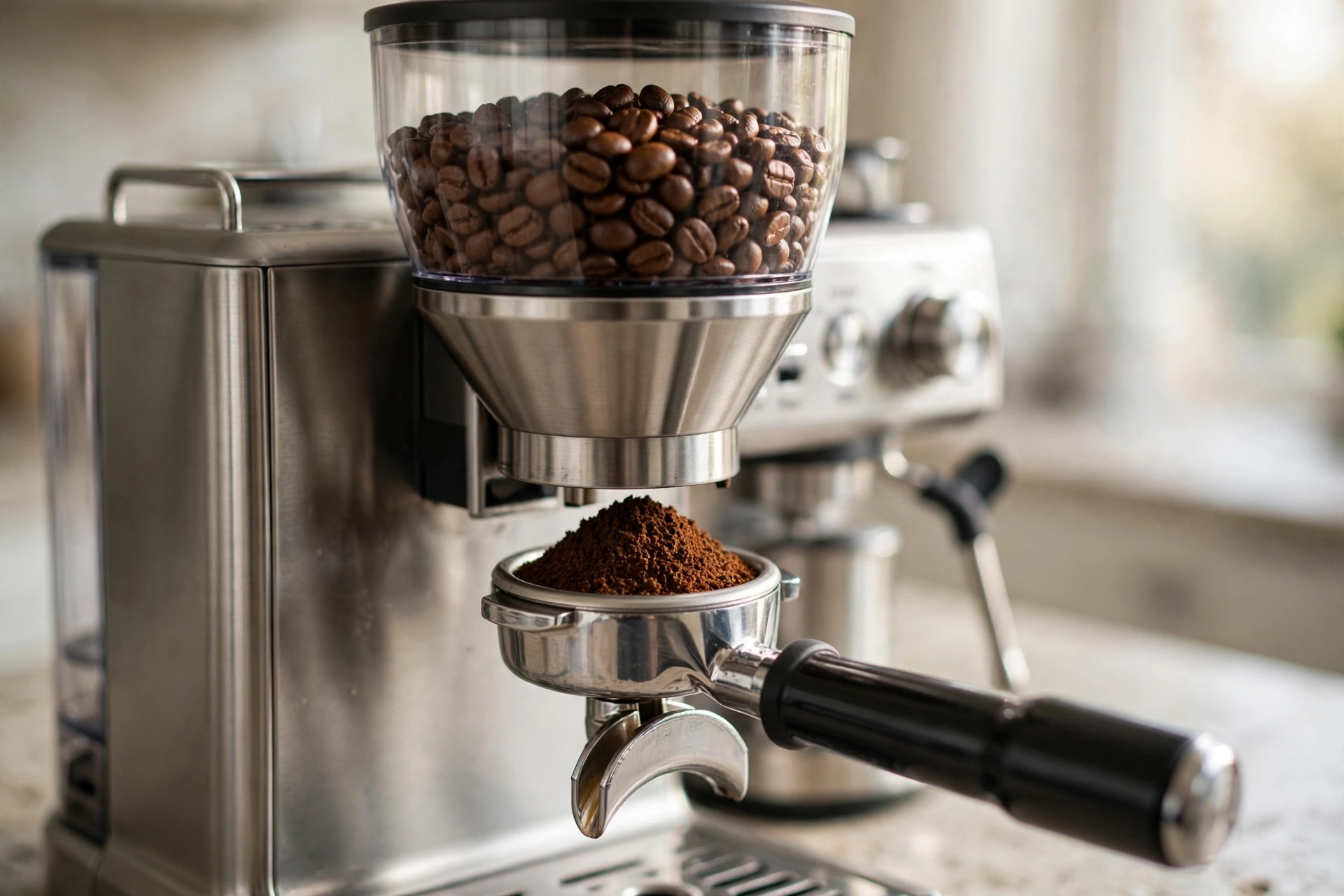
Tamping automation is the real dividing line. Grinding directly into the portafilter defines this category’s convenience, but grounds land in a mound, and a mound tamps into an uneven puck. A level, consistent tamp at a repeatable pressure removes the variable beginners struggle with most. The two Impress models automate the answer: intelligent dosing measures the dose, corrects the next one, and applies a guided 10 kg tamp with a finishing twist. De’Longhi ships a dosing funnel and a proper tamper instead, and your hand does the rest. Neither approach raises the ceiling; they differ in how many shots it takes to get there each morning.
Heat architecture still decides the milk workflow. The Breville Express models use a Thermocoil that controls temperature precisely but makes steam on demand, so milk drinks are sequential: brew, purge, steam, purge back. The Pro and Touch Impress use ThermoJet, reaching extraction temperature in about 3 seconds with near-instant steam transitions. The La Specialista Arte uses a thermoblock with three selectable infusion temperatures. None brew and steam simultaneously; that requires a dual boiler, which no integrated-grinder machine in this price band offers.
Comparison table
Prices and specs checked 2026-10-03. Prices vary by retailer; where sources disagreed we used the manufacturer’s current price.
| Machine | Typical price | Grinder | Heating | Portafilter | Steam | Tank | Best for |
|---|---|---|---|---|---|---|---|
| Breville Barista Express Impress (BES876) | $799.95 list, about $649.95 street | Conical burr, 25 settings, intelligent dosing | Thermocoil, PID | 54mm | Manual wand | 2L (67 oz) | Most people; assisted tamping removes the hardest step |
| Breville Barista Express (BES870) | $699.95 list, about $499.95 street | Conical burr, 16 settings | Thermocoil, PID | 54mm | Manual wand | 67 oz (2L) | Best value; the proven all-in-one formula |
| Breville Barista Pro (BES878) | $849.95 | Conical burr, 30 settings | ThermoJet, PID, about 3-second heat-up | 54mm | Manual wand, LCD guidance | 67 oz (2L) | Speed and feedback; enthusiasts who tamp by hand |
| De’Longhi La Specialista Arte (EC9155) | $699.95 | Conical burr, 8 settings | Thermoblock, 3 temperature levels | 51mm | My LatteArt manual wand | 56 oz (1.7L) | Compact footprint; full manual craft with a barista kit |
| Breville Barista Touch Impress (BES881) | $1,499.95 list, about $1,199.95 street | Conical burr, 30 settings, Baratza burrs | ThermoJet, PID, about 3-second heat-up | 54mm | Auto MilQ automatic texturing | 2L (67 oz) | Premium automation; touchscreen guidance and hands-free milk |
The five machines, in depth
1. Breville Barista Express Impress (BES876) — best for most people
The Express Impress takes the Barista Express formula and removes the two steps that ruin the most beginner shots: dosing by eye and tamping by hope. Its integrated conical burr grinder offers 25 grind settings, and the Intelligent Dosing system measures the dose in the basket and auto-corrects the next grind to hit the target again. The assisted tamping lever applies a consistent 10 kg tamp with a 7-degree twist finish. Underneath sit the proven Express internals: Thermocoil heating with PID control, low-pressure pre-infusion before the 15-bar pump ramps to about 9 bars at the puck, a 54mm portafilter with single and dual wall baskets, and a manual steam wand. Steam is sequential rather than simultaneous, and the grinder’s 25 settings top out below a dedicated unit’s range. At $799.95 list, about $649.95 street when we checked, the premium over the original Express buys dose and tamp consistency. For most people, that is the right money.
2. Breville Barista Express (BES870) — best value
The original Barista Express created this category, and it remains the benchmark everything else is priced against. The integrated grinder has 16 settings, fewer than the Impress, and dosing is timed rather than measured, so a scale under the portafilter is a worthwhile habit. Tamping is manual with the included magnetic tamper. In return you get the same Thermocoil heater with PID control, the same 54mm portafilter system, low-pressure pre-infusion, a pressure gauge for extraction feedback, and a manual steam wand. The owner knowledge around this machine is unmatched; every problem you might have has been diagnosed in a forum thread already. The grinder is the known weak point, coarser in adjustment than the Pro’s, and owners who outgrow the machine cite it first. At $699.95 list and about $499.95 street when we checked, it is the cheapest honest entry into fresh-ground espresso.
3. Breville Barista Pro (BES878) — best for speed and feedback
The Barista Pro is the Express concept rebuilt around pace. ThermoJet reaches extraction temperature in about 3 seconds, and the transition from brewing to steam is close to instant: the machine is ready when you are, with no warm-up ritual. The grinder steps up to 30 settings, giving finer resolution around the dial-in point than either Express model, and an LCD screen displays grind time, shot clock, and extraction progress. Tamping is fully manual, and that is the point: the Pro assumes you want to develop the skill and gives you the information to do it quickly. The 54mm portafilter, PID-controlled temperature, pre-infusion, and manual steam wand carry over. At $849.95 when we checked, you are paying for heat speed and grind resolution, the two upgrades an improving home barista feels most.
4. De’Longhi La Specialista Arte (EC9155) — the compact manual alternative
The La Specialista Arte is the only non-Breville in this roundup, and the most deliberately manual machine here. The integrated conical burr grinder has 8 settings, the fewest of the five, and De’Longhi leans into hands-on craft to compensate: a full barista kit with a metal tamper, tamping mat, and dosing funnel, plus a 51mm portafilter with unpressurized baskets, so the machine assumes a real grind from day one. Active Temperature Control offers three infusion levels, about 92, 94, and 96°C. The My LatteArt steam wand is a proper manual wand, and owner reports rate the Arte’s milk texture as the easiest to learn on in this group. The costs: 8 grind settings frustrate with light roasts sooner than the Breville grinders will, the 56 oz tank needs frequent refilling, and the 51mm accessory ecosystem is thinner than 54mm. At $699.95 when we checked, choose it for the footprint and the craft, not the spec sheet.
5. Breville Barista Touch Impress (BES881) — best premium automation
The Barista Touch Impress is what this category looks like with the budget doubled. It combines the Impress puck system, intelligent dosing, and assisted 10 kg tamping with dose correction, plus the two upgrades the Express Impress lacks: a full-color touchscreen that walks you through each drink with real-time feedback, and Auto MilQ, an automatic steam wand that textures milk hands-free to your selected temperature and foam level, including settings for alternative milks. The grinder uses Baratza European precision burrs with 30 settings, the widest range here, and ThermoJet delivers the same about 3-second heat-up as the Pro. The honest caveat: none of this buys a higher extraction ceiling than the Express Impress. The 54mm hardware, PID control, pre-infusion, and about 9 bars at the puck are the same. The premium, $1,499.95 list and about $1,199.95 street when we checked, buys automation of the steps around the shot. If milk drinks are half your output and mornings are rushed, that automation earns its keep. If you drink straight espresso, it does not.
How to choose among the five
- You are new to espresso and want the fewest ruined shots: Barista Express Impress. Dose and tamp are the two variables it removes, and they are the right two.
- Your budget is fixed and you want the proven formula: Barista Express. Add a small scale and put the savings into beans.
- You make milk drinks back-to-back and hate waiting: Barista Pro. ThermoJet heat and near-instant steam are a workflow upgrade, not a spec-sheet one.
- Your counter is narrow and you want to learn the craft by hand: La Specialista Arte. The barista kit and unpressurized baskets assume you want the skill.
- Two people, different skill levels, milk every morning: Barista Touch Impress. Touchscreen guidance and automatic milk are household features, used daily.
When a built-in grinder is the wrong answer
One honest paragraph against the format itself. If you will chase light-roast single origins, single-dose different beans through the day, or keep a grinder for a decade across two machine upgrades, buy machine and grinder separately. A standalone setup costs about the same as the Barista Pro, takes more counter, and beats every machine here on grind range, retention, and upgrade path. These five win on footprint and workflow speed. Fresh grounds, dosed consistently, at a stable temperature and about 9 bars: meet those conditions and they make espresso that holds up against cafe shots.