
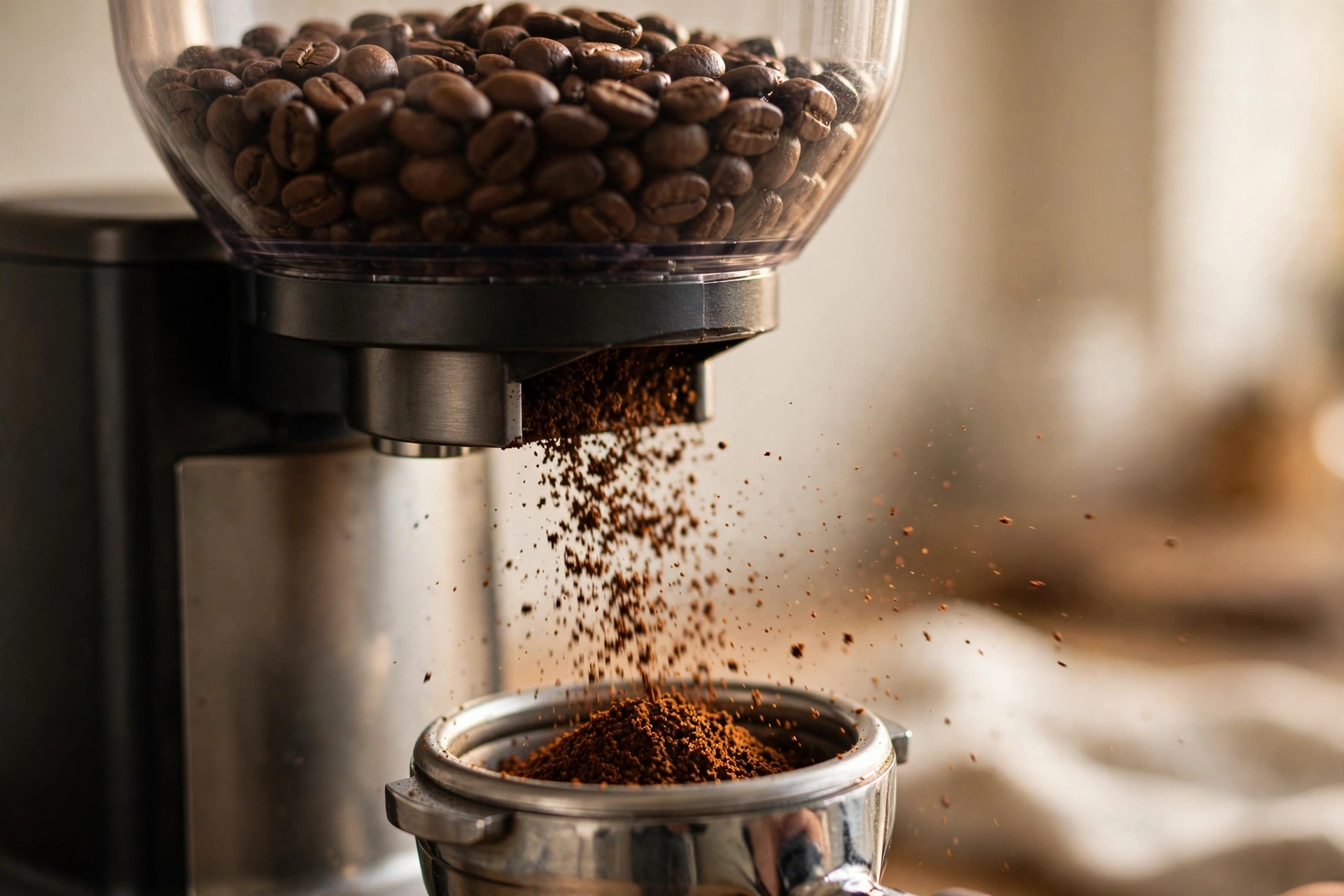
The short answer: espresso is the only common brew method where grind size is a precision instrument, not a preference. The grind controls how fast pressurized water flows through the coffee — and flow speed determines extraction, which determines flavor. Get the grind wrong and no machine on earth saves the shot.
Three mechanisms make the grinder non-negotiable: grind size controls resistance, grind consistency controls evenness, and grinding fresh controls flavor. Each one breaks in a different way when the grinder is wrong.
Mechanism 1: grind size is the flow valve
Picture the puck: 18 grams of coffee compressed into a dense disc, with ≈9 bars of water pressure above it. The water has to get through. How fast it gets through depends on how tightly the grounds pack together — and packing density is set by particle size.
- Too coarse: water blasts through in 10–15 seconds. Contact time is too short to extract properly → sour, thin, watery (under-extraction).
- Just right: water takes 25–30 seconds to push through, extracting acids, then sweetness, and stopping before bitter compounds dominate → balanced, syrupy.
- Too fine: the puck chokes. Water barely drips, pressure spikes, the shot runs long → bitter, harsh, dry (over-extraction).
Espresso grounds sit around 200–400 microns — roughly the texture of table salt, far finer than drip. And the adjustment window is tiny: the difference between a 22-second gusher and a 32-second choker can be a few dozen microns. That’s why espresso grinders need fine adjustment — stepless (infinite) or micro-stepped. A grinder whose clicks jump from “too coarse” to “too fine” with nothing in between is useless for espresso, no matter how good its burrs are.
This is also why every new bag of coffee needs dialing in: beans change with roast level, age, and even humidity. A setting that pulled a perfect 27-second shot on Monday might run 22 seconds on Friday as the beans degas and dry out. Without your own grinder, you can’t respond — you’re stuck with whatever the bag contains.
Mechanism 2: consistency prevents channeling
Size isn’t enough; the particles have to be uniform. Here’s why.
Imagine a puck mixing powder-fine dust with coarse chunks. Water under pressure takes the path of least resistance — it flows around the chunks through the gaps, and stalls in the dense dusty regions. The chunks under-extract (sour) while the dust over-extracts (bitter). You get both defects in one cup, and adjusting anything else can’t fix it, because the problem is inside the puck’s structure.
This is the burr vs. blade divide:
| Blade grinder | Burr grinder | |
|---|---|---|
| How it works | Spinning blade smashes beans randomly | Beans crushed between two ridged surfaces at a fixed gap |
| Particle sizes | Wild mix of dust and chunks | Uniform, set by the gap between burrs |
| Espresso? | No — the inconsistency guarantees channeling | Yes — the fixed gap is the whole point |
Within burr grinders, the two geometries — conical and flat — both work for espresso. Flat burrs tend toward slightly more uniform particles and cost more, but either beats any blade grinder. The spec that matters is simple: burrs, with a gap that adjusts fine enough.
Mechanism 3: freshness is a clock that starts at grinding
Whole coffee beans stay flavorful for 2–4 weeks after roasting. Ground coffee starts dying in minutes. The reason is surface area: grinding one bean exposes thousands of times more surface to oxygen, and two things escape immediately:
- CO2. Fresh beans are full of trapped carbon dioxide from roasting. CO2 contributes to crema and carries aromatics out of the cup as it escapes. Ground coffee degasses in hours; pre-ground coffee in a bag degassed weeks ago. Flat, lifeless crema is the visible symptom.
- Volatile aromatics. The compounds that make coffee smell like coffee evaporate fast once exposed to air. This is why a bag of pre-ground smells great when opened and like nothing a day later.
So “fresh coffee” really means “recently ground coffee.” A grinder at home is a time machine: it moves the grinding step from weeks before brewing to seconds before. No bag, however premium, can do that — the clock starts the moment the grinder stops.
The dial-in loop: what owning a grinder actually feels like
Dialing in sounds technical, but it’s a simple feedback loop you’ll run every time you open a new bag:
- Start at your last setting and pull a shot, timing it and tasting it.
- Too fast and sour? Grind finer — you’re increasing resistance, slowing the water, giving it more contact time.
- Too slow and bitter? Grind coarser — you’re opening the puck up, letting water through faster.
- Repeat until the shot lands in the 25–30 second window and tastes balanced.
The first bag takes a few tries; after that, you’re usually one or two adjustments away. Notice what this loop requires: the ability to change grind size in small steps, taste the result, and change it again. That’s the whole argument for owning the grinder in one paragraph — without it, you’re locked out of the only feedback loop espresso gives you.
Why the common shortcuts fail
Put the three mechanisms together and the usual workarounds collapse:
- Pre-ground “espresso” coffee fails mechanisms 1 and 3: you can’t adjust the size (no dialing in), and it’s stale (ground weeks ago). It only “works” in pressurized baskets, which fake the resistance with a tiny exit hole instead of the puck itself — training wheels that cap your shot quality.
- A drip grinder fails mechanisms 1 and 2: most can’t grind fine enough, their steps are too coarse, and cheaper ones produce too many fines. One click chokes, the next gushes, with no usable setting in between.
- A spice/blade grinder fails mechanism 2 catastrophically: dust plus boulders, channeling guaranteed.
What to actually look for
You don’t need to spend a fortune. You need four things:
- Burrs, not blades. Non-negotiable — this is the consistency mechanism.
- Espresso-capable range. It must grind fine enough, with room to go finer. “Espresso” printed on the box isn’t a guarantee; check reviews for actual espresso use.
- Fine adjustment. Stepless or micro-stepped. If one click swings the shot by 10 seconds, you’ll never dial in.
- Low retention. Grounds left inside the grinder from yesterday go stale and contaminate today’s shot. Less retention means fresher coffee in the cup.
Hand vs. electric is the budget question:
| Hand grinder | Electric grinder | |
|---|---|---|
| Cost for espresso quality | $100–$160 | $200–$400+ |
| Grind quality | Excellent — same burr principles | Excellent |
| Effort | 30–60 seconds of cranking per shot | Push button |
| Best for | 1–2 drinks a day, tight budgets | Households, milk drinks, convenience |
A $130 hand grinder with steel burrs will out-grind a $150 electric every time — electrics only pull ahead once you spend real money on the motor and burr set. If your budget is tight, the hand grinder isn’t the compromise; it’s the smart money.
The bottom line
The machine holds temperature and pressure steady. But the puck — the thing the water actually flows through — is entirely the grinder’s product: its size sets the flow rate, its uniformity sets the evenness, and grinding it fresh sets the flavor ceiling. Spend on the grinder first. A modest machine fed by a great grinder makes café-quality espresso; a great machine fed by a bad grinder makes expensive disappointment.