The short answer: the Breville Bambino Plus is the best espresso machine under $500 for most people, the Gaggia Classic Pro E24 is the best long-term platform, and the Breville Bambino is the best value. What separates them is not pressure — every machine here can build enough of it — but how each design manages temperature, steam, and the compromises a $500 ceiling forces. Prices and specs checked 2026-10-03. Prices vary by retailer; where sources disagreed we used the manufacturer’s current price.
We are a research desk, not a test lab: we synthesize owner reports, forum threads, published measurements, reviews, and teardowns rather than claiming hands-on testing we have not done.
First principles: what an espresso machine actually has to do
Espresso is a constrained extraction problem. Hot water must pass through a compacted puck of finely ground coffee evenly enough that it dissolves the desirable compounds without over-extracting the bitter ones or under-extracting the sour ones. Three conditions decide whether that happens:
- Temperature stability. Water at about 90 to 94°C. Too cool and the shot runs sour and thin; too hot and it turns bitter and ashy. The second shot should taste like the first, so the heating system must return to the same temperature quickly after each extraction.
- Pressure at the puck. About 9 bars during extraction. The pump rating on the box (usually 15 bars) is the pump’s maximum, not the brew pressure — an over-pressure valve (OPV) is what actually caps it. Machines without a sensible OPV setting push water too hard, which forces channeling: water finds cracks in the puck and rushes through them, leaving most of the coffee untouched.
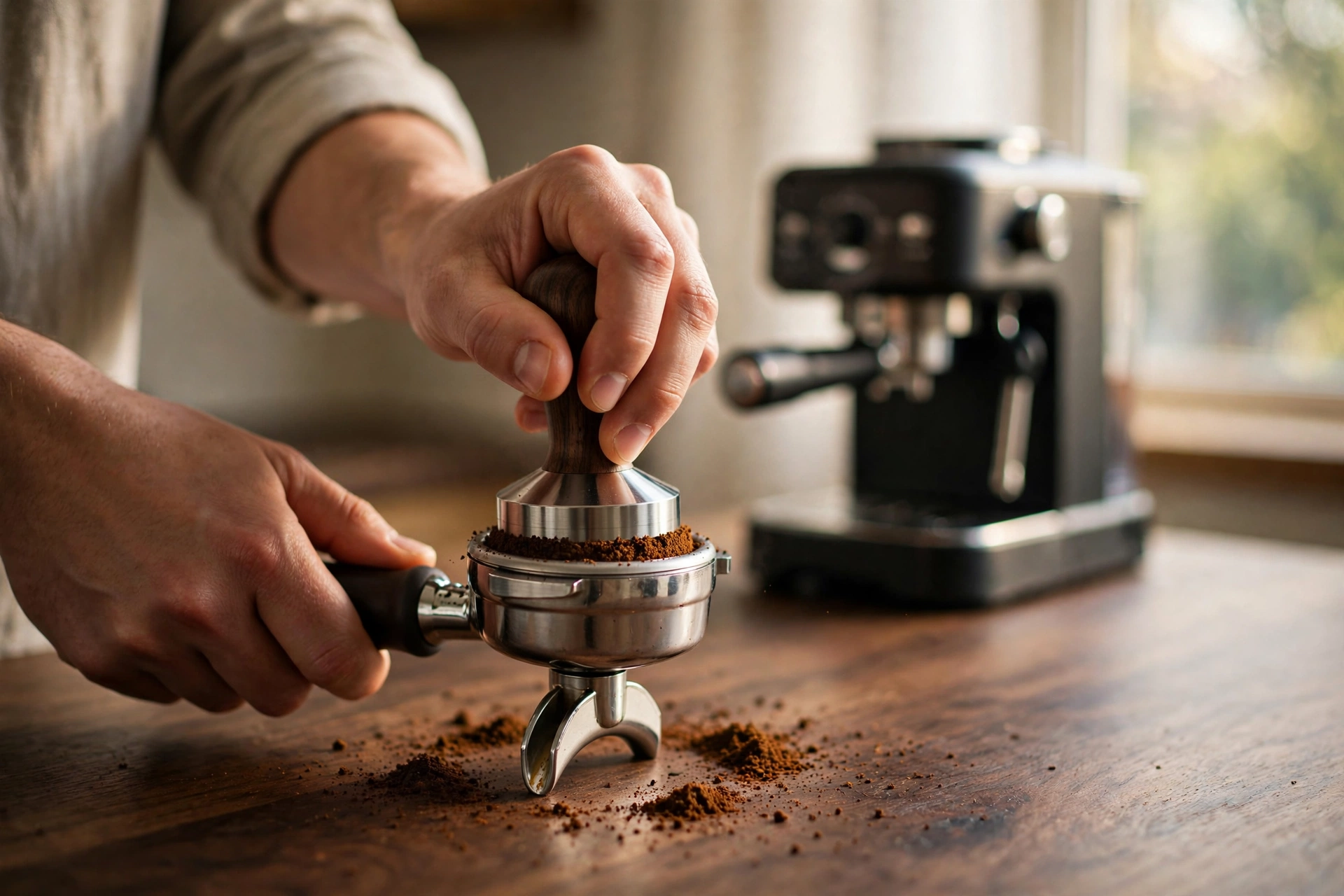
- Even resistance from the puck. Dose, distribution, tamp, and grind size create the resistance the water works against. This is the grinder’s job, not the machine’s — which is why no machine under $500 should be judged without asking what grinder sits next to it.
Everything else — portafilter diameter, boiler versus thermoblock, steam wand design — is a trade-off in service of those three conditions. That is the lens for the five machines below.
What the $500 ceiling forces you to choose
Under $500, you choose which compromise you live with. There are three heating architectures in this band, and each one spends the budget differently:
Thermoblock / ThermoJet (Breville Bambino, Bambino Plus, De’Longhi Dedica Arte). Water is heated on demand as it passes through a heated block or coil. Heat-up is measured in seconds, temperature control can be electronic and precise, and the machine stays small and cheap. The cost of that convenience is steam: a thermoblock makes steam on demand too, so it has less reserve for back-to-back milk drinks, and power delivery is pulsed rather than continuous.
Single boiler (Gaggia Classic Pro E24, De’Longhi Stilosa). One boiler does both brewing and steaming, at two different temperatures. You brew, then wait for the boiler to climb to steam temperature, then steam, then wait for it to fall back before the next shot. A boiler with more metal mass holds temperature steadier and stores more steam, but the machine needs 10 to 20 minutes to be genuinely ready and the brew-steam-brew rhythm is slower.
Pressurized versus non-pressurized baskets. Dual-wall (pressurized) baskets create back-pressure artificially, so they forgive pre-ground coffee or a coarse grind — a useful on-ramp. Single-wall baskets create pressure only from the puck, demanding a real espresso grinder and rewarding it with a higher ceiling. Portafilter size decides the aftermarket (51mm De’Longhi, 54mm Breville, 58mm Gaggia — the commercial standard, with the cheapest accessories). A solenoid valve (Bambino line and Gaggia; absent on the De’Longhis) releases pressure after the shot for a dry, clean-knocking puck.
The grinder is half the machine. None of these five includes an espresso-capable grinder. If your total budget is $500 all-in, buy the Stilosa or Bambino and reserve $150 to $250 for the grinder.
Comparison table
Prices and specs checked 2026-10-03. Prices vary by retailer; where sources disagreed we used the manufacturer’s current price.
| Machine | Typical price | Heating | Portafilter | Temperature control | Steam | Tank | Best for |
|---|---|---|---|---|---|---|---|
| Breville Bambino Plus (BES500) | $499.95 | ThermoJet thermocoil | 54mm | PID | Automatic microfoam, 3 temps / 3 textures | 64 oz | Most people; milk drinks without the learning curve |
| Gaggia Classic Pro E24 | $499 (list $549) | Single brass boiler | 58mm | Thermostat, no PID | Manual commercial wand | 2.1L | Enthusiasts; repairable, moddable, decade-long platform |
| Breville Bambino (BES450) | $299.95 | ThermoJet thermocoil | 54mm | PID | Manual 1-hole wand | 48 oz | Best value; fast, simple, small kitchens |
| De’Longhi Dedica Arte (EC885) | $349.95 | Thermoblock | 51mm | Electronic, preset | Manual My LatteArt wand | 1.1L | Smallest counters; slim 15cm footprint |
| De’Longhi Stilosa (EC260) | $149.95 | Stainless steel boiler | 51mm | Thermostat | Manual cappuccino frother | 1L | Tightest budgets; leaves room for a real grinder |
The five machines, in depth
1. Breville Bambino Plus (BES500) — best for most people
The Bambino Plus spends its budget on the two things beginners feel most: temperature control and milk. Its ThermoJet system reaches extraction temperature in about 3 seconds, and PID control holds that temperature instead of cycling around it. Low-pressure pre-infusion wets the puck gently before the pump ramps to full pressure, which reduces channeling when your distribution is imperfect — precisely when you are learning.
The defining feature is automatic milk texturing: set one of three temperatures and three texture levels, park the jug, and the machine builds microfoam and stops at temperature. The 54mm portafilter takes an 18g dose, both basket types are in the box, and the 64 oz tank is the largest of the thermoblock machines here. The compromises: no simultaneous brew-and-steam, less steam reserve than the Gaggia’s boiler for back-to-back milk drinks, and more plastic in the chassis. At $499.95 list — $399.95 at Seattle Coffee Gear when we checked — it earns its place as the machine least likely to be replaced in year two.
2. Gaggia Classic Pro E24 — the long-term platform
The Gaggia is the opposite bet: metal, mass, and standard parts over speed. The E24’s larger brass boiler stores more heat and steam than the aluminum unit it replaced. The 58mm stainless portafilter, 3-way solenoid valve, and 9-bar OPV are commercial architecture scaled down, in a one-piece steel frame made in Italy — and, uniquely at this price, designed to be opened, repaired, and modified, with a decades-deep owner community documenting every upgrade. What you give up is automation: no PID, a proper warm-up, and a brew-then-steam-then-wait rhythm from the single boiler. Budget for a real 58mm tamper; the included one is a placeholder. At $499 at Whole Latte Love when we checked ($549 list), it is the only machine here owners routinely keep for ten years.
3. Breville Bambino (BES450) — best value
The Bambino is the Bambino Plus with the automation stripped out and $200 removed: same ThermoJet heat-up in about 3 seconds, same PID control, same pre-infusion and 54mm portafilter. The differences are a manual single-hole steam wand, a smaller 48 oz tank, and a one-year warranty instead of two. The manual wand gives full control but no rescue on a bad morning. At $299.95 list ($249.95 at Seattle Coffee Gear when we checked), Bambino plus a $200 grinder is a better $500 setup than a Bambino Plus with no grinder at all.
4. De’Longhi Dedica Arte (EC885) — the small-counter pick
The Dedica Arte’s reason to exist is its width: about 15cm. The thermoblock heats in about 40 seconds, the 51mm portafilter ships with pressurized baskets and an ESE pod filter, and the My LatteArt wand is a proper manual wand, so latte art is genuinely learnable. A metal tamper and milk jug are included. The constraints follow from the size: a 1.1L tank that needs frequent refilling, a smaller 51mm accessory ecosystem, and steam that handles one cappuccino at a time. At $349.95 list ($299.95 street when we checked), you pay a premium over the Bambino for the footprint — rational if the counter cannot take the Breville’s width, hard to justify if it can.
5. De’Longhi Stilosa (EC260) — the budget that leaves room for a grinder
The Stilosa is the honest bottom of the market: stainless steel boiler, 15-bar pump, pressurized 51mm baskets, ESE pod compatibility, and a manual frother for $149.95. With fresh coffee it is better than it has any right to be at the price. What $150 does not buy: PID control, a solenoid valve (pucks come out wet), a usable tamper (the plastic scoop-tamper should be replaced immediately), or simultaneous steam. None of that matters if the alternative is spending the whole budget on the machine — Stilosa plus a $200 grinder out-pulls a $400 machine fed by a blade grinder, and the grinder stays when you upgrade.
How to choose among the five
- You drink milk drinks every day and want them easy: Bambino Plus. Automatic texturing is the feature you will use 500 times a year.
- You want to learn espresso as a craft and keep the machine for years: Gaggia Classic Pro E24, plus a real tamper. Accept the warm-up time as part of the ritual.
- Your total budget, grinder included, is about $500: Breville Bambino if you can stretch, Stilosa if you cannot. Spend the remainder on the grinder.
- Your counter is genuinely tiny: Dedica Arte. Fifteen centimetres wide is a category of one here.
- You are not sure espresso is for you: Stilosa. It is the cheapest honest test of whether you enjoy the process, and its resale or second-duty loss is small.
What to budget beyond the sticker
Every machine here needs the same supporting cast: an espresso-capable grinder ($150 to $250), a 0.1g scale (about $15 to $25), and for the Gaggia and Stilosa a proper tamper (about $20 to $40). The $500 in the title buys the machine, not the setup. Meet the three conditions — temperature, about 9 bars at the puck, and an even grind — and a $150 Stilosa makes espresso while a badly fed $500 machine does not. Choose the machine whose compromises match your mornings, and put the grinder money where it belongs.