
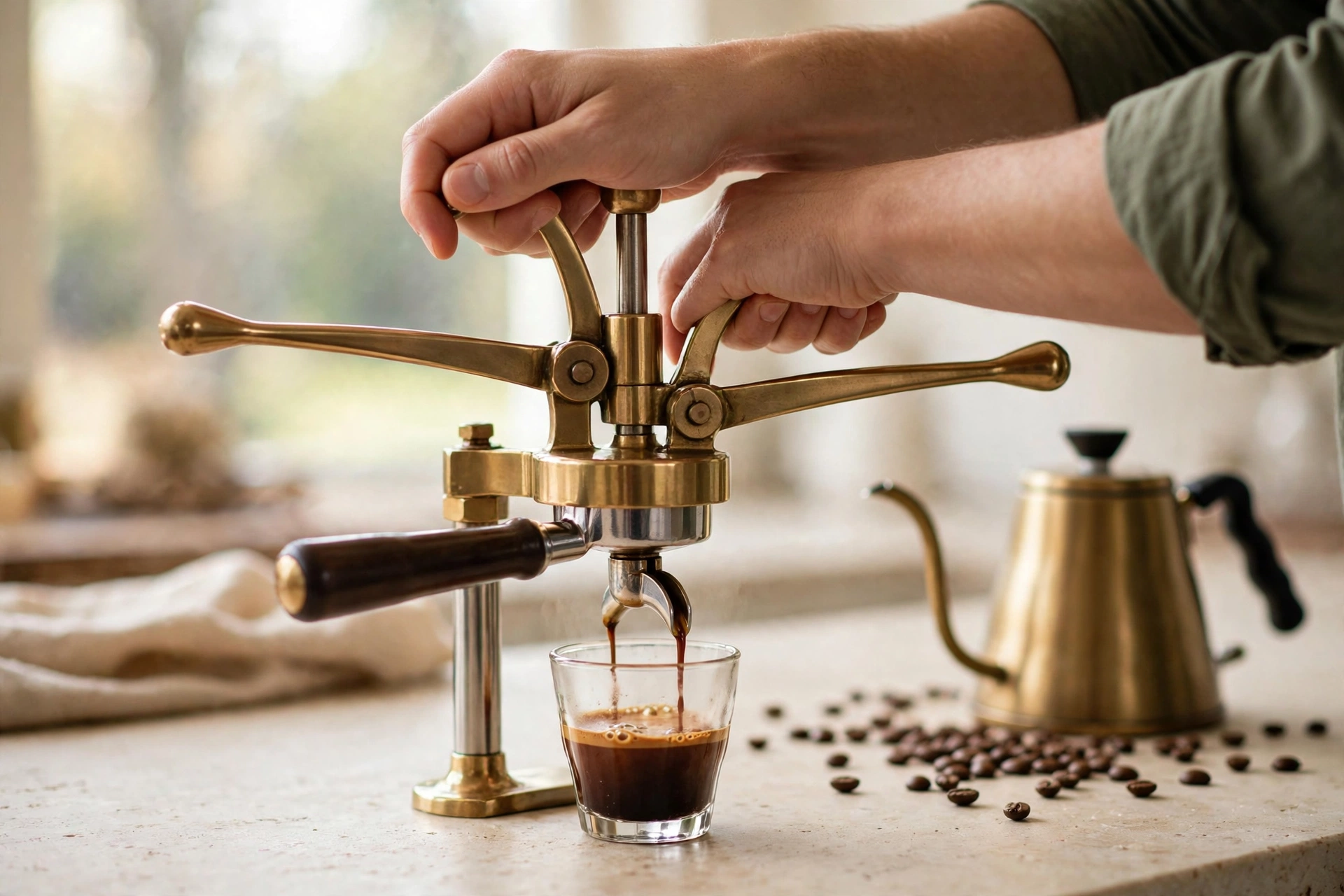
The short answer: the Flair PRO 2 is the best manual espresso machine for most people, the Cafelat Robot is the best-built boilerless lever, and the La Pavoni Europiccola is the best manual machine with steam. All six here can reach espresso pressure; what separates them is who controls the pressure curve, how temperature is managed without a pump boiler, and how much ritual you want. Prices and specs checked 2026-10-03. Prices vary by retailer; where sources disagreed we used the manufacturer’s current price.
We are a research desk, not a test lab: we synthesize owner reports, forum threads, published measurements, reviews, and teardowns rather than claiming hands-on testing we have not done.
First principles: what “manual” actually changes
A pumped machine hides three jobs inside the box: a pump builds pressure, an over-pressure valve caps it, and a boiler or thermoblock holds temperature. A manual machine deletes the pump and the valve and hands both jobs to you. Mechanically, that is an upgrade in control and a downgrade in convenience, for one reason:
You become the pressure profile. Extraction quality depends on the shape of pressure over time: a gentle pre-infusion wets the puck and reduces channeling, a peak around 6 to 9 bars does the main extraction, and a declining tail avoids bitter over-extraction. A cheap pump machine gives you one fixed curve set by its valve. A lever gives you any curve your hands can repeat — including a bad one. Manual espresso is therefore a skill purchase, not just a hardware purchase.
Temperature leaves the machine. With no brew boiler (the La Pavoni is the exception here), water temperature is whatever your kettle delivers minus whatever the metal absorbs. An unpreheated brew head can strip several degrees before water touches coffee, so every boilerless machine below is a temperature-management exercise: preheat the head, pour water just off the boil, and accept a declining profile through the shot. That decline is not automatically a flaw — traditional lever machines have always extracted this way.
Force is a design problem, not a fitness test. The push you feel is pressure multiplied by piston area, spread over lever length. Twin-arm geometry (ROK, Robot) and long levers (Flair 58 Plus 2) trade effort for control. Judge machines by whether you can hold peak pressure steady for 25 to 35 seconds, not by whether you can spike it once.
The three architectures, and who each one suits
Direct lever, boilerless (Flair PRO 2, Cafelat Robot, ROK EspressoGC). Fill a small chamber with kettle water and drive a piston down with a lever. No electricity, almost nothing to descale or fail, full pressure profiling. The costs: one shot at a time, careful preheating, no steam. Per dollar, the highest shot-quality ceiling here.
Direct lever with electric preheat (Flair 58 Plus 2). The same hand-driven extraction, but a controller holds the brew head at one of three temperatures so kettle water arrives at the puck instead of heating cold metal. It fixes the boilerless weak point — repeatable temperature — while keeping manual pressure. It still does not heat brew water or steam milk.
Boiler lever (La Pavoni Europiccola). A pressurised boiler feeds the group and a steam wand, and raising the lever lets boiler pressure pre-infuse before you pull. You gain steam and back-to-back shots; you inherit warm-up time, an overheating group, and the steepest learning curve here. The only machine in this list that runs a full milk-drink workflow alone.
Hand pump, portable (Wacaco Picopresso). A hand-squeezed piston replaces the lever. You lose mechanical advantage and dose size, and gain a 350 gram machine that brews anywhere a kettle exists.
Comparison table
Prices and specs checked 2026-10-03. Prices vary by retailer; where sources disagreed we used the manufacturer’s current price.
| Machine | Typical price | Type | Portafilter and dose | Water and heat | Gauge | Steam | Best for |
|---|---|---|---|---|---|---|---|
| Flair PRO 2 | $325 | Direct lever, boilerless | PRO, 16-24g | 70ml, kettle water | Yes | None | Learning manual espresso |
| Cafelat Robot | $399 | Twin-arm lever, boilerless | 58mm, 16-25g | Kettle water into basket | Barista version only | None | Build and 58mm simplicity |
| Flair 58 Plus 2 | $699 | Lever, electric preheat | 58mm, 16-20g | 90ml, 3-setting head heat | Yes | None | Thermal repeatability |
| La Pavoni Europiccola Lusso | $899 | Boiler lever | 51mm | 0.8L boiler, 1000W | Boiler only | Yes | Lever craft plus milk |
| ROK EspressoGC Classic PLUS | $259 | Twin-arm lever, boilerless | 49-50mm class | Kettle water | No | Frother included | Lowest-cost lever ritual |
| Wacaco Picopresso | $129.90 | Hand pump | 52mm, 18g | 80ml, kettle water | No | None | Travel espresso |
The six machines, in depth
1. Flair PRO 2 — best for most people
The PRO 2 is the reference point for affordable manual espresso because it removes the two beginner unknowns — pressure and dose flexibility — without adding a boiler. The stainless steel PRO brew head holds about 70ml of water, the bottomless portafilter accepts about 16 to 24 grams, and the included pressure gauge reads the extraction zone directly, so you learn what 6 to 9 bars feels like instead of guessing. The workflow is kettle, preheat, pull: warm the brew head, add water just off the boil, pre-infuse gently, then ramp and hold. There is no steam and no second shot without repeating the ritual, and the PRO portafilter is its own accessory ecosystem rather than the 58mm standard. Flair lists the PRO 2 at $325, matched by US retailers when we checked. For most readers, this is the manual machine to buy first.
2. Cafelat Robot — best build, simplest mechanism
The Robot reduces manual espresso to its minimum moving parts: a die-cast aluminium body, two arms, a stainless steel piston, and a 58mm basket that holds about 16 to 25 grams and yields about 50ml. Water goes directly into the basket over the puck, so there is less metal to preheat than a chamber design, and the water path contacts only stainless steel, silicone seals, and the coffee. Cafelat’s own guidance is to target about 6 to 7 bars rather than chasing 9 — traditional lever territory. There are no electronics and nothing to descale; maintenance is a piston seal and food-safe grease. The Standard model has no gauge; the Barista version adds one and costs more. Prima Coffee lists the Standard Robot at $399 in the US. If you value 58mm baskets and the fewest failure points over gauge feedback, the Robot outlasts everything else here.
3. Flair 58 Plus 2 — best for thermal control and 58mm workflow
The 58 Plus 2 is Flair’s flagship answer to the boilerless weakness: temperature drift. Its integrated preheat controller holds the brew head at three settings matched roughly to dark, medium, and light roasts, so the water you add stays at brewing temperature instead of warming cold steel. You still supply kettle water (90ml chamber, up to about 55ml yield) and drive extraction by hand with full pressure profiling on the included gauge — only the thermal guesswork is removed. The package follows the commercial standard: a walnut-handled 58mm portafilter with high-flow, low-flow, and pressurised baskets, palm tamper, puck screen, shot mirror, and a five-year limited warranty. It needs wall power for preheating (it can still brew unplugged) and does not steam. Flair lists it at $699. Buy it if you drink light roasts and want manual shots to share tools with the wider 58mm world.
4. La Pavoni Europiccola Lusso — best with steam, steepest curve
The Europiccola has been in production, in evolved form, since 1961 for a reason: it is a complete espresso bar in one casting. The 0.8 litre brass boiler (1000W, ready in about 5 minutes) feeds the lever group and a steam wand, so unlike every boilerless machine here it textures milk and pulls consecutive shots — about eight espressos per fill. Raising the lever admits boiler-pressure water for a natural pre-infusion; your pull then adds extraction pressure. Traditional also means unforgiving. There is no brew-pressure gauge and no PID: group temperature climbs with use, and shot quality depends entirely on your grind, distribution, and pull discipline. The portafilter is 51mm on current models; replace the included plastic tamper immediately. US pricing starts at about $899 and rises with finish (European list is 749 EUR). Buy it if milk drinks and the classic lever ritual are the point, and accept weeks of learning as part of the price.
5. ROK EspressoGC Classic PLUS — best low-cost lever ritual
The ROK replaces the single lever with two polished arms you squeeze down together, driving a glass-composite pressure chamber that needs less force than the original metal design. It uses no electricity, carries a 10-year warranty on metal parts, and the Classic PLUS bundle adds the Smartshot pressurised basket alongside the standard basket, plus a dosing funnel and manual milk frother — so beginners can produce crema-topped shots before their grinder technique catches up, then graduate to the standard basket. Trade-offs are feedback and milk: there is no pressure gauge on this trim, so you judge the pull by time and resistance, and the frother makes foamed milk rather than true steamed microfoam. Preheat the chamber with hot water first; cold starts taste sour. ROK’s US store lists the Classic PLUS at $259 — the cheapest lever ritual here, and the easiest to store.
6. Wacaco Picopresso — best portable
The Picopresso is a hand-pumped piston in a 350 gram body (about 106 by 78 by 71mm) built around a proper 52mm, 18 gram stainless steel basket and a naked portafilter — real puck prep, not a pressurised shortcut. You add 80ml of hot water, pump to build pressure (rated to 18 bars maximum; good extractions live at about 9 to 12 bars), and watch the shot fall. Wacaco is explicit that commercial preground coffee will not do: this machine demands fresh, finely ground coffee. In return you get genuine espresso at a desk, in a hotel, or at a campsite, with all tools nesting inside the body and a protective case included. Preheat everything and work fast; expect the best results with medium and darker roasts. Wacaco lists it at $129.90, matched at major retailers when we checked. As a primary home machine it is too small and fiddly; as the manual machine you actually take with you, nothing else here competes.
How to choose
- Learn manual espresso with feedback: Flair PRO 2. The gauge teaches your hands fastest at the price.
- Longest life, least maintenance: Cafelat Robot. Add the Barista gauge version only if you will still use the gauge after month one.
- Light roasts or repeatability: Flair 58 Plus 2. Electric head preheating changes shot-to-shot consistency, not just workflow.
- Lattes from the machine itself: La Pavoni Europiccola, plus a proper 51mm tamper. Hardest machine here, most rewarding once dialled.
- Tight budget or no spare outlet: ROK EspressoGC Classic PLUS. The Smartshot basket covers month one; the standard basket waits for your grinder skills.
- Travel without pod coffee: Wacaco Picopresso, plus a hand grinder. Real espresso anywhere hot water exists.
What to budget beyond the sticker
No machine in this list includes a grinder, and here the grinder matters more, not less: there is no pump curve quietly correcting a poor grind (the ROK Smartshot and Flair 58 Plus 2 pressurised baskets are training wheels, not destinations). Budget $150 to $250 for an espresso-capable burr grinder, about $15 to $25 for a 0.1g scale, and a precise-pour kettle — since you are now the boiler.
Milk is the second hidden cost. Only the La Pavoni steams; everyone else needs a stovetop steamer, standalone electric steamer, or press-and-plunge frother (about $30 to $200). Add a real tamper for the La Pavoni (about $20 to $40) before its first shot.
Meet the three conditions — even grind, water at about 90 to 94°C at the puck, and a pressure curve you can repeat — and a $130 Picopresso makes espresso while a badly fed $700 setup does not. Choose the machine whose ritual fits your mornings, and put the grinder money where it belongs.