
The short answer: the Profitec Pro 700 is the best prosumer espresso machine overall, the Profitec Pro 300 is the best dual-boiler value, and the Lelit Mara X is the cheapest honest way into the band. Prosumer is not a price tag — it is a mechanical definition. Every machine here has parallel thermal circuits (two boilers, or one boiler feeding a heat exchanger), PID temperature control, a 58mm commercial-pattern portafilter, and construction built from standard parts a technician can service. What changes across the $1,700 to $3,000 band is not the extraction physics — water at about 90 to 94°C through a fine puck at about 9 bars — but how much control, steam, and silence you get while doing it. Prices and specs checked 2026-10-26. Prices vary by retailer; where sources disagreed we used the manufacturer’s current price.
Disclosure: we are an independent research desk and earn no commission on anything here. Vendor links on this page are plain links to manufacturer and retailer pages — no affiliate tracking. See our disclosure policy for how we stay independent.
We are a research desk, not a test lab: we synthesize owner reports, forum threads, published measurements, reviews, and teardowns rather than claiming hands-on testing we have not done.
First principles: what “prosumer” actually means
The word gets abused — retailers stick it on anything over $1,000 — so here is the mechanical test. A prosumer machine passes four checks:
- Parallel thermal circuits. A dual boiler, or a heat exchanger. You brew and steam at the same time; the single-boiler queue is gone. This is the defining capability, and it is why our dual-boiler roundup and heat-exchanger roundup are the two halves of this one.
- PID temperature control. Brew temperature set in degrees on a controller, not surfed by timing a thermostat’s heating cycle. See our guide on whether PID is worth it for why this matters more than any other single feature.
- A 58mm commercial-pattern portafilter. The widest accessory ecosystem in home espresso: baskets, tampers, distribution tools, and bottomless portafilters all built to this standard.
- Serviceable, standard-part construction. E61 groups, standard gaskets, boilers a technician can open — machines built to be repaired for decades, not replaced in five years.
What prosumer does not mean: a built-in grinder, a touchscreen, or one-touch milk. Those are appliance features, and this band deliberately leaves them behind. Every machine here assumes you own, or will buy, a separate espresso-capable grinder — and that is a feature, not an omission, because the grinder decides more of the cup than the machine does.
The band, in three steps
The $1,700 to $3,000 range is not a slope; it is three distinct steps, and knowing which step you are on prevents the most common prosumer mistake — paying for the top step when the entry step already does the job.
Entry, $1,700 to $1,800: the capability arrives. The Mara X and the Pro 300 both deliver simultaneous brew and steam with PID control. The Mara X is a heat exchanger with a controller smart enough to mostly eliminate the cooling-flush dance; the Pro 300 is a true dual boiler in a 10-inch chassis. At this step you get everything that matters for the cup. What you do not get is E61 mass, rotary-pump silence, or large steam capacity.
Middle, $2,050 to $2,400: the workflow arrives. The Appartamento TCA, Silvia Pro X, and Pro 600 add the E61 group ritual, stronger steam, and more refined control — a variable pressurestat on the TCA, programmable pre-infusion on the Silvia Pro X, a full E61 dual boiler on the Pro 600. The cup does not improve; the morning does. This is the step for buyers who make milk drinks daily and want the machine to feel like a cafe tool rather than an appliance.
Top, $2,979: the machine disappears. The Pro 700 adds a rotary pump (near-silent, plumb-in capable), a 2-litre steam boiler, and the largest thermal mass in the band. Nothing here extracts better than the Pro 300 — but nothing here asks less of you while doing it, either. Above this step sit machines like the ECM Synchronika II ($3,599) and the La Marzocco Linea Mini, which are the same two jobs in fancier clothing with flow profiling added. This band ends where diminishing returns begin.
Comparison table
Prices and specs checked 2026-10-26. Prices vary by retailer; where sources disagreed we used the manufacturer’s current price.
| Machine | Typical price | Architecture | Heating / Control | Pump | Best for |
|---|---|---|---|---|---|
| Lelit Mara X | $1,699.95 | Heat exchanger, E61 group | Dual-sensor controller, 3 temp presets | Vibration | Cheapest entry, smartest HX |
| Profitec Pro 300 | $1,799 | Dual boiler | PID, shot timer | Vibration | Best dual-boiler value |
| Rocket Appartamento TCA | $2,050 | Heat exchanger, E61 group | Variable pressurestat, 4 temp presets | Vibration | Classic E61 HX ritual |
| Rancilio Silvia Pro X | $2,195 | Dual boiler | Dual PID, programmable pre-infusion | Vibration | Most compact dual boiler |
| Profitec Pro 600 | $2,399 | Dual boiler, E61 group | Dual PID, Quick Steam | Vibration | E61 dual boiler under $2,500 |
| Profitec Pro 700 | $2,979 | Dual boiler, E61 group | Dual PID, shot timer | Rotary | Best overall prosumer machine |
The six machines, in depth
1. Lelit Mara X — cheapest entry, smartest heat exchanger
The Mara X is the heat exchanger that refuses to act like one. Conventional HX machines hold steam pressure constant and make you manage brew temperature with cooling flushes; the Mara X flips the priority with a second temperature sensor at the group, holding brew temperature steady and letting steam pressure vary instead. Three temperature presets (197, 201, or 205°F) are set on a physical toggle behind the drip tray, and a side switch selects Xmode Coffee for the most consistent shots or Xmode Steam for more frothing power after brewing. The E61 group, dual pump-and-steam gauges, long-ramp pre-infusion, a quiet pump, and a precision tamper in the box complete a package that feels considered rather than assembled.
Seattle Coffee Gear listed $1,699.95 when we checked, in stock, in three colors. Against the Pro 300 you trade independent steam control for stronger steam and the E61 group workflow; against the Appartamento TCA you trade the classic HX ritual for a machine that mostly eliminates the cooling-flush dance. Buy the Mara X when you want the cheapest honest entry into prosumer espresso and heat-exchanger steam without heat-exchanger temperature management. For the full HX picture, see our heat-exchanger roundup.
2. Profitec Pro 300 — best dual-boiler value
The Pro 300 is the least expensive way to get two independent boilers with PID control in a chassis only 10 inches wide. A Gicar PID holds brew and steam temperatures independently, a shot timer is built into the display, and the interior is engineered like machines costing twice as much — copper and braided stainless lines, vented steam routed away from the electronics, a vibration-isolated pump. Heat-up is 10 to 15 minutes, quick for a dual boiler. The 58mm group, three-way solenoid, and mirror-polished stainless exterior are proper prosumer hardware, made in Milan alongside the Profitec Go.
Whole Latte Love listed $1,799 when we checked. Against the Mara X you trade E61 mass and stronger steam for independent thermal control and a smaller footprint; against the Silvia Pro X you trade programmable pre-infusion for a lower price and a tighter chassis. The steam boiler is small, so back-to-back large milk drinks ask for patience, but for one or two drinks at a time it is the value peak of this roundup. Buy the Pro 300 when you want dual-boiler workflow with the least money and the least counter space.
3. Rocket Appartamento TCA — classic E61 heat exchanger
The Appartamento is the machine that made the E61 group a kitchen fixture, and the TCA update fixes its one real weakness: temperature control. TCA stands for Temperature Control Adjustment — a variable pressurestat controller with four preset temperature settings (about 196, 200, and 203°F, plus a higher setting), switched by lifting the brew lever while the machine is off and flipping the power switch. The streamlined housing, Rocket pennant, and angular E61 group keep the iconic look; the internals finally give you a way to match brew temperature to roast level without guessing flushes.
Whole Latte Love listed $2,050 when we checked for the TCA (the original Appartamento, without the controller, lists at $1,950). Against the Mara X you get the classic Rocket build and the E61 ritual in exchange for going back to pressurestat-managed temperature; against the Pro 600 you get the same group and a lower price in exchange for a single boiler. Buy the Appartamento TCA when you want the E61 experience in its most recognizable form, with just enough temperature control to stop guessing.
4. Rancilio Silvia Pro X — most compact dual boiler
The Silvia Pro X takes the cult-classic Silvia and adds everything the original lacked: a second boiler, dual PID controllers adjustable to the degree, a digital display that doubles as a shot timer, and programmable soft pre-infusion from 1 to 6 seconds. Inside the 10-inch-wide chassis sit a 1-litre steam boiler and a 300ml brew boiler, both PID-controlled, with a 4-hole steam wand that owners report steaming an 8-ounce drink in about 9 seconds. It is the only dual boiler here that fits a tight counter with room left for a knock box, a scale, and a grinder.
Seattle Coffee Gear and other retailers listed $2,195 when we checked. One honest caveat, reported by owners: the auto-on feature is a countdown timer, not a clock — you set it to turn on 30 minutes from now, not 30 minutes before your alarm. Against the Pro 300 you get programmable pre-infusion and stronger steam for $396 more; against the Pro 600 you trade E61 mass for a much smaller footprint. Buy the Silvia Pro X when counter space is the constraint and you still want a true dual boiler.
5. Profitec Pro 600 — E61 dual boiler under $2,500
The Pro 600 is the dual boiler for the buyer who wants the E61 group without paying rotary-pump money. Two stainless boilers under independent PID control — a 0.75-litre brew boiler and a 1-litre steam boiler — with the updated PID and safety valve delivering 2 bars of steam pressure, the same steam performance as the Pro 700. The E61 group, dual gauges, shot timer, and Quick Steam make it the most complete E61 dual boiler under $2,500, in a chassis designed for at-home maintenance.
Whole Latte Love and Clive Coffee both listed $2,399 when we checked. The honest trade is the vibration pump and reservoir-only water supply: no plumbing in, and the pump is audible in a way the Pro 700’s rotary pump is not. Against the Silvia Pro X you get the E61 group and a larger steam boiler for $204 more; against the Pro 700 you get nearly the same machine for $580 less, minus rotary silence and plumb-in capability. Buy the Pro 600 when you want the E61 dual-boiler experience and the rotary pump is a luxury you can live without.
6. Profitec Pro 700 — best overall prosumer machine
The Pro 700 is the machine the rest of this roundup is measured against. A dual boiler with independent PID control — a 0.75-litre brew boiler and a 2-litre steam boiler — an E61 group, a rotary pump, a 2.8-litre reservoir with plumb-in capability, dual gauges, a shot timer, and no-burn steam wands. The rotary pump runs near-silent, the steam boiler is the largest here by a wide margin, and the build is designed for at-home maintenance with the same serviceable construction as the ECM Synchronika it shares a factory with.
Whole Latte Love listed $2,979 when we checked, and CoffeeUnits confirmed the same price in stock. The honest trade is heat-up time: over 30 minutes from cold, so a smart-plug timer is effectively part of the purchase. Against the Pro 600 you pay $580 for rotary silence, plumb-in, and double the steam capacity; against the Synchronika II ($3,599) you get the same architecture for $620 less, minus flow control. Buy the Pro 700 when you want the full commercial-pattern machine — dual boilers, E61 group, rotary pump, plumb-in — and you are done upgrading for a decade.
How to choose among the six
- You want the cheapest honest entry into prosumer espresso: Lelit Mara X. $1,699.95, the smartest heat exchanger, and the only machine here that ships a genuinely good tamper.
- You want dual boilers for the least money and counter space: Profitec Pro 300. Compact, PID-controlled, properly built — the value peak of the band.
- You want the classic E61 heat exchanger in its most recognizable form: Rocket Appartamento TCA. $2,050, four temperature presets, the Rocket look.
- You want a true dual boiler on a tight counter: Rancilio Silvia Pro X. 10 inches wide, dual PID, programmable pre-infusion, $2,195.
- You want the E61 dual boiler without rotary-pump money: Profitec Pro 600. $2,399, 2 bars of steam, the most complete E61 dual boiler under $2,500.
- You want the best prosumer machine, full stop: Profitec Pro 700. $2,979, rotary pump, 2-litre steam boiler, plumb-in — the machine the rest of the band is measured against.
What to budget beyond the sticker
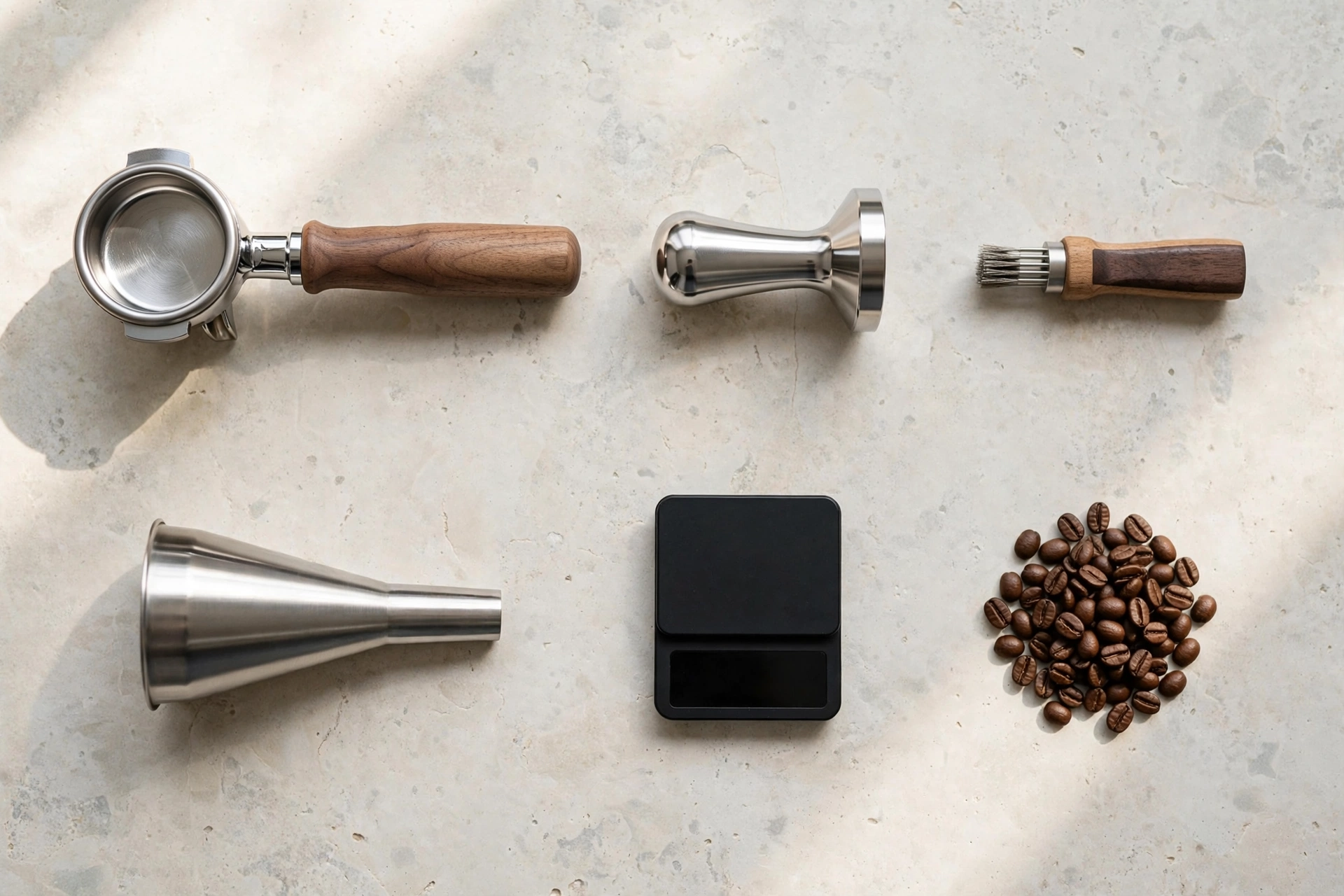
All six need an espresso-capable burr grinder — $300 to $500 for something worthy of the machine at this level (see our grinder budget guide and our grinders under $500). Add a proper 58mm tamper ($20 to $40; the included tampers are placeholders, except the Mara X’s), a 0.1g scale ($15 to $25), and filtered water. The Pro 700’s 30-minute heat-up also argues for a $15 smart plug on a timer.
A Mara X plus a $400 grinder lands at about $2,150 all-in; a Pro 700 with the same support kit lands at about $3,450. That is the honest math to do before buying: the machine is two-thirds of the setup, and the grinder decides more of the cup than the choice between these six. If you are still deciding how much grinder the machine deserves, our machine-and-grinder combos roundup pairs machines and grinders at matched budgets.
What sits above this band
The prosumer band ends at $2,979 for a reason: above it, the money buys flow profiling and brand, not extraction. The ECM Synchronika II ($3,599) adds flow control and a larger steam boiler to the Pro 700’s architecture; the La Marzocco Linea Mini adds the cafe badge and saturated-group stability at a similar price. Both are superb machines. Neither makes better espresso than the Pro 700 in a home kitchen — they make the same espresso with more control over the shot’s shape. Until the household needs flow profiling, plumbed-in workflow is already covered by the Pro 700, and the choice in this band is architecture, not extraction: dual boilers for independent control, heat exchangers for steam power and the E61 ritual, and the rotary pump for silence.