The short answer: the Breville Bambino Plus is the best espresso machine for beginners, the Breville Barista Express Impress is the best all-in-one, and the De’Longhi Stilosa is the best cheap way in. A beginner machine is not the one with the most features — it is the one that removes the most ways to fail while still teaching you how espresso works. Prices and specs checked 2026-10-03. Prices vary by retailer; where sources disagreed we used the manufacturer’s current price.
We are a research desk, not a test lab: we synthesize owner reports, forum threads, published measurements, reviews, and teardowns rather than claiming hands-on testing we have not done.
First principles: why beginners fail, and what fixes each failure
Espresso fails in four predictable places. A good beginner machine automates or forgives at least two of them:
- Grind and dose. Too coarse and water rushes through sour and weak; too fine and it chokes or turns bitter. The window is narrow — about 25 to 35 seconds for a 1:2 ratio — and only a burr grinder that grinds fine and evenly can hold it. Pressurised (dual-wall) baskets hide grind errors by creating back-pressure themselves; single-wall baskets expose them and reward fixing them.
- Tamping and distribution. An uneven puck channels: water finds the weak spot and bypasses the rest. Consistent pressure and a level bed matter more than heroic force. Assisted tamping and dosing guides exist precisely to delete this variable for beginners.
- Temperature and pressure. Water needs to arrive at about 90 to 94°C and about 9 bars at the puck, the same on shot three as on shot one. PID feedback control holds temperature steady instead of cycling around it. The 15-bar figure on boxes is the pump maximum; an over-pressure valve does the real work of capping brew pressure.
- Milk. Texturing milk to glossy microfoam without scalding it is a separate motor skill that takes weeks. It is also the skill most beginners actually drink — lattes and flat whites forgive a mediocre shot but not burnt, bubbly milk. Automatic texturing is therefore worth more to a beginner than any pressure gauge.
Judge every machine below by which failures it deletes. Speed, portafilter size, and boiler type are secondary — they decide workflow and upgrade paths, not whether week-one shots are drinkable.
The two architectures, and which beginner each suits
Machine plus separate grinder (Bambino, Bambino Plus, Stilosa). Two boxes, two purchases, better parts. The grinder can be upgraded, repaired, or resold alone, and the machine stays small. The cost is decisions: you must choose a grinder, learn two devices, and spend the grinder money on top of the sticker price.
All-in-one with built-in grinder (Barista Express Impress, La Specialista Arte Evo). One box, one plug, guided workflow. Dosing and tamping assistance compress the learning curve to grind setting and milk. The cost is lock-in: when you outgrow the grinder, you replace the whole machine, and the footprint is larger.
Neither is better. If you want the fewest bad mornings, buy assistance. If you want the highest ceiling per dollar over five years, buy separates.
Comparison table
Prices and specs checked 2026-10-03. Prices vary by retailer; where sources disagreed we used the manufacturer’s current price.
| Machine | Typical price | Grinder | Heating | Portafilter | Milk | Tank | Best for |
|---|---|---|---|---|---|---|---|
| Breville Bambino Plus (BES500) | $499.95 | None — buy separately | ThermoJet thermocoil, PID | 54mm | Automatic, 3 temperatures / 3 textures | 64 oz (about 1.9L) | Most beginners; milk drinks without the learning curve |
| Breville Barista Express Impress (BES876) | $799.95 | Integrated conical burr, 25 settings | Thermocoil, PID at about 200°F | 54mm | Manual wand | 67 oz (about 2L) | Beginners who want one box and assisted tamping |
| De’Longhi La Specialista Arte Evo (EC9255M) | $699.95 | Integrated grinder, 15 settings | Thermoblock, Active Temperature Control | 51mm | Manual My LatteArt wand | 56 oz (about 1.7L) | Beginners who prefer De’Longhi guidance and cold brew |
| Breville Bambino (BES450) | $299.95 | None — buy separately | ThermoJet thermocoil, PID | 54mm | Manual 1-hole wand | 47 oz (about 1.4L) | Best value; learn milk properly from day one |
| De’Longhi Stilosa (EC260) | $149.95 | None — buy separately | Stainless steel boiler | 51mm | Manual cappuccino frother | 1L | Tightest budgets; leaves the most money for a grinder |
The five machines, in depth
1. Breville Bambino Plus (BES500) — best for most beginners
The Bambino Plus deletes failures 3 and 4. The ThermoJet heating system reaches extraction temperature in about 3 seconds, and digital PID control delivers water at a steady temperature instead of swinging above and below the target — no temperature surfing, no waiting, and shot two tastes like shot one. Low-pressure pre-infusion wets the puck gently before full pressure, which reduces channeling when your distribution is still imperfect.
Its defining feature is automatic milk texturing: choose one of three milk temperatures and three texture levels, park the jug on the temperature sensor, and the machine builds microfoam and stops at temperature. That single feature converts the steepest beginner skill into a button press. Manual texturing is still available when you want to learn.
The 54mm stainless portafilter takes an 18g dose, both pressurised and non-pressurised baskets are in the box so the machine grows with your grinder, the 64 oz tank is generous for its 7.7-inch width, and a solenoid valve leaves dry pucks that knock out cleanly. Compromises: no simultaneous brew-and-steam, less steam reserve than a boiler for back-to-back milk drinks, and a two-year warranty that reflects the more complex steam system. Breville lists it at $499.95; Seattle Coffee Gear listed $499.95 when we checked, with street prices at about $399.95 on sale. Add a grinder before judging the total.
2. Breville Barista Express Impress (BES876) — best all-in-one
The Impress deletes failures 1 and 2. Its integrated conical burr grinder offers 25 grind settings, and Intelligent Dosing calculates the dose from the last grind and auto-corrects the next one. The Impress Puck System then tamps with a consistent about 22 lb (about 10 kg) of pressure finished with a 7-degree barista twist, guided by dose-level feedback — the two most inconsistent beginner gestures, mechanised.
Underneath, it is proven Barista Express architecture: Thermocoil heating with PID control delivering water at about 200°F, low-pressure pre-infusion followed by about 9-bar extraction, a 54mm portafilter with single and dual-wall baskets, a manual steam wand for hand-textured microfoam, and a 67 oz tank. Milk stays manual, so you learn steaming from the start — easier here because grind, dose, and tamp are already stable.
The trade-offs are size (about 13 inches wide), a manual wand with no automatic rescue, and grinder lock-in. Breville and Seattle Coffee Gear list $799.95; Crate & Barrel listed $649.95 on sale when we checked. Against Bambino Plus plus a $200 grinder at about $700 total, the Impress buys you tamping assistance and one-box simplicity for about the same money.
3. De’Longhi La Specialista Arte Evo (EC9255M) — the guided De’Longhi
De’Longhi’s answer to the Impress keeps more of the ritual manual while guiding each step. The integrated grinder provides 15 settings on the US model, a dosing and tamping guide sits on the portafilter to contain mess and level the dose, and the included barista kit adds a tamping mat and metal tamper. Active Temperature Control holds brew water stable, with three temperature profiles (about 92, 94, and 96°C) to adapt to bean roast level — a genuinely useful beginner teaching tool, since darker roasts usually prefer the cooler end.
The My LatteArt steam wand is manual and cool-touch, the thermoblock heats quickly, the tank holds about 1.7L, and this Evo model adds Cold Extraction Technology for cold brew alongside espresso and Americano presets. Baskets are 51mm single-wall, so a capable grind matters from day one; the guidance kit is what makes that reasonable for a first machine.
De’Longhi US lists $699.95, at $499.95 when we checked — the cheapest entry into assisted, built-in-grinder espresso if that sale holds. It is larger than the Bambinos and its grinder has fewer settings than Breville’s, but for a beginner who wants to learn tamping with training wheels rather than have it done for them, the Arte Evo is the middle path.
4. Breville Bambino (BES450) — best value, full manual milk
The Bambino is the Bambino Plus with automatic milk removed and about $200 taken off the price: same ThermoJet heat-up in about 3 seconds, same PID temperature control, same low-pressure pre-infusion, same 54mm portafilter with both basket types, same solenoid valve. What changes is a manual single-hole steam wand, a smaller 47 oz tank, and a one-year warranty instead of two.
For a beginner who drinks mostly espresso or Americanos, or who actively wants to learn milk texturing rather than automate it, nothing important is missing. The manual wand is slower to learn but teaches the real skill, and the money saved buys most of a proper grinder. Breville lists $299.95, and Seattle Coffee Gear listed $299.95 when we checked. Bambino plus a $200 grinder is a better $500 setup than any $500 all-in-one fed by its bundled grinder’s compromises — and the grinder survives your next machine.
5. De’Longhi Stilosa (EC260) — the honest $150 start
The Stilosa deletes failure 1 by cheating fairly: its pressurised 51mm baskets create back-pressure artificially, so pre-ground coffee or a coarse home grind still produces a drinkable, crema-topped shot. The stainless steel boiler is durable at the price, the 15-bar pump is standard, ESE pod compatibility offers a no-grind fallback, and the manual cappuccino frother textures milk adequately for cappuccinos and lattes.
What $149.95 does not buy: PID control, a solenoid valve (expect soupy pucks), or a usable tamper — replace the plastic scoop-tamper immediately for about $20. Temperature is thermostat-managed, so shots vary more than the Brevilles, and there is no path to simultaneous steam. None of that disqualifies it. Stilosa plus a $150 to $250 grinder and non-pressurised technique learned later out-pulls a $400 machine starved by a blade grinder, and if espresso turns out not to be your hobby, the total loss is the smallest here. US pricing is $149.95 at major retailers when we checked.
How to choose
- You drink milk drinks daily and want them right immediately: Bambino Plus. Automatic texturing is the feature a beginner uses twice a day, every day.
- You want one box, one plug, and the least to learn: Barista Express Impress if budget allows; La Specialista Arte Evo if you prefer De’Longhi or catch it at its $499.95 street price. Both mechanise dose and tamp.
- You want to learn espresso as a skill and keep costs down: Bambino, and put the savings into the grinder. You will learn milk the slow way and be better for it.
- You are testing whether home espresso is for you: Stilosa. Cheapest honest answer, pressurised baskets forgive your first month, and it pairs fine with a grinder upgrade later.
- Your counter is very small: Bambino or Bambino Plus at under 8 inches wide. The all-in-ones need roughly double the width.
What to budget beyond the sticker
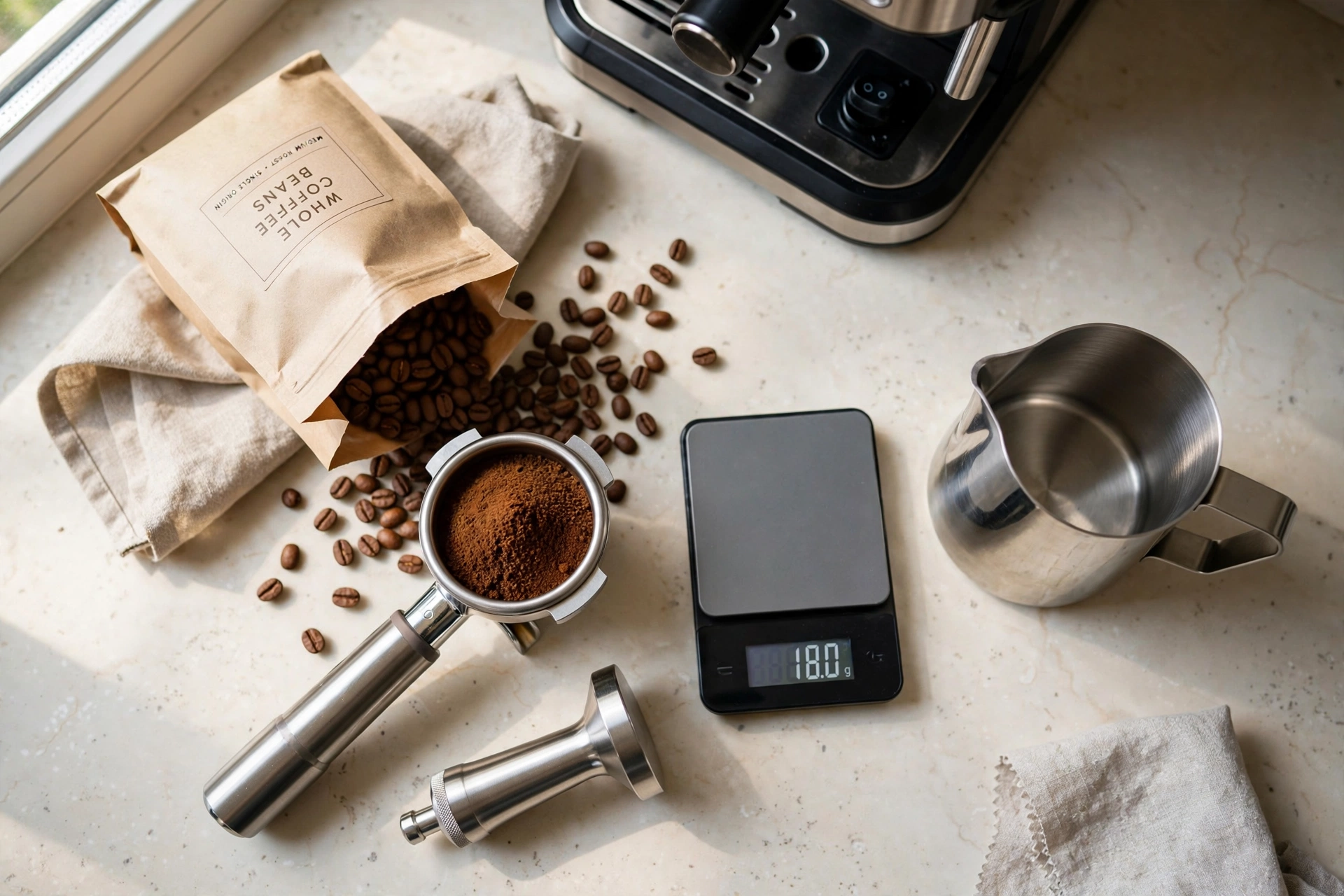
Only the two all-in-one machines can make espresso alone. The Bambino, Bambino Plus, and Stilosa each need an espresso-capable grinder ($150 to $250) to use their non-pressurised baskets — pressurised baskets and pre-ground coffee are a starting ramp, not the destination. Every setup needs a 0.1g scale (about $15 to $25) because dose by scoop varies too much to dial in, fresh beans (budget weekly, not monthly), and for the Stilosa a real tamper (about $20).
Meet the four conditions — even grind, level tamp, water at about 90 to 94°C, and about 9 bars at the puck — and any of these five makes real espresso. The beginner question is not which machine is best in absolute terms, but which failures you want the machine to absorb while you learn the rest.