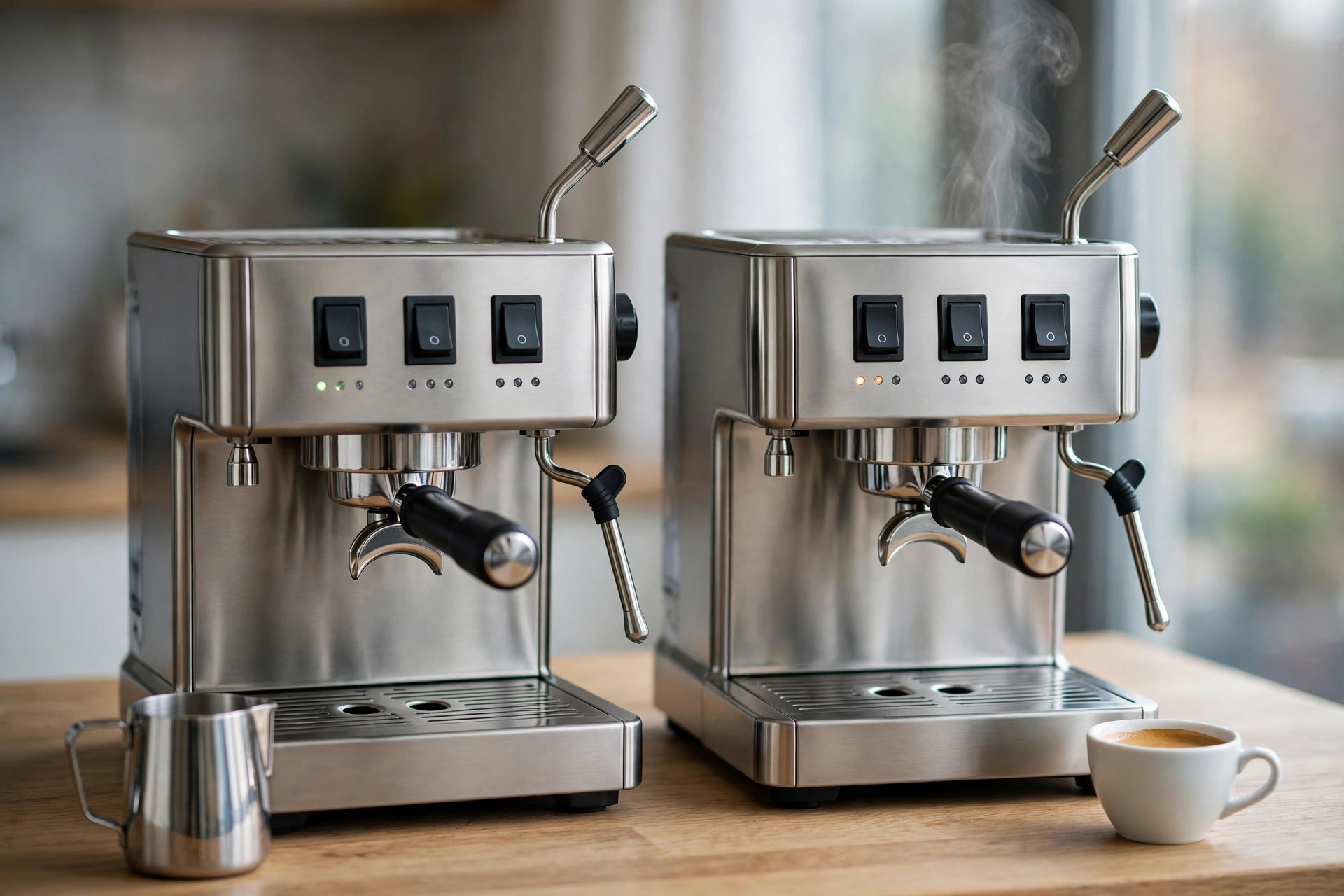
The short answer: the Gaggia Classic Pro and Rancilio Silvia pull from the same playbook; the Silvia costs twice as much because it carries twice the boiler and 10 more pounds of steel. Same 9-bar extraction, same 58mm portafilter, same rocker switches, no PID on either. What the extra ≈$500 buys is boiler mass and steam headroom: the Silvia’s 300 ml brass boiler steams milk drinks in sequence with far less fuss, and the heavier chassis is the kind of build people keep for decades. The Gaggia heats faster, carries a 2-year warranty, and is the deeper platform for DIY modification. Prices and specs checked 2026-10-18. Prices vary by retailer; where sources disagreed we used the current retail price from the pages linked below.
Disclosure: we are an independent research desk and earn no commission on anything here. Vendor links on this page are plain links to manufacturer and retailer pages — no affiliate tracking. See our disclosure policy for how we stay independent.
We are a research desk, not a test lab: we synthesize owner reports, forum threads, published measurements, reviews, and teardowns rather than claiming hands-on testing we have not done.
A note on Gaggia revisions. “Gaggia Classic Pro” now refers to a line, not a single machine. The 2019 version (RI9380/46) used a small aluminum boiler; an Evo Pro revision followed; and the current E24 uses a brass boiler. Old comparisons written against the aluminum boiler understate today’s machine. Every spec below describes the E24, which is what retailers sell new as of October 2026 — the current E24 listing at Whole Latte Love shows the brass-boiler revision at $499 against a $549 list. If you are shopping used, most of the market is the older aluminum version, and the comparison shifts toward the Silvia.
First principles: what the $500 gap is actually buying
In a single-boiler semi-automatic, the espresso side is governed by three things: pressure, temperature stability, and steam capacity. Both machines extract at 9 bars through a 58mm group with a 3-way solenoid — that part is now a tie. Temperature stability comes from boiler material and mass, and steam capacity from boiler volume and element power. That is where the money goes.
The mechanism. A thermostat-controlled boiler swings between “too hot” and “too cold” as the heater cycles — the famous deadband. A heavier brass boiler swings less and recovers faster, because the mass of metal acts as a heat reservoir. The Silvia’s 300 ml insulated brass boiler is roughly three times the thermal mass of the Gaggia’s, so it holds brew temperature steadier and, crucially, keeps producing steam while you texture milk. The Gaggia’s smaller brass boiler (a big upgrade over the old aluminum one, but still small) heats faster and costs less — physics charges a premium for mass.
So the comparison reduces to one question: is the extra mass worth double the price? The answer is in your routine, not in the spec sheet.
Comparison table
Prices and specs checked 2026-10-18 from Whole Latte Love (Gaggia E24) and Seattle Coffee Gear / Rancilio materials (Silvia); retailer prices vary.
| Spec | Gaggia Classic Pro (E24) | Rancilio Silvia |
|---|---|---|
| List / current street price | $549 list, ≈$499 current | $995 |
| Boiler | Brass, single | 300 ml (10 oz) insulated brass, single |
| Heating element | 1350 W (boiler), 1425 W total | 1100 W |
| Extraction pressure | 9-bar OPV (stock) | 15-bar pump with OPV set near 9 bar |
| Portafilter / group | 58mm stainless steel portafilter, brass group | 58mm chrome-plated brass portafilter, brass group |
| Steam wand | Commercial, 2-hole tip | Commercial, single-hole tip, longer reach |
| 3-way solenoid valve | Yes | Yes |
| Water tank | 72 oz (2.1 L), front/top access | 67.6 oz (2.0 L), top access |
| Controls | 3 rocker switches, LED lights | 3 rocker switches, LED lights |
| PID | No (stock) | No (stock) |
| Warm-up (owner-reported norms) | ≈5 min to brew-ready, ≈15–20 min fully soaked | ≈30–45 min for full thermal stability |
| Dimensions | 8″ W × 9.5″ D × 14.2″ H | 11.4″ W × 9.2″ D × 13.3″ H |
| Weight | 20 lb | 30.8 lb |
| Warranty | 2 years | 1 year |
| Colors | Stainless, black | Stainless, matte black, matte white |
| Grinder included | No (both) | No (both) |
Boiler and temperature: mass against speed
This is the section the whole decision turns on. Both machines use the simplest possible control scheme — a thermostat with a wide deadband and no PID. Nobody is buying precision electronics here; both reward the same ritual of temperature surfing, flushing the group until the ready light behaves the way you have learned it means “go.”
The difference is what happens around that ritual. The Silvia’s 300 ml insulated brass boiler holds enough hot water and metal that shot-to-shot temperature varies less, and it shrugs off the heat a back-to-back second shot steals. The Gaggia’s boiler is brass now (the E24 fixed the old aluminum version’s biggest weakness), but it is still the smaller reservoir — it reaches brew temperature in about 5 minutes while the Silvia is still warming, and owners report it fully ready in roughly a third of the Silvia’s warm-up time. If your mornings start with a button press and a shower, the Gaggia is already hot when you are.
For whether a PID is worth adding, both machines are the textbook case: huge aftermarket support, big deadband to fix. The difference is only in how much there is to fix.
Steam: where the Silvia’s boiler pays rent
Every single-boiler machine makes milk drinks in the same slow dance: pull the shot, flip to steam mode, wait for the boiler to climb to steaming temperature, purge the wand, texture, then bleed the boiler back down before the next shot. There is no escaping the choreography on either machine.
What differs is how forgiving it is. The Silvia’s larger boiler holds more steam, so a 6 oz latte gets textured before the pressure collapses; owners routinely steam two or three milk drinks back to back. The Gaggia’s wand is a genuine commercial-style 2-hole tip and makes real microfoam — but the smaller boiler runs out of steam sooner, and a second drink in a row becomes a wait. For one cappuccino a day this never matters. For a household making four lattes every morning, it is the entire comparison.
Build, size, and the long game
The Silvia weighs 30.8 lb to the Gaggia’s 20. That 10 lb is not decoration: it is a thicker steel chassis, the insulated brass boiler, and commercial-grade internals. It is also why the Silvia has its reputation as the machine you buy once — the parts ecosystem is enormous, every seal and switch is replaceable, and there are working Silvias from the early 2000s still pulling shots. The Gaggia is well built for its price (one-piece steel frame, brass group) and the E24’s steel portafilter and polished group cover age better than the old chrome, but it is the lighter machine in every sense.
The counter math runs the other way: the Gaggia is 8 inches wide against the Silvia’s 11.4, and shorter in depth, so it fits where the Silvia crowds. The 72 oz tank against 67.6 oz is a wash — both are weekly-fill machines at home volumes.
The warranty line favors the Gaggia plainly: 2 years against 1. On a $500 machine that is a meaningful share of the purchase price.
The mod culture
Both machines are legends in the modding world, and this matters because it is the real upgrade path either one offers. The Gaggia has the open-source Gaggiuino project — full PID, pressure profiling, and flow control on a $500 machine — plus simple OPV tweaks and shower-screen upgrades with parts stocked everywhere (Whole Latte Love alone lists dozens of Gaggia parts). The Silvia’s classic mod is an Auber PID kit that turns its deadband problem into precision, and its parts supply is equally deep. If you are the kind of person who will open a machine up, both reward you; the Gaggia’s scene is just bigger and more inventive. If you will never open one, ignore this section entirely.
Price and value
At current retail — ≈$499 for the Gaggia E24 (Whole Latte Love) against $995 for the Silvia (Seattle Coffee Gear) — the gap is almost exactly $500, or double. That has been the relationship for years: the Silvia costs what two Gaggias cost.
Framed as cost per upgrade: the $500 buys ≈3× the boiler mass, measurably better steam endurance, a heavier chassis with a longer documented lifespan, and a wider machine. It does not buy better-tasting espresso from a single morning shot — with a good grinder and the same beans, neither machine’s coffee is reliably distinguishable. It buys the milk-drink workflow and the build. Price the gap in lattes, not in shots.
The verdict
- Buy the Rancilio Silvia if milk drinks are a daily ritual for more than one person, you want the most steam headroom in the class, you are the buy-it-for-decades type, or counter space is generous. The extra $500 is real money for real mass.
- Buy the Gaggia Classic Pro (E24) if budget is the binding constraint, you want the fastest warm-up, your counter is small, the 2-year warranty matters, or you want the deepest mod platform for your money. It is the best espresso per dollar in this comparison, full stop.
- Buy neither alone without a grinder budget. Neither machine includes one, and grind quality is the ceiling on every shot either makes. The classic beginner mistake is buying the Silvia and pairing it with a cheap grinder — the Gaggia plus a good grinder will out-shoot the Silvia with a bad one.
Both machines are honest, repairable, fully manual single-boilers with no electronic training wheels. The Gaggia is the smart-money entry into real espresso; the Silvia is the machine you stop thinking about upgrading. Pick based on how many milk drinks you make and how long you intend to keep it, because that is the entire difference.