The short answer: the Breville Barista Express is the best espresso machine for latte art for most people — a manual 360° steam wand, PID temperature control, and a built-in grinder in one box for about $500 street. The Breville Bambino is the cheapest real path at about $250, the Gaggia Classic Pro has the best steam wand per dollar under $500, the Rancilio Silvia has the steamiest single boiler in its class, the De’Longhi La Specialista Arte is purpose-built around latte art, and the Lelit Mara X is the prosumer answer for people who will make milk drinks for years. Latte art is not a machine category — it is a capability, and every machine here earns its place by having a proper manual steam wand. Prices and specs checked 2026-10-14. Prices vary by retailer; where sources disagreed we used the specialty retailer’s or manufacturer’s current price.
Disclosure: we are an independent research desk and earn no commission on anything here. Vendor links on this page are plain links to manufacturer and retailer pages — no affiliate tracking. See our disclosure policy for how we stay independent.
We are a research desk, not a test lab: we synthesize owner reports, forum threads, published measurements, reviews, and teardowns rather than claiming hands-on testing we have not done.
First principles: what a machine must do for latte art
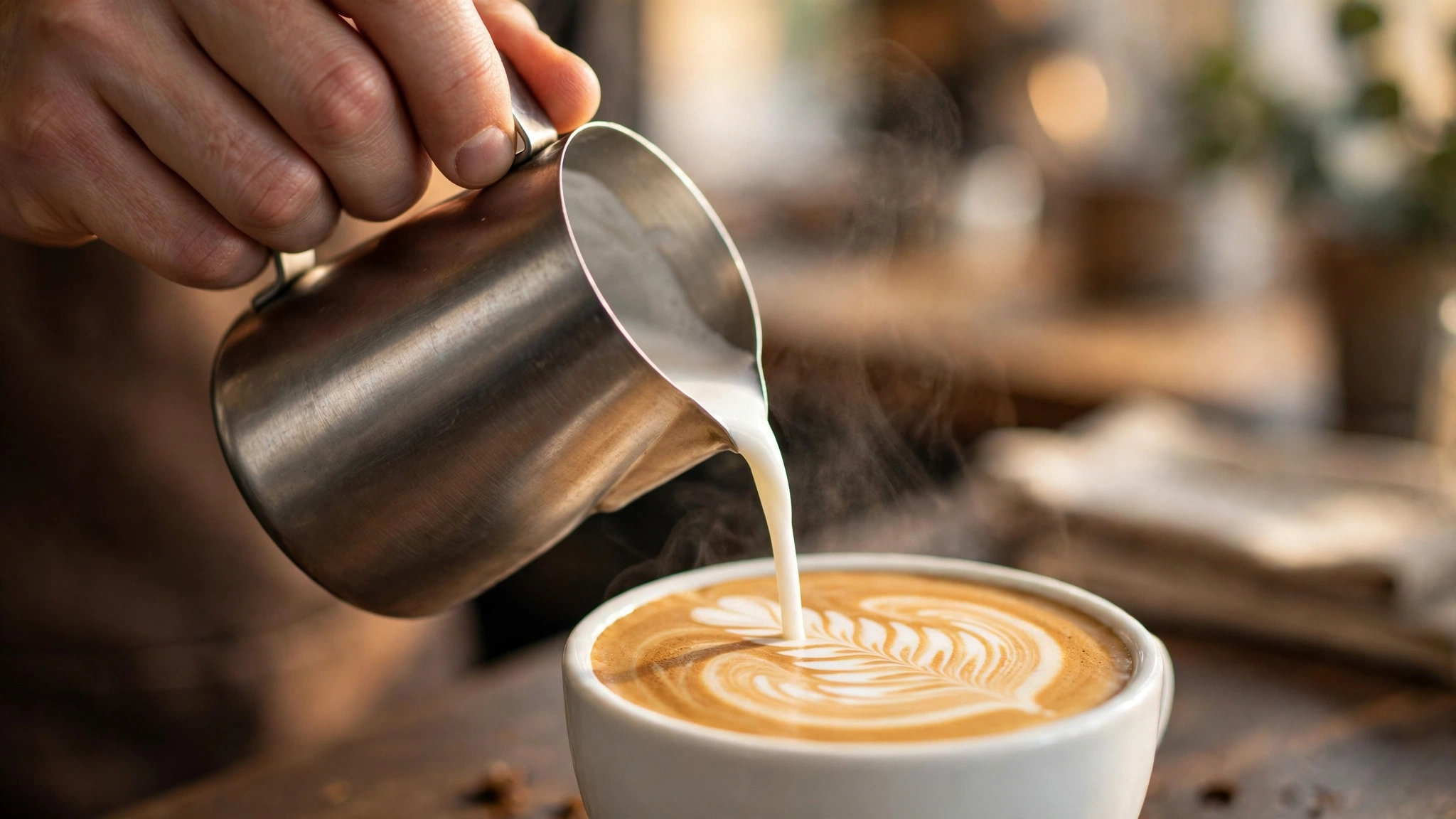
Latte art is not decoration on top of milk — it is a property of the milk itself. Pourable art needs microfoam: milk stretched and rolled into a glossy, paint-like emulsion whose bubbles are too small to see. That emulsion requires two phases, and the machine is responsible for the physics of both:
- Stretching. The wand tip sits just below the milk surface and injects air — briefly, seconds not tens of seconds. Too little air and the milk is flat and gray; too much and you have cappuccino foam, which does not pour. Control of this phase demands a manual steam wand: your hand decides exactly when stretching stops.
- Rolling. The tip sinks slightly and the steam jet creates a whirlpool that folds the injected air evenly through the milk, breaking large bubbles and polishing the surface. This demands dry, powerful steam: a strong jet makes a fast vortex. Weak, wet steam never rolls the milk properly, and the art never forms.
Notice what is not on the list: dual boilers, E61 group heads, rotary pumps, pressure gauges. All help espresso quality; none make the pour. What is on the list is a manual wand with a commercial-style tip (multiple holes, not a single panarello sleeve), enough steam pressure to sustain a vortex, and temperature stability so the espresso base holds its crema while you pour. Everything below is judged against those three things. Our boiler types guide explains the heating architectures behind them.
One hard exclusion follows from the mechanism: automatic steam wands do not count. The Bambino Plus, the Barista Touch’s auto mode, super-automatic carafes — they foam on a timer, with no say from you. Fine for lattes; useless for learning art. Every machine below has a manual wand.
Comparison table
Prices and specs checked 2026-10-14. Prices vary by retailer; where sources disagreed we used the specialty retailer’s or manufacturer’s current price.
| Machine | Typical price | Heating | Steam wand | Portafilter | Grinder | Best for |
|---|---|---|---|---|---|---|
| Breville Barista Express (BES870) | $699.95 list, about $500 street | 1600W thermocoil with PID | Manual 360° swivel | 54mm | Built-in conical burr (16 settings) | Most people; all-in-one practice rig |
| Breville Bambino (BES450) | $299.95 list, about $250 street | ThermoJet, 3-second heat-up | Manual 360° swivel, one-hole tip | 54mm | None — buy separately | Cheapest real path to art |
| Gaggia Classic Pro | $549 list, about $499 street | Single brass boiler (E24) | Commercial-style 2-hole tip | 58mm brass | None — buy separately | Best steam wand per dollar under $500 |
| Rancilio Silvia V6 | About $995 (tariff-inflated) | Single 0.3L brass boiler | Professional stainless, dual-walled | 58mm commercial | None — buy separately | The steamiest single boiler; built to last |
| De’Longhi La Specialista Arte (EC9155) | $699.99 list | 1400W thermoblock, 92/94/96°C profiles | Manual “My LatteArt” wand | 51mm | Built-in 8-setting conical burr | Purpose-built for latte art beginners |
| Lelit Mara X V3 | $1,699.95 list | Heat exchanger, 1.8L stainless boiler, dual-probe PID | No-burn commercial, fully articulated | 58mm E61 | None — buy separately | Prosumer: brew and steam simultaneously |
The six machines, in depth
1. Breville Barista Express (BES870) — best all-in-one for latte art
The Barista Express is the default recommendation for latte-art practice for a structural reason: it is the cheapest machine that combines all three requirements in one box. The 360° swivel steam wand is manual and marketed explicitly for hand-texturing microfoam. A 1600W thermocoil with PID holds brew temperature steady while you learn, and the built-in conical burr grinder (16 settings) produces real espresso grinds — no hidden second purchase. There is even a purge function that resets brew temperature after steaming, which tells you the machine was designed by people who thought about the milk-drink workflow.
The caveats are Breville-standard: 54mm portafilter instead of 58mm, thermocoil rather than boiler steam (fine for one or two drinks, not a party), and vibration-pump noise. None affect the pour. At about $500 street against a $699.95 list, it remains the machine where a beginner’s money goes furthest: machine, wand, grinder, PID, no compromises on the art side. We cover it in more detail in our under-$500 roundup.
2. Breville Bambino (BES450) — cheapest real path
This is the base Bambino with the manual wand — not the Plus, whose automatic wand disqualifies it from this list. The pitch is simple: ThermoJet heat-up in about 3 seconds, PID and pre-infusion for consistent shots, a 54mm portafilter, and a genuine manual 360° wand with a one-hole tip for roughly $250 street ($299.95 list). It steams well for a thermoblock, moves from brew to steam essentially instantly, and leaves most of your budget for the grinder you still need — which our grinder budget guide puts at $150 to $250.
The honest trade-offs: the one-hole tip is slower to roll milk than a multi-hole commercial tip, so steaming takes longer and the window for clean technique is narrower; there is no pressure gauge; and you still must buy a grinder, which erases the price gap to the Barista Express unless you already own one. Buy it when the grinder question is already solved and you want the cheapest machine that can genuinely teach you to pour. See our Bambino vs Bambino Plus comparison for the full manual-versus-auto breakdown.
3. Gaggia Classic Pro — best steam wand per dollar under $500
The Classic Pro earns this spot for one component: a commercial-style manual wand with a 2-hole tip that rolls milk better than anything else under $500. Two holes inject steam across a wider area of the pitcher, which is exactly what builds the whirlpool in the rolling phase. Behind the wand sits a 58mm chrome-plated brass group, a 3-way solenoid valve, and — in the current E24 revision — a lead-free solid brass boiler with dual heating elements that is steam-ready in about 30 seconds. About $499 street against a $549 list.
The costs are the Classic Pro’s known character: no PID, so temperature surfing is part of the ritual; single boiler, so you brew, wait, then steam; and the steam boiler is small, so large pitchers ask for patience. This is the machine for someone who wants 58mm accessories and real steam pressure at the lowest price, and who accepts the workflow as the price. If the pause between brewing and steaming bothers you, the Mara X below removes it — for three times the money.
4. Rancilio Silvia V6 — the steamiest single boiler
The Silvia is the machine cafe-trained home baristas graduate to, and the reputation rests on steam: a 0.3L brass steam boiler at full pressure delivers strong, dry steam through a professional dual-walled stainless wand, texturing milk faster than any thermoblock or small boiler in this price band. That steam power is the whole point — it makes the rolling phase forgiving. Construction is famously stout: brass boiler, brass group, 58mm commercial portafilter, and a decade-plus track record of being repaired rather than replaced.
Two things to be clear-eyed about. First, price: US retail has climbed to about $995 (tariff-inflated from the long-standing $865 street price), which is a lot for a single boiler with no PID. Second, like the Gaggia it has no PID and demands temperature surfing, and like the Gaggia it makes you wait between brewing and steaming. The Silvia is the buy when steam quality and longevity are the priorities and the workflow is already muscle memory. For machines that remove the workflow tax entirely, our dual boiler roundup starts at $1,600.
5. De’Longhi La Specialista Arte (EC9155) — purpose-built for beginners
De’Longhi’s Arte line is the rare machine designed around this exact query: the steam wand is literally branded “My LatteArt” and positioned for microfoam, the 1400W thermoblock runs Active Temperature Control with three selectable infusion temperatures (92, 94, 96°C) so you can tune the espresso base, and an 8-setting conical burr grinder is built in, so it is a complete bean-to-cup latte-art station out of the box. List price $699.99; street pricing moves around, so check current retail.
The caveats: the 51mm portafilter is the smallest in this roundup, limiting dose and the accessory ecosystem; thermoblock steam is adequate for one drink but has less reserve than the boiler machines; and De’Longhi’s service-parts ecosystem is thinner than Breville’s. Buy it when you want a machine whose entire design brief was “teach a beginner to pour,” with the grinder question answered from day one. The Evo revision (EC9255) adds cold brew; it changes nothing about the latte-art capability.
6. Lelit Mara X V3 — the prosumer answer
The Mara X is what you buy when the art is no longer the question and the workflow is. A 1.8L stainless heat-exchanger boiler steams and brews simultaneously — no pause, no temperature juggling — while Lelit’s patented dual-probe PID boiler management holds brew temperature where a classic HX would drift. The no-burn commercial steam wand is fully articulated, the 58mm E61 group takes the entire commercial accessory ecosystem, and a steam/brew priority switch optimizes the boiler for milk when the morning is all lattes. $1,699.95 list.
Nothing about this machine makes better latte art than the Bambino — the milk physics are identical once the steam is strong enough. What it buys is speed, repeatability, and the ability to make four milk drinks in a row without the workflow degrading. If you are pouring daily and hosting weekly, this is the honest endpoint; if you are still learning the pour, spend the difference on coffee and a good milk pitcher instead.
How to choose among the six
- You want the complete beginner rig, one purchase: Barista Express. Wand, PID, grinder, 54mm — nothing missing.
- Your budget is absolute and the grinder is handled: Bambino. Real manual steam for about $250.
- You want the best steam per dollar and 58mm: Gaggia Classic Pro. The 2-hole tip rolls milk the cheapest.
- You want the steamiest single boiler and a machine for a decade: Rancilio Silvia. Steam power and build, at about $995.
- You want the machine whose brief was literally latte art: La Specialista Arte. Built-in grinder, tuned profiles, My LatteArt wand.
- You make milk drinks daily and want zero workflow friction: Lelit Mara X. Brew and steam at once, HX reserve, PID management.
What to budget beyond the sticker
A proper milk pitcher is not optional for art — you need a small (12–20 oz for one drink) pitcher with a sharp, defined spout; round-lipped jugs make clean patterns nearly impossible. Our milk pitcher guide walks through the choice. The Bambino, Gaggia, Silvia, and Mara X all need a grinder ($150 to $400 for espresso-capable; the DF64 and Niche Zero in our grinder comparison are the deep end). Buy fresh whole milk — protein structure degrades with age, and old milk makes flat art regardless of equipment. And expect to spend a few weeks and several gallons of milk: the stretching phase is the skill, and no machine automates it. That is the entire reason the automatics are not on this list.