The short answer: the Bambino and Bambino Plus pull the same espresso; the Plus is the better milk machine. The same ThermoJet thermocoil, 15-bar Italian pump, low-pressure pre-infusion, and 54mm portafilter sit inside both boxes — nothing about the shot differs. What the extra money buys is an automatic 4-hole steam wand with adjustable milk temperature and texture, PID temperature control with three extraction temperatures, a 64 oz tank against ≈47 oz, a 3-way solenoid valve for dry pucks, and a second year of warranty. If milk drinks are the daily default, the Plus earns the premium. If you drink mostly espresso or americanos, buy the base Bambino and put the savings toward a grinder. Prices and specs checked 2026-10-11. Prices vary by retailer; where sources disagreed we used the manufacturer’s current price.
Disclosure: we are an independent research desk and earn no commission on anything here. Vendor links on this page are plain links to manufacturer and retailer pages — no affiliate tracking. See our disclosure policy for how we stay independent.
We are a research desk, not a test lab: we synthesize owner reports, forum threads, published measurements, reviews, and teardowns rather than claiming hands-on testing we have not done.
First principles: what the price gap is actually buying
An espresso machine does two jobs: extracting coffee and steaming milk. Extraction is decided by grind, dose, water temperature, and pressure — and on that side these two machines are the same machine. The steaming side is where they diverge, and milk is also where the skill gap is widest for beginners.
Extraction: identical. Both heat water on demand through the same ThermoJet thermocoil path, ready in 3 seconds, with low-pressure pre-infusion before the pump drives the shot at 9 bars through a 54mm portafilter. The dose, grind requirement, and yield behave the same. A grinder that dials in one dials in the other.
Milk: not even close. The base Bambino has a manual single-hole wand — you hold the pitcher, find the angle, and learn. The Plus has a 4-hole automatic wand with three milk temperature and three texture settings, hands-free, plus a manual mode for when you want control. The same difference, in skill terms, as cruise control versus a manual gearbox: the automation does not make better milk than an expert, it makes acceptable milk much sooner.
Control and convenience hardware. The Plus adds PID temperature control with three infusion temperatures, an automatic purge that resets brew temperature after steaming, a 3-way solenoid valve, a larger tank, a taller cup clearance, and a second warranty year. These are workflow upgrades, not quality upgrades.
Comparison table
Prices and specs checked 2026-10-11. Prices vary by retailer; where sources disagreed we used the manufacturer’s current price.
| Spec | Breville Bambino | Breville Bambino Plus |
|---|---|---|
| List price (Breville) | $299.95 | $499.95 |
| Street price when checked | $249.95 (Seattle Coffee Gear, Amazon) | $399.95 (Seattle Coffee Gear, Amazon) |
| Heating | ThermoJet thermocoil, 3-second heat-up | ThermoJet thermocoil, 3-second heat-up |
| Temperature control | No listed PID | Digital PID, 3 infusion temperature settings |
| Steam wand | Manual, 1-hole tip | Automatic + manual, 4-hole tip |
| Milk settings | None — manual only | 3 milk temperature + 3 texture levels, hands-free auto mode |
| Pump | 15-bar Italian | 15-bar Italian |
| Pre-infusion | Low-pressure pre-infusion | Low-pressure pre-infusion |
| Portafilter | 54mm stainless | 54mm stainless |
| Water tank | ≈47 oz (1.4L) | 64 oz (1.9L) |
| 3-way solenoid valve | No | Yes — dry pucks |
| Hot water | Dedicated button | Two-button combo |
| Automatic purge after steam | No | Yes |
| Cup clearance | 4 in | 5 in |
| Shot programming | 1 and 2 cup volumetric | 1 and 2 cup volumetric |
| Warranty | 1 year | 2 years |
| Grinder included | No (both) | No (both) |
| Footprint | One of the smallest of any quality machine | Slightly larger, still compact |
Steam: manual 1-hole against automatic 4-hole
This is the difference the premium exists for. A single-hole tip delivers one jet of steam; you swirl the pitcher to distribute it, which is how microfoam gets made and how beginners learn. Owners report the base Bambino makes genuine, pourable microfoam — just at a slower pace, and it punishes lazy technique with bubbly milk.
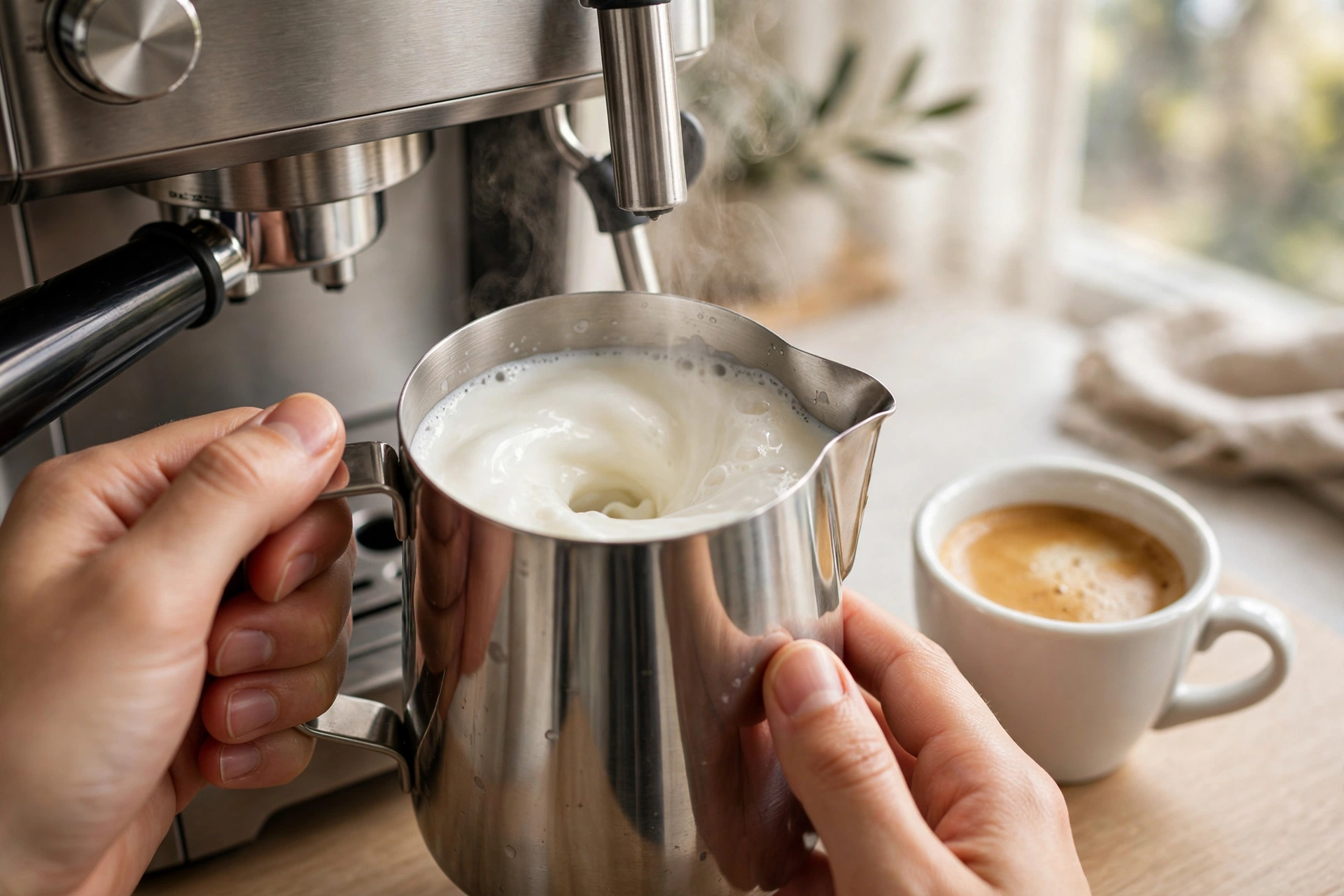
The Plus’s 4-hole tip delivers four jets for a wider, faster steam distribution, and the automatic mode textures hands-free: place the jug, press the button, and the machine stops at the temperature and texture you selected. Three temperature and three texture settings cover flat-white silky through cappuccino dry. Owner reports consistently call the Plus the better plant-milk machine too, which makes sense — oat and soy scorch and separate faster, and consistent auto texturing avoids the window where they break.
For straight-espresso drinkers this entire section is moot. For a household making two lattes every morning, it is the whole decision.
Temperature and heat-up: PID against the fixed setting
Both machines reach brew temperature in about 3 seconds from a ThermoJet thermocoil — no warm-up ritual, no waiting. The Plus adds digital PID control with three user-selectable infusion temperatures. Run the cooler setting for dark roasts, the hotter one for light-roast single origins that need heat to extract properly. The base Bambino offers no temperature choice; it brews at the one temperature Breville set.
The practical difference is narrow but real: for medium and dark roasts, the most common home coffees, no one can taste it. For light roasts, the Plus’s hotter setting is a genuine advantage — light beans extract stubbornly, and heat is one of the few tools that opens them up.
The Plus also purges automatically after steaming: it dumps overheated water so the next shot starts at brew temperature. The base Bambino needs a manual flush — run water through the group head for a few seconds before the next shot. Minor, but it is one more small workflow tax on the cheaper machine.
Tank, solenoid valve, and hot water workflow
The Plus’s 64 oz tank holds about a third more than the base’s ≈47 oz. On a machine this small that is two fewer refills a week for a two-drink household — pure convenience, but the kind you notice daily.
The 3-way solenoid valve releases pressure from the group head the instant the pump stops. Spent grounds knock out as a dry, firm puck; the group head stays cleaner; the portafilter does not hiss at you. The base Bambino lacks it, so the puck comes out wet and soupy — a minor annoyance on every single shot.
One small inversion in the Plus’s favor does not exist: hot water for americanos. The base Bambino has a dedicated hot water button; on the Plus it is a two-button combination. If you drink mostly americanos and long blacks, the cheaper machine is actually the more convenient one — an odd but genuine point for it.
Build, footprint, and what’s in the box
Both are brushed stainless with plastic, compact enough for a small counter, and both ship with 54mm portafilters, single and dual-wall baskets, a tamper, a milk jug, and cleaning tools. The Plus adds the Razor dosing tool in the box. The base Bambino is marginally smaller and lighter (≈10.9 lb against 11 lb) — on a crowded counter, the smaller machine wins.
Ecosystem is shared: the 54mm Breville system has the deepest accessory market in home espresso — precision baskets, tampers, bottomless portafilters — so either machine upgrades the same way with the same parts.
The warranty difference is worth stating plainly: one year on the base, two on the Plus. On a $200–$300 machine that is a meaningful share of the price, and Breville service is the real safety net for a beginner’s first machine.
Price and value
At list price the gap is $200: $299.95 against $499.95. At current street prices — $249.95 and $399.95 at Seattle Coffee Gear and Amazon when checked — the real-world gap is about $150. The Plus discounts in the same proportion as the base, so the street-price gap has stayed roughly constant.
Framed against what each adds: the Plus’s premium buys milk automation, PID, a bigger tank, a solenoid valve, an auto purge, and a second warranty year. None of it improves the shot. The value question is therefore a drinks question, not a quality question — and the answer is in your cup rotation.
The verdict
- Buy the Bambino Plus if milk drinks are the daily default, you are learning and want the automation to flatten the curve, you drink light roasts that benefit from the hotter PID setting, or the two-year warranty matters to you.
- Buy the Bambino if you drink mostly espresso or americanos — you get the identical shot for less, plus the more convenient dedicated hot water button — or you want the smallest possible footprint.
- Buy neither alone without a grinder budget. Neither machine includes one, and grind quality is the ceiling on every shot either makes. A dedicated espresso grinder is not optional at this level. If the budget only stretches to one machine, the base Bambino plus a good grinder will beat the Plus paired with a cheap one.
Both machines pull the same excellent espresso for the class. The Plus does not make better coffee — it makes milk easier, more consistent, and hands-free. Pick based on what is in your cup most mornings, because that is the entire difference.