
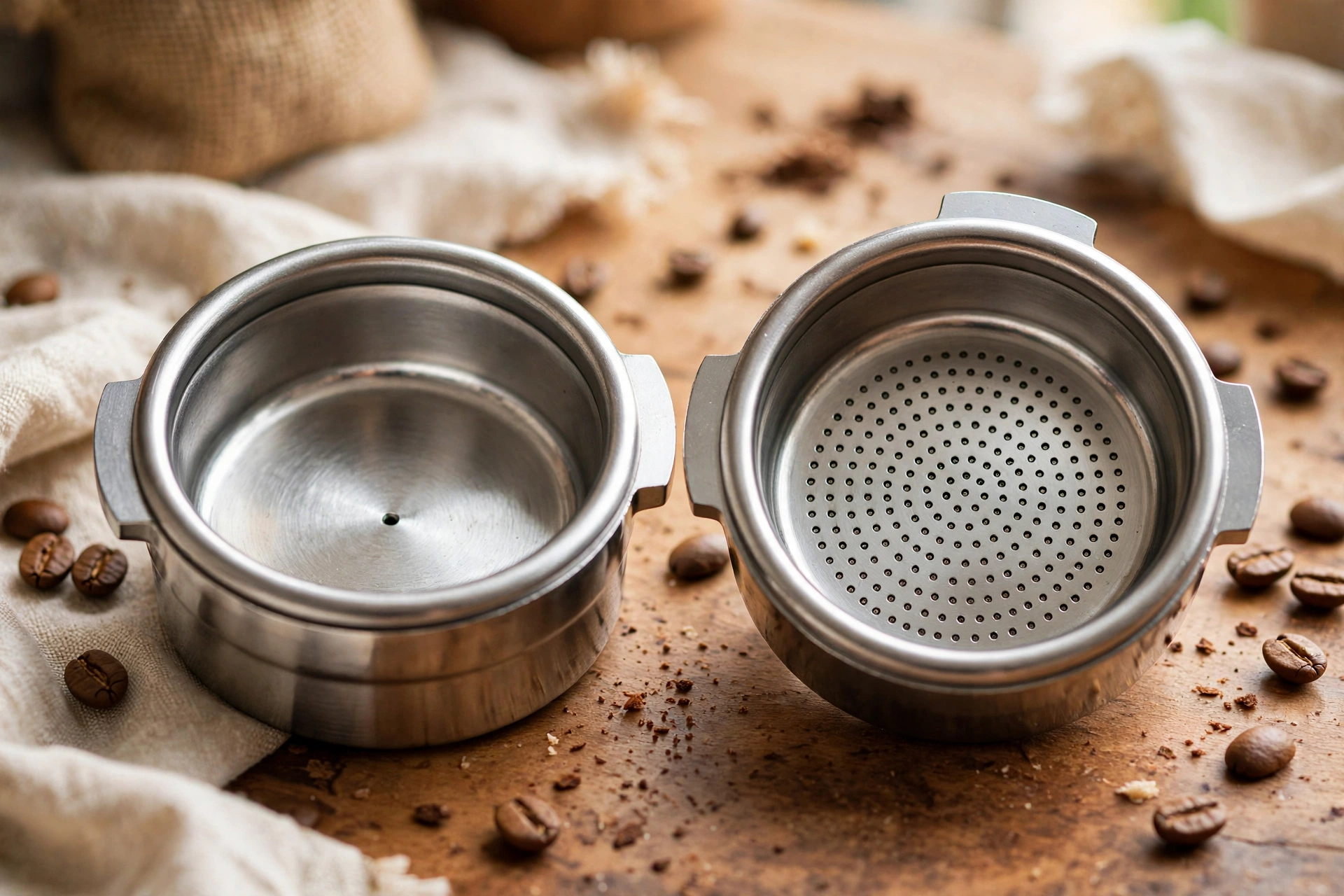
The short answer: a non-pressurized basket asks the coffee puck to create the resistance; a pressurized basket adds a mechanical restriction after the puck. That difference explains almost everything else — which coffee each basket can use, how forgiving it feels, why one produces more reliable flavour, and why the other often produces impressive-looking foam that does not tell you much.
A useful correction first: the basket is the removable metal filter that holds the coffee. The portafilter is the handled holder it sits in. “Pressurized portafilter” is common shorthand, but the pressure trick lives in the basket, not the handle.
Espresso needs controlled resistance
An espresso machine does not create a good shot merely by reaching high pump pressure. The puck has to resist the water enough to slow the flow and give the water time to dissolve flavour. If resistance is too low, water rushes through and the cup is thin and sour. If it is too high, the flow chokes or finds a crack and channels.
There are two ways to produce that resistance:
- Let the puck do it, as in a traditional single-wall basket.
- Add a second restriction beneath the puck, as in a pressurized or dual-wall basket.
Both designs aim at a controlled extraction. They distribute control differently between the coffee and the hardware.
How a non-pressurized basket works
A non-pressurized basket has one perforated wall. Water enters the puck, moves through the coffee, and leaves through many holes spread across the base. There is no second chamber and no tiny valve waiting below.
That means the puck is the main flow restrictor. Its resistance comes from:
- Fine particle size
- The amount of coffee in the basket
- Even distribution before tamping
- A level tamp that seals the edges
- Fresh coffee that swells and maintains structure when wet
This is why single-wall baskets are demanding. The holes do not rescue a poor puck. If one area is less dense, water preferentially follows it, over-extracting that channel while leaving other coffee under-extracted. The cup can taste sour and bitter at the same time — not because those flavours cancel out, but because different parts of the puck extracted unevenly.
The reward for accepting that sensitivity is feedback. When you change the grind one step, the shot time and flavour respond. When distribution improves, channeling decreases. The basket gets out of the way and lets the grind, dose, and puck preparation become precise controls.
What a single-wall basket needs from you
It needs fresh coffee and a grinder that can make fine, repeatable adjustments. A blade grinder or a coarse all-purpose grind usually cannot build enough even resistance. Pre-ground supermarket coffee is also a poor match: it is often too coarse, and even when labelled espresso-fine it has lost gas and aroma since grinding.
Use the dose printed or specified for the basket as a starting range, distribute the grounds evenly, tamp level, and weigh the yield. The familiar target — about a 1:2 ratio in 25–30 seconds — is a starting point, not a law. It gives you a measurable place from which to adjust by taste.
How a pressurized basket works
A pressurized basket has two walls. The upper wall, which touches the coffee, is perforated so liquid can pass through the puck. Beneath it is a mostly closed lower wall with one small outlet. Brewed coffee collects briefly in the space between the walls, pressure builds behind the restriction, and the liquid is forced through the tiny exit.
The order matters. Water still passes through the coffee first. The dual-wall basket does not brew the coffee by itself. What it changes is the dominant source of back pressure. Even if the puck is coarse, uneven, or made from stale pre-ground coffee, the outlet restricts the flow after extraction. The machine therefore sees a more predictable total resistance.
Some designs use a plain double wall; others combine the second wall with inserts or valve-like parts. The details vary, but the principle is the same: a mechanical bottleneck covers for an unreliable puck.
Why it is forgiving
A traditional basket reveals every weakness in grind size and preparation. A pressurized basket smooths over many of them. That is valuable when:
- You use pre-ground coffee.
- Your grinder cannot grind finely or consistently enough.
- You are learning the machine and want repeatable drinks before buying more equipment.
- Convenience matters more than extracting the last layer of flavour from fresh beans.
It does not eliminate puck preparation. Water still has to pass through coffee, and a badly uneven puck can still extract unevenly. The downstream restriction can hide channeling from the shot timer, but it cannot put flavour back into dry pockets of coffee. “Forgiving” means usable results across a wider range of inputs, not immunity from technique.
The practical difference in the cup
| Question | Pressurized basket | Non-pressurized basket |
|---|---|---|
| Main resistance | Second wall and small outlet | Coffee puck |
| Best coffee input | Pre-ground or inconsistently ground coffee | Freshly ground coffee |
| Grinder requirement | Basic; espresso-range precision not essential | Capable espresso grinder required |
| Feedback when you adjust grind | Muted | Direct and obvious |
| Typical strength | Forgiving, simpler flavour | Higher ceiling for sweetness and clarity |
| Main failure mode | Muddy flavour, foam that overstates quality | Fast shots, channelling, sourness |
| Cleaning concern | Grounds and oil can lodge between walls | Easier to rinse and inspect |
The pressurized design lowers the floor: it is harder to make something undrinkable. The non-pressurized design raises the ceiling: with fresh coffee and a suitable grinder, it gives cleaner sweetness and more separation between coffees.
That distinction is more useful than calling one “bad” and the other “real.” If your current grinder cannot support a single-wall basket, the pressurized basket is the right tool. If you already own a capable grinder and fresh beans, the same basket becomes the bottleneck because it takes control away from the puck and obscures the feedback you need to improve.
Why the crema looks different
Crema is an emulsion of coffee oils, gas, and liquid. In a non-pressurized basket, its amount and texture depend heavily on coffee freshness, roast, pressure, and extraction. Fresh coffee normally produces more stable crema because it still contains carbon dioxide and soluble material that can support the foam.
A pressurized basket can make a pale, bubbly, crema-like foam even from coffee that would produce little crema in a traditional basket. The small outlet increases turbulence as pressurized liquid passes through it, whipping gas into the stream. The result may look abundant at first and then collapse quickly.
Neither foam should be treated as a scorecard. A thick cap does not prove balanced extraction, and a thin cap does not automatically mean a poor cup. Taste and measured yield are more useful. This matters especially when switching baskets: do not judge the first single-wall shot against the pressurized basket by foam alone. Judge whether the drink is sweeter, clearer, and more balanced.
How to tell which basket you have
Remove the basket and flip it over.
- Non-pressurized: you see many holes across the base.
- Pressurized: you see a mostly smooth second bottom with a single small hole, often near the centre.
Also check the inside. Dual-wall baskets feel deeper or show a layered construction because of the chamber underneath. Spouts on the portafilter do not tell you the basket type. A spouted portafilter can hold either basket. A bottomless portafilter exposes the basket so you can watch for channeling, but it is a different feature and normally pairs with a traditional basket.
Basket diameter and dose rating still matter. Common home systems use baskets around 51 mm, 54 mm, or 58 mm, and a basket must match the portafilter and machine group. A nominal 18 g basket is built around that dose range; severe underfilling leaves too much headspace and can disturb the puck, while overfilling can press against the shower screen. Fit comes before experiments with precision baskets or new accessories.
Precision baskets are a subtype of non-pressurized basket. Their holes are made to tighter tolerances and may cover more of the base. They can improve evenness, but they do not solve stale coffee, a weak grinder, or poor distribution. They are a refinement, not the first upgrade.
Which one should you use now?
Use the pressurized basket if your limiting factor is the coffee or grinder. It makes sense for pre-ground coffee, a basic grinder, or a low-fuss routine. Keep the coffee as fresh as you can, distribute it level, and clean the basket well. There is no benefit in forcing a single-wall basket to work with inputs it cannot handle; the likely result is a fast, sour shot every morning.
Use the non-pressurized basket when you have the tools to control the puck: fresh beans, a burr grinder that adjusts in small steps, a scale, and a level tamp. That combination turns basket choice into a genuine upgrade. You gain feedback, repeatability, and access to the flavour differences between coffees.
A simple transition works well:
- Keep the same coffee and dose.
- Start with the grind setting that seems close to espresso-fine.
- Pull about a 1:2 yield and time the shot from pump start.
- If it runs much faster than 25 seconds, grind finer.
- If it chokes or runs much slower, grind coarser.
- Change one step at a time and taste before changing dose.
Expect the first few single-wall shots to be worse than the pressurized ones. That is not evidence that the traditional basket is inferior. It is evidence that the mechanical safety net is gone. Once the grind is in range, the traditional basket usually overtakes it quickly.
Cleaning is not optional with dual-wall baskets
The hidden chamber that makes a pressurized basket forgiving also traps coffee fines and oils. Rinse it immediately after use, soak it periodically in hot water with an espresso-machine detergent made for the purpose, and make sure the single outlet is clear. A partly blocked outlet changes resistance and can make shots inconsistent for reasons that look like grinder problems.
Single-wall baskets are easier: rinse, brush away grounds, and inspect the holes against the light. In both cases, keep the basket dry when stored so old coffee oils do not become the first flavour in the next shot.
The bottom line
Choose the basket that matches the resistance you can actually create. If the puck cannot do the job because the coffee is pre-ground or the grinder is not up to espresso, a pressurized basket supplies the missing restriction. If you can grind fresh and adjust precisely, a non-pressurized basket removes the mechanical crutch and gives you better feedback and better espresso. The right basket is not the most traditional one; it is the one whose assumptions match your equipment and coffee.