
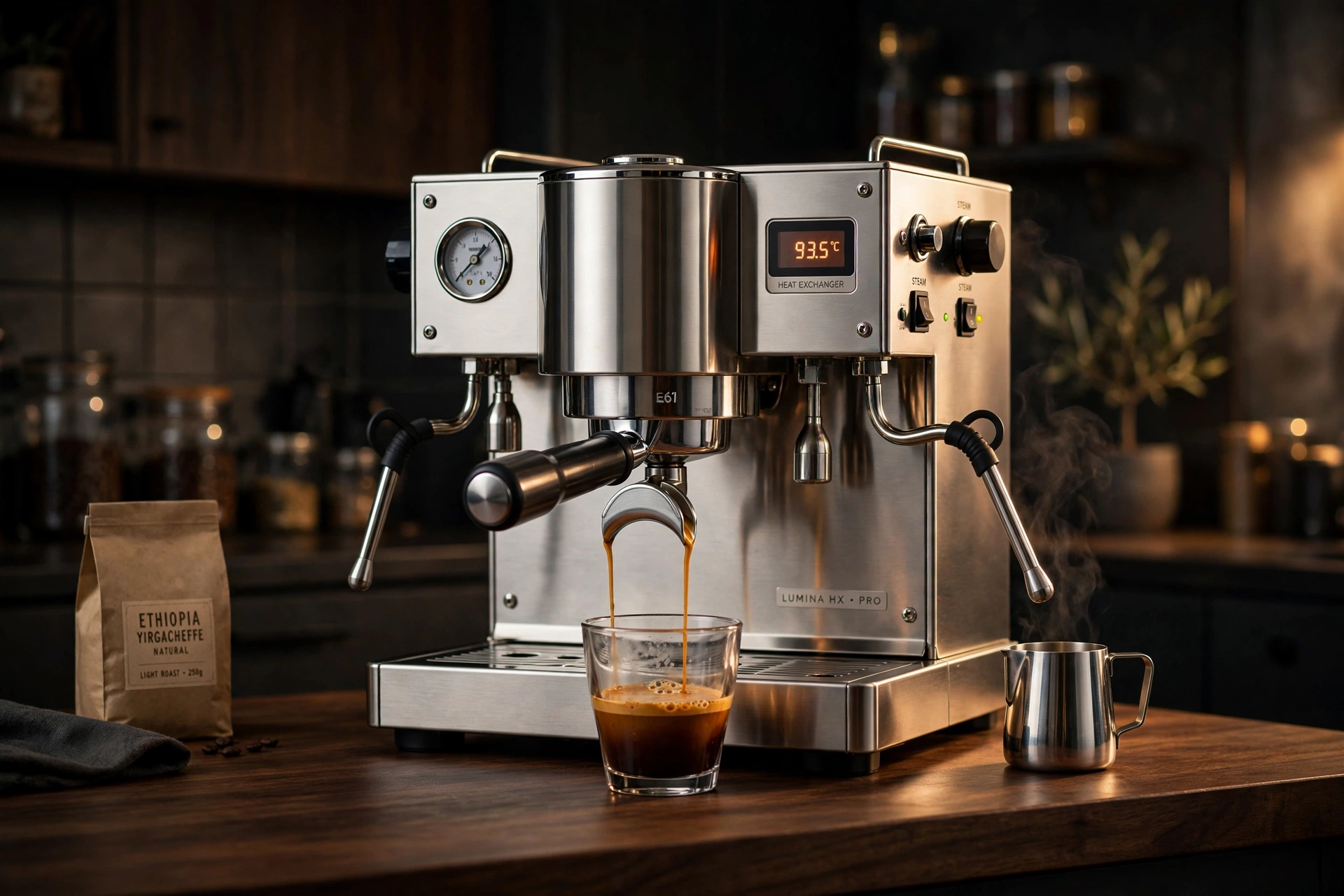
The short answer: the Diletta Bello+ is the best heat exchanger espresso machine for most people — PID control, shot timer, and programmable pre-infusion on a 1.8L stainless boiler for $2,149, backed by Seattle Coffee Gear’s in-house warranty. The Turin Gallatin R HX is the value pick — rotary pump, PID, and flow control for $1,499 from a newer brand. The Rocket Appartamento 2.0 remains the style icon at $2,150. A heat exchanger is the sweet spot for most home baristas: one boiler does both jobs, so you brew and steam simultaneously without the dual-boiler invoice. Prices and specs checked 2026-10-16. Prices vary by retailer; where sources disagreed we used the manufacturer’s or specialty retailer’s current price.
Disclosure: we are an independent research desk and earn no commission on anything here. Vendor links on this page are plain links to manufacturer and retailer pages — no affiliate tracking. See our disclosure policy for how we stay independent.
We are a research desk, not a test lab: we synthesize owner reports, forum threads, published measurements, reviews, and teardowns rather than claiming hands-on testing we have not done. If you want the mechanism behind every machine here, read our boiler-types guide first — this roundup is the “which one” answer, not the “why” one.
First principles: what the heat exchanger actually buys
Brew water wants ≈93°C; steam wants ≈120°C and up. A dual boiler solves the conflict with two vessels. A heat exchanger solves it with one hot vessel and clever plumbing: the boiler runs permanently at steam temperature, and fresh brew water travels through a copper or stainless tube immersed in that boiler, flash-heating on its way to the group. Steam is instant and dry because the boiler never changes modes; brew temperature is set by steam-boiler pressure, not by a direct control loop.
That last clause is the whole trade-off. Because brew temperature follows steam pressure, it drifts as you work, and water sitting idle in the exchange tube overheats — which is why HX machines need the cooling flush: run water through the group for a few seconds before the shot until the brew path settles into the 90–94°C range, then pull immediately. The flush is the price of simultaneity.
HX also used to be the budget way into simultaneous brewing. That is no longer cleanly true: current HX machines run $1,449 to $2,250, and the Breville Dual Boiler starts at $1,599.95. So the honest frame for 2026 is not “HX is cheaper” — it is “HX is simpler.” One boiler, one heating circuit, no mode switching, and (dollar for dollar) usually stronger steam. You trade a few degrees of temperature precision and a small ritual for mechanical simplicity and machines that prosumer shops have serviced for decades.
Comparison table
Prices and specs checked 2026-10-16. Prices vary by retailer; where sources disagreed we used the specialty retailer’s current price.
| Machine | Typical price | Pump | Group | Boiler | Temperature control | Tank / plumbing | Best for |
|---|---|---|---|---|---|---|---|
| Diletta Bello+ | $2,149 | Vibration | 58mm E61 | 1.8L stainless, 1500W | PID + shot timer + programmable pre-infusion | 3L tank | Most people; control + warranty |
| Turin Gallatin R HX | $1,499 | Rotary | E61, flow control stock | 2.0L stainless | PID + shot timer + programmable pre-infusion | 1.7L tank or plumbed | Value; rotary + plumbing |
| Rocket Appartamento 2.0 | $2,150 | Vibration | E61 (dual pre-infusion) | 1.8L copper, 1350W | Pressurestat, no PID | 2.5L tank | Design icon; simplicity |
| Profitec Pro 500 PID | $1,999 | Vibration (quiet) | E61 | 2.0L insulated stainless, 1400W | Front PID + shot timer | 3L tank | German build + PID |
| Lelit Mara X V2 (PL62X) | $1,699 | Vibration (quiet) | E61 | 1.8L stainless | Dual-probe PID: Warm/Hot/Extra Hot, Coffee/Steam X-Mode | 2.5L tank | Compact; minimal flush workflow |
| Nuova Simonelli Oscar II | $1,995 | Vibration | Oscar group (thermosiphon) | 2.0L copper, 1200W | Pressurestat, timed/volumetric buttons | 2.8L tank or direct-connect | Commercial-DNA milk workhorse |
The six machines, in depth
1. Diletta Bello+ — best for most people
Seattle Coffee Gear’s house brand — built by Quick Mill, sold and serviced by SCG — takes the top spot because it is the most complete package here. The PID sits behind a front display with a shot timer, programmable 10-second pre-infusion, and an eco mode; the 1.8L stainless boiler and 1500W element warm in about 13.5 minutes, fast for an E61 HX; and the 3L reservoir is the largest here. SCG’s in-house two-year warranty and their own repair bench back it, which matters more than any spec line for a machine you will own for a decade.
One honest mechanism note, which applies to every PID HX machine: the PID controls the steam boiler, and brew temperature follows it indirectly. That steadies things enormously versus a pressurestat, but it is not the same as the direct brew-temp control of a dual boiler. The cooling flush is not gone — it is shorter and more predictable.
Seattle Coffee Gear listed $2,149 when we checked, with units in stock. The Bello+ is not the cheapest way to get HX — it is the most complete way to buy HX without giving up anything a home barista actually uses. Buy it when you want PID control, a shot timer, and a real warranty from the people who sell it, with no asterisks.
2. Turin Gallatin R HX — best value
The disruptor of this roundup. For $1,499 you get a spec sheet that costs $2,200-plus from the established brands: a rotary pump, PID with shot timer, programmable pre-infusion, flow control as standard, a 2.0L stainless boiler, and a direct-plumb option alongside the 1.7L tank. On paper, nothing here touches it.
The caveats are real and the article would be dishonest without them. Turin is a small, new brand sold through niche retailers (Cliff & Pebble, Espresso Outlet, Kafeto) with a one-year reseller warranty — there is no national service network, no decade of forum teardowns, no SCG-style repair bench. Cliff & Pebble softens this with 365-day returns and price matching, and the machine was in stock when we checked, but you are buying the machine, not the institution. The tank is also the smallest here, and like every PID HX, the cooling-flush discipline still applies after idle periods — the PID steadies the boiler, not the puck.
Choose the Gallatin R when the spec sheet is what matters and you are comfortable being an early adopter. For buyers who want the rotary-pump HX experience without flagship money, this is the entire argument. If the brand risk bothers you, the Profitec Pro 500 is the establishment answer for $500 more.
3. Rocket Appartamento 2.0 — best design icon
The Appartamento is the machine people picture when they picture a prosumer home setup, and the 2.0 revision (now the standard Appartamento — older T64 listings are the same machine pre-revision) modernizes it without diluting it: a deeper drip tray that takes taller cups, RGB LED status indicators, a water-tank sensor, an eco mode that auto-offs 90 minutes after the last shot, a bump to 1350W, and corrosion-resistant internals.
The honesty section is required here. At $2,150 (espressosale and Coffee Machine Depot, in stock; $2,200 for the Nera at Chris Coffee), the Appartamento now costs more than the Profitec Pro 500 PID while offering no PID, no shot timer, and tank-only operation, and it still needs a cooling flush before every shot. Rocket is charging for the design, the brand, and deliberate simplicity — this is a machine that will never have a firmware update because it has no firmware. For many buyers that is the point; for buyers who want control per dollar, the Bello+ and Gallatin R exist.
Choose the Appartamento 2.0 when the machine is furniture as well as equipment and you are happy to manage temperature with flush technique. Choose anything else when a digital setpoint matters to you.
4. Profitec Pro 500 PID — best German build with PID
The establishment answer. The 2022 revision with the front-mounted PID and shot timer is the current Pro 500, and it remains the benchmark for how a German HX should feel: a quiet vibration pump, a 2.0L insulated stainless boiler, the E61 group, and a 3L tank in a chassis that owners repair rather than replace. Profitec’s parts ecosystem and the brand’s long service history are the institutional safety the Gallatin R lacks.
Whole Latte Love listed $1,999 when we checked — $150 less than the Bello+ and $151 less than the Appartamento 2.0. The honest comparison: against the Bello+, you trade SCG’s in-house warranty and programmable pre-infusion for Profitec’s build reputation; against the Gallatin R, you trade $500 and rotary-plumb spec for two decades of brand history and a real service network. The cooling flush remains part of the workflow — the PID steadies the steam boiler, it does not remove the tube’s superheated water.
Choose the Pro 500 when you want a PID-equipped HX from a manufacturer whose machines are still being repaired twelve years on. It is the least exciting pick here, which is exactly why so many cafes-turned-home-bars recommend it.
5. Lelit Mara X V2 (PL62X) — best compact, least flush
The cleverest machine here. The Mara X’s dual-probe PID runs two modes — Coffee and Steam priority — and in Coffee mode it manages the cooling-flush timing for you: the brew temperature target is held by design, so you pull when the light says pull instead of counting flush seconds. It is the closest an HX gets to the dual-boiler workflow without the second boiler. At 22cm wide it is also the only machine here that fits a genuinely small counter, and the 1.8L stainless boiler runs quietly.
Majesty Coffee listed the V2 at $1,699 when we checked; Kanen Coffee showed $1,699.95. Two things buyers should know: Lelit has a V3 in the wild at $1,999.95 (Seattle Coffee Gear) with flow control, so the V2 is the value generation now, not the latest — we are not hiding that. And the tank is the honest 2.5L, tank-only, like most of the class.
Choose the Mara X V2 when you want the HX price and steam but hate the flush ritual, or when counter space is the binding constraint. For the buyer who will actually learn the modes rather than leave it on one setting, this is the smartest $1,700 in HX.
6. Nuova Simonelli Oscar II — the commercial-DNA workhorse
The Oscar II is the odd one out, and it earns its place on exactly one strength: it is a commercial machine wearing home clothes. The 4-hole steam tip on the 2.0L copper boiler is the fastest, driest steamer here; volumetric dosing buttons automate the shot; the direct-connect version skips the tank entirely; and it is NSF-rated, which no other machine here is. Milk-drink households that steam constantly will feel the difference.
The rest of the machine has not kept pace, and the price has outrun it: Seattle Coffee Gear listed the pour-over version at $1,995 when we checked — pressurestat control with no PID, a plastic-heavy case, a roughly 25-minute warm-up, and a cooling flush with none of the modern aids. At this money it is the weakest value of the six for a general buyer. It survives as the pick for the buyer who steams milk like a small café and wants NSF-rated commercial DNA in a home-sized footprint.
Choose the Oscar II when the steam wand is the product and the espresso is the accessory. Everyone else should start higher up the list.
Honorable mentions
- ECM Mechanika Max (about $2,249 at Whole Latte Love): the quietest rotary-pump HX from an establishment brand — the Gallatin R’s institutional opposite, for buyers who want rotary and a decade of parts.
- Bezzera BZ10 (about $1,449 at Whole Latte Love): the cheapest new HX from a major Italian brand. Compact, copper boiler, pressurestat simplicity — but small and basic next to the shortlist.
- Turin Gallatin V HX (about $1,249 at Espresso Outlet): the Gallatin R’s vibration-pump sibling — the cheapest credible path into a PID-equipped HX at all.
How to choose among the six
- You want the most complete HX package with a real warranty: Diletta Bello+. PID, shot timer, pre-infusion, and SCG’s repair bench for $2,149.
- You want flagship specs for $1,500: Turin Gallatin R HX. Rotary pump, PID, flow control, plumbing — from a new brand with a thin service network. Know what you are trading.
- You want the design icon and deliberate simplicity: Rocket Appartamento 2.0. $2,150 for the machine everyone recognizes; manage temperature with technique.
- You want German build quality with PID control: Profitec Pro 500. $1,999 for the establishment answer and a chassis built to be repaired.
- You want the smallest footprint and the least flush ritual: Lelit Mara X V2. $1,699 for the X-Mode workflow in 22cm of counter.
- You steam milk constantly and want commercial hardware: Nuova Simonelli Oscar II. $1,995 for the fastest steam here and NSF-rated build.
What to budget beyond the sticker
No machine here includes a grinder, and an HX at this tier exposes a weak grinder mercilessly. Budget $200 to $400 for an espresso-capable burr grinder — the grinder guide explains why the grinder is the ceiling on cup quality. Add a 0.1g scale (about $15 to $25) and a water-filtration plan from day one: E61 groups and boilers scale fast, and descaling a heat exchanger is a job you want to avoid. One HX-specific cost: the cooling flush wastes a little water every shot — trivial on a city supply, worth knowing if your water is expensive or metered.
Meet the three conditions — brew water at about 90 to 94°C when it hits the puck, about 9 bars of pressure, and an even fine grind — and any of these six makes café-quality espresso with steam to match. The heat exchanger premium buys simultaneity with simplicity: brew and steam at once, from one boiler, with one ritual standing between you and the shot.