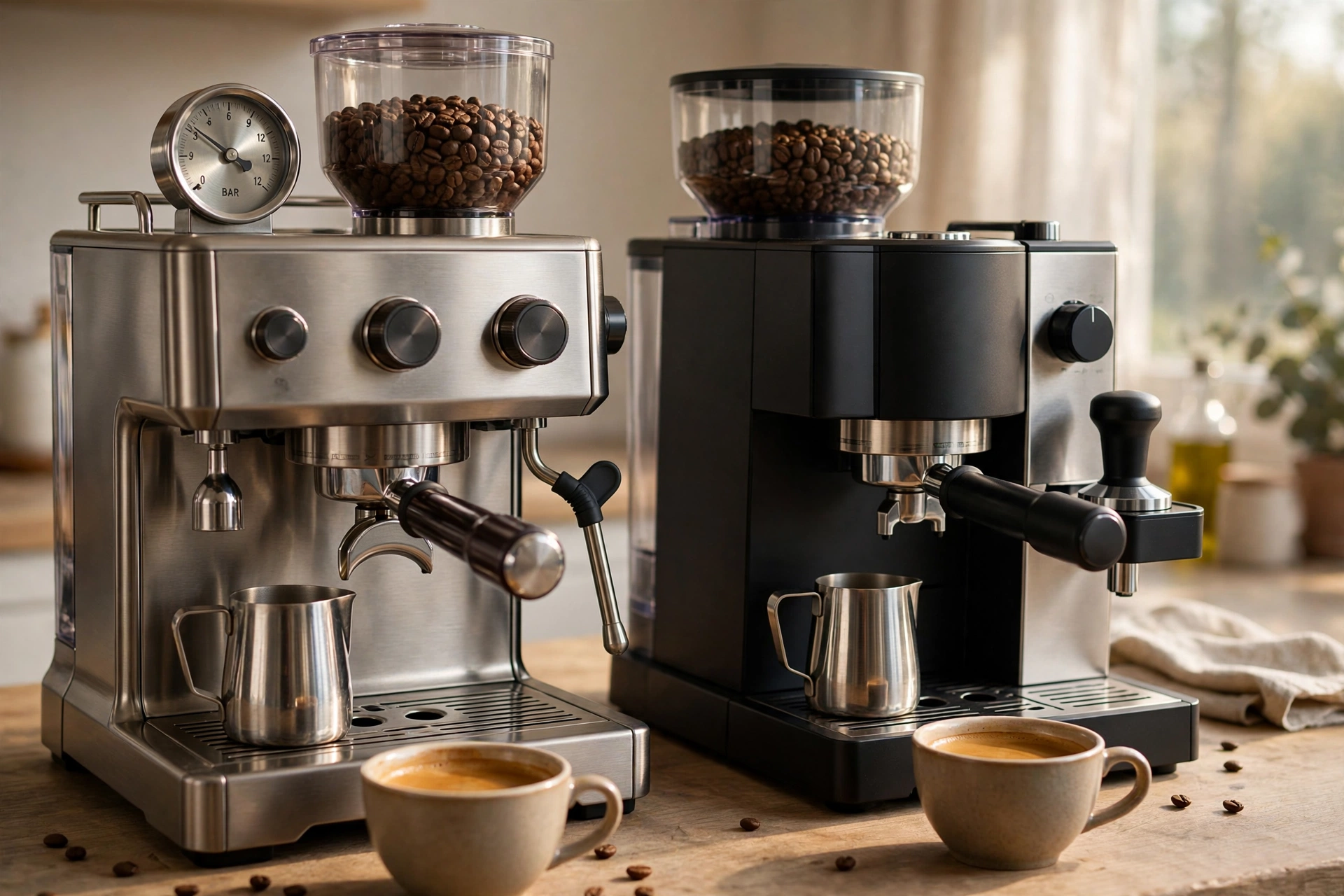
The short answer: the Breville Barista Express is the better machine for learning espresso and growing into it; the De’Longhi La Specialista Arte is the better machine for getting good drinks with less effort and less counter. Both list at about $700, both grind, brew, and steam in one box, and neither can brew and steam at once. What separates them is where each spends its budget: Breville on range and feedback, De’Longhi on guidance and finish. Prices and specs checked 2026-10-04. Prices vary by retailer; where sources disagreed we used the manufacturer’s current price.
We are a research desk, not a test lab: we synthesize owner reports, forum threads, published measurements, reviews, and teardowns rather than claiming hands-on testing we have not done.
First principles: what an all-in-one machine has to do
A machine with a built-in grinder is three devices sharing one budget: a grinder, a heating system, and a steam system. The shot is decided by the weakest of the three, and at about $700 the compromises are structural, not accidental.
Heat. Espresso needs water at about 90 to 94°C, delivered at the same temperature on the second shot as the first. Both machines here heat water on demand — Breville through a thermocoil (a water path embedded in a heated block, controlled by a PID feedback loop), De’Longhi through a thermoblock with what it calls Active Temperature Control. On-demand heating means seconds of heat-up and no boiler to descale around, at the cost of steam reserve: steam is made as you go, not stored.
Grind. The integrated grinder is the binding constraint. It must grind fine enough, evenly enough, and repeatably enough that the puck resists water evenly. You cannot upgrade it later without replacing the machine, so its range and adjustment steps set the ceiling on every coffee you will ever make with it.
Pressure and feedback. Both machines use 15-bar pumps capped by an over-pressure valve to about 9 bars at the puck. What differs is what the machine tells you. A pressure gauge (Breville) turns every shot into a measurement. Guided dosing and tamping (De’Longhi) removes the measurement by removing the variable. Neither is a gimmick; they are two different answers to the beginner’s real problem, which is not knowing what went wrong.
Comparison table
Prices and specs checked 2026-10-04. Prices vary by retailer; where sources disagreed we used the manufacturer’s current price.
| Spec | Breville Barista Express (BES870) | De’Longhi La Specialista Arte (EC9155) |
|---|---|---|
| Typical price | $699.95 list; $499.95 at Macy’s when checked | $699.99 list |
| Heating | Thermocoil with PID, 200°F (93°C) | Thermoblock, Active Temperature Control |
| Temperature choice | PID-held single brew temperature | 3 infusion temperature levels |
| Grinder | Integrated steel conical burr | Integrated conical burr |
| Grind settings | 16 | 8 (US model) |
| Portafilter | 54mm stainless steel | 51mm |
| Dose | 18g | Single-wall baskets hold up to 20g |
| Baskets included | 1 and 2 cup, single and dual wall | 2 single-wall (unpressurized) filters |
| Tamping | Integrated removable tamper, manual | Barista kit: tamper, tamping mat, dosing and tamping guide |
| Steam | Manual wand, 360° swivel | Manual My LatteArt wand, cool-touch |
| Feedback | Analog pressure gauge | Dose and temperature selectors, guided workflow |
| Water tank | 67 oz (2L) | Removable tank, about 1.5L |
| Bean hopper | 1/2 lb (250g) | Integrated hopper |
| Build | Brushed stainless steel | Stainless steel and black, colour variants |
| Weight | About 10 kg | About 9 kg |
Heating: thermocoil against thermoblock
This is closer than the marketing suggests. Breville’s thermocoil runs water through an integrated stainless steel path in a heated block, with PID control holding 200°F (93°C) — a feedback controller that corrects temperature continuously rather than cycling around a thermostat. De’Longhi’s thermoblock does the same physical job with a different control philosophy: Active Temperature Control plus three user-selectable infusion temperatures, so you can run cooler for a dark roast and hotter for a light one.
The practical difference is not stability — both approaches hold brew temperature well enough that the coffee cannot tell them apart. It is choice. The Breville decides the temperature for you and holds it; the De’Longhi hands you three levels and a reason to use them. Owners stepping up to light-roast single origins tend to value the De’Longhi’s hotter setting. Everyone else never touches it.
Neither machine brews and steams simultaneously, and neither has boiler steam reserve. Milk drinks arrive in sequence: shot, purge, steam, pour. For one or two drinks that is a workflow. For four cappuccinos it is a queue.
Grinder: 16 settings against 8
Both grinders are steel conical burrs grinding on demand into the portafilter, and both are adequate for espresso with pressurized help and good with single-wall baskets and fresh beans. The difference is resolution. Sixteen settings (Breville) against eight (US La Specialista Arte) means the Breville’s steps between too-fast and too-slow are smaller, which matters most with light roasts and fresh, gassy beans that need fine adjustments as they age.
Dose handling differs too. The Breville grinds a timed dose you trim with the included Razor tool, into an 18g basket. The De’Longhi’s barista kit centres on a dosing and tamping guide that sits on the basket and keeps grounds and tamping level contained — the mess stays in the basket, and the tamp starts level by construction.
The honest ceiling for both: when owners outgrow these machines, the grinder is usually why. A $200 standalone grinder outperforms either built-in unit, which is the strongest argument for buying either machine at a discount and treating the grinder as a starter.
Tamping and feedback: gauge against guide
The Barista Express gives you a magnetic, removable tamper stored in the machine and an analog pressure gauge on the face. The gauge is the feature owners cite most: it shows pre-infusion, the climb into the extraction zone, and the over-extraction you caused, shot after shot. It turns dialling in from folklore into iteration.
The La Specialista Arte removes the variable instead. Dose through the guide, tamp on the mat with the guide keeping you level, and the two largest beginner errors — uneven dose and tilted tamp — are engineered down before the pump starts. You learn less about why a shot failed, because fewer shots fail for mechanical reasons. What remains is grind and temperature, which the machine also constrains.
Choose based on temperament: if you want to understand espresso, buy the gauge. If you want to drink espresso, buy the guide.
Steam and milk
Both wands are manual and capable of genuine microfoam — neither machine automates milk. The Breville’s 360° swivel wand is the traditional tool: powerful for its class, positioned where you expect, and the steam comes on demand from the thermocoil. The De’Longhi My LatteArt wand is designed to stay cool to the touch and is shaped for the swirling, glossy texture latte art needs; owner reports consistently rate it the more forgiving of the two for a first month of milk.
For straight espresso drinkers the difference is minor. For a household making two lattes every morning, the De’Longhi’s milk workflow — guided puck, forgiving wand — is measurably less fiddly before coffee.
Build, footprint, and ecosystem
The Barista Express is brushed stainless steel, about 10 kg, with the physical dials and gauge of a machine designed in 2013 and refined since. The La Specialista Arte is slimmer (about 275mm wide), about 9 kg, in stainless and black with colour variants, and looks like the newer appliance it is. On a small counter the De’Longhi wins outright.
Ecosystem runs the other way. Breville’s 54mm portafilter has the deepest accessory market in home espresso: precision baskets, tampers at 53.3mm, bottomless portafilters, and a decade of owner documentation for every fault code. The De’Longhi’s 51mm system is supported but thinner — Normcore and others make 51mm parts, including a La Specialista-specific bottomless portafilter, but you will search longer and pay a little more. If you are the kind of owner who modifies, that gap compounds.
Price and value
At list price they are identical: $699.95 for the Breville, $699.99 for the De’Longhi. Street prices are not. The Barista Express is one of the most discounted espresso machines sold — $499.95 at Macy’s when we checked, with similar deals rotating through major retailers. The La Specialista Arte discounts less often in the US. At $500, the Breville is the value pick of the class. At list price head-to-head, the De’Longhi’s included barista kit (tamper, mat, dosing guide, milk jug) closes some of the gap, because Breville owners typically buy a better tamper and mat anyway.
The verdict
- Buy the Barista Express if you want to learn espresso properly, you drink a range of roasts, you may keep the machine for years and modify it, or you find it near $500 — at that price nothing else with a grinder is close.
- Buy the La Specialista Arte if counter space is tight, milk drinks are the default, you want the shortest path from box to good coffee, or you value temperature choice for light roasts over grinder range.
- Buy neither if you already own a good grinder. The same money buys a Breville Bambino Plus or a Gaggia Classic Pro E24 with budget left over, and a separate grinder is the upgrade path both of these machines eventually force.
Both machines make real espresso. The Breville teaches you how; the De’Longhi gets out of the way. Pick the relationship you want with the process, because at the same price that — not temperature, not pressure — is the actual difference.