
The short answer: the Breville Bambino is the best espresso machine under $250 — at its common $249.95 sale price, where it sits exactly at the top of this band. It is the first machine at this price with PID temperature control, low-pressure pre-infusion, and a 54mm portafilter system that can grow with you. The De’Longhi Dedica is the pick for narrow counters (about 6 inches wide, street price often under $250), and if you’d rather spend less, the sub-$200 winners from our best espresso machines under $200 roundup still hold up. Prices and specs checked 2026-10-22. Prices vary by retailer; where sources disagreed we used the manufacturer’s current price.
Disclosure: we are an independent research desk and earn no commission on anything here. Vendor links on this page are plain links to manufacturer pages — no affiliate tracking. See our disclosure policy for how we stay independent.
We are a research desk, not a test lab: we synthesize owner reports, forum threads, published measurements, reviews, and teardowns rather than claiming hands-on testing we have not done.
First principles: what the extra $50 above $200 buys
Espresso is the same constrained extraction problem at every price: water at about 90 to 94°C must pass through a compacted puck of finely ground coffee at about 9 bars of pressure, evenly enough to extract the good compounds without channeling. The sub-$200 machines solve it by faking the pressure — dual-wall (pressurized) baskets build back-pressure artificially, so the pump’s 15 or 20 bars become something that looks like espresso.
The $200–250 band is where the first two conditions — temperature stability and even saturation — start to be solved honestly instead of faked:
- PID temperature control (Bambino). A digital feedback loop that holds brew water at the set temperature, replacing the bang-bang thermostat of cheaper thermoblocks. Temperature swings are the main source of shot-to-shot inconsistency in this price range; PID removes most of them. This is normally a $300-plus feature.
- Low-pressure pre-infusion (Bambino). The puck is wetted at low pressure before full pressure ramps up, so it saturates evenly instead of channeling along the weakest path. Channeling is the physics behind sour, thin shots — pre-infusion attacks the cause, not the symptom.
- A real upgrade ecosystem (Bambino, 54mm). The Bambino ships with pressurized baskets but accepts 54mm single-wall baskets, bottomless portafilters, and a wide aftermarket — so the machine can grow with your grinder instead of being replaced by it.
- Extreme compactness (Dedica). The Dedica’s contribution is different: 149mm wide, about 6 inches — a machine for counters where nothing else fits, still with a manual steam wand and 15-bar pump.
None of this makes these machines “real espresso” out of the box — both still ship with pressurized baskets. What the extra $50 buys is a ceiling: the Bambino can become a real espresso machine with aftermarket baskets, while the sub-$200 machines cannot.
If you want the mechanism behind baskets before you shop, our pressurized vs non-pressurized baskets explainer covers it.
What the $250 ceiling forces you to choose
Speed versus steadiness. The Bambino’s ThermoJet heats in about 3 seconds; the Dedica’s thermoblock takes about 40 seconds. Both are heat-on-demand designs with limited steam reserve — you brew, pause, then steam — but the Bambino’s PID keeps brew temperature stable where the Dedica’s thermostat does not.
54mm versus 51mm. The Bambino’s 54mm portafilter is the Breville standard: baskets, bottomless portafilters, and distributors are made by dozens of third parties. The Dedica’s 51mm system has an aftermarket too, but it is smaller and mostly De’Longhi-specific. Portafilter diameter matters because it decides what you can buy for the machine next year.
Price reality. Neither of the two deep-dive picks lists under $250 — the Bambino lists at $299.95 and the Dedica at $279.95. Both routinely sell under $250 (the Bambino at its $249.95 sale price, the Dedica at typical street prices of $230 to $280). We include them because the sale price, not the list price, is what people pay — but note the honesty in it: if prices firm up, both belong in the under-$500 roundup instead.
Comparison table
Prices and specs checked 2026-10-22. Prices vary by retailer; where sources disagreed we used the manufacturer’s current price.
| Machine | Typical price | Heating | Portafilter | Pre-infusion / PID | Steam | Tank | Best for |
|---|---|---|---|---|---|---|---|
| Breville Bambino (BES450) | $249.95 on sale ($299.95 list) | ThermoJet, 3-sec heat-up | 54mm, dual-wall included | Yes / Yes | Manual wand | 1.4L | Best overall; highest ceiling |
| De’Longhi Dedica (EC685) | About $230–$280 street ($279.95 list) | Thermoblock, about 40 sec | 51mm, pressurized + ESE pods | No / No | Manual wand | 1.1L | Narrow counters; slim profile |
| CASABREWS CM5418 | $139.99 | Thermoblock | 51mm, pressurized | Yes / on current units | Manual wand | 1.0L | Best value if you’d rather save |
| De’Longhi Stilosa (EC260) | $149.95 | Stainless steel boiler | 51mm, pressurized | No / No | Manual frother | 1L | Proven reliability; leaves room for a grinder |
| Flair Neo Flex | About $119 | None (kettle water) | Bottomless 2-in-1 | Manual / N/A | None | N/A | Real espresso, no electricity |
The five machines, in depth
1. Breville Bambino (BES450) — best overall
The Bambino is the machine this band exists around. The ThermoJet heating system reaches brew temperature in about 3 seconds, PID digital temperature control holds it there, and low-pressure pre-infusion wets the puck before full pressure ramps up — three mechanisms that belong on machines costing twice as much. The 15-bar pump delivers about 9 bars at the puck during extraction, the 54mm portafilter ships with dual-wall (pressurized) baskets, and the manual steam wand is genuinely capable of microfoam for latte art. The 1.4L tank is generous for the size, and the footprint is compact (about 7.7 inches wide).
The honest caveats: $299.95 list means you are buying on sale at $249.95 — at full price this is a $300 machine, and the distinction matters for the article title. Out of the box it is still a pressurized-basket machine, so “real espresso” requires aftermarket single-wall baskets and, critically, an espresso-capable grinder. The single-wall path is the upgrade; the dual-wall baskets are the starting line. One-year manufacturer’s warranty. See our Bambino vs Bambino Plus comparison if you drink mostly milk drinks — the Plus’s automatic wand is a different machine at a different price.
Plain links: Breville’s official Bambino page for current specs and pricing.
2. De’Longhi Dedica (EC685) — the narrow-counter pick
The Dedica’s entire argument is 149mm wide — barely 6 inches — against a 15-bar pump, a thermoblock that heats in about 40 seconds, and a proper manual steam wand. The 51mm portafilter ships with pressurized baskets and an ESE pod filter, the 1.1L tank is removable, and the 1300W thermoblock runs programmable shot volumes. At $230 to $280 street against a $279.95 list, it is the cheapest way to put a name-brand machine on a counter where a Bambino physically does not fit.
The constraints follow from the price and the size: no PID and no pre-infusion, so shot-to-shot consistency depends on your routine; the build is plastic-heavy; the 51mm accessory ecosystem is thinner than the Breville 54mm world. Like the Bambino, it is a pressurized machine out of the box — the grinder question applies equally. We go deeper on this exact pair in our Dedica vs Bambino head-to-head.
Plain links: De’Longhi’s official Dedica page for current specs.
3. CASABREWS CM5418 — best value if you’d rather save
The CM5418 was our best-for-most pick in the under-$200 roundup, and it belongs here as the value anchor: $139.99 for a 20-bar pump, a pressure gauge, pre-infusion, PID temperature control on current units, and a manual steam wand in a 5.9-inch body. Everything we said there still holds — full details in that roundup rather than repeated here.
4. De’Longhi Stilosa (EC260) — leaves room for the grinder
Also carried up from the under-$200 roundup: $149.95, stainless steel boiler, 15-bar pump, pressurized 51mm baskets, ESE pod compatibility. Its case here is budget math — a Stilosa plus a $100-to-$150 grinder fund is a better setup than a Bambino fed by a blade grinder, and the grinder outlasts the machine.
5. Flair Neo Flex — the manual alternative
The Neo Flex makes genuine espresso at about $119 by deleting the electricity: your arm is the pump, the bottomless 2-in-1 portafilter does real extraction, and there is no pressurized basket in sight. The price is manual effort, no steam, and a mandatory espresso-capable grinder. Details in our under-$200 roundup and the manual machine roundup.
How to choose among the five
- You want the best machine the budget allows and will shop the sale: Bambino at $249.95. Nothing else at $250 has its mechanisms.
- Your counter is genuinely narrow: Dedica. Six inches is the whole argument.
- You’d rather spend $150 and put the difference toward a grinder: Stilosa — and read our grinder budget guide before you decide.
- You want the most features for the least money: CM5418. The instrumentation per dollar is unmatched.
- You already own an espresso-capable grinder and want real extraction now: Flair Neo Flex. Nothing electric here extracts like it.
What to budget beyond the sticker
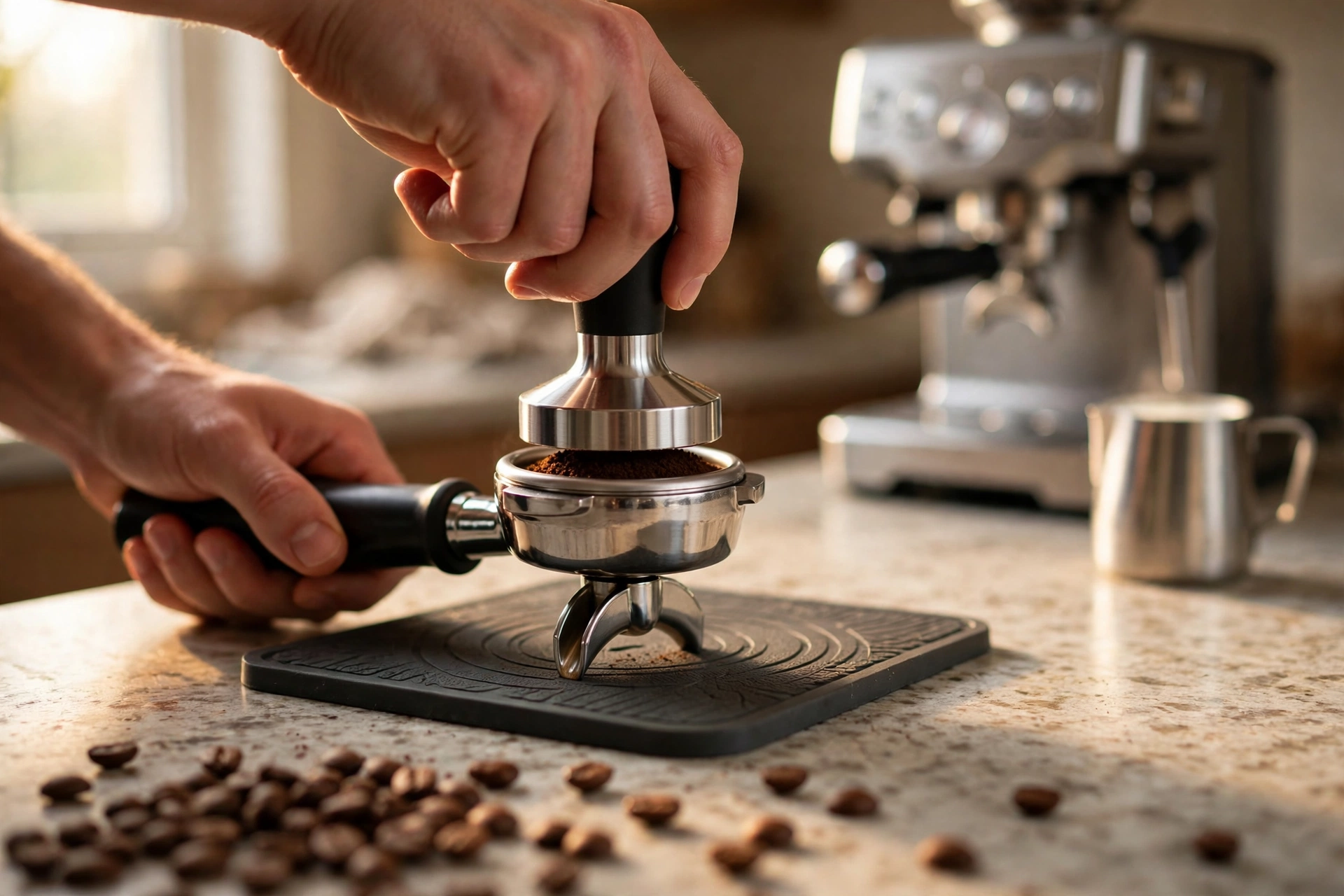
Every electric machine here needs a proper tamper (about $20 to $40 — the included ones are placeholders) and a 0.1g scale (about $15 to $25). The pressurized baskets mean pre-ground coffee works, so the grinder can wait — but the Bambino’s ceiling is only reachable with single-wall baskets (about $20 to $40 aftermarket) and a true espresso grinder, which is another $150 to $250 and the binding constraint on quality. See why espresso needs a grinder for the mechanism. If your total budget can stretch past $300, the under-$500 roundup is where machines stop being on-sale boundary cases and start being the real tier.