
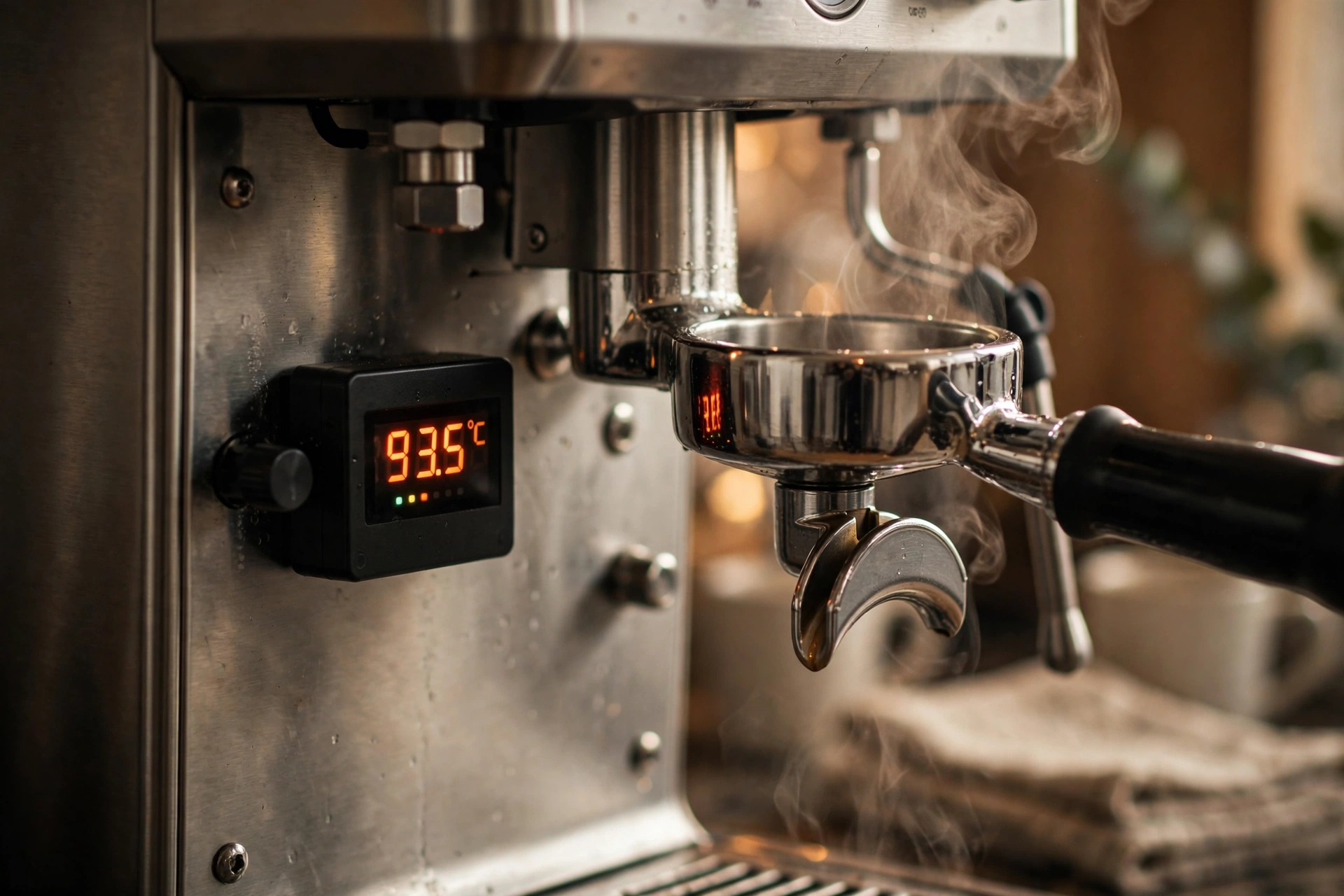
The short answer: yes, if you drink milk drinks, chase light roasts, or plan to keep the machine for years; no, if you only pull an occasional dark-roast shot and never change coffees. A PID does not make bad espresso good. It removes the largest uncontrolled variable in the machine, so the shot you dialled in yesterday is the shot you get today.
The problem a PID actually solves
Espresso extraction is a chemistry problem running on a timer. Hot water passes through ground coffee for about 25 to 30 seconds and dissolves compounds in a rough order: acids and salts first, sugars in the middle, bitter and astringent compounds last. Temperature sets how fast that dissolving happens. Water a few degrees hotter extracts more overall and pulls the balance toward bitter. Water a few degrees cooler extracts less and leaves the shot sour and thin.
The accepted brew window is about 90 to 94°C at the puck. That is a narrow band, and staying inside it matters more than hitting any single magic number. A shot brewed at a steady 92°C will taste balanced. A shot that starts at 88°C and climbs to 95°C during those 30 seconds tastes like two different coffees mixed together, because chemically, it is.
So the machine’s real job is not reaching brew temperature. Any heating element can get water hot. The job is holding a chosen temperature steady while cold water and cold coffee steal heat from it. That is a control problem, and it is the problem a PID is built to solve.
How a thermostat loses control
Most entry-level machines do without a PID and control the boiler with a mechanical thermostat, sometimes called a dead-band switch. The mechanism is simple: the heating element runs at full power until the water hits the top of a set range, then clicks off. It stays off while the water slowly cools, then clicks back on at the bottom of the range.
Two weaknesses follow from that design.
First, the range itself is wide. A typical mechanical thermostat allows a swing of about 10°C between clicking off and clicking back on. The boiler is only ever passing through your target temperature on the way up or down; it rarely sits there.
Second, the element overshoots. A heating element stays hot after the power cuts, and the water nearest it keeps heating. By the time the thermostat reacts, the boiler has sailed past the top of the range. Then it drifts down and undershoots at the bottom. The result is a slow temperature wave, and where your shot lands on that wave is mostly luck. This is why owners of thermostat machines develop routines like temperature surfing: flushing water or timing the shot to the boiler light, trying to catch the wave at the right point. It works, but it is the user doing the controller’s job.
What a PID does differently
PID stands for proportional, integral, derivative. It is a feedback controller borrowed from industrial process control, and each of the three terms fixes one weakness of the thermostat.
Proportional means the power applied depends on how far the water is from the target. Far below the set point, the element runs hard. Close to it, the controller pulses the element in short bursts, easing the temperature in instead of charging past it. This alone removes most of the overshoot.
Integral corrects the leftover error over time. A purely proportional controller often settles a degree or two below target, because at some point the small power input exactly balances the heat leaking out of the boiler. The integral term notices that persistent gap and nudges the output up until it closes.
Derivative watches how fast the temperature is moving. If the water is climbing quickly toward the target, the controller backs off early, anticipating where the temperature will land rather than reacting after it has arrived. This is what turns a wave into a flat line.
The combined result is a boiler that sits within about 1°C of the set point, held there by small corrections many times per second, instead of swinging through a 10-degree range on a timer. On a single-boiler machine, you also gain something a thermostat can never offer: you can choose the temperature. One button press moves the brew point from 91°C to 94°C, which matters as soon as you change coffees.
Where a PID helps, design by design
A PID’s value depends entirely on which water it controls. This is where marketing and mechanism part ways.
| Machine design | What the PID controls | Direct brew-temperature control? | Value of the PID |
|---|---|---|---|
| Single boiler | The only boiler, used for brewing and steaming | Yes | Highest: replaces the thermostat for both jobs, ends temperature surfing |
| Dual boiler | Each boiler separately, including the dedicated brew boiler | Yes | High: exact, adjustable brew temperature with no compromise |
| Heat exchanger | The steam boiler only; brew water passes through it | No, indirect | Moderate: steadier boiler, more consistent cooling flush, no set brew temperature |
| Thermoblock | The heating block, in better implementations | Partly | Variable: helps stability, but low thermal mass limits how steady the shot can be |
On a single boiler, the PID is transformative because the boiler it controls is the boiler you brew from. It replaces the widest-swinging controller with the tightest one, and it holds a degree-accurate temperature you can set. If you are choosing between two otherwise similar single-boiler machines, this is the feature worth paying for.
On a dual boiler, the brew boiler gets its own PID, so you set the brew temperature directly and independently of steam. This is the complete version of the idea, and it is part of why dual boilers cost what they do.
On a heat exchanger, read the spec sheet carefully. The PID controls the steam boiler, which sits far above brew temperature. Holding that boiler steady does make the whole system calmer, and your cooling flush behaves more consistently from shot to shot. But you still cannot dial in 93°C at the puck; you manage brew temperature with flush length. A PID on a heat exchanger is a genuine improvement sold with an inflated promise.
The honest limits
A PID is not a quality guarantee, and three limits are worth knowing before you pay for one.
The sensor does not measure the puck. The controller holds the temperature where its probe sits, usually in or on the boiler. Water loses heat travelling to the group head, so the puck can sit a few degrees below the displayed number, especially on a cold machine. Manufacturers account for this with a built-in offset, but the display is a boiler reading, not a promise about the coffee bed. Warm the machine up properly and the gap shrinks to something small and, more importantly, consistent.
Stability beats accuracy. What ruins shots is shot-to-shot variation, not being half a degree from a theoretical ideal. A PID that holds a repeatable temperature slightly off textbook is worth more than a machine that occasionally nails 93°C between swings. Repeatability is what lets you adjust one variable at a time.
The grinder still decides more. Temperature drift of 10°C is a real problem, but an inconsistent grind will wreck more shots than a thermostat does. If the choice is between a PID upgrade and a better grinder, buy the grinder first. The PID is the second purchase, not the first.
Who should pay for it
Pay for a PID if any of these sound like you:
- You make milk drinks and want to pull a shot and steam without mode-waiting rituals dictating your morning.
- You buy different coffees, especially light roasts that need hotter water to extract fully. Adjustable temperature is the whole point for this style of drinking.
- You plan to keep the machine five years or more. Spread over that life, the price difference between PID and non-PID versions of the same machine is small, and you use the benefit every single shot.
- You enjoy dialling in and keep notes. A controller you can set makes experiments repeatable instead of anecdotal.
Skip it, for now, if you drink one style of dark-roast coffee, make an occasional espresso rather than a daily one, or are choosing your first machine on a tight budget where the money left over decides whether you get a capable grinder. A thermostat machine with a good grinder and a simple surfing routine will serve you better than a PID machine paired with a grinder that cannot hold a setting.
The bottom line
A PID is worth it because espresso is a narrow-window process being run by machines that, without one, cannot stay in the window. The thermostat guesses, overshoots, and drifts; the PID measures, anticipates, and holds. The payoff is not a magical flavour that only PID owners taste. It is the removal of the machine as a suspect: when a shot runs sour, you fix the grind, confident the water was where you left it. That confidence is what you are actually buying, and for anyone pulling daily shots across changing coffees, it is money well spent.