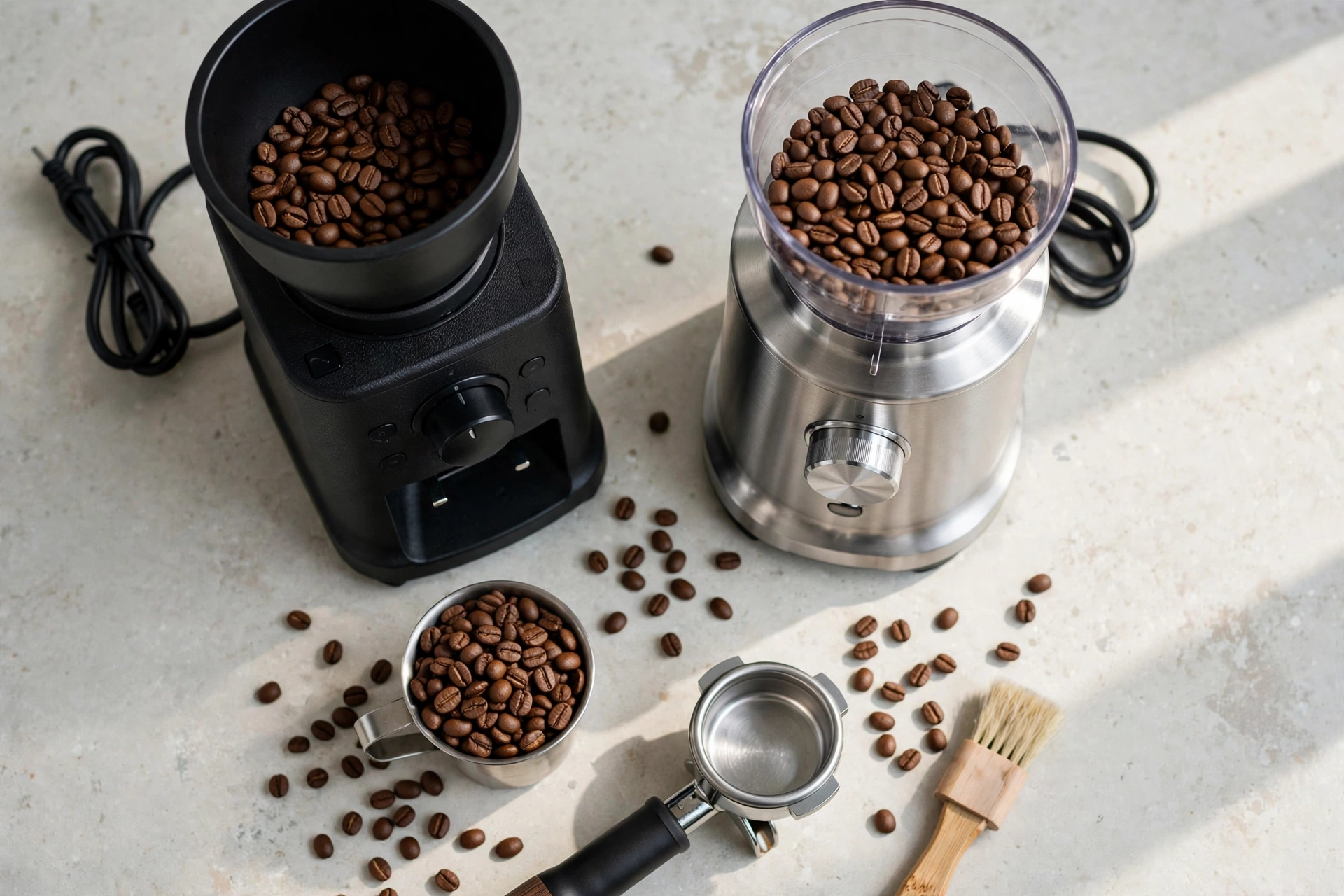
The short answer: if espresso is the point of the setup, buy the Baratza Encore ESP; if the grinder serves the whole kitchen, the Fellow Opus earns its place. Both cost ≈$200 — the Encore ESP at $199.95, the original Opus at $195 at launch and $179.99 at one retailer at the time of writing, where original stock remains. Both use 40mm conical steel burrs and both genuinely span espresso to cold brew. What separates them is not grind quality — side-by-side comparisons find the grounds and the cup very close, with the Opus, if anything, slightly sweeter when dissected — but how each divides its fine end, and what each asks of you in return. Prices and specs checked 2026-11-02. Prices vary by retailer; where sources disagreed we used the manufacturer’s current price.
Disclosure: we are an independent research desk and earn no commission on anything here. This page contains no affiliate links. See our disclosure policy for how we stay independent.
We are a research desk, not a test lab: we synthesize manufacturer specifications, owner reports, forum threads, and published reviews rather than claiming hands-on testing we have not done.
Before you buy: check which Opus you are actually buying
This comparison is about the original Fellow Opus: 40mm C6-40 burrs, an outer dial numbered 1–11, and an inner micro-adjustment ring under the load bin. Fellow now sells the Opus 2 in the US — a different grinder with 48mm burrs and a stepless side dial — and the original Opus’s US product page is gone. Original stock still turns up at retailers, but a listing that just says “Opus” may ship either generation. If it ships the Opus 2, none of the adjustment, burr, or workflow detail below applies. Confirm the generation first; everything that follows is original-Opus only.
First principles: at $200, adjustment resolution is the espresso decision
Espresso dial-in means finding the one setting where 18g of coffee extracts in the right time, and the steps around that setting need to be small — the difference between a choked shot and a gushing one can be a few microns. Both grinders solve this, but with opposite architectures.
The Encore ESP concentrates its resolution: its 40 settings are split into two bands, with settings 1–20 moving the burrs in tiny steps across the espresso range and settings 21–40 taking bigger strides for filter. Turn the dial and you are, by construction, moving in espresso-sized increments where it counts.
The Opus spreads its resolution: its outer dial runs 1–11 in quarter steps across the entire range, espresso to cold brew, and precision at the fine end comes from a second, inner ring inside the load bin that subdivides each outer step. Per Fellow’s figures, one outer step moves the burrs about 50 microns; with the inner ring, steps shrink to roughly 16.7 microns — finer, on paper, than the ESP’s steps. But that precision is behind a hatch: you lift the lid, reach inside, and adjust a ring you cannot see while grinding. Owner reports reflect the learning curve — the printed espresso range of 1–2 grinds finer than many owners need, and typical shots land around 3.5–5 rather than where the dial suggests.
So the mechanism question is not “which grinder is more precise” but “where does its precision live, and what does it cost you to use it?” The ESP puts espresso precision on the main dial. The Opus puts it behind a second control, and spends the main dial on the whole brewing range.
Comparison table
Prices and specs checked 2026-11-02. Prices vary by retailer; where sources disagreed we used the manufacturer’s current price.
| Spec | Baratza Encore ESP | Fellow Opus (original) |
|---|---|---|
| Current price | $199.95 | $195 at launch; $179.99 at one retailer at time of writing, original stock varies |
| Burrs | 40mm M2 conical steel | 40mm C6-40 6-blade conical steel |
| Adjustment | 40 stepped settings: #1–20 fine micro-steps for espresso, #21–40 macro-steps for filter | 41+ settings: outer dial 1–11 in quarter steps, plus inner micro-adjustment ring under the load bin |
| Burr speed / motor | 550 RPM, high-torque DC with gear reduction | 350 RPM, 6 Nm torque |
| Grind speed | 1.3–2.2 g/sec | Not published as a headline figure; timed autostop instead of a speed claim |
| Hopper / load bin | 300g hopper (holds a full bag) | 110g load bin with volumetric dosing lid and grind guide under the lid |
| Grinds into | 120g grounds bin + 54mm dosing cup (58mm adapter included) | 110g magnetic catch cup |
| Dosing | Manual: pulse button or on/off knob, hands-free; no timer | Timed autostop: 30, 60, or 90 seconds, or a long press for 2 minutes |
| Static control | Low RPM keeps static and heat down | Anti-static ionizer; Fellow guidance says it wants cleaning about every 60 grinds |
| Retention | Typically 1–2g | Low by design; one former owner reported roughly 1–2g held back |
| Noise | Loud — the loudest unit in one five-grinder comparison | Quiet — repeatedly described as roughly half as loud as the ESP |
| Cleaning | Quick-release toolless upper burr; shim kit included to shift the whole range finer | Burrs accessible for cleaning; no-tool calibration |
| Size | ≈13 × 15 × 34 cm | ≈8.3 × 5.1 × 10.6 in |
| Warranty | 1 year (US parts and labor) | 1 year |
| Repairability | Low-cost parts + self-help guides sold direct by Baratza | No comparable official parts channel |
| Availability note | In current production | Original US page gone; successor Opus 2 now sold in the US — verify generation before buying |
Grind quality and the espresso window
This is the section that matters most, and the honest summary is that the cup does not separate these two as much as the dials do.
Encore ESP: the fine end is the whole point. Settings 1–20 exist for one job, and owners consistently describe the ESP as espresso-capable out of the box with no calibration ritual. A shim kit ships in the box; each shim moves the whole range finer by about five settings’ worth, a real tuning option if your machine needs a finer window. The cost of the ESP’s approach shows up elsewhere — it is loud, and dosing is fully manual — but at the fine end itself, there is nothing to learn beyond turning the dial.
Opus: capable, with a learning curve. The burrs and the motor are not the limitation: the 40mm C6-40 set at a slow 350 RPM produces grounds whose uniformity reviewers found very similar to the ESP’s, and in the cup the two are close enough that side-by-side tasters struggle to tell them apart except, on close dissection, a slightly sweeter Opus. The limitation is the interface. The outer dial’s espresso territory is narrow — settings 1–2 on paper — and owners report that territory running too fine in practice, pushing real shots out to 3.5–5. The inner ring fixes the granularity, but it is a second control inside the machine, not a dial you nudge mid-routine. Once learned, it works; until learned, dial-in takes more shots than the ESP asks for.
Clumps and retention are a draw. Both grinders benefit from a WDT stir at espresso fineness, and both retain roughly 1–2g in owner reports — ordinary for 40mm conicals at this price. Neither grinder wins the retention argument; the ESP’s slow burrs and the Opus’s ionizer attack static from different directions and land in a similar place.
The practical translation: if your shots run through unpressurized baskets and you dial in new coffees often, the ESP’s dedicated micro range saves you shots every week. If you run pressurized baskets, where the basket forgives grind error, the Opus’s adjustment question mostly disappears.
Workflow and features: the Opus’s home turf
This is where the Opus earns its half of the comparison, and the gap is wide.
The Opus is the quieter, smaller, more automated machine. Timed autostop means dosing is a button press — 30, 60, or 90 seconds — rather than a watched pour. The magnetic catch cup lifts off cleanly, the volumetric dosing lid measures beans for up to 12 cups of brewed coffee, and the grind guide printed under the lid means you rarely consult a chart. At roughly 8.3 × 5.1 × 10.6 in, it is the smaller countertop object, and its Fellow styling — the same restrained geometry as the Ode — reads as kitchen furniture where the ESP reads as an appliance. The trade is material: the Opus’s external pieces are plastic, which is part of how it hits its price, and it lacks the ESP’s premium heft.
The Encore ESP is deliberately manual. There is no timer, no scale, no display: a pulse button (runs while held) and an on/off knob with hands-free operation. Dosing means weighing or watching, and the 300g hopper means you load a bag and grind from it all week rather than weighing each dose. For espresso-purist workflows that single-dose with a scale anyway, the manual dosing is not a loss. For everyone else, it is the ESP’s biggest daily inconvenience — and the noise compounds it, since a loud manual grind at 6 a.m. is the worst version of both drawbacks at once.
Neither grinder is a true single-doser: the ESP is a hopper grinder, and the Opus’s 110g bin sits between a hopper and a single-dose workflow — enough for several brews, not a full bag, and its timed autostop suits grinding a few doses ahead rather than one weighed dose at a time.
Build, longevity, and the repairability gap
The two companies sell different promises about what happens in year three.
Baratza sells repairability as a feature. The company actively markets low-cost replacement parts and self-help guides from its own site, the burr set releases toollessly for cleaning, and the motor carries thermal overload protection. The warranty is short — 1 year — but the expected life is long because a broken grinder can become a working one with a cheap part. Our Encore ESP vs Smart Grinder Pro comparison covers the same repairability argument against a different rival.
Fellow sells design and a quieter motor on a plastic body. The Opus carries the same 1-year warranty, but there is no official parts channel comparable to Baratza’s, so a post-warranty failure is closer to a replacement event than a repair. What Fellow does offer is a motor running at 350 RPM — slower, cooler, and under less stress than the ESP’s 550 RPM — inside a body that asks less of your counter and your ears every morning.
Net: the Baratza is more likely to still be grinding in year five because you can fix it; the Opus is more pleasant to live with in years one and two because it is quiet, small, and timed. Which matters more depends on how you buy appliances — repair math or daily-experience math.
The verdict
- Buy the Baratza Encore ESP if your coffee is mostly espresso through unpressurized baskets. The 20-setting micro range is the single most useful espresso feature either grinder offers at this price, the 300g hopper suits a bag-at-a-time routine, and the repairability story means it is a purchase rather than a subscription. Accept manual dosing and the noise as the price of the specialisation.
- Buy the Fellow Opus (original) if you brew across methods, value a quiet morning, a small footprint, and timed dosing, and you are willing to learn the inner ring to unlock its espresso range. Confirm the listing ships the original, not the Opus 2 — and if it ships the Opus 2, treat that as a different purchase decision, not this one.
- Either grinder pairs with a Bambino-class machine, but note the match-up: a pressurized-basket beginner gets more from the Opus’s convenience, while a non-pressurized dial-in devotee gets more from the ESP’s fine control. For the wider context, our grinders under $500 roundup places both against the next tier up, how much to spend on a grinder explains what each price band buys, and how to dial in espresso covers the routine both grinders serve.