
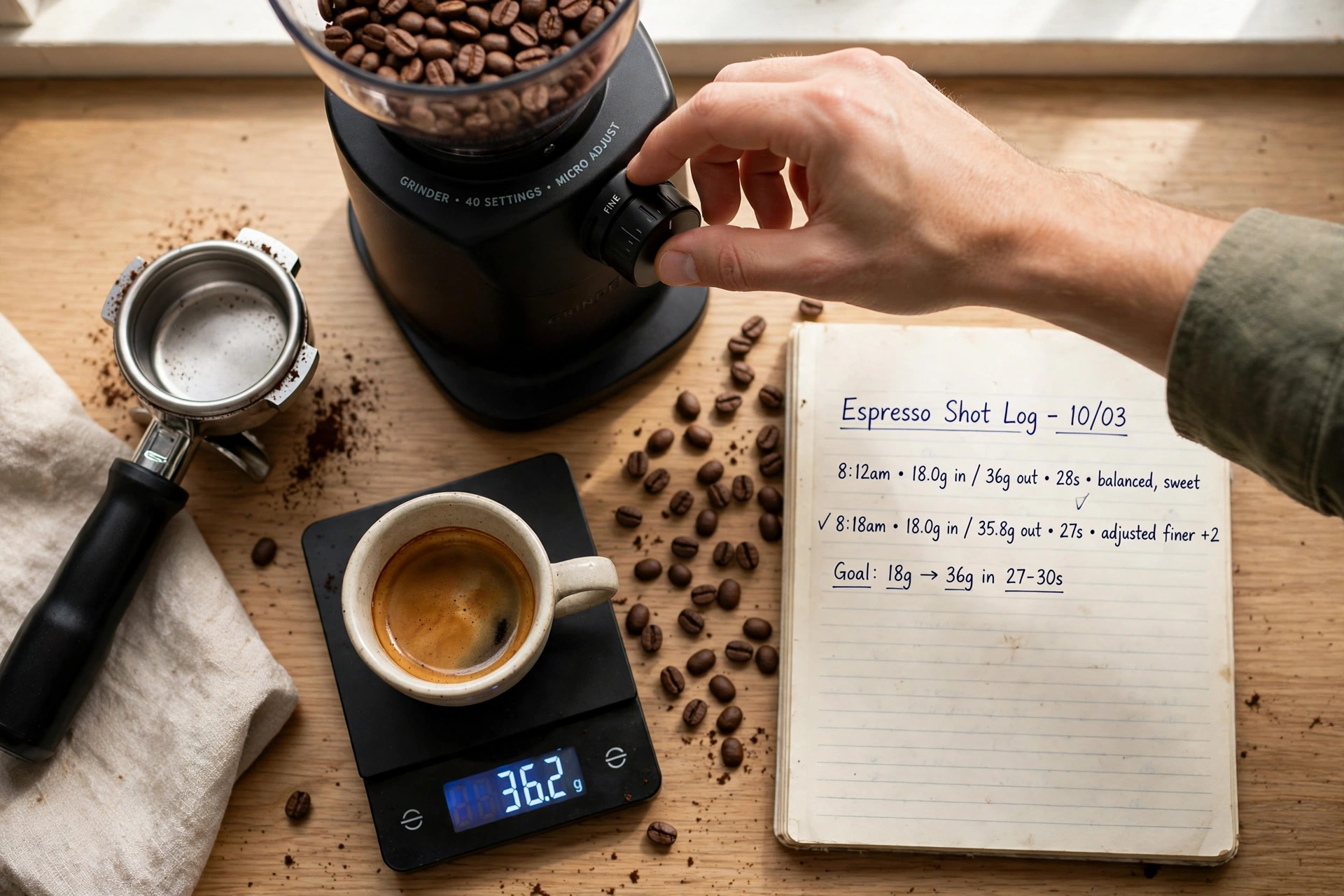
The short answer: dialing in is a controlled search, not a talent. Fix the dose at about 18g and the yield at about 36g out, then move only the grind — finer to slow the shot, coarser to speed it up — until the shot lands in 25 to 30 seconds. Then stop chasing the clock and adjust by taste: a touch finer or a longer yield for sour, a touch coarser or a shorter yield for bitter. Every bag of coffee gets this treatment because every bag pushes back against the water differently.
What you are actually solving for
An espresso machine does one crude thing: it forces hot water at about 9 bars through a packed puck of ground coffee. The machine does not decide how the shot tastes. The puck does, by resisting.
That resistance controls two things at once. It sets how long water spends in contact with the coffee, and it sets how much of the coffee’s soluble material the water can strip out on the way through. Water dissolves flavor compounds in a fixed sequence — bright acids first, then sugars, then harsh bitter compounds — so contact time becomes a cutoff. Stop the water early and the cup is sour and thin, all first act. Let it run long and the bitter compounds flood in and dry the shot out. A balanced shot is the cutoff landing after the sugars and before the bitters take over.
Dialing in is simply finding the grind setting where that cutoff lands in the sweet window for the coffee in your hopper. Grind is the master variable because particle size is resistance: finer particles pack into smaller gaps, water struggles through more slowly, and the same water also sees more surface area to dissolve from. One turn of the dial moves time and extraction together, which is why small turns matter so much in espresso and why the search converges fast if you change nothing else at the same time.
The recipe you start from, and why
You need a fixed reference point or the search has no anchor. The standard starting recipe for a double shot:
- Dose: 18g of dry coffee in the basket
- Yield: about 36g of liquid espresso in the cup, a 1 to 2 ratio
- Time: 25 to 30 seconds from pump start
- Water: about 93°C, which most machines hold on their own
None of these numbers is magic. Eighteen grams is what a typical double basket holds without the puck pressing into the shower screen. One to two is the middle of the usable ratio range — shorter ratios (1 to 1.5) taste intense and syrupy, longer ones (1 to 2.5 or more) taste clearer and weaker. The 25 to 30 second window is where a medium-roast coffee at this dose and ratio usually finishes dissolving its sugars before the bitters arrive. Treat the recipe as a hypothesis, not a rule: the point of dialing in is to test it against the coffee you actually have and move it where the taste says to.
Two practical notes. Weigh the yield with a scale under the cup, because crema makes volume readings meaningless — 36g and 50 milliliters are not interchangeable. And decide whether your machine’s timer should start at pump-on or first drips, then stay consistent; about 5 seconds of that gap is pre-infusion, and mixing conventions makes your notes incomparable.
The loop, shot by shot
- Weigh 18g, grind, distribute, tamp level. Distribution matters more than tamp force: break up clumps and spread the grounds evenly, or water finds one weak channel and the shot lies to you.
- Pull the shot onto the scale and time it. Stop the pump at about 36g out, wherever the clock happens to be.
- Taste before you touch anything. Sour, salty, and thin means the cutoff fell early. Dry, ashy, and bitter means it fell late. A shot that is both sour and bitter is not a grind problem — that is channeling, and the fix is distribution.
- Move one small grind step in the direction the taste indicates. Faster than 25 seconds and sour means finer. Slower than 30 seconds and bitter means coarser.
- Purge, then repeat. Most grinders hold a few grams of the previous setting in the chamber and chute. Run a few grams through after each adjustment or the next shot is a blend of two settings and the result teaches you nothing.
Because finer grind stacks slower flow on top of more surface area, the response to each step is amplified. A big jump can sail straight past the window — a 17-second sour shot becomes a choked 42-second bitter one. Sneak up on it. Two to four shots is a normal dial-in once the first shot has told you which direction the coffee needs.
Reading the shot
| What you observe | What it means | Next move |
|---|---|---|
| About 36g out in under 20 seconds, sour and thin | Too coarse, cutoff fell in the acid phase | One step finer |
| About 36g out in 25 to 30 seconds, sweet, clean finish | The cutoff landed in the window | Stop. Write the setting down |
| About 36g out past 35 seconds, dry and bitter | Too fine, cutoff fell in the bitter phase | One step coarser |
| Good time, but sour and bitter together | Channeling, not a grind setting issue | Fix distribution and clumps |
| Good time and ratio, tastes flat and woody | The coffee is stale, not mis-dialed | Fresher beans; no setting rescues it |
| Shot chokes, only drips | Far too fine, or basket overfilled | Coarser; check the puck clears the shower screen |
Keep this table honest with weights. If you are eyeballing yield, the time column and the taste column stop agreeing and every diagnosis gets murky.
When the recipe stops working: roast and age
The starting recipe is tuned for medium roasts. Roast level physically rebuilds the bean, so it moves the window your grind has to find.
Light roasts are dense and less porous. Water penetrates slowly and extraction lags, so dialed like a medium roast they stall in the acid phase and taste sour even at textbook times. Compensate with a finer grind, a longer ratio around 1 to 2.5, or both — and accept a longer shot time as correct for that coffee.
Dark roasts are brittle and porous. They give up their compounds quickly and slide into bitterness early. Start coarser, consider a shorter ratio around 1 to 1.5 to 1 to 2, and expect the window to be narrower before the shot turns harsh.
Aging moves the target within a single bag. Fresh-roasted coffee is loaded with carbon dioxide, which adds puck resistance. Over one to three weeks the gas escapes, resistance falls, and shots at the identical setting run progressively faster and thinner. Nothing is broken. Nudge the grind finer as the bag ages, and stop expecting a week-old dial-in to survive contact with a fresh bag — a new bag, especially a new roast, restarts the search from the recipe.
The variables you are not touching (yet)
Temperature, pressure, and puck prep all influence extraction, but while dialing in they are constants, not dials. Temperature around 90 to 94°C is whatever your machine holds; hotter water extracts more aggressively, cooler water is more forgiving, and most home machines give you little say. Pressure is about 9 bars at the pump by design. What you do control in prep — even distribution and a level tamp — determines whether the grind setting gets a fair test. Channeling makes a correct setting look wrong, which is why prep is fixed first and grind is judged second.
Change one variable at a time, and only one. That discipline is the entire method. The moment dose, yield, and grind all move between shots, every result becomes uninterpretable and dialing in turns into roulette.
Keep a log, or re-learn it every morning
Dialing in ends with information, and information evaporates unless you write it down. A minimal log per bag: the coffee and roast date, the grind setting, dose and yield, time, and two or three words of taste. The pattern across a bag teaches you how that coffee ages; the setting for the last bag gets you within a step or two on the next one. Thirty seconds of writing converts tomorrow’s guesswork into a starting point.
That is the whole skill. A fixed recipe as the hypothesis, grind as the single dial, taste as the instrument, and a log so the search never starts from zero. Master that loop and the machine becomes what it should be — plumbing that holds its side steady while you run the experiment.