
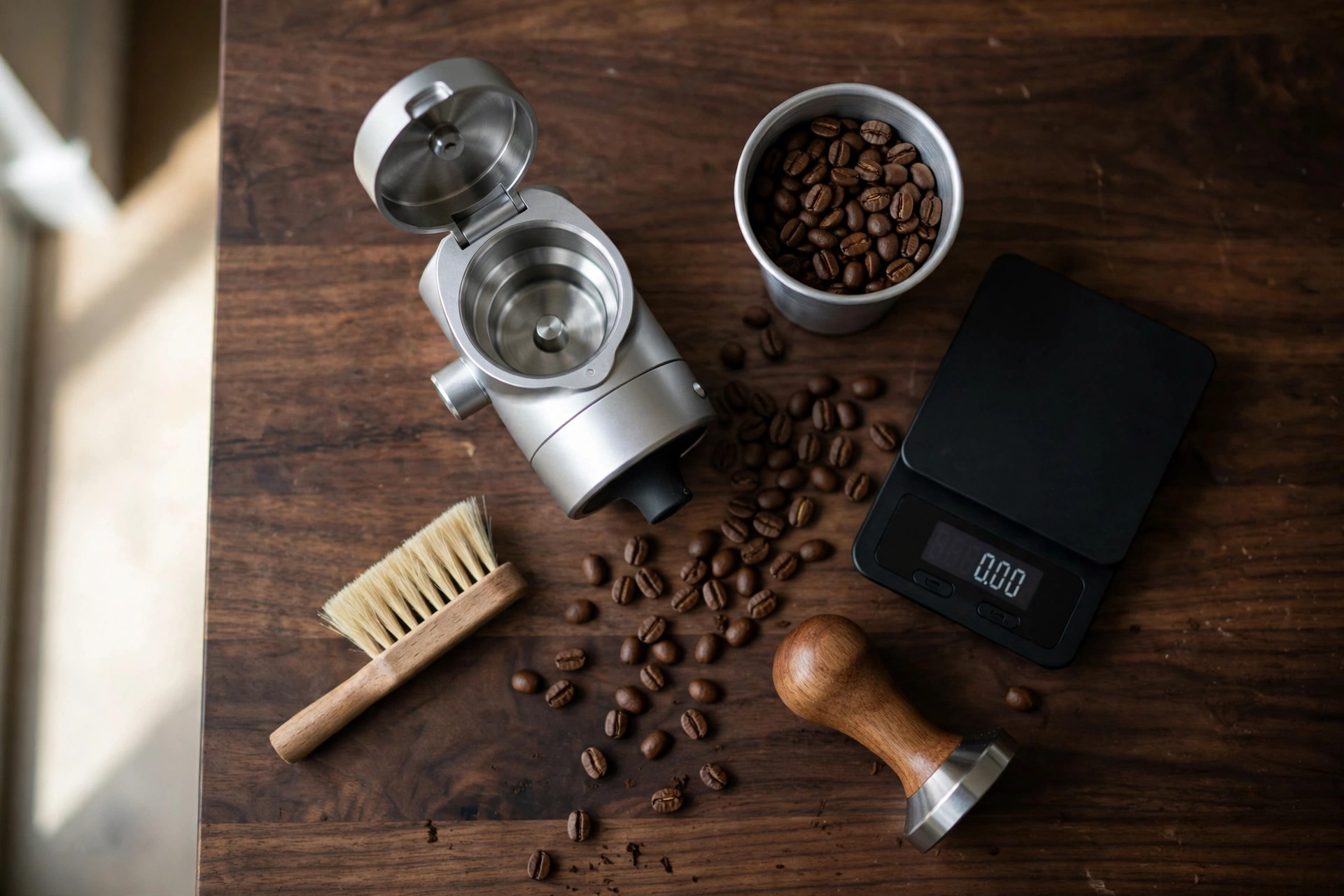
The short answer: the Niche Zero and the DF64 II answer different questions. The Niche Zero is a £559 (about $740) 63mm conical single-dose grinder optimised for ease: the quietest serious grinder in its class, a straight-through path that retains almost nothing without bellows, and the smoothest workflow of any grinder near this money. The MiiCoffee DF64 II is a $399 64mm flat-burr single-dose grinder optimised as a platform: brighter clarity in the cup, especially with light roasts, and access to the whole 64mm aftermarket burr ecosystem (SSP sets at $185) for the cost of one upgrade. Both are stepless, both single-dose, both espresso-capable. Buy the Niche for the ritual; buy the DF64 for the tuning bench. Prices and specs checked 2026-10-12. Prices vary by retailer; where sources disagreed we used the manufacturer’s current price.
Disclosure: we are an independent research desk and earn no commission on anything here. Vendor links on this page are plain links to manufacturer and retailer pages — no affiliate tracking. See our disclosure policy for how we stay independent.
We are a research desk, not a test lab: we synthesize owner reports, forum threads, published measurements, reviews, and teardowns rather than claiming hands-on testing we have not done.
First principles: the price gap is a burr-philosophy gap
Every comparison of these two grinders eventually reduces to one line: conical versus flat burrs. The rest — price, noise, workflow, upgrade paths — is downstream of that geometry choice, so understand it first.
Conical burrs crush beans between a cone and an outer ring. The particle spread they produce is bimodal: a main peak at the target size plus a tail of very fine particles. Those fines do three useful things for espresso. They add body and texture to the cup. They make the puck more cohesive, which resists channelling — the uneven flow that ruins shots. And they forgive dial-in mistakes, because the fines slow the shot even when the main peak is a little off. The cost is flavour separation: the wide spread muddles delicate notes into one warm, sweet, integrated cup. This is the classic espresso profile — chocolate, nuts, caramel, syrup — and it is what the Niche Zero’s 63mm Mazzer Kony-family conical burrs are tuned to deliver.
Flat burrs shear beans between two parallel rings. The spread is unimodal: tighter, with fewer fines. Tighter extraction means flavours land separately rather than merged — clarity, acidity, distinct floral or fruit notes. Light roasts, which are dense and extract stubbornly, are where flat burrs earn their reputation: the uniform grind lets you push extraction without the bitterness that fines would bring. The cost is forgiveness. A tight distribution means the dial-in window is narrower; miss it and channelling shows up faster because there are no fines bracing the puck. That is the DF64 II’s flavour signature, and it is also why its 64mm burr platform matters: you can swap burr geometries (SSP Multipurpose, High Uniformity, Lab Sweet) and change the flavour character without buying a new grinder.
Neither shape is objectively superior. If your cup is mostly medium and dark roasts and you value texture, the conical philosophy wins. If you chase light-roast single origins and want each note identifiable, flat wins. The Niche Zero is a destination: it does one philosophy perfectly. The DF64 II is a platform: it lets you change philosophies for $185 a set.
Comparison table
Prices and specs checked 2026-10-12. Prices vary by retailer; where sources disagreed we used the manufacturer’s current price.
| Spec | MiiCoffee DF64 II (Gen 2) | Niche Zero |
|---|---|---|
| Current price | $399 (MiiCoffee) | £559 direct from Niche (about $740) |
| Burrs | 64mm custom stainless flat | 63mm hardened steel conical (Mazzer Kony family) |
| Adjustment | Stepless | Stepless, infinite dial |
| Motor | 250W AC, 1400 RPM | Geared permanent-magnet DC (slow burr speed) |
| Grind speed | About 2–3 g/sec | About 1 g/sec (≈10–12 sec per 18g dose) |
| Dosing | Single-dose, bellows to clear chamber | Single-dose, straight-through path, no bellows |
| Retention | Claimed under 0.1g (bellows technique) | Exchange retention under 0.5g by design; independent tests 0.4–0.7g total, max 0.3g exchange, dose ±0.2g |
| Static control | Plasma generator (ionizer) in exit chute | Geared slow burrs, direct-drop path |
| Anti-popcorning | Anti-popcorn cover/disc | NFC (flow-control) disc |
| Noise | Typical single-dose grinder, 1400 RPM pitch | 72dB claimed; widely reported as the quietest in its class |
| Weight | 15 lb (6.5 kg) | 9 lb (4.1 kg) |
| Footprint | About 12 x 5.2 x 10 in | 122 x 211 x 311mm (4.8 x 8.3 x 12.2 in) |
| Build | Aluminium body, plastic collar | Aluminium body, real oak trim |
| Burr upgrade path | Full 64mm ecosystem; SSP sets $185 from MiiCoffee | Sealed platform; stock burrs only |
| In the box | 58mm aluminium dosing cup, brush, metal power button | Grinder, 58mm grind cup, socket driver, cleaning brush, user manual |
| Warranty | 1 year (importer) | 1 year |
| Availability | In stock at MiiCoffee | US plug variant in stock, ships within 7 days |
Grind quality and flavour: clarity against body
This is the section that matters most, and it is almost entirely burr geometry.
DF64 II (flat): clarity and separation. The custom stainless 64mm flat burrs produce the tighter distribution flat burrs are known for. In the cup that reads as definition: florals stay floral, acidity stays bright, and light-roast single origins get the clean, separated extraction they need. Owner reports consistently describe the stock-burr cup as clear with slightly thinner texture than conical competitors — the expected trade for the unimodal spread. Dialling in takes more shots: the narrow window means a grind that is slightly off shows in the cup faster.
Niche Zero (conical): body, sweetness, and forgiveness. The 63mm conical burrs make the bimodal spread that defines classic espresso: bigger body, thicker texture, integrated sweetness across chocolate-nut-caramel coffees. The fines give the puck structural forgiveness, so a new coffee dials in within a few shots and the window for a good pull is wider. Owners describe medium and dark roasts as easy and sweet. The trade is at the top end of delicacy: the same fines that build body blur the fine detail that flat-burr shots separate.
The practical translation: neither grinder makes a bad shot. The DF64 II rewards attention and punishes sloppiness; the Niche rewards routine and rarely punishes anything. For a beginner, that forgiveness is a real, daily advantage. For a tinker who enjoys the dial-in process, the flat-burr ceiling is higher on the coffees it favours.
Workflow: bellows technique against the straight-through path
Both are single-dose grinders — you weigh the beans, pour them in, grind them out, and the next dose starts fresh. How each achieves low retention is where the daily experience diverges.
The Niche Zero was designed from the ground up for single dosing. Its straight-through path drops grounds directly from the burrs with almost no chute to hold them, so nothing needs clearing: open the lid, drop in beans, flip the toggle switch. Exchange retention runs under half a gram by design, and independent tests put total retention at 0.4–0.7g with dose consistency within ±0.2g. There is no bellows, no thump ritual, no static spray needed for most users. It is the simplest single-dose routine on the market, and its quietness is the other half of the ritual: the geared DC motor spins slowly and Niche claims 72dB, with owners widely calling it the quietest grinder they have owned.
The DF64 II takes the engineer’s route: a horizontal-ish grind chamber with bellows on top that you pump to push retained grounds through the chute. MiiCoffee claims under 0.1g retention with the technique, and the current V2.6 adds an anti-popcorn disc with a convex blocker plus a plasma generator (ionizer) in the chute to kill static. It works, but it is a technique — bellows occasionally fall off, static shows up with some beans, and the declumper assembly wants more cleaning attention than the Niche’s direct-drop path. The 1400 RPM AC motor is an ordinary single-dose grinder in noise: louder and higher-pitched than the Niche, which matters at 6 a.m.
Both have anti-popcorning discs now (the Niche’s NFC disc, the DF64 II’s anti-popcorn cover), and both are stepless — the Niche’s collar adjustment is famously smooth and intuitive; the DF64 II’s collar uses a metal indicator so a setting can be noted and returned to, which is essential since stepless dials have no numbered home.
Size, build, and the kitchen question
The Niche is the smaller, lighter, quieter object: 9 lb and a 122 x 211 x 311mm footprint, aluminium body with real oak trim, designed to look at home on a kitchen counter. It reads as furniture; the designer, Martin Nicholson, came at it as an object first and it shows.
The DF64 II is industrial: 15 lb, a taller body (about 12 x 5.2 x 10 in), aluminium with a plastic collar, utilitarian rather than elegant. It is a machine that looks like what it does. On a crowded counter the Niche’s smaller footprint and lighter presence are genuine advantages, and at about 5 inches wide the DF64 II is not huge either — but nobody buys the DF64 for its looks.
Price, value, and the SSP question
The pricing structure is the honest summary of the two philosophies.
- DF64 II: $399 at MiiCoffee (in stock when checked; also $399 at df64coffee.com).
- Niche Zero: £559 direct from Niche — about $740 at current rates — with a US plug variant in stock and shipping within 7 days. Niche sells direct; there is no US retailer network to hunt for discounts.
The gap is roughly $340, and it buys refinement, quiet, workflow simplicity, and design — not grind superiority in any absolute sense.
The DF64 II’s counterweight is the upgrade path. SSP burr sets (Multipurpose, High Uniformity, Lab Sweet V2/V3) run $185 from MiiCoffee, and independent testing reports the SSP Multipurpose burrs cut fines by roughly 15–20% in sieve testing, noticeably lifting sweetness in light roasts while keeping flat-burr clarity. A $584 all-in DF64 II with SSP burrs still undercuts the Niche by about $155 and delivers light-roast clarity the Niche’s conical geometry cannot replicate. That is the platform argument: the DF64 II is the only grinder here that can grow into a second grinder.
Note what the SSP upgrade does not change: workflow, noise, size, or the conical-versus-flat question. If what you want is the Niche’s ease, buy the Niche; burrs do not make a DF64 II quiet or bellows-free.
The verdict
- Buy the Niche Zero if you value the daily ritual: the smoothest single-dose workflow here, near-zero retention with no bellows, the quietest grinder in its class, a small counter-friendly footprint, and forgiving shots from medium and dark roasts. You are paying about $340 over the DF64 II for ease and refinement — a real, daily-meaningful premium if ease is what you are buying.
- Buy the DF64 II if you want flat-burr clarity, especially for light-roast single origins; you like the idea of a burr platform that can change flavour character with a $185 SSP set; or $400 is the budget and the alternative is a worse grinder, not the Niche. Accept the bellows routine, the louder motor, and the narrower dial-in window as the price of the platform.
- Start with stock burrs on the DF64 II. Run them for a few months, learn the grinder’s dial-in rhythm, and only then decide whether an SSP set targets a flavour you are actually missing. The stock burrs already do the flat-burr job.
Both grinders justify their reputations: the Niche Zero as the single-dose grinder that made the category, the DF64 II as the flat-burr platform that democratised it. Pick the flavour philosophy and the workflow you will live with every morning, because that — not the price — is the real decision. If you want the broader picture first, our best grinders under $500 roundup covers the DF64 II against six others, and how much to spend on a grinder explains what each price band actually buys.