
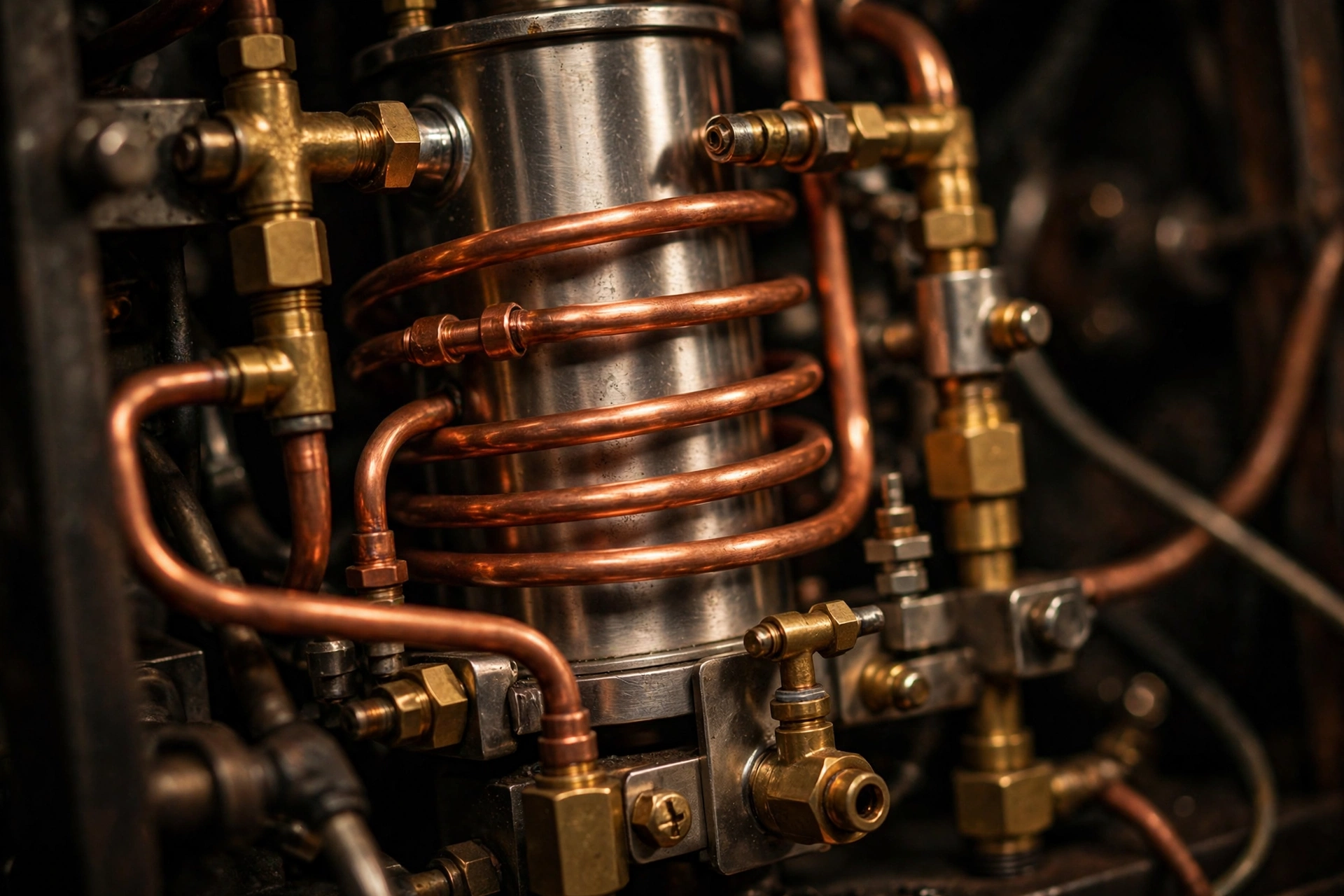
The short answer: a boiler has one hard job — keep brew water at 90–94°C, stable, shot after shot, while also producing steam. Every boiler design is a different answer to the same conflict: brewing wants ≈93°C water, steaming wants ≈120°C and up, and one vessel can’t be both temperatures at once. Single boilers pick one at a time, heat exchangers run hot and cool the brew water on the way through, dual boilers keep two vessels, and thermoblocks skip the vessel entirely.
The conflict every design is solving
Espresso extraction is temperature-sensitive in a way that forgiving methods like pour-over aren’t. Water at 88°C under-extracts (sour, thin); water at 96°C over-extracts (bitter, harsh). The target band is narrow — roughly 90–94°C — and it has to hold steady while 25–30 seconds of cold-ground coffee is absorbing heat from it.
Steam has the opposite demand. To stretch and texture milk you need dry, forceful steam, which means a boiler running well above boiling point — typically 120–140°C — building 1–1.5 bars of steam pressure.
One vessel, two temperatures, mutually exclusive. That’s the entire problem space. Everything below is engineering working around it.
The four answers
Thermoblock: heat on demand
Mechanism: No reservoir. Cold water enters a narrow, heated channel (usually an aluminum block with a serpentine water path) and exits at temperature seconds later.
Strengths: Warmup in 1–3 minutes instead of 20–30. Compact, lightweight, cheap to manufacture — which is why it dominates entry-level machines.
Weaknesses: There’s no thermal mass to buffer anything. When cold water rushes in mid-shot, the block plays catch-up, so brew temperature fluctuates more than in any boiler design. Steam is typically weaker too, since you can’t store pressurized steam — you generate it as you go.
Best for: Beginners pulling straight espresso or occasional milk drinks, anyone who wants the machine on and ready in minutes. Not the pick if you’re chasing shot-to-shot repeatability.
Single boiler: one vessel, two modes
Mechanism: A real boiler (usually brass or stainless, 0.5–1.5 liters) held at one temperature. A switch or the machine’s logic flips it between brew mode (≈93°C) and steam mode (≈120°C+).
Strengths: Genuine thermal mass gives better temperature stability than a thermoblock at the same price. Often paired with a PID controller on mid-range models, which holds the set temperature within a degree or two. Simple, proven, inexpensive.
Weaknesses: You can’t brew and steam at the same time. The workflow for a cappuccino is: pull the shot, flip to steam mode, wait 1–2 minutes for the boiler to climb, steam, then wait for it to cool back down (often with a purge of water) before the next shot. For one milk drink a morning this is fine. For three lattes in a row it’s a chore.
Best for: Straight-espresso drinkers, or one-milk-drink-per-day routines where the waiting doesn’t compound. The price-to-shot-quality ratio is excellent — the grinder matters more at this tier anyway.
Heat exchanger (HX): one hot boiler, clever plumbing
Mechanism: The boiler runs permanently at steam temperature (≈120°C+), which gives you full steam pressure on demand. Brew water never sits in that boiler — it travels through a copper tube immersed in it, absorbing heat as it passes. Because the tube’s water is slightly superheated, you do a short cooling flush before the shot to bring the brew path into the 90–94°C range.
Strengths: Brew and steam simultaneously — the boiler never changes modes. Strong, dry steam (prosumer HX machines are famously good steamers). Mid-range price point for the capability.
Weaknesses: The cooling-flush ritual is real and slightly wasteful — you run water through the group for several seconds before every shot, and the timing matters. Temperature precision is inherently a few degrees looser than a PID dual boiler; you manage temperature with flush timing rather than a digital setpoint. (A PID on an HX controls the steam boiler, which indirectly steadies brew temps — helpful, but not the same as direct brew-temp control.)
Best for: Home baristas who make milk drinks regularly and want simultaneous brewing and steaming without dual-boiler money. The HX is the classic “prosumer sweet spot” for a reason.
Dual boiler: two vessels, no compromises
Mechanism: Two independent boilers — a small brew boiler (≈0.5–0.8 L) held at your exact brew temperature, and a larger steam boiler held at steam temperature. Each has its own PID or pressurestat. You set 93°C and it stays 93°C.
Strengths: The best of everything: brew and steam simultaneously, direct digital control of brew temperature (adjust single degrees to suit different coffees), strong steam, no flush rituals, fastest back-to-back workflow. Saturated groups on many models add even more temperature stability at the group head.
Weaknesses: Price (usually 1.5–2× an equivalent HX), size, weight, and energy use. More plumbing means more potential maintenance points over a decade of ownership.
Best for: Enthusiasts who want exact control, households making several milk drinks back-to-back, and anyone who’d rather pay once than upgrade twice.
Side-by-side
| Thermoblock | Single boiler | Heat exchanger | Dual boiler | |
|---|---|---|---|---|
| Brew + steam simultaneously | Weak steam, yes | No | Yes | Yes |
| Temperature precision | Lowest | Good (great with PID) | Good (flush technique) | Best (direct PID) |
| Warmup time | 1–3 min | 15–25 min | 20–30 min | 25–40 min |
| Steam power | Weakest | Good | Strong | Strongest |
| Ritual/skill required | Low | Mode switching | Cooling flush | Low |
| Typical home price tier | Entry ($–$$) | Entry–mid ($$–$$$) | Mid–upper ($$$) | Upper ($$$$–$$$$$) |
What actually matters when you’re choosing
Warmup time is a lifestyle question, not a quality question. Thermoblocks win on speed, but many boiler machines can be put on a smart plug timer so the machine is hot when you wake up. Don’t buy a thermoblock for warmup speed alone — buy it for the price, or don’t.
Count your milk drinks. One flat white a day? A single boiler’s wait is a minor annoyance. Three lattes every morning, or entertaining guests? Simultaneous brewing and steaming (HX or dual) stops being a luxury and starts being the whole experience.
PID matters more on single boilers than anywhere else. On a single boiler, a PID directly holds your brew temperature — it’s the single most impactful upgrade at that tier. On an HX, a PID controls the steam boiler, so it’s an indirect benefit. On a dual boiler, you get one per boiler and full direct control.
Don’t overbuy the boiler and underbuy the grinder. A single-boiler machine paired with a genuinely good grinder will out-pull a dual boiler fed by a mediocre one, every time. The boiler controls temperature stability; the grinder controls extraction itself, and extraction dominates the cup. Budget accordingly.
Think in decades. Boilers are built to be serviced — gaskets, pressurestats, and heating elements are replaceable on most boiler machines, and a well-maintained dual boiler or HX can run 15–20 years. Thermoblocks are less serviceable by design. If you’re buying your “forever” machine, serviceability is part of the price calculation.
The bottom line
The boiler types aren’t ranked by quality — they’re ranked by how much of the temperature problem you want the machine to solve for you. Thermoblocks solve it cheaply and approximately. Single boilers solve brewing well and make you wait for steam. Heat exchangers solve both with a small ritual. Dual boilers solve both with a digital setpoint and a bigger invoice. Match the design to how many milk drinks you make, how much ritual you’ll tolerate, and — always — leave enough budget for the grinder, because it decides the cup more than the boiler does.