
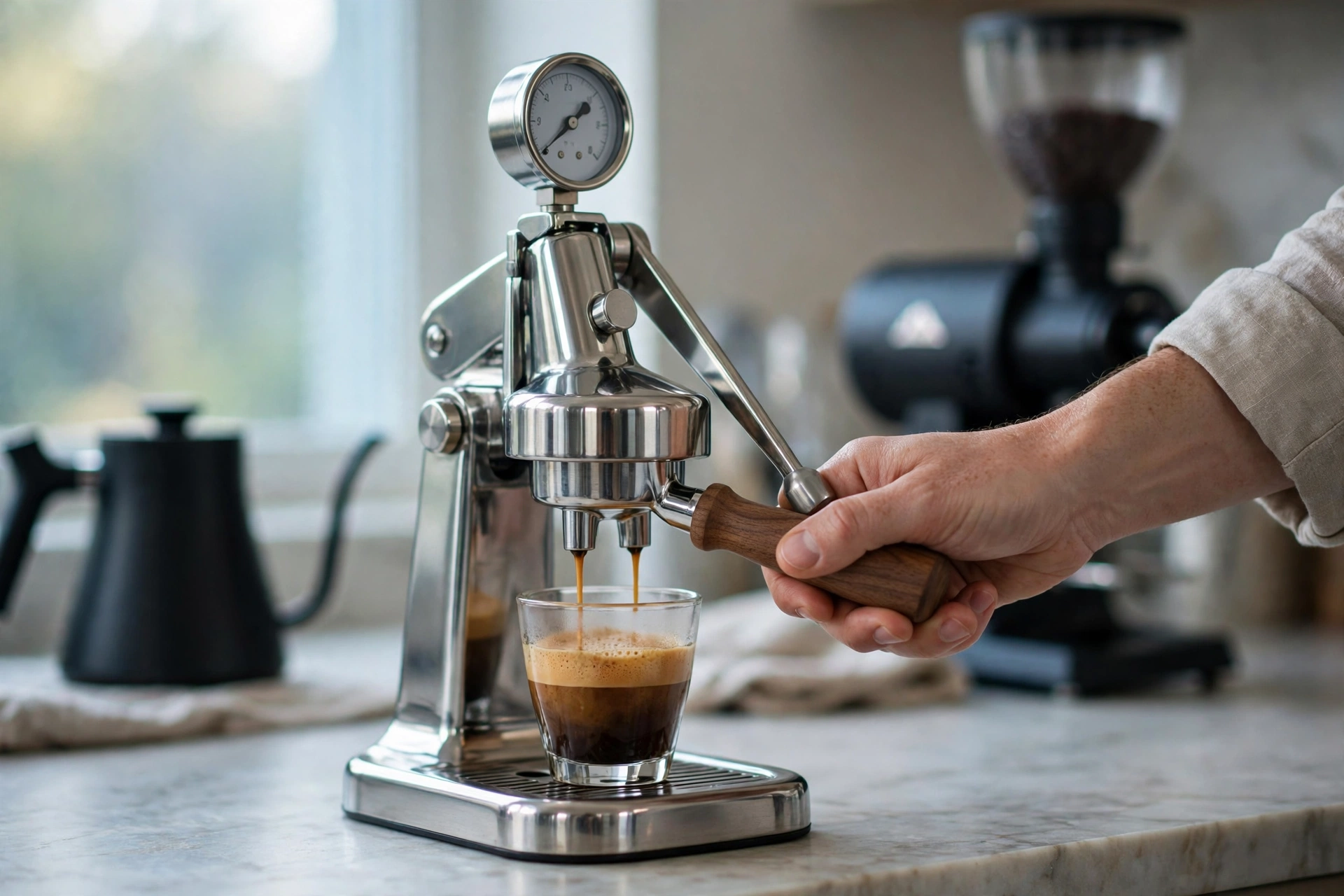
The short answer: buy the Gaggia Classic Pro E24 if you want a complete espresso machine; buy the Flair 58 Plus 2 if you want the best shot your hands can pull. The Gaggia ($449–$499) is a pump machine with a brass boiler, a 58mm portafilter, and a real steam wand — it heats its own water, holds 9 bar on its own, and makes milk drinks with nothing extra to buy. The Flair 58 Plus 2 ($699 on flairespresso.com) has no pump, no boiler, and no steam wand: your arm is the pump, your kettle is the boiler, and a separate steamer handles milk. What it gives you in exchange is total control over the pressure curve — the one thing a stock pump machine cannot do — in a smaller, silent footprint with a 5-year warranty. Prices and specs checked 2026-11-14. Prices vary by retailer; where sources disagreed we used the current retailer price and said so.
Disclosure: we are an independent research desk and earn no commission on anything here. Vendor links on this page are plain links to manufacturer and retailer pages — no affiliate tracking. See our disclosure policy for how we stay independent.
We are a research desk, not a test lab: we synthesize manufacturer specifications, owner reports, forum threads, and published reviews rather than claiming hands-on testing we have not done.
First, the naming: which Flair 58, and which Gaggia
Both names in this comparison need a sentence of untangling before any spec matters, because both lines have been renamed.
On the Flair side, “Flair 58” now means one machine: the Flair 58 Plus 2, $699 on flairespresso.com. The original Flair 58 launched with no built-in preheat, the Flair 58 Plus added an optional electric preheat element, and the Plus 2 folds that preheat controller — plus simplified wiring and a smaller power supply — into the standard package. Flair’s own product page for the 58 now sells only the Plus 2, and the current lineup’s other models are the Classic ($159–$229), the NEO Flex ($99), and the 49 Pro ($349). If you see an older review quoting a Flair 58 at $580, or a used listing described simply as “the Flair 58,” it is a discontinued configuration — confirm which generation you are buying, especially secondhand, because the preheat setup and the included baskets differ.
On the Gaggia side, the current machine is the Classic Pro E24 (model RI9380), the brass-boiler revision of the 2019 Classic Pro. It sells for $499 at Whole Latte Love and ≈$449 at Amazon when checked 2026-11-14. Gaggia’s own US site has restructured its manual-machine pages — the old Classic Pro URL now returns a 404, and the current menu lists the Classic E24, Classic GT, and Classic UP — but retailers still sell the E24 as the Classic Pro, and it is the machine every current comparison means by the name. Confirm the model code RI9380 with the seller before paying.
First principles: who makes the pressure
An espresso machine does four jobs: heat water, push it through finely ground coffee at about 9 bar, hold the temperature steady while it does so, and — if you drink milk — turn steam into microfoam. The two machines split those jobs in opposite ways, and that split is the whole comparison.
The Gaggia is a pump machine. An electric pump pushes water at a fixed pressure — its OPV is set to 9 bar from the factory on the E24 — through a brass boiler held at temperature by a thermostat. You flip a switch and the machine does the pushing; your job is the puck. The pressure curve is the same every shot: on, hold, off.
The Flair is a direct lever machine. There is no pump and no boiler. You heat water in a kettle, pour it into the brew chamber, and press a lever with your arm — roughly 25–30 lb of force — while a pressure gauge shows what you are applying. The pressure curve is whatever your arm does: start gently at 3–4 bar to let the puck soak, build to 9 bar for extraction, ease off to 6–7 bar at the finish. That declining profile is how the best lever espresso has always been made, and it is the reason high-end electric machines now ship programmable pumps that imitate it.
Neither approach is a shortcut. The pump gives you consistency you do not have to think about; the lever gives you control a pump cannot offer. The question is which one you want to own every morning.
Comparison table
Prices and specs checked 2026-11-14 from Flair’s product page, Whole Latte Love and Amazon listings for the Gaggia E24, and current 2026 reviews; retailer prices vary. Where the manufacturer’s own page is gone, the table says so.
| Spec | Gaggia Classic Pro E24 (RI9380) | Flair 58 Plus 2 |
|---|---|---|
| Price when checked | $499 at Whole Latte Love (was $549); ≈$449 at Amazon | $699 on flairespresso.com; $780 with travel case |
| Price gap | $200–$250 cheaper | — |
| Machine type | Semi-automatic, single boiler, pump | Manual direct lever, no pump, no boiler |
| Boiler / heating | Brass single boiler, 1350 W boiler (1425 W total) | None — kettle water poured in; electric preheat controller in brew head, 3 settings (85 / 90 / 95 °C) |
| Extraction pressure | 9-bar OPV (stock) | Your arm, via lever; gauge included; peak ≈9 bar |
| Pre-infusion | Manual, via switch timing | Manual, via lever at 3–4 bar |
| Portafilter / group | 58mm stainless portafilter, brass group | 58mm walnut portafilter, 3 baskets (high dose, low dose, pressurized) |
| Dose | ≈18 g | 16–20 g |
| Water capacity | 72 oz (2.1 L) tank | 90 ml per shot, poured in by hand |
| Yield | Continuous, tank-fed | Up to 55 ml per shot |
| Steam / milk | Commercial 2-hole steam wand, built in | None — separate Wizard / eWizard steamer or handheld frother required |
| Grinder included | No (both) | No (both) |
| 3-way solenoid valve | Yes | N/A (no pump) |
| Warm-up | ≈5 min to brew-ready | Under 3 min per shot including preheat and kettle time (Flair) |
| Dimensions (W × D × H) | 8 × 9.5 × 14.2 in | 17.5 × 13 × 6.5 in (base 7.5 × 13 in, 11 in tall with lever lowered) |
| Weight | 20 lb | 12 lb |
| Power | 1425 W | 96 W (preheat controller only) |
| Warranty | 2 years | 5-year limited |
| Electricity needed | Yes | Only for the preheat controller — unplugs to brew without wires |
Extraction: a fixed 9 bar against a curve you draw
The Gaggia’s extraction is a fixed-pressure event. The pump pushes at 9 bar, the thermostat holds the boiler, and the shot runs the same way whether you are awake or not. That consistency is the machine’s core virtue and its ceiling: it cannot pre-infuse gently and taper off, because the pump has one speed. What it can do is repeat — and repeatability is what a beginner needs most, because a shot that changes every morning teaches nothing.
The Flair’s extraction is a performance. You control the pressure in real time, watching the gauge, and the shot is different every time your arm is different. Done well, the gentle start and the tapered finish produce espresso often described as silkier and more complex than the same coffee from a pump machine — the declining pressure extracts fewer of the harsh compounds that a flat 9 bar pulls at the end of a shot. Done badly, the same freedom produces a fast, sour shot or a choked one, and the gauge tells you only after the fact.
One honest caveat belongs here, because the thin comparisons on page 1 skip it: the Flair’s temperature control is less even than its marketing suggests. Long-term thermocouple testing by The Coffee Chronicler found the bottom of the heated chamber running around 87–88 °C on a standard preheat while the top runs significantly hotter, and the frame measurably flexes above 4–6 bar of pressure. The preheat controller helps — it is a real improvement over the original Flair 58, which asked you to preheat a cold metal chamber with boiling water and race the clock — but it does not make the Flair a temperature-stable machine in the way a boiler is. For light roasts, use the highest setting and give it time.
Dialling in works the same way on both machines — grind, time the shot, adjust — but on the Flair the lever is a second variable on top of the grind, and the gauge is your only feedback.
Temperature and workflow: five minutes against three, every morning
The Gaggia warms up in about five minutes to brew-ready, longer for full thermal stability, and then it stays ready: flip the switch, pull the shot, flip the steam switch, texture milk. One machine, one plug, one workflow. The cost is the single boiler’s wait between brewing and steaming, and the thermostat’s temperature surfing — the stock machine has no PID, and owners learn to time the ready light rather than trust it.
The Flair’s per-shot workflow is shorter on paper — Flair says under three minutes including preheat and kettle time — but it is a ritual every time: boil the kettle, set the preheat, dose and tamp, pour 90 ml of water in, pull the lever, then repeat the whole sequence for a second shot, including reheating the water. There is no tank, no ready light, no idle state. For one espresso a morning the ritual is part of the pleasure. For two lattes back to back it is a production line you run by hand.
The footprint difference favours the Flair on paper — its base is about 40% smaller than a standard semi-automatic — but the comparison is misleading, because the Flair’s station includes a kettle and, for milk drinks, a separate steamer. Counted as a complete station, the Flair takes more counter, not less. The Gaggia is 8 inches wide and 14.2 inches tall; the Flair is 7.5 inches wide at the base but needs kettle space beside it and clearance above for the lever’s arc.
Milk: built in against bought separately
This is the cleanest split in the comparison, and for milk-drink households it decides the purchase on its own.
The Gaggia has a commercial two-hole steam wand and a boiler behind it. It textures real microfoam for latte art, with the usual single-boiler pause between brewing and steaming. Nothing extra to buy, nothing extra on the counter.
The Flair has no steam at all. Milk drinks need Flair’s Wizard stovetop steamer or eWizard electric steamer, or a handheld frother such as the Subminimal NanoFoamer (≈$35). The frother route works and adds about a minute; the steamer route adds a real appliance and real money. Either way, the Flair’s headline price is not the price of a milk-drink station.
If your daily drink is a flat white or a latte, the Gaggia wins this section outright. If your daily drink is straight espresso, the section does not matter — and the Flair’s lack of a steam wand is weight and cost you never carry.
Grinder and total station cost: the gap reverses
Neither machine includes a grinder, and both are equally grinder-dependent: lever extraction punishes inconsistent grind just as much as pump extraction does. Flair itself says to expect at least $150 for an espresso-capable stepless grinder, and that figure is a floor, not a recommendation — a good espresso grinder is the difference between a lever that rewards you and one that frustrates you. Our guide to how much to spend on an espresso grinder and our beginner grinder roundup cover the options.
Counted as complete stations, the price gap reverses. The Gaggia at $449–$499 plus a $150–$250 grinder is a complete espresso-and-milk station for roughly $600–$750. The Flair at $699 plus the same grinder, plus a temperature-controlled kettle (≈$50–$100 for a good one), plus a milk solution ($35 for a frother, more for a steamer), is a complete station for roughly $950–$1,050 — before the travel case ($780 package) or any accessories. The Flair is the more expensive machine to own, not the cheaper one, and its $200–$250 headline premium understates the real gap by about half.
The Gaggia’s other cost advantage is its mod community — the largest in home espresso. A PID kit ($40–$80) drops temperature variance from roughly ±5 °C to ±0.5 °C, and the OPV, baskets, and bottomless portafilter all have deep aftermarket support. The Flair has no equivalent upgrade path because there is almost nothing to upgrade: no pump, no boiler, no electronics beyond the preheat controller. That is a virtue if you value simplicity and a 5-year warranty on a machine with almost nothing to break; it is a ceiling if you enjoy improving a machine over time.
Who should buy which
The decision turns on one question: do you want a machine, or a ritual?
Buy the Gaggia Classic Pro E24 if you want a complete espresso machine — one plug, one workflow, milk drinks included — or you make more than one drink a morning, or you want the deepest mod community in home espresso and a machine that grows with you. It is the better buy for most people, and the cheaper station by a wide margin once the kettle and the milk solution are counted.
Buy the Flair 58 Plus 2 if you drink straight espresso, you want full control over the pressure curve, you value silence and a small footprint, you travel or move often (it unplugs and brews without wires), or you simply enjoy the hands-on ritual and the 5-year warranty on a machine with almost nothing to fail. It is the better shot per dollar in skilled hands — and the more demanding machine in every other respect.
Buy neither if you want push-button convenience: the Gaggia still asks you to learn temperature surfing and tamping, and the Flair asks you to be the pump. Our machines for beginners roundup covers the more forgiving end of the range, and our manual machines hub covers the Flair’s lever neighbours, including the Cafelat Robot.
The verdict
- Buy the Gaggia Classic Pro E24 if you want a complete machine that heats its own water, holds 9 bar on its own, and steams milk with nothing extra — or you make multiple drinks a morning, or you want the mod path (PID, OPV, baskets) that lets the machine grow with you.
- Buy the Flair 58 Plus 2 if you drink straight espresso, you want the pressure control only a lever gives, you value silence and a 5-year warranty on a near-mechanical machine, or you want a station that unplugs and travels.
- Buy neither if milk drinks are the daily default and you will resent buying a separate steamer — that is the Gaggia’s job — or if you want the machine to do the work for you, in which case neither a pump machine without a PID nor a hand-powered lever is the right answer.
- Check the generation before paying. “Flair 58” on a used listing or an older review may be the discontinued original or the 58 Plus, not the Plus 2 sold new today at $699. And “Gaggia Classic Pro” should be the E24, model RI9380 — confirm the code with the seller.
The Gaggia is the better machine for most people. The Flair is the better shot for the person willing to be the machine.
Sources checked 2026-11-14: Flair’s Flair 58 Plus 2 product page ($699, $780 with case; 16–20 g dose, 90 ml capacity, up to 55 ml yield, 12 lb, 17.5 × 13 × 6.5 in, 5-year limited warranty, preheat settings 85 / 90 / 95 °C, grinder + kettle + scale required, Wizard / eWizard steamers); Whole Latte Love Gaggia Classic Pro E24 listing ($499.00, was $549.00; brass boiler, 58mm portafilter, 3-way solenoid, 2-year manufacturer warranty); Amazon and multiple 2026 reviews confirming the Gaggia E24 at ≈$449; our own Gaggia Classic Pro vs Rancilio Silvia comparison (2026-10-18) for E24 specs (brass boiler, 1350 W boiler / 1425 W total, 9-bar OPV stock, 72 oz tank, 8 × 9.5 × 14.2 in, 20 lb); 2026 Flair lineup reporting (original Flair 58 and 58 Plus folded into the Plus 2, the only 58mm model sold new) and The Coffee Chronicler’s thermocouple findings on the heated chamber (≈87–88 °C at the bottom on standard preheat, frame flex above 4–6 bar). Plain links: Flair 58 Plus 2 at Flair Espresso, Gaggia Classic Pro E24 at Whole Latte Love.