
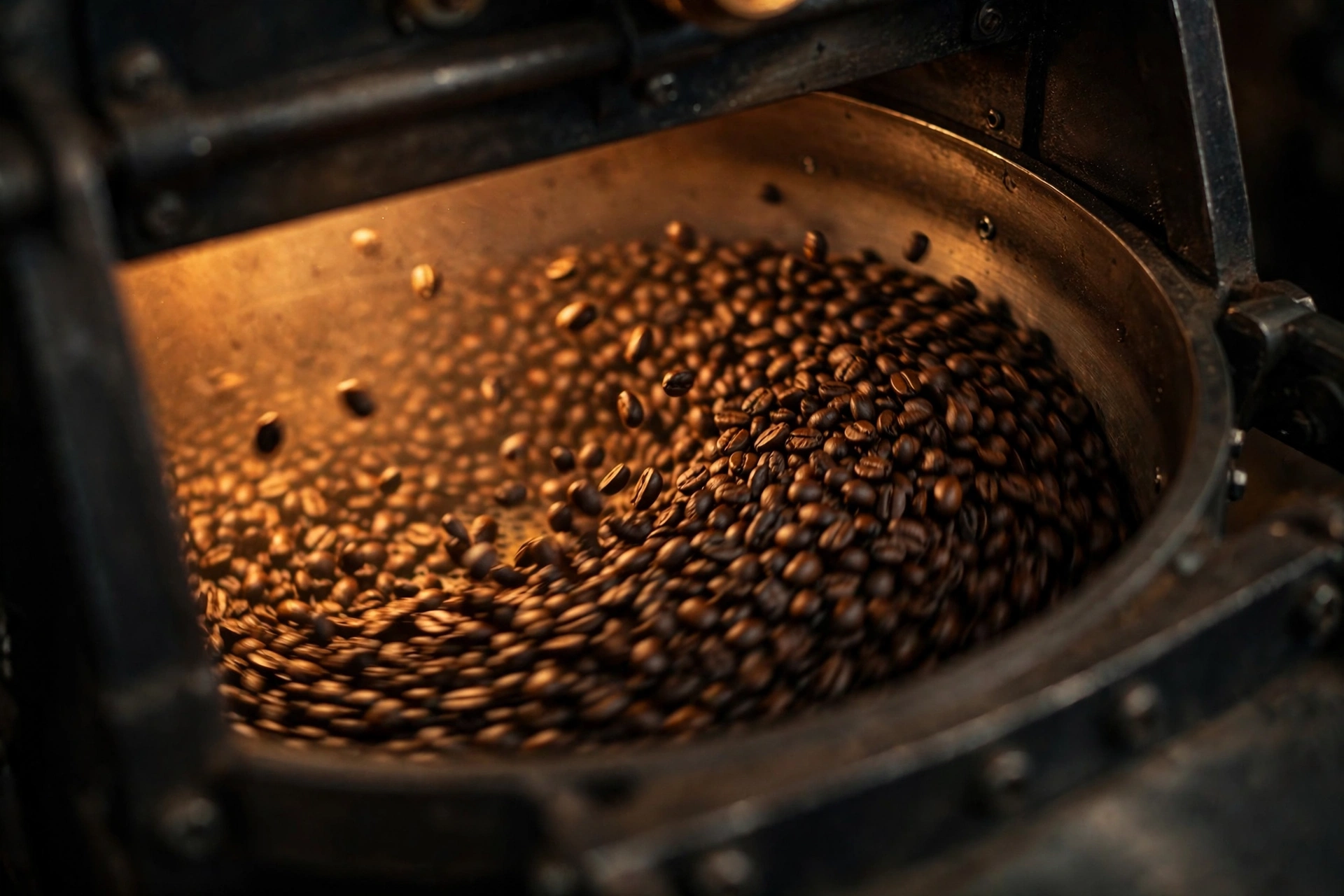
The short answer: dark roast is the easier espresso default, and light roast is the higher-ceiling option. Dark-roasted beans are more porous and soluble, so they extract fully in espresso’s brief 25–30 second contact time — low acidity, heavy body, rich crema, forgiving to dial in. Light roasts keep more of the bean’s origin character: brighter, fruitier, more acidic — but their dense, hard structure under-extracts easily, so they demand a finer grind, hotter water, and longer ratios. Most home baristas should start with a medium-dark espresso roast, then explore lighter roasts once their grinder and technique are solid.
We are a research desk, not a test lab: we synthesize roaster specifications, published measurements, and owner reports rather than claiming hands-on testing we have not done. Facts checked 2026-10-14 against current coffee reference sources.
First principles: what roasting does to the bean
Roasting is chemistry, not colouring. As green beans heat up, a few transformations happen in sequence:
- First crack (about 196°C): built-up water vapour and gases rupture the bean’s cell walls with an audible pop. The bean expands and its density drops.
- Pyrolysis (201–206°C): carbohydrates and fats break down, releasing gases and creating around 700 volatile aromatic compounds — this is where most of the flavour you taste is born.
- Second crack (about 224°C): the bean’s cellulose structure itself begins to fracture. Oils migrate to the surface. The bean is now significantly darker, lighter in mass (beans lose 10–20% of their weight through the roast), and structurally porous.
That last point is the one that decides everything for espresso. Longer roast → more cell-wall breakdown → more porous bean → more soluble coffee. Espresso gives hot water only about 25–30 seconds to dissolve flavour out of the grounds. A dark-roasted, porous bean surrenders its compounds quickly and completely in that window. A light-roast bean, pulled off just after first crack, is still dense and hard — water bounces off the locked-up interior, pulling acids out but leaving the balancing sweetness behind. That is why light-roast espresso so often tastes sour: it’s not the roast being “too acidic,” it’s under-extraction.
Meanwhile the acid chemistry moves in the opposite direction: chlorogenic acids (bitter/astringent when degraded) and bright organic acids both decline as the roast lengthens, while caramelisation and Maillard browning build chocolate, toast, and smoke notes. So roast level doesn’t add flavour so much as trade one flavour portfolio for another — origin character and acidity early, roast character and body late.
Side-by-side comparison
Facts checked 2026-10-14. Values are typical ranges across coffee reference sources; exact numbers vary by bean, roaster, and equipment.
| Factor | Light roast | Medium-dark roast | Dark roast |
|---|---|---|---|
| Pulled | Just after first crack | Between the cracks | Into or past second crack |
| Bean surface | Dry, matte, light brown | Dry to slightly glossy | Dark brown, oily sheen |
| Bean structure | Dense, hard, less soluble | Partially broken down | Porous, highly soluble |
| Acidity | High, bright, fruity | Balanced | Low, smooth |
| Body | Lighter, tea-like | Medium, rounded | Heavy, syrupy |
| Flavour direction | Floral, fruity, origin character | Caramel, chocolate, nuts | Chocolate, toast, smoke; ashy at the extreme |
| Crema (espresso) | Thinner, lighter | Full, persistent | Dark, dense, long-lasting |
| Extraction speed | Slow — under-extracts easily | Cooperates with 25–30 s | Fast — over-extracts if pushed |
| Dial-in difficulty | Hardest: sour if wrong | Forgiving | Easy, but ashy if overdone |
The middle column is where most “espresso roast” bags live, and it exists for a reason: medium-dark is the compromise point where the bean is soluble enough to extract cleanly in the espresso window while still holding some sweetness and character. It is the default recommendation for a reason — not because it’s the “best” flavour, but because it minimises the number of variables fighting you.
How each roast behaves in the cup
Straight espresso. Dark roast gives you the classic shot: low acidity, heavy body, chocolate and roast character, a dark dense crema that holds. Light roast gives you a very different shot — bright, juicy, sometimes tea-like, with the origin’s fruit notes front and centre — and noticeably thinner crema. Neither is objectively better; they’re different drinks that happen to share a basket.
Under milk. Milk fat is a great equaliser: it mutes bright acidity and softens delicate aromatics. A light roast’s floral fruit notes — the whole reason you paid the premium — largely vanish under 200 g of steamed milk, while its acidity can read as curdled sharpness. Dark roast’s body and low acidity cut straight through milk, which is why café lattes have tasted the way they do for a century. Match the roast to the drink: dark for milk, light for straight shots, medium-dark for both.
Dialing in: the recipe for each roast
Start from these conventions for an 18 g basket, then adjust one variable at a time:
- Medium-dark (the default): 18 g in → 36–40 g out, 25–30 seconds, 92–93°C. This is the forgiving zone — most bags labelled “espresso roast” land here.
- Light roast: 18 g in → 42–46 g out (roughly 1:2.3 to 1:2.5), 30–34 seconds, 94–95°C, grind noticeably finer. Add a 5–10 second pre-infusion if your machine allows it. Expect to work harder: small grind changes move the flavour a lot.
- Dark roast: 18 g in → 34–38 g out, 25–28 seconds, 90–92°C, grind slightly coarser. Lower temperature is the key move — dark roasts extract so easily that hot water pushes them into bitter, ashy territory.
Troubleshooting by taste: sour, sharp, thin means under-extracted — grind finer, raise temperature, or lengthen the shot. Bitter, dry, ashy means over-extracted — grind coarser, lower temperature, or shorten the ratio. For the full method behind these adjustments, see our dial-in guide and grind-size guide.
One equipment caveat: light roasts are the harshest test of your grinder. Finer grind demands a uniform grind — a budget grinder that produces lots of fines will give you sour and bitter in the same cup. If your shots are unpredictable, the grinder, not the roast, is usually the constraint. Dark roast is kinder to imperfect equipment precisely because it gives up its flavour so readily.
Which roast for which drinker
- New to espresso. Start medium-dark, roasted for espresso. You get balanced shots with the widest margin of error, and you learn what a correct extraction tastes like before adding difficulty. See our beginner bean guide and dark roast roundup.
- Milk-drink household. Medium-dark to dark. The body survives milk, the acidity stays smooth, and the whole family gets consistent drinks. Our latte beans roundup is built for this.
- Straight-shot flavour chaser. Medium or light roast, ideally single-origin arabica with a roast date on the bag. You’ll taste origin character that dark roasts erase. Budget for the learning curve — and a capable grinder.
- Caffeine-first drinker. Roast level barely matters; drink whichever tastes best. (And note that decaf beans are almost always arabica roasted medium-dark — see our decaf roundup.)
- Deciding between species too. Roast and species interact: a dark-roast robusta is about maximum body and crema, while a light-roast arabica is about pure flavour. Our arabica vs robusta guide and the Coffee Beans hub cover that axis.
Buying tips: roast dates and “omni roast”
Two things to read on the bag:
- Roast date matters more than roast level. Coffee degasses CO₂ for several days after roasting — espresso brewed from beans roasted yesterday is gassy and uneven. Let bags rest about 3–10 days post-roast, then drink within roughly 2–6 weeks. A two-month-old “premium light roast” will lose to a fresh medium-dark every time.
- “Omni roast” means one roast profile sold for both espresso and filter. It’s a commercial convenience (one roast, one bag, one SKU), not an optimisation — it usually lands medium, acceptable at both methods, ideal at neither. For espresso specifically, a roast actually designed for espresso extracts more reliably.
If you’re still building the rest of the setup — dose, grind, and extraction mechanics — those move the needle far more than agonising between roast levels. Freshness, a capable grinder, and a sane recipe will take any reasonable roast further than a “perfect” roast brewed carelessly.