
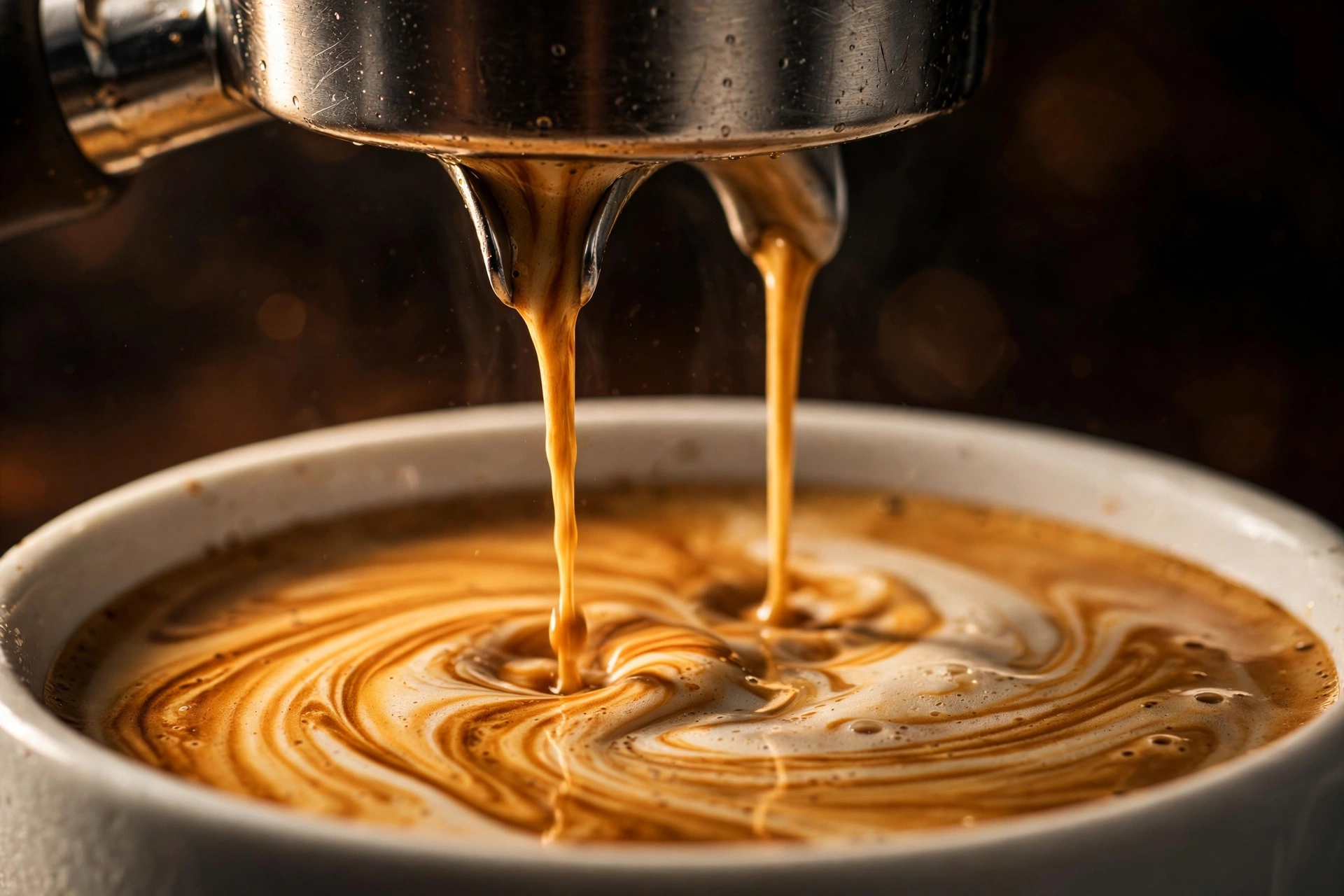
The short answer: extraction is the forced dissolving of flavor compounds out of the coffee puck — and it happens in a fixed sequence. Bright acids dissolve first, sweetness second, harsh bitter compounds last. A good espresso shot is a timed cutoff: you capture the first two stages and stop before the third takes over. Everything about dialing in espresso — grind size, shot time, brew ratio — is just engineering that cutoff.
Why there’s a sequence at all
Coffee grounds contain hundreds of compounds, and they don’t all dissolve equally. Small, highly soluble molecules — fruit acids, some salts — wash out almost immediately when hot water hits them. Larger, less soluble molecules — caramelized sugars, then bitter alkaloids and woody phenols — need more time and more water to let go.
Pressure doesn’t change this order; it compresses it. In drip brewing the sequence plays out over minutes. Under 9 bars of pressure through a fine puck, the same sequence plays out in 25–30 seconds. That compression is the entire reason espresso tastes like espresso: you get a concentrated hit of the early-to-middle compounds in a tiny serving, and you can stop the water before the late-stage bitterness arrives.
Think of it as three rough phases:
- Acids and brightness (roughly the first 10 seconds) — citric, malic, and other organic acids; salty notes. Alone this tastes sour and sharp.
- Sweetness and body (≈10–25 seconds) — sugars, caramelized compounds, the round middle of the coffee. This is the payoff zone.
- Bitterness and dryness (beyond ≈30 seconds) — caffeine’s harsh cousins, woody and ashy compounds. A little adds structure; too much ruins the cup.
No shot is purely one phase — they overlap. But the balance shifts as the shot runs longer, and that shift is what you’re tasting when you diagnose a shot.
The four variables that control the cutoff
You can’t reach into the puck and grab compounds selectively. You control the cutoff indirectly through four variables:
Grind size — the master dial. Finer grounds pack tighter and resist water longer, stretching the shot time and pushing deeper into the compound sequence. Coarser grounds let water through fast, cutting extraction short. Grind is the variable you adjust most, because it changes resistance without changing anything else.
Dose — the weight of dry coffee in the basket (typically 18g for a double). More coffee in the same basket means a thicker puck and more resistance, which slows the shot. Keep dose fixed while dialing in; changing it changes everything else.
Yield — the weight of liquid espresso out. More water pulled through the puck means more compounds dissolved. The standard starting ratio is 1:2 — 18g in, ≈36g out.
Time — how long the shot runs, typically 25–30 seconds from pump start. Time is mostly a readout of the other three: if your grind, dose, and yield are set and the shot takes 15 seconds, the puck offered too little resistance.
Then there are the supporting variables: water temperature (90–94°C; hotter extracts more aggressively, cooler is more forgiving), distribution (uneven grounds create channels where water rushes through, over-extracting the channel and under-extracting the rest), and tamp pressure (matters less than people think — a level, consistent tamp beats a hard one).
Reading a shot: the diagnosis table
Taste is the instrument. Here’s how to translate what you taste into what went wrong:
| Taste | Diagnosis | Fix |
|---|---|---|
| Sour, sharp, thin, salty | Under-extracted — stopped in the acid phase | Grind finer, or extend the yield slightly |
| Sweet, balanced, clean finish | In the window | Change nothing; this is the target |
| Dry, harsh, bitter, ashy | Over-extracted — too deep into the bitter phase | Grind coarser, or cut the shot earlier |
| Sour and bitter at once | Channeling — water rushed through cracks | Improve distribution; check for an uneven tamp or clumpy grounds |
| Hollow, watery, no sweetness | Stale coffee or far too coarse | Fresher beans; grind finer |
The sour-and-bitter combination confuses beginners, because it seems contradictory. It’s the signature of channeling: water found a weak path through the puck and over-extracted that channel while barely touching the rest. The fix isn’t grind — it’s puck preparation.
How dialing in actually works
Forget the folklore. The practical procedure:
- Fix your dose. Weigh 18g into the basket every time. Dose is a constant, not a dial.
- Fix your target yield. Aim for ≈36g of espresso out (1:2).
- Adjust grind until the shot lands in 25–30 seconds. Too fast? Grind finer. Choking or dripping past 35 seconds? Grind coarser.
- Taste. Now you’re in the right window — adjust by flavor. Sour? A touch finer or a slightly longer ratio (1:2.2). Bitter? A touch coarser or cut earlier (1:1.8).
Change one variable at a time. If you change grind, dose, and yield together, you’ll never know what fixed the shot.
One more thing beginners get wrong: shot time is a symptom, not a target. “25–30 seconds” is where a balanced shot tends to land with an 18g dose at 1:2 — it’s not a law. A light-roast coffee might taste best at 32 seconds; a dark roast might peak at 24. Time gets you into the neighborhood; taste picks the house.
What blonding tells you
Watch the stream coming out of the portafilter. It starts dark brown, almost syrupy, then gradually lightens to a pale yellow — “blonding.” That color shift is the easily dissolved compounds running out. Early, heavy blonding (pale by 15 seconds) means the puck gave up its good compounds fast — usually too coarse a grind or stale coffee. A stream that stays dark and never blondes suggests the shot is choked and barely extracting at all.
Many baristas use blonding as the visual cue to cut the shot: when the stream turns distinctly pale, the sweetness is mostly spent and what’s left is bitterness. It’s an approximation, but a useful one — especially before your palate is trained enough to diagnose by taste alone.
Roast level moves the whole window
The sequence is fixed, but roast level shifts where your shot lands in it. Light roasts are dense and less porous — water penetrates slowly, so they extract slower and often need a finer grind, a longer ratio (1:2.5 or even 1:3), or a slightly higher temperature to reach sweetness. This is why light-roast espresso frustrates beginners: dialed like a medium roast, it stalls in the acid phase and tastes sour.
Dark roasts are the opposite: porous, brittle, quick to give up their compounds. They extract fast and slide into bitterness early, so they typically want a coarser grind and a shorter ratio (1:1.5 to 1:2). The classic Italian-style dark shot — short, syrupy, low-acid — is just extraction stopped early on a coffee that was already halfway there.
This is also why “one recipe for all coffees” fails. The 18g-in/36g-out/27-seconds starting point is a medium-roast recipe. When you switch bags, expect to re-dial — not because anything is wrong, but because the roast moved the window and your grind has to follow it.
Why this matters more than gear
Here’s the payoff of understanding the mechanism: extraction is mostly about coffee freshness and grind, not machine price. A $3,000 machine pulling stale, pre-ground coffee produces perfectly extracted staleness — the pressure executes the sequence flawlessly on compounds that are already gone. Meanwhile a basic machine with fresh beans and a decent grinder can land squarely in the sweet window.
The machine’s job is to hold its side steady: consistent temperature, consistent pressure, even water distribution. Everything about what ends up in the cup is decided by the puck — how fresh the coffee is, how fine and even the grind is, and where you cut the shot. Learn to read extraction and you’ve learned the skill that every piece of gear is supposed to serve.