The short answer: arabica and robusta are not rivals — they are different tools. Arabica supplies sweetness, acidity, and aromatic complexity; robusta supplies caffeine, body, and a thick, persistent crema. Classic Italian espresso blends use both, typically 60–90% arabica with 10–40% robusta. Whether you buy 100% arabica or a blend comes down to how you drink your espresso: straight shots reward arabica’s nuance, while milk drinks and maximum-caffeine cups lean on robusta’s muscle.
We are a research desk, not a test lab: we synthesize roaster specifications, published measurements, and owner reports rather than claiming hands-on testing we have not done. Facts checked 2026-10-13 against current coffee reference sources.
The two species, briefly
Nearly all commercial coffee comes from two species of the Coffea genus. Coffea arabica accounts for roughly 60–70% of world production; Coffea canephora — universally called robusta — supplies most of the remaining 30–40%. For the full species profiles, including where each is grown and how the other two commercial species (liberica and excelsa) fit in, see our Coffee Beans hub.
The plant biology explains the economics before the cup ever gets involved. Arabica evolved at altitude (about 600–2,000 m), where cool temperatures and lower pest pressure let it grow slowly and develop complex chemistry — but the plant is fragile, prone to leaf rust, and yields modestly. Robusta evolved in lowland heat (about 0–800 m), shrugging off pests and disease with high yields and cheap farming. That single difference in hardiness is why robusta costs less at every stage from farm to bag.
First principles: chemistry predicts the cup
Forget flavour notes for a moment. The two species differ in three measurable ways, and almost every sensory difference follows from those three:
- Caffeine is roughly double in robusta. Arabica runs about 1.2–1.5% caffeine by dry weight; robusta about 2.2–2.7%. Caffeine is naturally bitter, so a large share of robusta’s harshness is caffeine itself, not bad roasting. The caffeine also acts as a natural pesticide in the field — one reason robusta needs less coddling — and it’s why instant coffee and “strong coffee” blends lean on robusta.
- Arabica carries more sugars and lipids. Arabica beans contain about 60% more lipids than robusta, plus higher natural sugar content. Lipids and sugars are the raw material for sweetness, aromatic complexity, and the silky mouthfeel that specialty roasters talk about. Robusta’s lower sugar and lipid levels leave its bitterness unmasked and its cup comparatively flat — though its lipid profile contributes a heavy, creamy body that works well under pressure in an espresso machine.
- Chlorogenic acids run higher in robusta. These antioxidants (about 10% of robusta’s dry weight versus about 8% for arabica) degrade during roasting into bitter and astringent compounds. More chlorogenic acid at the start means more bitterness and dryness in the finished cup, especially in lighter roasts that don’t caramelise it away.
One more consequence: crema. Robusta’s higher concentration of surface-active compounds stabilises foam better, so pure robusta shots wear a thick, dark, long-lasting crema. Arabica’s crema is thinner and more reddish-brown, though often more aromatic. Crema mechanics are the quiet reason robusta survives in espresso at all — a café pulling 100% arabica gets less visual drama and a crema that fades faster.
Side-by-side comparison
Facts checked 2026-10-13. Values are typical ranges across coffee reference sources; exact numbers vary by variety, origin, and roast.
| Factor | Arabica (Coffea arabica) | Robusta (Coffea canephora) |
|---|---|---|
| Share of world production | 60–70% | 30–40% |
| Caffeine | About 1.2–1.5% by weight | About 2.2–2.7% by weight |
| Sugars and lipids | Higher; drives sweetness and aroma | Lower; bitterness less masked |
| Flavour direction | Sweet, fruity, floral, acidic | Earthy, woody, bitter, rubbery when poor quality |
| Body | Light to medium, silky | Full and heavy |
| Crema (espresso) | Thinner, reddish-brown, aromatic | Thick, dark, long-lasting |
| Growing altitude | 600–2,000 m | 0–800 m |
| Plant hardiness | Fragile, rust-prone, low yield | Hardy, high yield |
| Price | Higher | Lower |
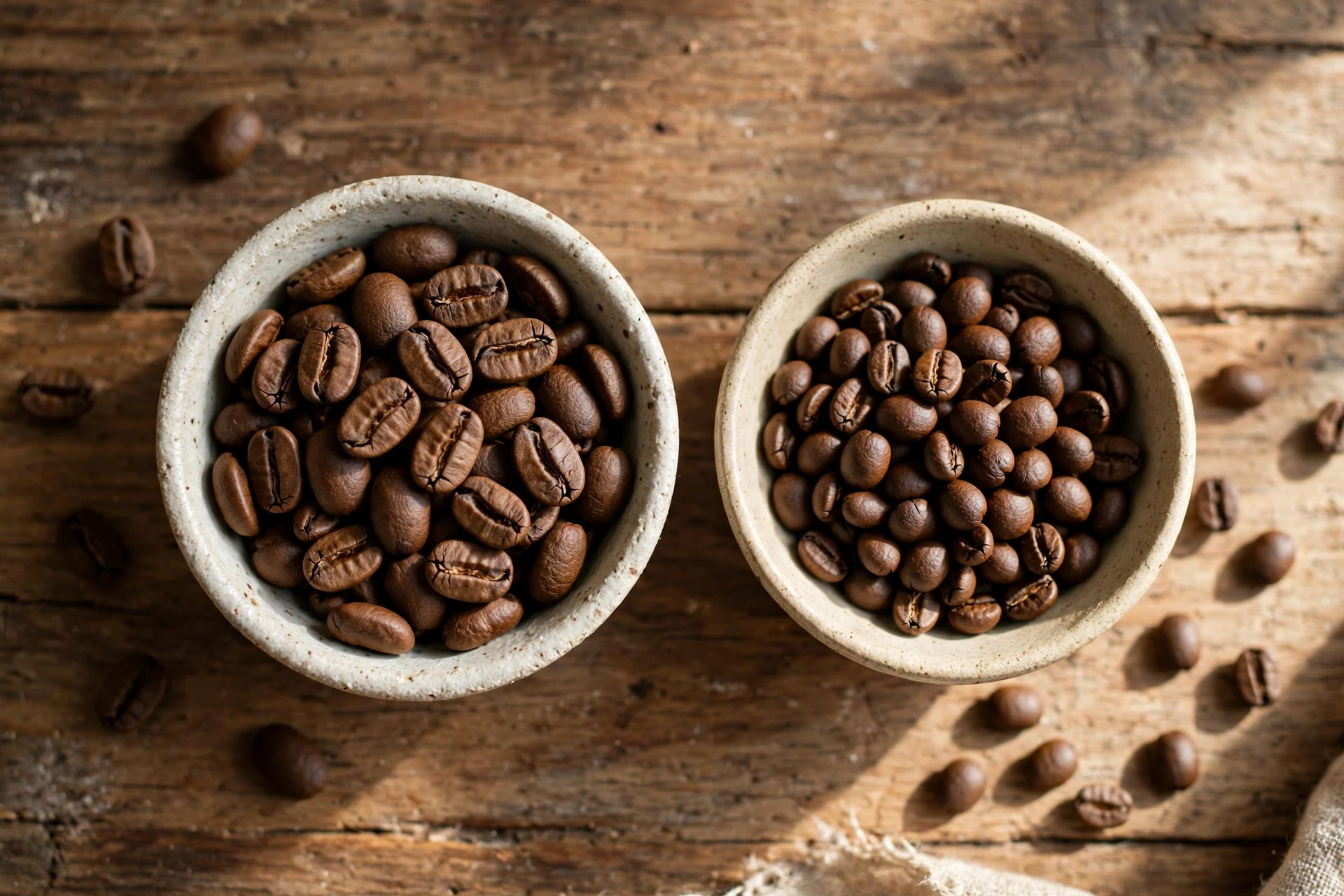
| Bean shape | Larger, oval, curved crease | Smaller, round, straight crease |
| Typical uses | Specialty espresso, single origins, filter coffee | Espresso blends, instant coffee, dark roasts |
Which should go in your espresso machine?
Stop asking which species is “better” and ask what the drink needs:
- Straight espresso you savour for flavour. Buy 100% arabica, ideally roasted for espresso (medium to medium-dark). You get the acidity, sweetness, and complexity that make a shot worth slowing down for. Our dark roast roundup is arabica-led for this reason.
- Milk drinks — lattes, cappuccinos, flat whites. Milk fat mutes bright acidity and delicacy, so the nuance you paid a premium for in 100% arabica partially disappears. An arabica–robusta blend (20–40% robusta is the traditional Italian range) keeps its body and punch under milk and gives you that dense, lasting crema. See our best beans for lattes.
- Maximum caffeine, minimum cost. Higher robusta percentages mean more kick per gram and usually a lower price. If the morning cup is fuel, robusta-heavy blends are the rational choice — though the cup will be heavier and more bitter.
- Decaf espresso. Decaf beans are almost always arabica (there’s little demand for robusta decaf, since caffeine is the point of robusta). Our decaf roundup covers the picks.
The traditional Italian answer deserves respect: blends exist because each species covers the other’s weakness. Arabica alone can taste thin under milk and produce a crema that fades before you sit down. Robusta alone is too bitter and one-dimensional for a straight shot. The blend — arabica for flavour, robusta for crema, body, and caffeine — is the original espresso engineering compromise, and it still works.
How to read the bag
- “100% arabica” tells you the species, not the quality. There is excellent arabica and commodity arabica; the label alone says nothing about origin, processing, or roast freshness. It’s a floor, not a guarantee.
- Blend ratios (“70/30”, “80/20”) are arabica-to-robusta unless the roaster says otherwise. Higher robusta means more crema and caffeine, less subtlety.
- Origin names (Colombia, Ethiopia, Vietnam) usually imply arabica — Vietnam is the notable robusta-majority origin. If a bag doesn’t specify, it’s probably a blend.
- “Espresso roast” describes a roast level aimed at espresso extraction, not a species rule. Espresso is a brewing method, not a bean — any coffee can be pulled as a shot.
If you’re new to buying beans for espresso generally, start with our beginner bean guide before optimising species ratios — freshness, grind, and dose move the needle far more than arabica-versus-robusta does.