
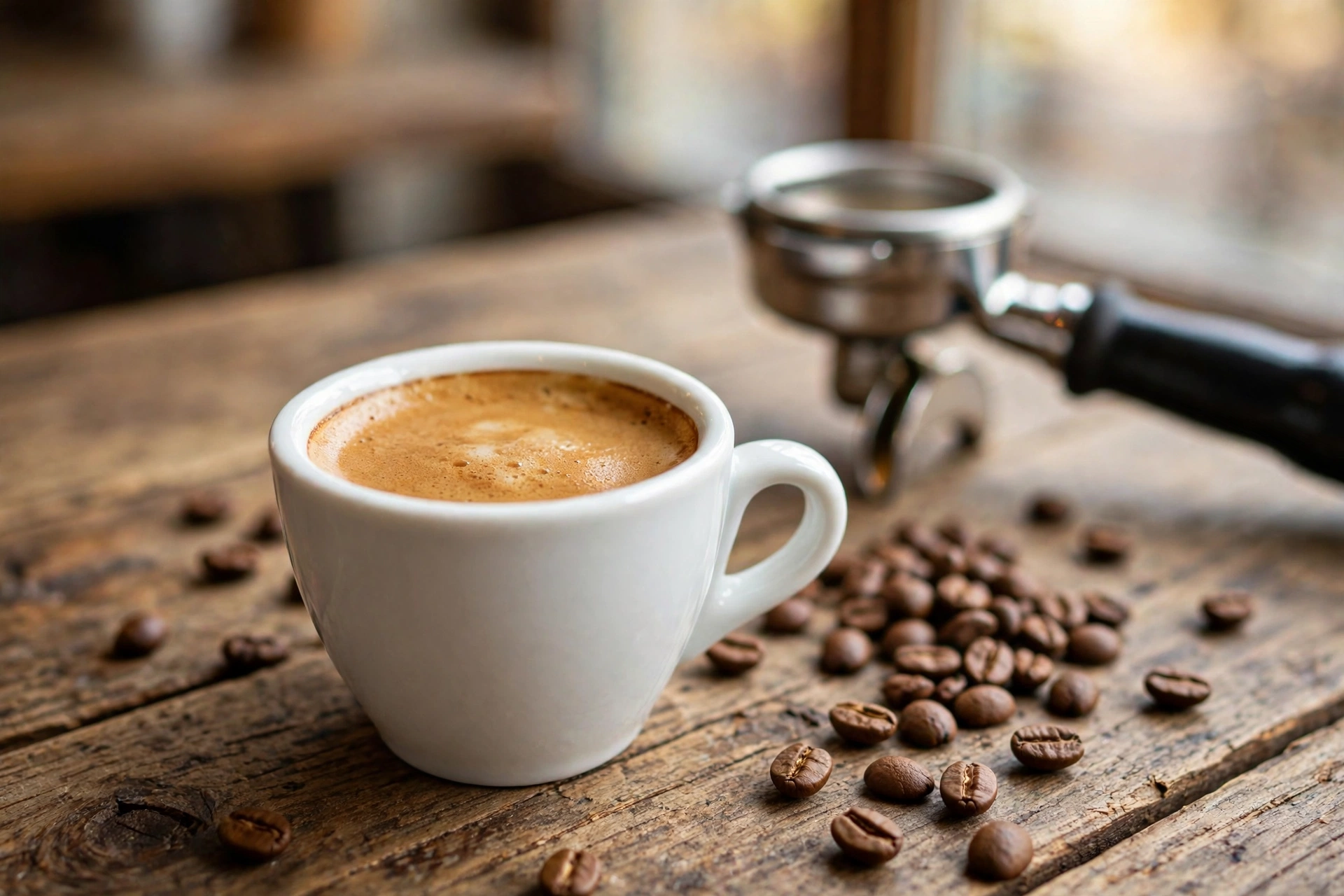
The short answer: espresso is a brewing method, not a bean, a roast, or a drink size. It means forcing 90–94°C water through a compacted puck of finely ground coffee at roughly 9 bars of pressure, extracting a small, concentrated shot in 25–30 seconds. Everything distinctive about espresso — the intensity, the crema, the speed — follows from that one mechanism.
Why the definition matters
Because almost everything sold to you under the word “espresso” is a marketing invention. Bags labeled “espresso roast” are just dark roasts. “Espresso beans” are ordinary beans in a different bag. Espresso-ground coffee from the supermarket is pre-ground coffee that went stale before it left the warehouse.
Once you know the actual mechanism, all of this stops being confusing and starts being a filter: anything that doesn’t involve pressure, a fine grind, and a short extraction window isn’t espresso, whatever the packaging says. That’s a genuinely useful superpower when you’re shopping for gear, beans, or even a café.
The mechanism: pressure rewrites the rules of extraction
All coffee brewing is extraction — dissolving flavor compounds out of ground coffee into water. Drip, pour-over, and French press do it with gravity and time: water sits with the grounds for minutes and slowly pulls compounds out.
Espresso does it with pressure and speed. Forcing water through a dense puck of fine grounds at ≈9 bars (about 130 psi, nine times atmospheric pressure) compresses into 25–30 seconds what gravity brewing takes minutes to do. That speed isn’t just convenience — it changes which compounds end up in the cup.
Extraction happens in a sequence:
- Acids and bright flavors dissolve first (the first ≈10 seconds)
- Sugars and sweetness come next
- Bitter, woody compounds dissolve last
A 25–30 second shot captures the first two and mostly stops before the third. That’s the whole trick: pressure buys you a time window where the good stuff is extracted and the harsh stuff mostly isn’t. Run the shot much longer and bitterness climbs; cut it much shorter and you get sour, thin under-extraction — all acids, no sweetness.
This also explains why the grind has to be fine. The puck must resist the water — if water blasts through in 10 seconds, there’s no extraction window at all. Too fine and the puck chokes: pressure spikes, extraction drags past the bitter threshold, or nothing comes out. The entire dance between grinder and machine is about holding this balance: enough resistance to slow the water, not so much that it stalls.
What’s actually in the cup: dose, yield, and ratio
Espresso is measured by brew ratio — the weight of liquid espresso out divided by the weight of dry coffee in. This is the single most useful number in home espresso, because it turns “my shot tastes off” into something diagnosable.
| Style | Ratio (coffee : espresso) | From an 18g dose | Character |
|---|---|---|---|
| Ristretto | ≈1:1 to 1:1.5 | ≈18–27g out | Intense, syrupy, sweet — but can taste underdeveloped |
| Normale (standard) | ≈1:2 | ≈36g out | Balanced — the default target for most coffees |
| Lungo | ≈1:3 or longer | ≈54g+ out | Thinner, more bitter — closer to strong drip coffee |
The standard double shot — 18 grams in, ≈36 grams out, in 25–30 seconds — is the reference point everything else is judged against. When people say “dial in your espresso,” they mostly mean: adjust the grind until 18g in gives you 36g out in roughly 27 seconds, then taste and tweak from there.
Note what the ratio doesn’t say: nothing about strength in the way people usually mean it. A 1:2 shot is concentrated — about 8–10% dissolved solids versus ≈1.3% for drip — but “strong” is doing a lot of ambiguous work in coffee conversation. Which brings us to the myths.
Crema: what it is, and what it isn’t
That golden-brown foam on a fresh shot is crema — an emulsion of CO₂ gas, coffee oils, and dissolved solids, whipped into foam as pressurized liquid exits the portafilter. It only exists because of pressure; you don’t get crema from drip or French press.
Crema is mostly a freshness signal. Freshly roasted beans are full of CO₂, which forms abundant crema; beans roasted weeks ago have degassed and produce little. It also thins out with lighter roasts and coarser grinds. So: thick crema tells you the coffee is fresh and the extraction is roughly right. Thin crema tells you… the beans might be old, or the roast is light, or the shot ran fast. It’s a clue, not a grade. Some of the best-tasting shots — light-roast singles pulled as ristrettos — have modest crema and taste extraordinary.
Four things that aren’t true about espresso
“Espresso roast” is required. Any coffee can be brewed as espresso — light, medium, or dark, any origin. Dark roasts became the café default because their bold, low-acid profile survives milk well and forgives sloppy technique, not because the method demands them. Some of the most interesting home espresso right now is light-roast.
“Espresso beans” exist. They don’t. It’s a label, not a category. The same bag brewed as pour-over is pour-over coffee; brewed under pressure it’s espresso.
Espresso has the most caffeine. Per ounce, yes — it’s concentrated. Per serving, no. A double shot carries roughly 120–150mg of caffeine; a standard 12oz drip coffee carries ≈180–200mg. If you drink espresso to wake up faster, the small cup is lying to you slightly.
Espresso is “stronger” coffee. Concentration and strength aren’t the same thing. Espresso is more concentrated (more coffee solids per sip), which reads as intensity. But a well-pulled shot should taste balanced — sweet, with some brightness, and a clean finish. If your espresso just tastes harsh and “strong,” that’s usually over-extraction or stale coffee, not the method working correctly.
Why this matters before you buy anything
Here’s the practical payoff. An espresso setup has two halves: the machine holds up its side of the bargain (steady heat, steady pressure, even water delivery) and the grinder handles the puck’s side (fresh, fine, even grounds). Most beginners overspend on the machine and underspend on the grinder — but as the mechanism shows, a perfect machine can’t fix a bad puck. Stale, unevenly ground coffee under 9 bars of pressure just makes bad espresso faster.
So the definition isn’t trivia. It tells you where the money goes: fresh beans, a grinder that can actually grind fine enough for espresso, and only then the machine. Understand the mechanism and every buying decision after it gets simpler.
The espresso family tree (quick reference)
Every café drink is a standard shot plus something. Knowing the base ratios stops menu anxiety:
- Espresso — the shot itself, ≈36g out from 18g in
- Macchiato — shot “stained” with a spoonful of milk foam
- Cortado — shot with roughly equal parts steamed milk (small, ≈120ml total)
- Flat white — double shot with velvety steamed milk (≈150–180ml), thin foam layer
- Cappuccino — shot with steamed milk and a deep cap of foam, roughly thirds
- Latte — shot with lots of steamed milk (≈240ml+), mostly milk by volume
- Americano — shot diluted with hot water, approximating drip strength
Notice the pattern: the espresso never changes. Milk quantity and texture are the only variables. Which means the quality ceiling of every drink on this list is set by the shot — another reason the mechanism matters more than the menu.