
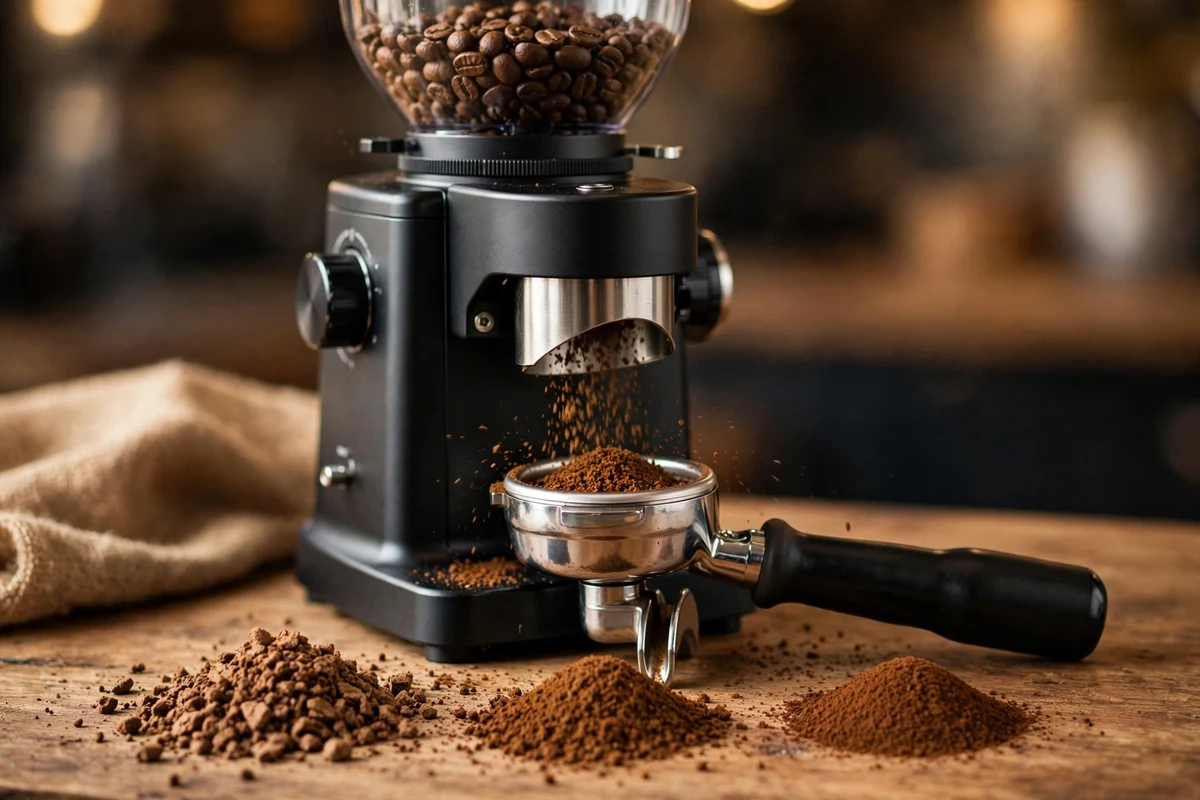
The short answer: grind fine, like table salt, until 18g of coffee produces about 36g of espresso in 25 to 30 seconds. That texture and that timing describe the same thing. Grind size is not a style preference. It is the valve that controls how fast water moves through the puck, and how much flavor it pulls out on the way. Get it right and the shot tastes sweet and balanced. Get it wrong in either direction and you get sour water or bitter sludge.
Grind size is really about resistance
Think about what the machine actually does. It pushes hot water at about 9 bars of pressure into a small basket of ground coffee. That pressure is fixed. What decides the shot is how much the puck pushes back.
A coffee puck is a packed bed of particles with gaps between them. Water has to wind through those gaps. Two things follow, and they explain almost everything about grind size.
First, smaller particles pack into smaller gaps. Grind finer and the spaces shrink, so water struggles through and the shot slows. Grind coarser and the gaps widen, water rushes, and the shot speeds up. Grind size is flow control, nothing more mystical than that.
Second, smaller particles expose more surface area. One bean broken into a thousand fine pieces presents far more surface to water than the same bean in a hundred coarse chunks. More surface means water dissolves flavor compounds faster. So a finer grind does not just slow the shot. It also extracts more per second.
Those two effects stack. Go finer and you get slower water moving over more surface, so extraction climbs quickly. Go coarser and extraction falls just as fast. That stacking is why tiny adjustments matter in espresso and barely matter in a French press. Espresso is a high-pressure, short-contact system, so a small turn of the grinder collar shifts both variables at once.
Why espresso is finer than every other brew method
Every brew method is a negotiation between pressure, time, and grind. A French press steeps for about four minutes with no pressure, so coarse grounds work, because water has minutes to penetrate big particles. Drip uses gravity alone over two to four minutes, so a medium grind is enough. Espresso gives water only 25 to 30 seconds under about 9 bars. With that little time, the only way to extract enough is to maximize surface area and make the water work for its path. That means fine.
| Brew method | Driving force | Contact time | Typical grind | Why |
|---|---|---|---|---|
| French press | Steeping, no pressure | About 4 minutes | Coarse, like raw sugar | Long time compensates for low surface area |
| Pour over / drip | Gravity | About 2 to 4 minutes | Medium, like sand | Moderate time, moderate surface |
| Moka pot | Low steam pressure | About 1 to 2 minutes | Fine-medium | Some pressure, shorter time |
| Espresso | About 9 bars pump pressure | About 25 to 30 seconds | Fine, like table salt | Very short time needs maximum surface and resistance |
Read that table as cause and effect, not a chart to memorize. The grind is fine because the time is short and the pressure is high. Change any one and the other two have to move.
The target: 18g in, about 36g out, 25 to 30 seconds
Grind is too slippery to judge by feel alone, so you judge it by what it does to the shot. The standard starting recipe for a double is:
- Dose: 18g of dry coffee in the basket
- Yield: about 36g of liquid espresso in the cup, a 1 to 2 ratio
- Time: 25 to 30 seconds from pump start
The grind is correct when those three land together. If 36g arrives in 16 seconds, the grind is too coarse no matter how it felt between your fingers. If it takes 40 seconds, it is too fine. Time is the readout that tells you whether the puck offered the right resistance.
This is why you adjust grind and only grind while dialing in. Keep dose and yield fixed so time stays a clean signal. Change the dose and you change puck thickness, which changes resistance for a separate reason, and you can no longer tell what fixed the shot. One variable at a time is not fussiness. It is the only way the feedback loop works.
How to adjust: the dialing-in loop
- Start fine, like table salt. Pinch a little. It should feel gritty and soft, clumping slightly, not powdery and not like distinct grains of sand.
- Weigh 18g in, pull for about 36g out, and time it. Use a small scale under the cup. Weight, not volume, because crema makes volume readings unreliable.
- Read the time and taste, then move one small step. Faster than 25 seconds and sour or thin means go finer. Slower than 30 seconds and dry or bitter means go coarser.
- Purge before the next shot. Most grinders retain a few grams of the previous grind. Run a few grams through after each adjustment, or the next shot is a blend of old and new settings and the signal smears.
Small steps are the whole game. Because finer grind stacks slower flow on top of faster extraction, a big jump can take you from a 16-second sour shot straight to a choked 45-second bitter one, sailing past the sweet window. Adjust like you are sneaking up on something, because you are.
Fresh beans also fight back. Coffee roasted in the last few days still holds carbon dioxide from roasting. That gas adds resistance, and it escapes over the first week or two. A bag dialed in perfectly on day five may run faster on day fifteen at the identical setting. Nothing broke. The coffee changed, so the grind has to follow it. Expect to nudge finer as a bag ages.
What wrong looks and tastes like
Water pulls compounds from coffee in sequence: bright acids first, then sugars, then bitter compounds. A shot is a timed cutoff through that sequence, and grind decides where the cutoff falls.
| What you see and taste | What happened | Grind fix |
|---|---|---|
| Gushes out, pale, done in 15 to 20 seconds, sour and thin | Too coarse, under-extracted, stopped in the acid stage | Go finer, one step at a time |
| Drips slowly, dark, past 35 seconds, dry and bitter | Too fine, over-extracted, deep into bitter compounds | Go coarser |
| Starts fine, then suddenly speeds up and blondes early | Channeling, water found a crack | Distribute grounds evenly, check for clumps |
| Sour and bitter at the same time | Channeling, one path over-extracted, the rest under | Fix distribution and clumps, not just grind |
| Timing is right but the cup tastes flat and dull | Coffee is stale, not a grind problem | Fresher beans, ground right before brewing |
The sour-and-bitter row catches people out. It seems contradictory, but it is the fingerprint of uneven flow: part of the puck was bypassed and stayed sour, part was flooded and turned bitter. Grinding finer will not fix it and often makes it worse, because finer grinds clump more. Break up clumps, spread the grounds evenly, tamp level, then judge the grind.
Fineness is not the same as evenness
Your grinder does not produce one particle size. It produces a spread: some dust-fine particles, a main population near your setting, and some larger chunks. The dust, called fines, extracts almost instantly and can choke the puck. The chunks, called boulders, barely extract at all and add weak, sour notes.
A grinder that produces a tight, even spread gives water a uniform maze to travel, so the whole puck extracts at roughly the same rate. A poor grinder gives you the sour-and-bitter problem built into every shot, no matter where you set the dial. That is why grinder quality shows up in the cup as clarity. Almost any burr grinder can grind fine enough to choke a machine. A good one grinds more evenly, so one setting actually means one extraction instead of three happening at once in the same puck.
Blade grinders sit at the bad end of this spectrum. They chop rather than grind, producing a chaotic mix of powder and chunks with no repeatable setting. You cannot dial in with a tool that gives a different spread every time. A burr grinder, which crushes beans between two abrasive surfaces at a fixed gap, is what makes a grind setting a setting at all.
Roast level moves your starting point
The 18g, about 36g, 25 to 30 seconds recipe is a medium-roast starting point. Roast level changes the physical structure of the bean, so it changes where you start.
Dark roasts are porous and brittle from longer roasting. They shatter easily and let water penetrate fast, so they extract quickly and slide into bitterness early. Start slightly coarser, and expect a shorter window before the shot turns harsh.
Light roasts are dense and hard. Water penetrates slowly and extraction lags, so dialed like a medium roast they taste sour. Start finer, and do not panic if the best shot runs a few seconds long. You are compensating for a bean that gives up its flavor reluctantly.
Treat every new bag as a small re-dial, not a failure of your last setting. Two or three shots to walk the grind onto new coffee is normal, even for people who do this daily.
Freshness quietly changes your grind
Ground coffee stales fast for a geometric reason: grinding multiplies surface area, and surface is where coffee meets air. Oxygen attacks the aromatics, and the carbon dioxide that helps build puck resistance escapes. Whole beans hold freshness for weeks. Ground coffee can taste flat within hours.
Stale coffee puts up less resistance, so shots run faster as a pre-ground bag ages, and no adjustment can restore compounds that have already oxidized. If shots keep speeding up and the cup tastes like cardboard despite correct timing, the coffee is done. Store whole beans sealed, away from heat and light, buy what you will use within about two to four weeks of the roast date, and grind only what the shot needs.
A morning routine that actually works
- Keep the dose locked at 18g and weigh it. Scoops drift, and drift destroys the feedback loop.
- Grind fresh, distribute to break clumps, tamp level.
- Pull to about 36g on the scale, watching the time. Aim for 25 to 30 seconds.
- Taste before you adjust. A shot at 27 seconds that tastes balanced is finished, whatever the chart says.
- Adjust one small step, purge a few grams, pull again. Note the setting for that bag so tomorrow starts from data, not memory.
Do this and grind size stops being the intimidating variable beginners fear. It becomes one honest dial with a cause and effect you can taste. Every other technique exists to keep that puck even and consistent while the grind does its work.