
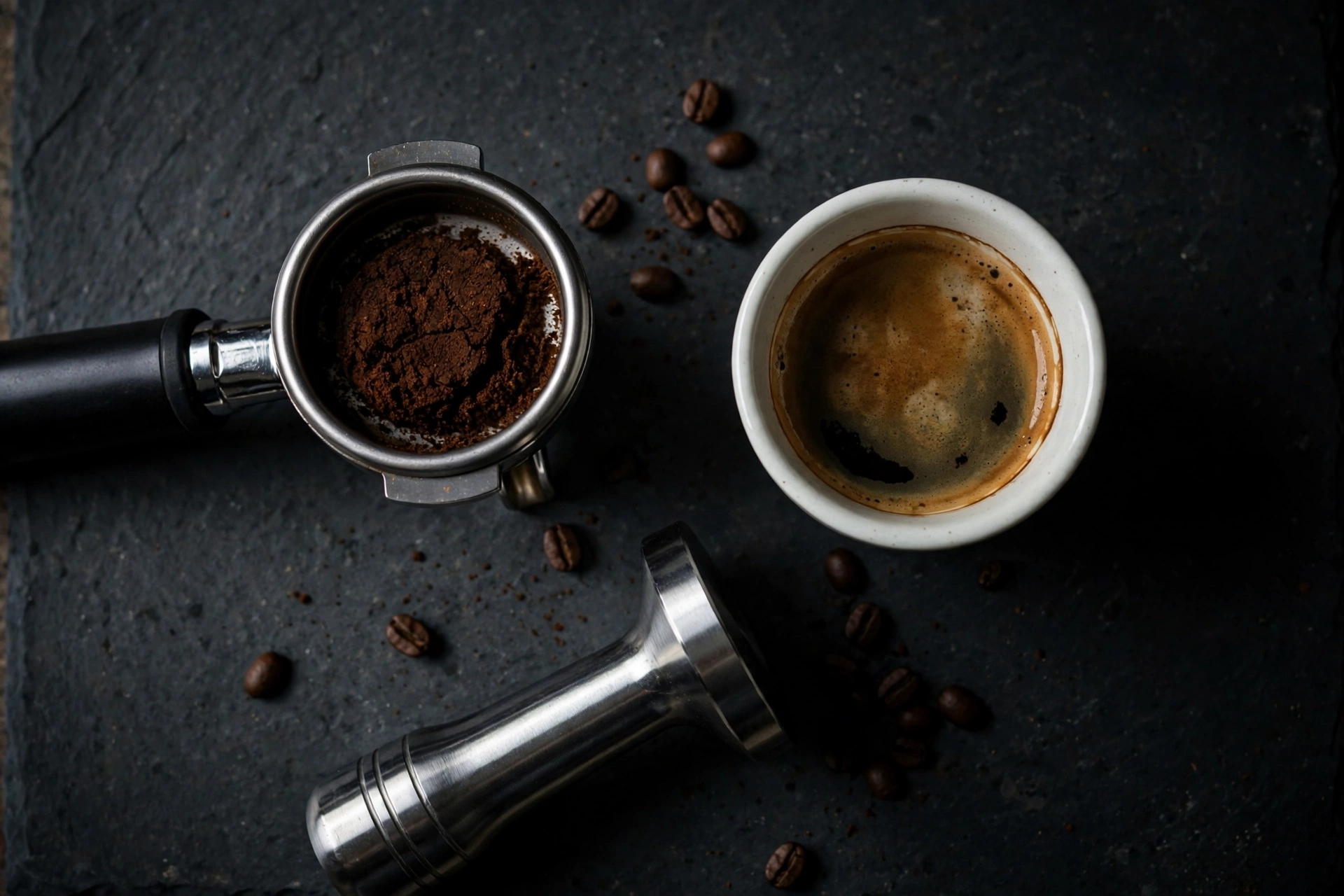
The short answer: bitter espresso is usually over-extraction — water pulling the late, harsh compounds out of the puck — but the same taste can come from the roast or from a dirty machine, and each needs a different fix. Check the beans first, then the machine, then the grind, changing one variable at a time.
Disclosure: we are an independent research desk and earn no commission on anything here. This page contains no affiliate links. See our disclosure policy for how we stay independent.
We are a research desk, not a test lab: we synthesize manufacturer specifications, owner reports, forum threads, and published guides rather than claiming hands-on testing we have not done.
What “bitter” actually is
Extraction dissolves flavour compounds out of the grounds in a fixed sequence: bright acids first, then sugars, then harsh bitter compounds last. That sequence is the mechanism behind everything in espresso extraction explained — a well-pulled shot stops after the sugars and before the bitters dominate.
A bitter shot runs the sequence too far, or starts from a bean that was already bitter. The Specialty Coffee Association describes an extraction-yield sweet spot of roughly 18 to 22 percent of the coffee’s mass dissolved into the cup; push past the upper end and the cup turns bitter, hollow, and ashy. Bitterness is the mirror image of the sour, sharp cup you get from under-extraction — same spectrum, opposite ends.
That is why “grind coarser” is the standard advice and also why it so often makes things worse: it only addresses one of three roads to the same taste. A shot can taste bitter because of how you pulled it (over-extraction), because of what you put in it (the roast), or because of what it ran through (a dirty machine). Grind fixes the first and does nothing for the other two — and if you grind coarser on a shot that was already balanced, you land in sour territory instead.
One distinction before the causes: bitter is not the same as strong. A strong shot is concentrated, rich, and bittersweet with a clean finish. A bitter shot is harsh, dry, and ashy, with a drying, astringent sensation that lingers at the back of the throat. Strength comes from the ratio; bitterness comes from which compounds were extracted.
The causes, in the order to check them
1. The beans — the cause people skip
Dark, oily roasts are more soluble: they surrender their solids faster, so at the same grind and ratio they over-extract more easily and tip bitter. And once beans go stale — past three or four weeks off the roast date — the sweetness fades first, leaving a flat, bitter shadow behind. Whole bean vs pre-ground matters here too: pre-ground coffee stales faster once the bag is open, and stale grounds taste bitter whatever the grind setting was.
The fix is a test, not a purchase: before blaming your hands, pull a shot with a fresh medium roast you trust. If the bitterness vanishes, it was never your grind — it was the bag. If the dark roast is the problem, grind coarser than you would for a medium roast, pull a shorter ratio of about 1:1.5, and consider dropping the water temperature a degree or two. One honest caveat: a very dark, oily, second-crack-heavy roast carries inherent roast bitterness that no amount of dialling can fully remove.
2. The machine — the invisible one
Every shot leaves coffee oil behind: in the group screen, the basket, the seals. That oil goes rancid within days, and rancid oil tastes exactly like you would fear — bitter, ashy, faintly metallic — and it taints every shot, no matter how perfectly you grind. The tell is constancy: bitter on every bean, every recipe, every day, with no change to the routine.
Fix it with cleaning, not with the grinder. Wipe and rinse the group screen, soak the basket and portafilter, and run the machine’s cleaning routine — a detergent backflush if your machine has a three-way valve; some popular single-boiler and beginner machines clean with a cycle and a tablet instead, so check the manual. Our guide to how to backflush an espresso machine walks through it, and how often to clean and descale covers the routine. Descale on schedule as well: scale does not just slow a machine down, it skews brew temperature, and hot, scaled water over-extracts.
3. Grind too fine — the classic cause
Only now, with fresh beans and a clean machine, is grind the prime suspect. A finer grind creates more surface area and slows water flow, both of which increase extraction. Push the grind too fine and water lingers in the puck, dissolving the late bitter compounds you wanted to leave behind. The shot usually runs slow as well — past 35 seconds for a standard double — and the stream comes out as a dark thread.
The fix is one step coarser on the grinder, then a fresh test shot. Grinders respond nonlinearly near the espresso range, so a tiny adjustment can shift timing by several seconds; move in small increments and taste each shot. If the shot speeds up and the bitterness fades, grind was the cause — keep stepping coarser until you land in the 25 to 30 second window. If several steps coarser barely changes the time or the taste, the cause is further down this list, not the grind.
4. Ratio pulled too long
Ratio is the relationship between your dose of dry coffee and the weight of liquid espresso in the cup. A standard starting point is 1:2 — an 18g dose yielding about 36g of liquid. The longer you let the shot run, the more water passes through the same grounds, and the more of those late bitter solubles end up in the cup. A shot pulled to 1:3 or 1:4 without any other change will almost always taste more bitter and more diluted at once.
Stop the shot by weight, not by the timer: pull until the scale reads about 36g, then stop the pump, whatever the clock says. If 1:2 still tastes harsh, try shortening to 1:1.5 — a modern ristretto-ish ratio that captures the sweet early extraction and stops before the bitter tail. This is the cheapest fix on the list: it costs no beans and no adjustments.
5. Water too hot
Hotter water extracts faster and reaches deeper into the bitter compounds. The usual target band is 93 to 96°C (195 to 205°F); water above that pulls out extra bitterness, especially from dark roasts. If your machine lets you adjust temperature — a PID controller, or a temperature setting on a prosumer machine — drop it by one or two degrees and taste. If your machine has no temperature control, a slightly coarser grind and a shorter ratio are the levers you have instead; do not try to cool the water by other means, it is not worth the inconsistency.
6. Channeling — bitter and sour together
If the shot tastes bitter and sour in the same sip, that is usually channeling, not a wrong extraction level. Water finds a crack through the puck and over-extracts the coffee along that channel while under-extracting the rest, so both flavours land in the cup at once. The shot often sprays, spurts, or runs blonde-then-dark, and the puck shows a visible hole or crack after the shot.
Fix distribution before changing anything else: break clumps with a WDT tool, level the surface, then tamp straight and square. Our channeling guide walks through the full routine in order. Note the diagnostic value here: a shot that is bitter alone points to extraction level, roast, or cleanliness; a shot that is bitter and sour together points to the puck.
7. Dose too high for the basket
Too much coffee leaves an overfilled puck with too much material for water to push through, and the shot drags — which is over-extraction by another name. This one is easy to miss because the grinder gets blamed first: a shot can run slow and bitter at any grind setting if the basket is overfilled.
Weigh the dose against the basket’s rated capacity rather than eyeballing it. Most double baskets are designed for about 18 to 20g — check your specific basket, since this varies by manufacturer — and stay within a gram or two of that number. If the puck presses against the shower screen when you lock the portafilter in, or you see a circular imprint on the puck after the shot, remove coffee before touching the grind.
Tamp force, for completeness, is almost never the cause. Once the puck is fully compressed, pressing harder adds almost nothing to resistance — the bed cannot get denser. What matters is squareness: a tilted tamp builds a density gradient, and water stalls in the dense side. Press straight down with consistent, moderate force and move on.
Diagnose it in one shot
Pull a shot the way you normally would, watch the flow, and match what you see and taste:
| What you see and taste | Most likely cause | First move |
|---|---|---|
| Bitter, harsh, dry; shot ran past 35 seconds | Over-extraction, grind too fine | One step coarser, retest |
| Bitter at every grind setting and ratio | Dark roast or stale beans | Fresh medium roast test shot |
| Bitter on every bean, every day, no change to routine | Dirty machine, rancid oil | Backflush, clean screen, descale |
| Bitter and sour together, flow uneven or spurting | Channeling | WDT, level, tamp square |
| Bitter and thin at once, ratio past 1:3 | Ratio too long | Stop at about 36g from 18g in |
| Bitter only on dark roasts, fine on medium | Roast solubility / water too hot | Coarser grind, 1:1.5 ratio, drop temp 1–2°C |
| Bitter at every grind setting, puck imprinted by shower screen | Dose too high | Weigh dose to basket capacity |
The fix routine
Work through the causes in order, changing one thing per shot:
- Test the beans. Pull a shot with a fresh medium roast you trust. If the bitterness vanishes, the bag was the problem — stop here.
- Clean the machine. Backflush, scrub the shower screen, soak the basket. If the bitterness was constant across beans, this is the fix.
- Lock the dose. Weigh about 18g into the basket and keep it fixed for the whole session. Dose is the constant; grind is the variable.
- Grind one step coarser. Pull a fresh shot, stop at about 36g, and time it. Repeat in small steps until the shot lands in 25 to 30 seconds and tastes sweet.
- If the shot is still bitter at the right time and ratio, drop the temperature by one or two degrees if your machine allows it, or shorten the ratio to 1:1.5.
- If the shot is bitter and sour together, fix distribution. WDT, level, tamp square — then retest before touching the grind again.
Do not change grind, dose, and temperature in the same session. Each change teaches you something only if the other variables stay put — and the problem returns the moment one of them slips back.
When it is not a bitter-shot problem
A few things look like bitterness but are not:
- A very dark roast. As above, some roast bitterness is inherent to the bean. If a dark roast tastes bitter at every setting and a medium roast does not, the roast is the answer, not the recipe — see light vs dark roast for espresso for how roast level changes extraction.
- A shot that is strong, not bitter. A concentrated ristretto can taste intense and bittersweet without being harsh. Judge the finish: a strong shot finishes clean; a bitter shot finishes dry and ashy and lingers unpleasantly.
- The mirror problem. If your shots taste sour and sharp instead of bitter, the causes are the same variables in reverse — too coarse a grind, too short a ratio, water too cool. Our guide to espresso extraction too fast covers the other half of the picture, and how to dial in espresso ties the whole routine together.
- A pressurized basket. A dual-wall basket forces coffee through a small exit valve, which controls flow regardless of the puck — see pressurized vs non-pressurized baskets. Timing and grind rules still apply, but the basket masks puck errors, so bitterness there points to the coffee or the grind rather than distribution.
The bottom line
Bitter espresso is usually over-extraction, and over-extraction is usually a grind that is too fine or a ratio pulled too long. But the same taste comes from a dark or stale roast and from rancid oil in a dirty machine, and grinding coarser fixes neither of those — it only makes a balanced shot sour. Test the beans, clean the machine, then grind coarser in small steps, stopping the shot at about 36g from 18g in, in 25 to 30 seconds. When the shot lands there and tastes sweet with a clean finish, the extraction is doing its job.