
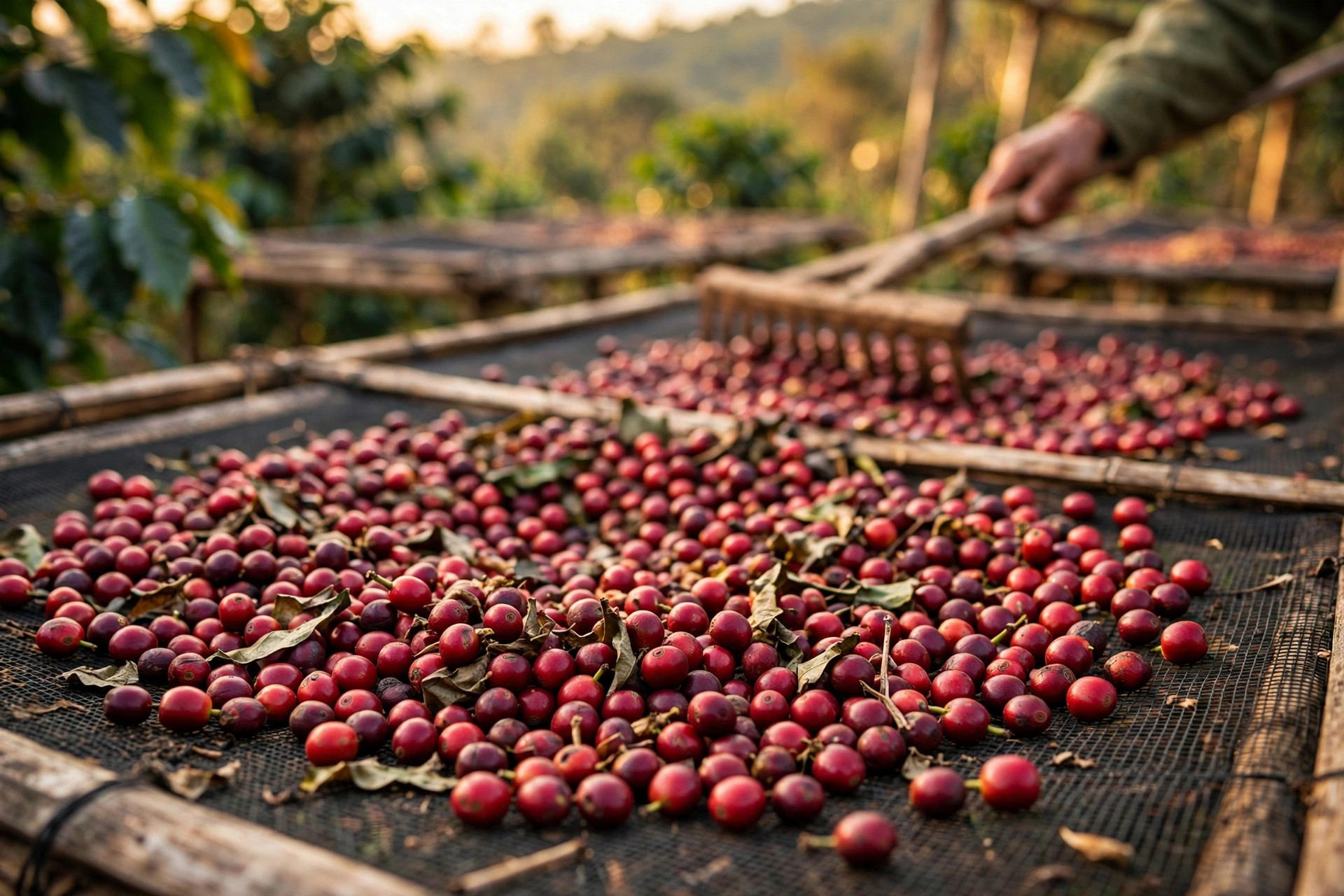
The short answer: process decides what happens to the coffee fruit after picking — and that decides a lot of what you taste. In the natural (dry) process, the whole cherry is sun-dried intact, so the bean spends weeks in contact with the fruit’s sugars, fermenting into a sweet, fruity, full-bodied cup. In the washed (wet) process, the fruit is pulped off before drying, so the bean dries clean — producing a brighter, clearer, lighter-bodied cup where the origin’s own character comes through. Neither is better; they’re two different flavour portfolios, and knowing which you’re drinking explains more about your cup than the brand on the bag.
We are a research desk, not a test lab: we synthesize roaster specifications, published measurements, and owner reports rather than claiming hands-on testing we have not done. Facts checked 2026-10-15 against current coffee reference sources.
First principles: what “processing” actually is
A coffee bean is a seed inside a fruit. The cherry has layers, from the outside in: skin, pulp (fruit flesh), mucilage (a sticky pectin layer), parchment (a papery shell), silver skin, and finally the two bean halves. Processing is the method used to get the bean out of those layers and down to a stable moisture content for storage and roasting.
Here is the mechanism that matters: sugar plus time plus microbes equals fermentation, and fermentation rewrites flavour. The longer the bean stays in contact with the fruit’s sugars and mucilage during drying, the more fermentation products — esters, alcohols, organic acids — form and migrate into the seed. Processing is really just a decision about how much of that contact happens:
- More fruit contact (natural): more fermentation, more sweetness and fruit notes in the cup, more body — but more risk of spoilage and off-flavours if drying is uneven.
- Less fruit contact (washed): less fermentation, a cleaner cup that shows the bean’s intrinsic character — at the cost of the sweetness and body that fermentation adds.
Every processing method sits somewhere on that spectrum. Honey process — skin removed, mucilage left on — is the deliberate middle point. That one axis explains most of the flavour difference you’ll ever taste between two coffees of the same origin.
The natural process: dried inside the fruit
Natural (dry) processing is the oldest method, still dominant in dry regions like Ethiopia and parts of Brazil:
- Pick. Ripe cherries are harvested, ideally only the red ones — under-ripe cherries in a natural lot have nowhere to hide.
- Sort and float. Cherries are sorted, often floated in water to separate defective, low-density fruit.
- Dry whole. The intact cherries are spread in thin layers on raised beds or patios and dried for roughly 2–6 weeks, raked and turned many times a day so they dry evenly and don’t mould.
- Hull. Once dried, the shrivelled fruit and parchment are hulled off, leaving the green bean.
During those weeks of drying, the pulp’s sugars and pectin ferment around the bean. That prolonged contact is what gives naturals their signature cup: pronounced fruit (often blueberry, strawberry, wine-like), higher sweetness, heavier syrupy body, and lower perceived acidity. The trade-off is consistency: a natural is only as good as its drying. Cherries that dry too slowly or sit in clumps can develop fermented, sour, or musty defects — which is why natural processing is the hardest method to execute well, and why good naturals command respect (and sometimes a premium).
The washed process: fruit removed first
Washed (wet) processing strips the fruit away before drying:
- Pick and sort. Cherries are picked ripe and sorted.
- Pulp. A pulping machine strips the skin and most of the pulp within hours of picking.
- Ferment. The beans, still coated in sticky mucilage, soak in fermentation tanks for roughly 12–48 hours while enzymes and microbes break the mucilage down so it can be washed off. (Some mills skip fermentation entirely and remove mucilage mechanically.)
- Wash and dry. The beans are washed clean, then dried on beds, patios, or in mechanical dryers down to a stable moisture level.
Because the fruit is gone before drying, there is very little sugar left for microbes to work on. The cup reflects that: cleaner, brighter, more acidic — citrus and floral notes come forward — with a lighter, crisper body. What washed coffee gives up in sweetness and heft it returns in clarity: with no fruit character layered on top, you taste the bean itself — the origin, the arabica variety, the terroir — more directly. Washed processing also fails more gracefully: with less fermentation to go wrong, washed lots are more consistent and less defect-prone than naturals, though they demand water, equipment, and trained staff, which is why washed coffees often cost more.
Side-by-side comparison
Facts checked 2026-10-15. Values are typical across coffee reference sources; exact character varies by origin, variety, and roaster.
| Factor | Natural (dry) process | Washed (wet) process |
|---|---|---|
| Fruit contact | Whole cherry dried intact, 2–6 weeks | Fruit pulped off before drying |
| Fermentation | Extensive — sugars ferment around the bean | Minimal — little material left for microbes |
| Acidity | Lower perceived, rounded | Brighter, more pronounced |
| Body | Heavier, syrupy | Lighter, crisper |
| Flavour direction | Fruity, winey — blueberry, strawberry, chocolate | Clean, floral, citrus — origin character forward |
| Consistency | Batch-dependent; higher defect risk if drying is careless | More uniform; fails more gracefully |
| Cost/inputs | Cheaper equipment, needs dry climate + careful turning | Water-intensive, needs pulpers and tanks — pricier |
| Classic origins | Ethiopia, natural Brazils | Colombia, Kenya, Central America |
Note these are tendencies, not laws. A washed Ethiopian can still be floral and tea-like, and a natural can be clean and restrained in skilled hands. Origin and variety — see the Coffee Beans hub — set the raw material; process is the loudest of the levers applied after picking.
What each process does in an espresso shot
Espresso amplifies everything, including process character. General tendencies:
- Natural in espresso: heavier body, pronounced sweetness, fruit-forward shots with a syrupy mouthfeel. That body and sweetness survive milk well, which is why naturals are a popular pick for milk drinks. The risk: a careless natural shows its defects in espresso just as loudly as its fruit.
- Washed in espresso: brighter, cleaner shots with distinct acidity and clearer flavour separation. Better for straight shots where you want to taste nuance; under milk, the delicate notes can get muted while the acidity stays sharp.
Many espresso drinkers end up keeping both: naturals for milk drinks, washed for straight shots and pour-overs. If you’re dialling in, the same rules apply either way — see our light vs dark roast guide and dial-in guide.
How to buy: reading the bag
- Look for the process on the label. Specialty roasters usually list it: “washed”, “natural”, or “honey”. Blends often omit it — another reason single origins are better for learning.
- Run the same-origin experiment. Buy a washed and a natural from the same origin (and ideally the same roaster). Identical terroir, one variable changed — the difference you taste is the process. It is the single fastest way to train your palate on this axis.
- Match process to the drink. Milk-heavy household? Lean natural (heavier body, sweetness cuts through milk). Straight shots? Try washed (clarity, brightness). Our roundups name process where it matters: best beans for lattes, best dark roast beans for espresso, and best decaf.
- Don’t buy stale. Process character fades as beans age — a three-month-old natural tastes flat regardless of method. Check the roast date and drink within roughly 2–6 weeks; see our beginner bean guide for the full freshness rules.
- Species matters too. Processing applies to all coffee, but almost all specialty process-talk is about arabica; robusta is rarely sold by process because it’s bought for body and crema, not nuance.
Process is one of the cheapest variables to explore and one of the most audible in the cup. Two bags, one origin, two processes — you’ll taste the mechanism working.