The short answer: illy Intenso is the best dark roast espresso bean for most people — a dark-roasted, 100% Arabica blend with cocoa-led depth in a pressurised freshness can. Kimbo Napoli is the best Italian-style alternative (Naples-dark, intensity 10/13, in the economical 2.2 lb bag), and Starbucks Espresso Roast is the best dark roast you can grab on any grocery run. Prices and specs checked 2026-10-10. Prices vary by retailer; where sources disagreed we used the manufacturer’s or a major retailer’s current price.
Disclosure: we are an independent research desk and earn no commission on anything here. Vendor links on this page are plain links to manufacturer and retailer pages — no affiliate tracking. See our disclosure policy for how we stay independent.
We are a research desk, not a test lab: we synthesize owner reports, forum threads, published measurements, reviews, and roaster specifications rather than claiming hands-on testing we have not done.
First principles: what darker roasting actually does to a bean
Roasting is a continuum, not a category, but pushing beans darker changes four things that matter for espresso — and understanding them beats memorising roast names.
- Porosity rises, so extraction gets easier. As roast progresses, the bean’s cell structure opens up and compounds dissolve more readily. A dark roast gives up its soluble material across a wide range of grind settings, which is why a coarse grind or a weak grinder that would make a light roast taste sour still produces a passable dark shot. Dark roast is the most forgiving way to pull espresso with imperfect equipment.
- Acidity falls and roast character takes over. Chlorogenic acids and the volatile compounds that carry origin character degrade with prolonged roasting, replaced by bittersweet caramelised notes. A dark roast tells you more about the roast than about the farm — which makes it a poor way to taste a coffee’s origin, and a very reliable way to get the same bold cup every morning.
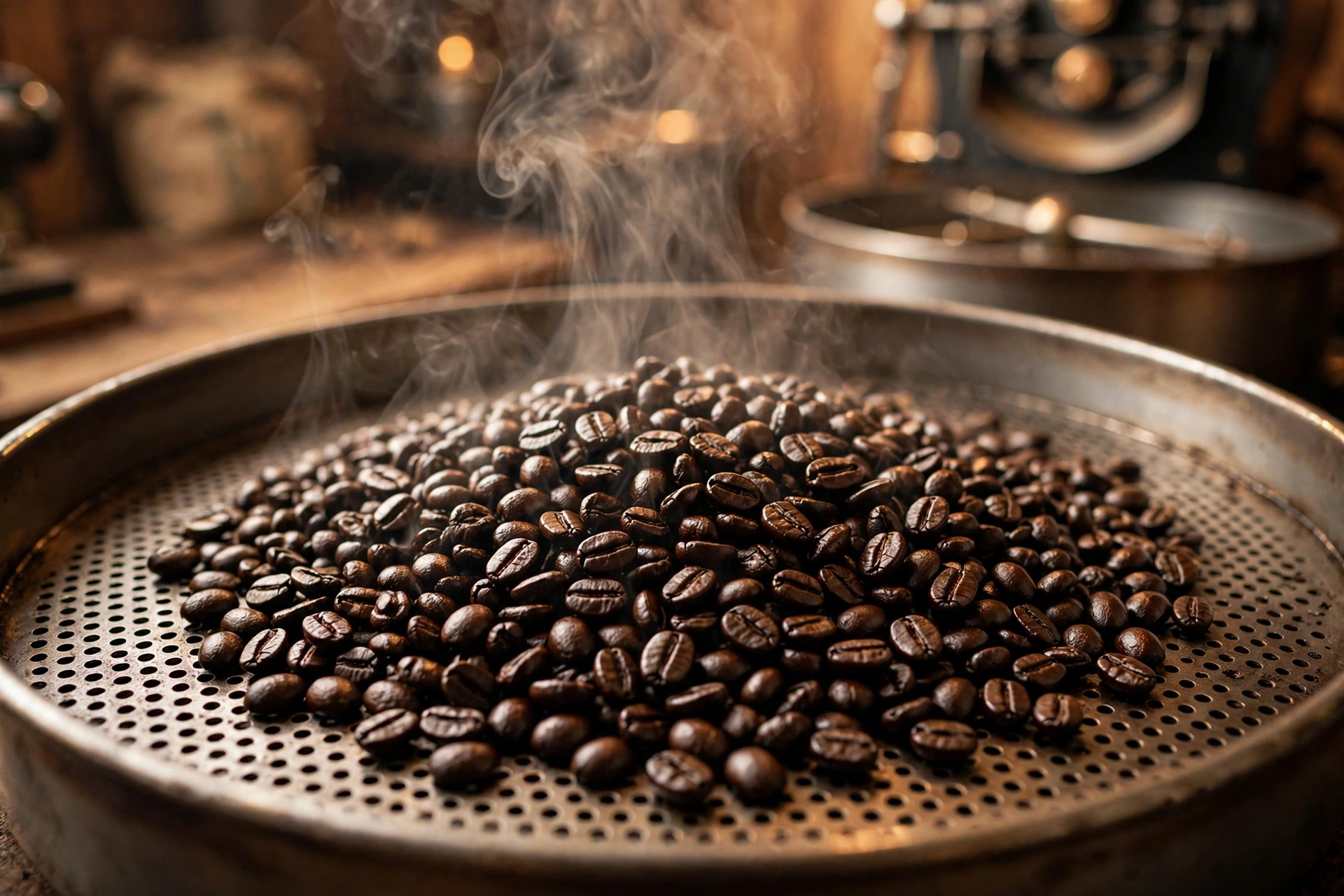
- Oils migrate to the surface. The same compounds that made the bean aromatic now coat it, which is why dark beans look glossy. That oil is harmless in a standalone grinder, but in a super-automatic the hopper feeds the built-in grinder by gravity, and oil-coated beans cling and bridge instead of flowing. If you own a super-automatic, prefer dark roasts that are roasted dark rather than charred-oily, and keep the hopper clean.
- Degassing runs faster. Dark roast is more porous, so the carbon dioxide trapped during roasting escapes sooner and aroma compounds volatilise faster. A dark roast bag goes stale noticeably quicker than a light one — buy quantities you will finish in two to three weeks, and treat a months-old dark bag as flat even if the seal is intact.
One myth to clear up: darker does not mean much more caffeine. Caffeine is relatively stable through roasting, but the bean loses mass as it darkens. By weight a dark roast has slightly more caffeine per gram; by scoop (volume) slightly less, because the lighter beans pack less coffee into the same measure. The difference is small. Choose by flavour.
How we chose these five
Every bean below is a year-round, whole-bean, dark or dark-labelled espresso roast, sold widely in the US with published specs from the roaster. We checked each against the manufacturer page and at least one major retailer, favoured blends designed for espresso concentration rather than generic drip dark roasts, and excluded limited releases and single-farm lots. Most picks here are Arabica-led; where Robusta appears it is doing what robusta does best in dark blends — body, crema, and caffeine. For the lighter end of the spectrum, see our beginner espresso bean guide.
Comparison table
Prices and specs checked 2026-10-10. Prices vary by retailer; where sources disagreed we used the manufacturer’s or a major retailer’s current price.
| Bean | Bag size | Roast and composition | Published flavour direction | Typical price | Best for |
|---|---|---|---|---|---|
| illy Intenso | 8.8 oz (250 g) | Dark; 100% Arabica | Cocoa and dried fruit, robust finish | About $15 (retailers ranged $10 to $17) | Best overall dark, refined and easy |
| Kimbo Napoli | 2.2 lb | Dark, intensity 10/13 | Floral and sweet with Neapolitan boldness | $35.99 at Kimbo USA | Best Italian-style dark in a big bag |
| Starbucks Espresso Roast | 18 oz | Dark; 100% Arabica multi-region blend | Molasses and caramel | About $19 at US grocery | Best easy-to-find dark |
| Peet’s Espresso Forte | 16 oz | Dark; blend built for espresso | Bright tang, hazelnut nuance, smooth crema | $21.95 at Peet’s | Best dark blend designed for espresso |
| Death Wish Espresso Roast | 14 oz | Dark; Arabica and Robusta, Organic + Fair Trade | Caramelised sugar, cocoa, cherry | About $20 at US retailers | Boldest caffeine kick |
The five beans, in depth
1. illy Intenso — best overall dark
Intenso is illy’s dark-roast expression of its signature nine-Arabica blend: roasted dark for a robust, full-bodied cup with warm cocoa and dried-fruit notes, in illy’s signature pressurised can. The can matters more at dark roast than at medium — dark beans stale faster, and the air-free seal holds the aromatics the roast worked to develop. Street prices we found ranged from about $10 to $17, clustering near $15, which makes it one of the cheapest ways to drink a genuinely dark, refined espresso at home.
Choose it when you want dark-roast boldness without rough edges: it extracts easily, behaves predictably in a 1:2 ratio, and stays pleasant straight rather than needing milk to tame it. Its weakness is bag economics — the 8.8 oz can is a two-week supply for a daily drinker, which is exactly the freshness window dark roast wants anyway.
2. Kimbo Napoli — best Italian-style dark
Napoli is Kimbo’s Naples-dark whole bean, roasted and blended in Italy at an intensity of 10 out of 13, with the floral-and-sweet direction Neapolitan roasters aim for. Kimbo USA lists the 2.2 lb bag at $35.99, making it the lowest cost per ounce here by a clear margin. Owner reports consistently note thick crema and a strong but not harsh cup — dark the way a Naples bar is dark, not the way a char is dark.
Buy it if you drink a lot of espresso or milk drinks and want one big bag to work through. The 2.2 lb size is the trade-off: dark roast fades faster, so freeze weekly portions airtight if your household will not finish it inside three weeks. It is the value pick precisely because it is built for volume.
3. Starbucks Espresso Roast — best easy-to-find dark
Starbucks Espresso Roast has been unchanged since 1975: a dark-roasted, 100% Arabica multi-region blend with molasses and caramel notes, designed as the foundation of Starbucks’ own espresso drinks. The 18 oz bag sits around $19 at US grocery stores, and its real advantage is availability — nearly any supermarket run can restock it. The blend is engineered for the chain’s automatic machines, so it is deliberately forgiving: easy extraction, consistent shot to shot.
Its weakness is freshness transparency — grocery bags carry best-by dates, not roast dates, and the multi-region blend is designed for sameness rather than character. But for a dark roast that pulls a reliable shot while you are still learning your grinder, sameness is a feature. It is also the safest dark roast here for a beginner buying their first bag on a normal shopping trip.
4. Peet’s Espresso Forte — best dark blend designed for espresso
Espresso Forte is the one pick here built from the ground up for the espresso method: Peet’s describes a dark blend crafted specifically for extraction under pressure, with a bright tang, hazelnut nuance, and smooth crema. Peet’s lists the 16 oz (1 lb) bag at $21.95 and roasts to order for direct and grocery delivery, which is a meaningful freshness edge over grocery-only dark roasts of similar price. One caveat: Peet’s direct listing was showing sold-out status at our check on 2026-10-10 — check availability before ordering, or look for it through grocery channels.
Pick it if you want a dark roast with some lift rather than pure bittersweet weight — the bright tang keeps straight shots interesting where heavier darks turn monotone. The 16 oz bag suits a one-person household finishing it inside the dark roast’s shorter freshness window. Grocery prices we found were lower than the roaster’s own store, so check both before buying.
5. Death Wish Espresso Roast — boldest caffeine kick
Death Wish’s Espresso Roast is the outlier: a dark roast of Arabica and Robusta, USDA Organic and Fair Trade certified, built around maximum caffeine — about 170 mg per 6 oz cup against roughly 95 mg for a typical coffee. The robusta is doing structural work here, not just adding kick: body, persistent crema, and a bittersweet backbone, with the roaster’s stated notes of caramelised sugar, cocoa, and cherry. The 14 oz bag runs about $20 at US retailers.
Buy it for the caffeine and the intensity, not for subtlety. Robusta-forward dark roasts punish sloppy distribution more than the arabica-led picks above, so keep your puck prep honest. Note the caffeine honestly doubles a normal cup — this is a one-cup bean for most people, and a poor choice for evening espresso.
How to choose among the five
- Refined dark flavour, easy extraction, small commitment: illy Intenso. The pressurised can suits dark roast’s fast staling.
- Naples-style intensity at the lowest cost per shot: Kimbo Napoli. Freeze portions if the big bag outlasts three weeks.
- Dark roast from a normal grocery run: Starbucks Espresso Roast. Forgiving, consistent, everywhere.
- Dark with brightness, built for the method: Peet’s Espresso Forte. The most interesting straight shot here.
- Maximum caffeine and boldness: Death Wish Espresso Roast. Respect the dose.
Buying and storing rules that matter more than brand
Buy whole beans and grind right before each shot — dark roast stales faster than light, so pre-ground dark is the worst of both worlds. Rest fresh beans about five to seven days after roasting (dark needs less rest than light), store sealed, cool, and dark, and finish the bag inside two to three weeks. Keep very oily dark roasts out of super-automatic hoppers, or at least clean the hopper regularly.
Dial in the same way regardless of brand: constant dose by weight, about twice the beverage weight in 25 to 35 seconds, grind finer for sour shots, coarser for bitter slow ones. Dark roast forgives a wide grind window — use that margin to learn, then let the bean become the variable. For the full picture of coffee bean types behind these blends, browse the Coffee Beans hub.