
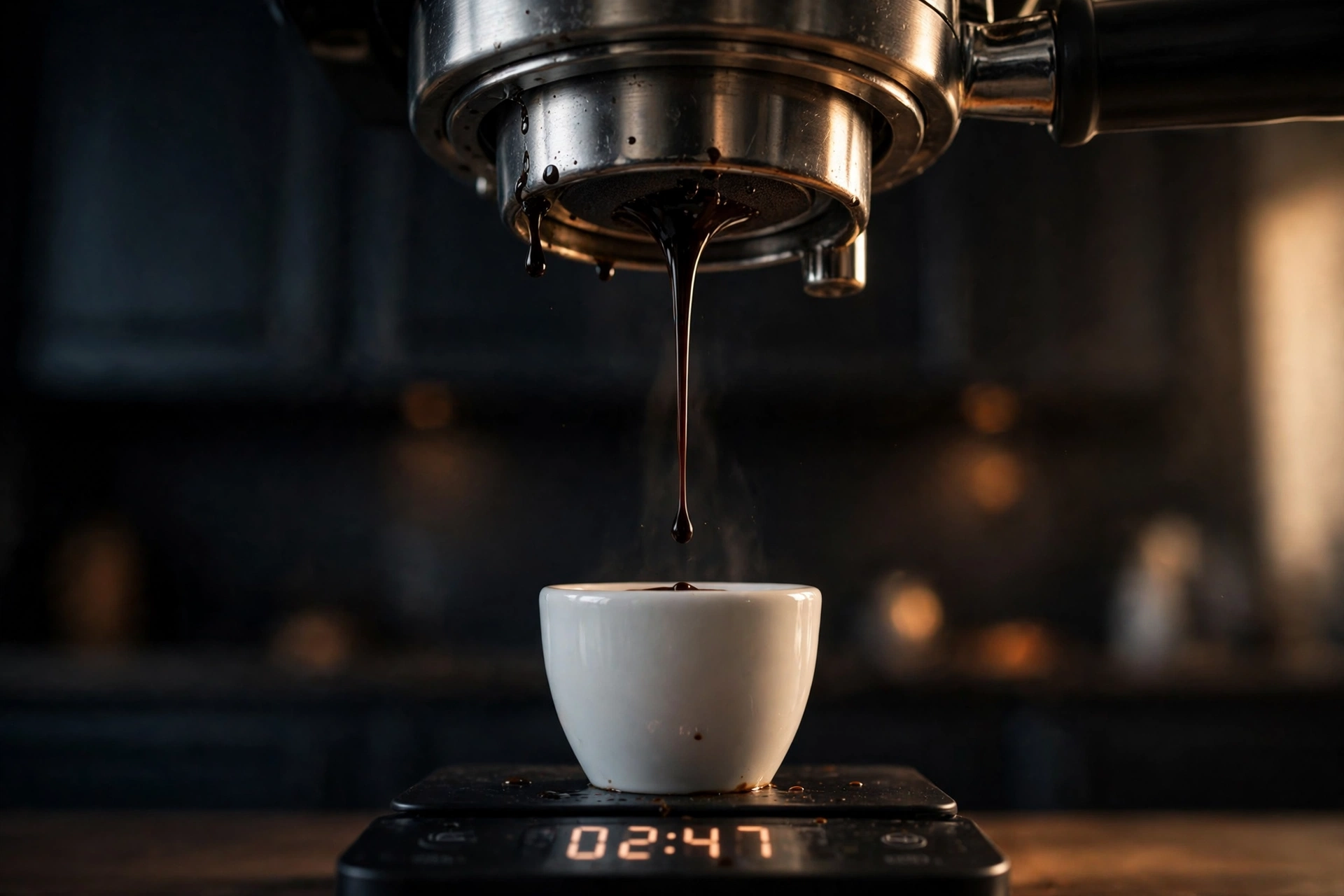
The short answer: a slow shot is water meeting too much resistance in the puck, and the fix is almost always grind coarser first. Change one variable at a time — grind, then dose, then distribution, then machine cleanliness — and pull a fresh test shot after each change. Most slow shots are fixed at step one.
Disclosure: we are an independent research desk and earn no commission on anything here. This page contains no affiliate links. See our disclosure policy for how we stay independent.
We are a research desk, not a test lab: we synthesize manufacturer specifications, owner reports, forum threads, and published guides rather than claiming hands-on testing we have not done.
What “too slow” actually means
A normal double shot is about 18g of ground coffee in and about 36g of liquid espresso out — a 1:2 ratio — in roughly 25 to 30 seconds from the moment the pump starts. That time is not a ritual number; it is the contact time water needs to dissolve the right share of the coffee’s soluble compounds.
| Shot time (18g in, ≈36g out) | What it means |
|---|---|
| Under 15 seconds | Gushing — the puck is offering almost no resistance |
| 15 to 20 seconds | Too fast — under-extracted, sour and thin |
| 25 to 30 seconds | Normal window — balanced extraction |
| 35 to 40 seconds | Slow — heading toward over-extraction and bitterness |
| Over 40 seconds | Too slow — over-extracted, bitter and harsh |
| Only drips, or nothing at all | Choking — the puck is resisting more than the pump can overcome |
Time alone is a symptom, not a diagnosis. The same 45-second shot can come from a grind that is too fine, an overfilled basket, a clogged shower screen, or a machine losing pressure — and each needs a different fix. The number tells you something is wrong; the taste and the flow tell you what.
One habit matters before anything else: stop the shot by weight, not by the timer. Pull until the scale reads about 36g, then stop the pump, whatever the clock says. A slow shot that reaches 36g in 45 seconds is over-extracted regardless of when you stop it — the weight tells you the ratio, the time tells you how the extraction happened. Both signals matter; weight is the primary one.
Why a slow shot tastes the way it does
Extraction dissolves flavour compounds out of the grounds in a fixed sequence: bright acids first, then sugars, then harsh bitter compounds last. That sequence is the mechanism behind everything in espresso extraction explained — a well-pulled shot stops after the sugars and before the bitters dominate.
A slow shot runs the sequence too far. Water stays in contact with the grounds long after the sugars have dissolved and keeps pulling out the late, bitter compounds. The result is a cup that tastes bitter, ashy, and harsh, with a dry, astringent mouthfeel and a dark, thin crema that fades fast — sometimes with a bitterness people mistake for the beans being “too dark.” It is not the beans. The water simply stayed too long and finished the job twice over.
The other half of the mechanism is resistance. The pump pushes water at about 9 bars, and the puck is the only thing slowing it down. Resistance comes from four things: how fine the particles are, how much coffee is in the basket, how evenly it is packed, and how clean the machine’s water path is. A slow shot means at least one of those four is too high. The causes below are ordered by how often each one is responsible, and by how cheaply each is tested.
The causes, in the order to fix them
1. Grind too fine — the cause most of the time
Fine particles pack tightly together and leave almost no gaps for water to pass through, so the puck builds far more resistance than the pump can push past in the normal window. The stream comes out as a slow, dark thread — or a few reluctant drips — and blonding never really arrives because the flow never gets going.
The fix is one step coarser on the grinder, then a fresh test shot. Grinders respond nonlinearly near the espresso range, so a tiny adjustment can shift timing by several seconds; move in small increments and taste each shot. If the shot speeds up by a few seconds, grind was the cause — keep stepping coarser until you land in the 25 to 30 second window. If several steps coarser barely changes the time, the cause is further down this list, not the grind.
One exception: pre-ground coffee. Coffee ground for espresso by a shop or a supermarket grinder can be far finer than your basket and dose expect, and no amount of lighter tamping compensates. If you brew with pre-ground coffee and every shot drags, the grind is the cause by definition — a burr grinder that lets you control fineness is the fix, and it matters more than the machine for this problem.
2. Dose too high for the basket
Too much coffee leaves an overfilled puck with too much material for water to push through, and the shot drags even at a grind setting that should otherwise work. This is the second most common cause, and it is easy to miss because the grinder gets blamed first: a shot can run slow at any grind setting if the basket is overfilled.
Weigh the dose against the basket’s rated capacity rather than eyeballing it. Most double baskets are designed for about 18 to 20g — check your specific basket, since this varies by manufacturer — and stay within a gram or two of that number. If the puck presses against the shower screen when you lock the portafilter in, or you see a circular imprint on the puck after the shot, remove coffee before touching the grind. The goal is not a magic number; it is the same number every shot, so the rest of the routine has a stable base.
3. Uneven distribution and fines clogging the basket
Even with the right grind and dose, a puck with dense clumps lets fine particles migrate downward during the shot and pack against the basket holes, choking the flow from below. Clumps, a mound tamped flat without levelling, or a tilted tamp all build uneven density, and water stalls in the dense patches while the rest of the puck barely extracts — the shot runs slow and tastes bitter and sour at the same time, which is the signature that separates a puck problem from a simple grind problem.
Fix distribution before changing anything else: break clumps with a WDT tool, level the surface, then tamp straight and square. Our channeling guide walks through the full routine in order. Also check the basket itself: hold it up to the light and look for holes blocked by fine grounds, and rinse it after every shot. A basket that slowly clogs over weeks will drag shot times longer a little at a time, which looks like a grind problem until you clean it.
4. Tamp too hard or uneven
Tamp force is the least likely cause on this list, but it belongs here because it is the first thing many people reach for. Once the puck is fully compressed, pressing harder adds almost nothing to resistance — the bed cannot get denser. What matters is squareness: a tilted tamp builds a density gradient across the puck, and water stalls in the dense side. Press straight down with consistent, moderate force and check the tamper base sits square to the basket rim. If your distribution is even and your tamp is square, tamp is not the cause — move on to grind, dose, and cleanliness.
5. A dirty machine restricting water flow
Coffee oils, scale, and old grounds narrow the water path before it ever reaches the puck. A shower screen caked with oils, a group head that has not been backflushed, or scale buildup in the boiler all reduce flow and pressure, and the shot runs slow no matter what the grind and dose are doing. The tell is timing: if shots that were dialled in last week gradually run slower with no change to grind, dose, or technique, the machine is the variable, not the coffee.
The quick test costs nothing: run water through the empty portafilter and watch the flow. A healthy machine gives a strong, even stream; a weak, sputtering, or uneven flow means the water path needs cleaning. Backflush with detergent, scrub the shower screen, and descale on the manufacturer’s schedule — our guide to how often to clean and descale an espresso machine covers the routine. Judge grind and dose only once the machine flows freely empty, or a cleaning problem will masquerade as a recipe problem.
6. Low pump pressure or a machine fault
If the beans are fresh, the dose matches the basket, distribution is even, the machine is clean — and shots still drag at a grind setting that used to work — the machine may not be reaching full pressure. A worn pump, a failing pressure valve, or a partially blocked internal line can all leave the puck under-pressured, which stretches shot times out.
Confirm the other causes first, because a repair is the expensive fix and the others are free. But once they are ruled out, no technique compensates for a machine that cannot hold pressure. Run the empty-portafilter flow test from cause 5, and if the flow is weak even after cleaning and descaling, the fault is inside the machine and a service check is the next step, not more grind changes.
Diagnose it in one shot
Pull a shot the way you normally would, watch the flow, and match what you see:
| What you see and taste | Most likely cause | First move |
|---|---|---|
| Slow dark thread, bitter and harsh, time barely moves across grind steps | Grind too fine | One step coarser, retest |
| Slow at every grind setting, puck imprinted by the shower screen | Dose too high | Weigh dose to basket capacity |
| Slow with bitter and sour together, flow uneven or spurting | Distribution / clogged basket | WDT, level, tamp square, clean basket holes |
| Was dialled in last week, now gradually slower with no changes | Dirty machine / scale | Backflush, clean screen, descale |
| Only drips or nothing at all | Choked puck | Grind 4–5 steps coarser immediately |
| Slow with weak flow even through an empty portafilter | Low pressure / machine fault | Clean, then service check |
The fix routine
Work through the causes in order, changing one thing per shot:
- Lock the dose. Weigh about 18g into the basket and keep it fixed for the whole session. Dose is the constant; grind is the variable.
- Grind one step coarser. Pull a fresh shot and time it. Repeat in small steps until the shot lands in 25 to 30 seconds.
- If time barely moves, check distribution. WDT the grounds, level the surface, tamp straight. A badly distributed puck runs slow at any grind setting.
- If distribution is clean and the shot is still slow, check the machine. Run water through the empty portafilter: weak flow means backflush, clean the shower screen, and descale before changing anything else.
- If the machine flows freely empty, the dose is right, distribution is even, and a coarser grind still drags, the pump may not be holding pressure. That is a service question, not a recipe question.
Do not change grind, dose, and tamp in the same session. Each change teaches you something only if the other variables stay put — and the problem returns the moment one of them slips back.
When it is not a slow-shot problem
A few things look like a slow shot but are not:
- A pressurized basket. A dual-wall basket forces coffee through a small exit valve, which controls flow regardless of the puck — see pressurized vs non-pressurized baskets. Timing rules still apply, but the basket masks grind and dose errors, so a slow shot there points to the coffee or the grind rather than the puck.
- A very light roast. Light roasts are denser and less soluble, so they extract more slowly and can need a longer ratio or a slightly higher water temperature to taste balanced. A 35-second light-roast shot can taste right where the same time on a dark roast tastes bitter — that is a roast characteristic, not a flow problem.
- A ristretto or a low-pressure profile. A 1:1 ristretto is intentionally slow and concentrated, and some machines and techniques deliberately pull longer shots at 6 bars. If the slow time is a choice and the cup tastes balanced, there is nothing to fix. Judge the taste, not the clock alone.
- The mirror problem. If your shots run too fast instead of too slow, the causes are the same variables in reverse — see our guide to espresso extraction too fast for the other half of the picture.
The bottom line
A slow shot is over-extraction caused by too much resistance, and the resistance lives in the puck or the water path. Grind coarser first — that is the cause most of the time — then check dose, then distribution, then machine cleanliness, changing one variable per shot. The numbers to aim for are simple: about 18g in, about 36g out, in 25 to 30 seconds. When the shot lands there and tastes sweet with a clean finish, the puck is doing its job.