
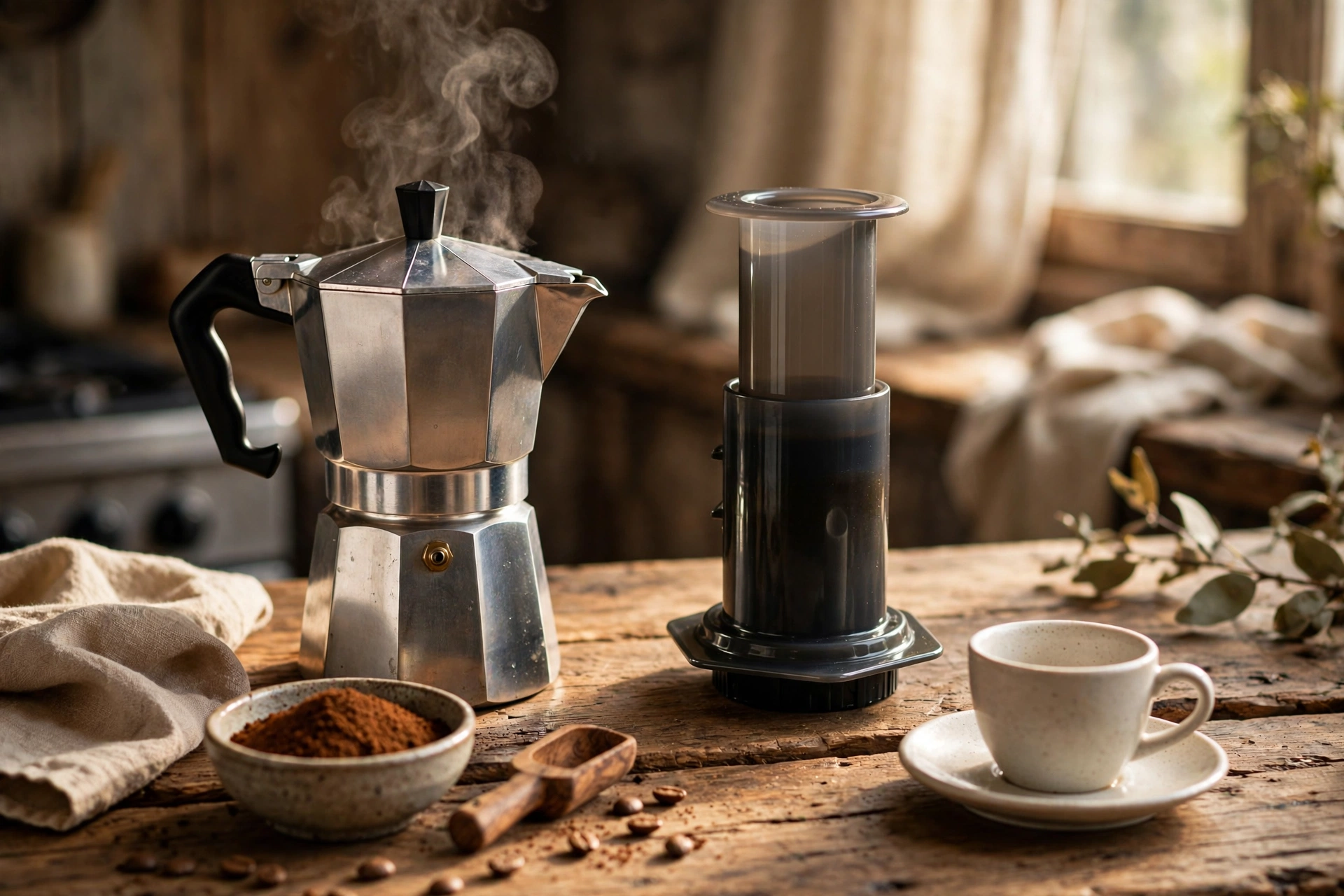
The short answer: no method without a machine makes true espresso — but a Moka pot or an AeroPress gets remarkably close, close enough that most people reaching for an espresso-based milk drink will be satisfied. Understanding why they fall short tells you exactly how to get the best out of each one.
What “espresso” actually requires
Espresso isn’t a roast level or a bean type — it’s a set of physical conditions. Three of them:
- ≈9 bars of pressure forcing water through the coffee (about nine times atmospheric pressure, ≈130 psi at the puck).
- A fine, compacted puck of coffee that resists that pressure.
- A 25–30 second extraction of a short ratio — typically 18g of coffee yielding ≈36g of liquid.
Pressure does two jobs that nothing else can do. First, it makes extraction fast: it pushes water through a dense, fine puck in half a minute, capturing acids and sweetness while mostly dodging the bitter compounds that come later. Second, it emulsifies: under 9 bars, CO₂ trapped in fresh coffee is forced into the liquid along with coffee oils, forming the stable golden foam we call crema. Both effects are pressure physics, not strength or darkness.
That’s the bar. Every machine-free method falls short on the pressure number — and the honest question is how far short, and what you can still get.
The contenders, compared
| Method | Pressure | Typical grind | Cup character | Crema? |
|---|---|---|---|---|
| Moka pot | ≈1–1.5 bars (steam) | Fine (table salt) | Strong, intense, slightly bitter | No |
| AeroPress | ≈1–2 bars (manual) | Fine to medium | Clean, sweet, full | No |
| Turkish / ibrik | ≈0 bars | Powder-fine | Thick, heavy, sludgy | No (foam, not crema) |
| French press (strong ratio) | 0 bars | Coarse | Heavy-bodied but muddy at high strength | No |
| Pour-over (short ratio) | 0 bars | Medium | Clear but thin when concentrated | No |
Nobody reaches 9 bars. The Moka pot and AeroPress get partway there through steam and muscle respectively; everything else is just concentrated gravity brewing. Ranked by how espresso-like the cup tastes — intensity, body, concentration — the Moka pot leads, the AeroPress follows, and the rest are different drinks that happen to be strong.
Method 1: the Moka pot — closest in intensity
The Moka pot is the only common home method that brews under genuine (if modest) pressure. Water in the sealed bottom chamber heats, steam pressure builds to roughly 1–1.5 bars, and that pressure pushes hot water up through a bed of fine grounds into the top chamber. It’s the closest thing to espresso physics you can get on a stovetop.
Getting the best from it is mostly about avoiding its failure modes:
- Use preheated water in the base. Starting with hot water means the grounds spend less time baking on the heat while pressure builds — the single biggest upgrade to Moka pot flavor. It also shortens the time the water sits at a rolling boil, which over-extracts.
- Grind fine, but not espresso-fine. Table salt, not powder. Too fine and the bed chokes — pressure spikes, the safety valve hisses, and you get bitter, over-extracted coffee. Too coarse and water rushes through weak and thin.
- Fill the basket, don’t tamp. Level the grounds off and leave them loose. Tamping creates the resistance of an espresso puck without the pressure to push through it — the result is choking and sputtering.
- Pull it off the heat early. When the coffee starts sputtering and bubbling (the pale, watery tail), the extraction is done. That last sputtering phase is over-extracted and bitter — stop it by running the base under cold water or pouring immediately.
- Low to medium heat. High heat rushes the process and superheats the water; gentle heat gives a steadier, sweeter extraction.
Done right, a Moka pot produces a short, intense, concentrated coffee that stands up to milk exactly the way espresso does. What it won’t give you is crema or the syrupy, emulsified body — 1.5 bars can’t do what 9 bars does.
Method 2: the AeroPress — closest in clarity
The AeroPress takes the opposite approach: instead of steam, you are the pump. You press a plunger by hand, generating roughly 1–2 bars of pressure through a fine-to-medium bed of grounds, with total immersion times of 1–2 minutes. It’s manual espresso-adjacent brewing.
Its strengths are different from the Moka pot’s:
- Pressure plus a paper filter gives a remarkably clean cup — all the concentration with none of the sludge or bitterness. Where the Moka pot is intense and rustic, the AeroPress is sweet and articulate.
- The inverted method (brewing upside-down, then flipping to press) lets you use finer grinds and longer steeps without drip-through, pushing concentration higher.
- Short ratios work well. A 1:4 to 1:5 coffee-to-water ratio — say 18g of coffee to 80–90g of water — produces a genuinely concentrated shot-like serving you can drink straight or top with hot water or milk.
The ceiling is your arm: sustained hand pressure tops out well below espresso pressure, and holding it steady is harder than it sounds. But for a clean, sweet, concentrated coffee with real body, nothing machine-free beats it.
Method 3: the rest — strong coffee, not espresso-like
Turkish coffee uses a powder-fine grind simmered in a small pot (ibrik/cezve), served unfiltered. The texture is thick and heavy — arguably the fullest body of any method here — and the fine grind extracts intensely. But there’s no pressure, the cup includes suspended grounds, and the flavor profile (often spiced, always unfiltered) is its own tradition, not an espresso substitute.
Strong French press (a 1:8 or 1:10 ratio instead of the usual 1:15) gives you concentrated coffee with heavy body from the metal filter’s oils. Push the ratio too far, though, and the same metal filter that gives body also gives muddiness — over-extracted fines and sludge scale up with the dose.
Short-ratio pour-over stays clean but gets thin: without pressure or immersion intensity, concentrating a pour-over mostly means under-extracting a big dose. It’s the least espresso-like option here.
All three make good strong coffee. None of them scratch the espresso itch the way the first two methods do.
Five rules for getting as close as possible
Whichever method you choose, these matter more than the equipment:
- Use fresh beans. Crema needs CO₂, and CO₂ leaves roasted coffee steadily — beans more than a month off roast are flat in every method. Freshness is the cheapest upgrade available.
- Grind fresh, and grind right. Pre-ground coffee stales in hours once opened, and the grind that suits a Moka pot or AeroPress is specific. A basic burr grinder covers both; you don’t need espresso-grade grind quality, just fresh and consistent.
- Mind the water temperature. Just off boiling (≈90–95°C) for AeroPress; preheated and not violently boiling for Moka. Boiling water scorches grounds and exaggerates bitterness in concentrated brews.
- Brew short ratios. Espresso is a 1:2 ratio. You won’t match it, but 1:4 to 1:8 (depending on method) gets you concentration in the right neighborhood. Normal drip ratios just make normal coffee.
- Preheat everything. The cup, the brewer, the water. Small volumes lose heat fast, and a concentrated brew served lukewarm tastes thin no matter how well it was extracted.
What you’ll never get — honestly
Two things remain exclusive to real pressure, and it’s worth naming them so expectations stay honest:
Crema. Not the look of foam — the substance. True crema is CO₂ and oils emulsified under 9 bars into a stable colloid that carries aroma and changes how the shot tastes. Aerated foam on a Moka pot brew looks similar for about thirty seconds and does none of that work.
The extraction curve. Espresso’s 25–30 second pressure extraction pulls flavors in a specific sequence — acids, then sweetness, stopping before the heavy bitters. Every machine-free method extracts on a different curve: longer, gentler, flatter. That’s not worse — the AeroPress’s sweetness is genuinely lovely — but it’s a different flavor architecture, and no technique closes that gap.
The bottom line
“Espresso without a machine” is a contradiction if you’re strict about it — pressure is the definition, and 9 bars doesn’t happen on a stovetop. But strictness isn’t the point. A well-made Moka pot brew or a short-ratio AeroPress delivers the intensity, concentration, and ritual that most people are actually after when they crave espresso, at a fraction of the cost and counter space. Learn the method’s physics, respect its limits, and you’ll stop missing the machine — except for the crema.