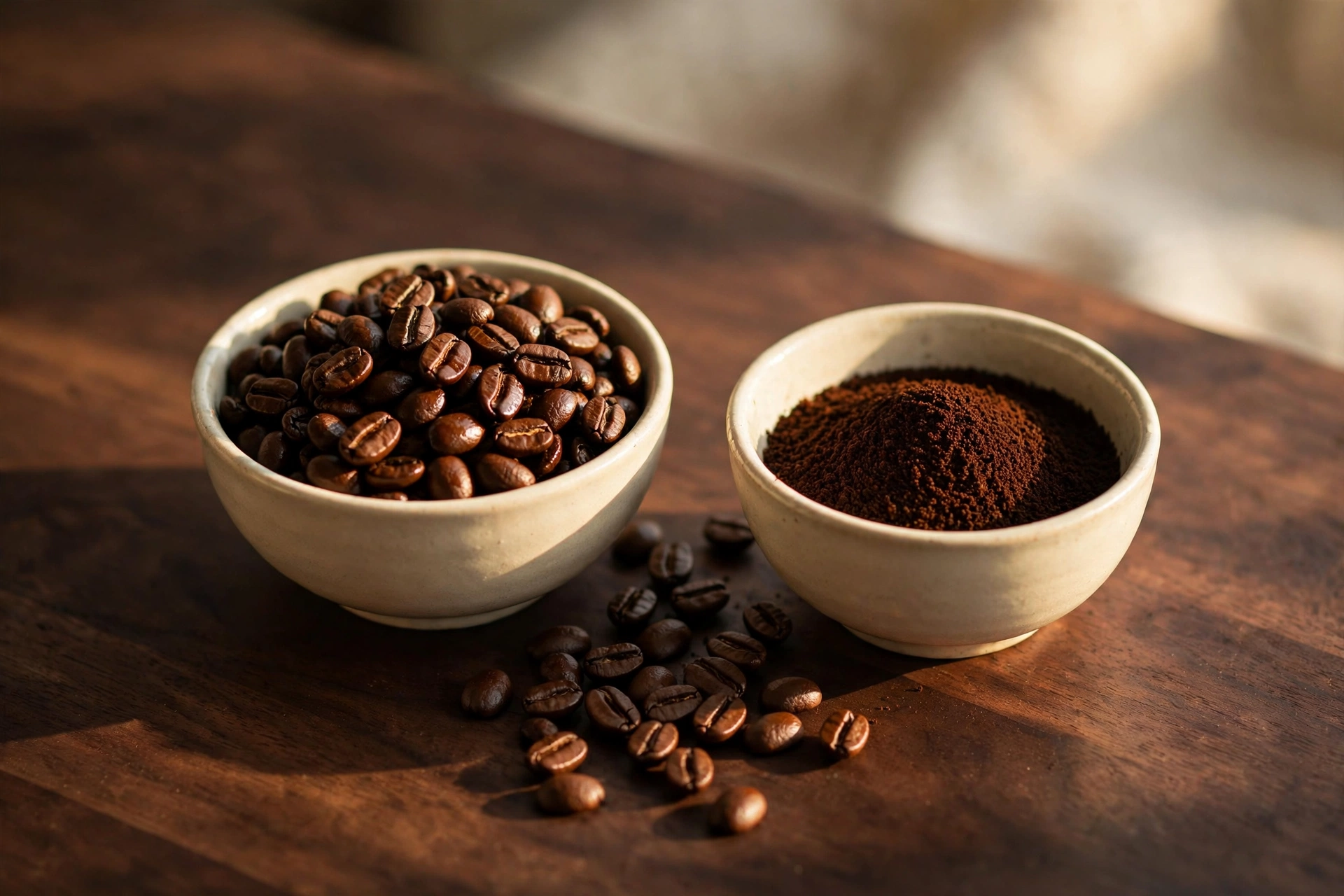
The short answer: for espresso, this isn’t a preference — it’s physics. Grinding multiplies the coffee’s surface area by roughly ten thousand times, and surface area is what staleness feeds on. Ground coffee starts losing its best compounds within minutes; whole beans hold them for weeks. Espresso is the one brew method where that difference is impossible to hide, because the entire extraction depends on a fresh, fine puck. If you remember one rule from this article: when you grind matters more than what you grind.
The mechanism: why grinding starts a countdown
A whole coffee bean is a sealed package. The roasting process fills it with CO₂ and hundreds of volatile aromatic compounds, and the bean’s intact cell structure keeps most of them locked inside. Staling is those compounds escaping and oxygen getting in — and both processes happen at surfaces.
Grinding shatters that package. A burr grinder turns each bean into hundreds of particles, and every new particle face is a new surface where:
- Aroma volatiles evaporate. The delicate compounds responsible for florals, fruit notes, and complexity are the lightest and most eager to leave. They start escaping immediately — this is why a grinder smells amazing and the resulting cup can taste comparatively dull if you wait.
- CO₂ degasses. Fresh coffee is full of carbon dioxide from roasting. CO₂ escaping from grounds is directly visible in espresso: it’s what forms crema. No CO₂ left, no crema — and flat crema is the calling card of stale grounds.
- Oxidation sets in. Oxygen attacks the exposed oils and compounds, producing the papery, cardboard flavors of stale coffee. Whole beans oxidize too, but slowly, from the outside in. Grounds oxidize from everywhere at once.
The timeline difference is stark. Whole beans: good for weeks. Grounds: meaningfully degraded within an hour, clearly stale within a day. It’s not a subtle connoisseur distinction — it’s the difference between coffee that tastes like its origin and coffee that tastes like brown.
Why espresso is uniquely unforgiving
Every brew method suffers from stale grounds, but espresso suffers twice:
First, the flavor problem. Espresso is concentrated — roughly 8–10% dissolved solids versus ≈1.3% for drip. Concentration amplifies everything, including staleness. Flat, oxidized flavors that might hide in a big mug of drip have nowhere to hide in a 36-gram shot.
Second, the physics problem. Espresso extraction depends on the puck resisting pressurized water for 25–30 seconds. That resistance comes from fine, fresh grounds packing together evenly. Stale grounds behave differently — they’ve lost CO₂ and moisture, the particle structure changes, and the puck doesn’t hold pressure the same way. Shots from stale grounds tend to run fast and taste thin even when the grind setting looks right. You’re fighting the physics, not just the flavor.
And there’s a third strike specific to pre-ground: it’s the wrong grind anyway. Espresso needs an extremely fine, precise grind — finer than table salt, with tight particle consistency. Supermarket “espresso grind” is ground for an imaginary average machine, which means it’s wrong for your specific machine, and you can’t adjust it. Dialing in espresso means adjusting grind in tiny steps; pre-ground gives you zero steps.
The honest comparison
| Whole bean (ground fresh) | Pre-ground | |
|---|---|---|
| Aroma and flavor | Full — volatiles intact until seconds before brewing | Degraded — most delicate compounds lost before the bag opened |
| Crema | Thick, persistent (fresh beans) | Thin or absent — CO₂ already gone |
| Grind control | Full — dial in precisely for your machine | None — fixed at whatever the factory chose |
| Freshness window | 2–4 weeks after roast | Minutes to hours after grinding |
| Cost per cup | Lower — whole bean is typically cheaper per gram than pre-ground specialty coffee | Higher per gram, and you’re paying for staleness |
| Effort | Grinding takes ≈30 seconds | Zero |
The only column pre-ground wins is effort, and it wins by thirty seconds.
What about the bag’s tricks?
Coffee packaging has evolved to fight staling, and it’s worth knowing what actually helps:
- One-way valve bags — genuinely useful. They let CO₂ out without letting oxygen in, which is why fresh whole-bean bags puff up. This protects whole beans well; it does almost nothing for grounds, which stale from the inside out regardless of the bag.
- Nitrogen flushing — pumping the bag full of inert nitrogen before sealing. This genuinely slows oxidation and is the reason some pre-ground coffee tastes acceptable for pour-over. But it can’t restore volatiles lost during grinding, and once you open the bag the clock starts at full speed.
- “Roasted on” vs. “best by” dates — “roasted on” is the honest number; “best by” dates a year out are marketing. For whole beans, buy within a few weeks of the roast date. For pre-ground, the roast date barely matters — the grind date does, and it’s never printed.
None of these change the verdict for espresso. Packaging slows staling; it doesn’t stop it, and espresso’s concentration plus its dependence on puck physics means even slowed staling shows up in the cup.
The degassing rest: why “fresh off roast” isn’t best
There’s one nuance worth knowing: beans straight off the roaster — day zero to two — actually brew worse than beans rested a few days. Freshly roasted beans are so full of CO₂ that the gas physically interferes with extraction: water can’t evenly penetrate the grounds, the puck behaves unpredictably, and shots run fast and uneven with huge, unstable crema that collapses.
The fix is a rest period: roughly 3–7 days after roasting for most espresso, up to 10–14 for very light roasts. During this time the beans degas enough to brew evenly while keeping the vast majority of their aromatics. This is the peak window — rested but not stale — and it’s the window good roasters are targeting when they stamp a roast date.
So the full freshness curve for whole beans looks like this: too fresh (days 0–2, gassy and uneven) → peak (days 3–14, the sweet spot) → declining (weeks 3–4, drinkable but fading) → stale (beyond a month, flat). Pre-ground coffee skips straight to the end of this curve the moment it’s ground, which is why no rest period or roast date can save it.
The practical setup
This is the good news: solving the problem is cheap and simple.
Buy whole beans with a roast date. Look for “roasted on” within the last 2–3 weeks. After opening, keep them in the original valve bag (squeezed of air, resealed) or an airtight container, at room temperature, away from light. Use within 2–4 weeks of the roast date.
Grind immediately before brewing. Not the night before, not that morning — right before the shot. The 30 seconds between grinding and tamping is the entire freshness strategy, and it costs nothing.
The grinder is the purchase that matters. This is the one piece of gear the whole-bean decision forces: you need a grinder that can grind fine and evenly enough for espresso, with small enough adjustment steps to dial in. It’s also, not coincidentally, the highest-leverage purchase in home espresso — a good grinder with a basic machine beats a great machine with a bad grinder every time, because the grinder controls the puck and the puck controls the extraction.
If the budget only stretches to one upgrade, make it the grinder, buy whole beans, and grind fresh. That single change — thirty seconds of grinding — does more for shot quality than any machine feature, and it’s the reason “whole bean vs. pre-ground” isn’t really a debate among people who’ve tasted both sides.