
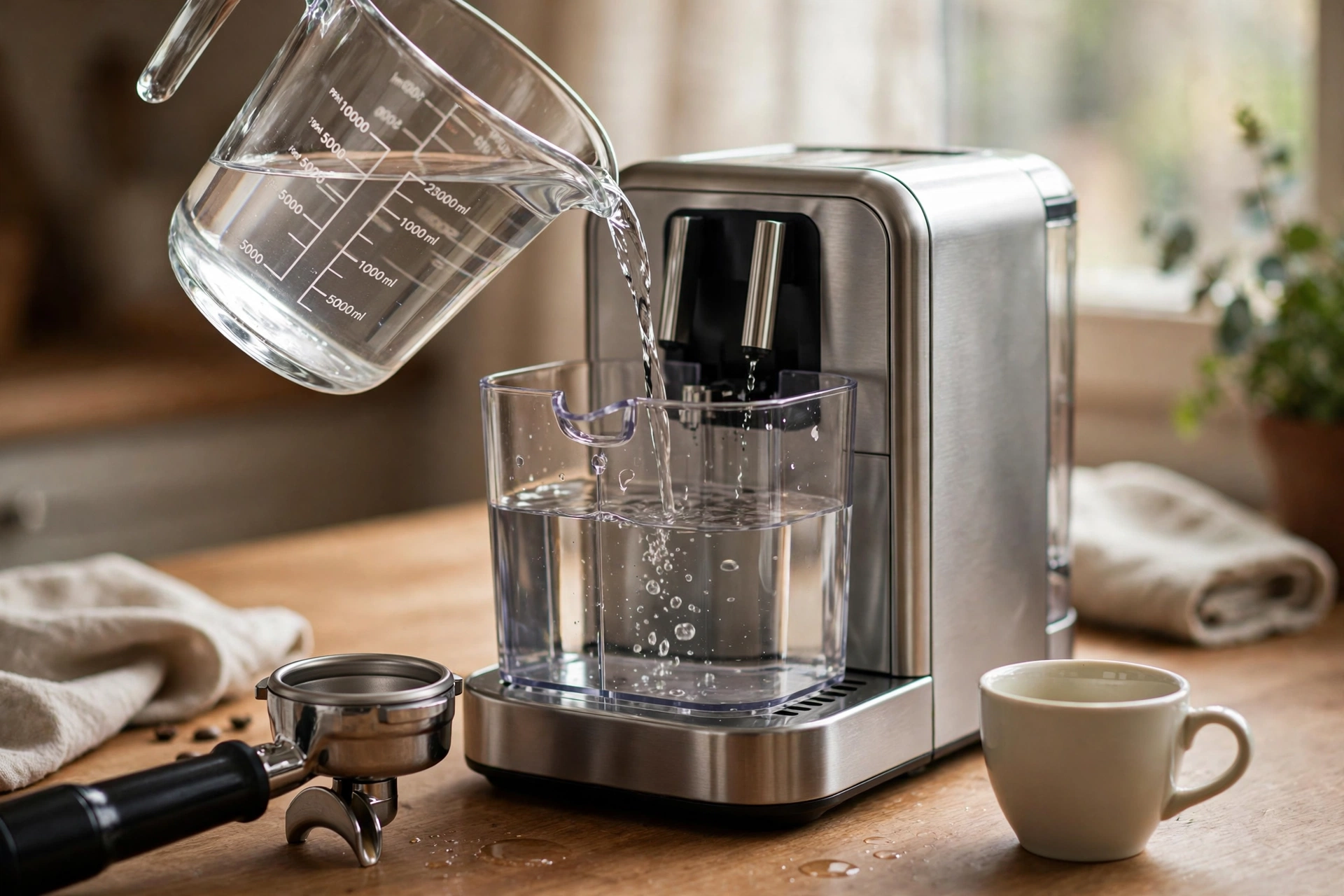
The short answer: descale every 2–3 months if your tap water is hard, every 3–6 months if it’s soft or filtered. Scale doesn’t announce itself — it builds silently inside the boiler and pipes until your shots drift, your steam wand weakens, or a valve clogs. By then the fix is harder than the maintenance ever was.
What limescale actually is
Your water carries dissolved minerals — mostly calcium and magnesium bicarbonates. That’s fine in a glass. But heat changes the chemistry: when water is heated, those bicarbonates convert to carbonates, which are far less soluble. The excess mineral has to go somewhere, so it crystallizes out as a hard, chalky crust on every hot surface it touches. That’s limescale — mostly calcium carbonate, the same stuff limestone is made of.
Two things make espresso machines the perfect scale factories:
- They run hot constantly. A boiler sitting at steam temperature (≈120°C+) for an hour every morning precipitates minerals far faster than a kettle that’s heated for three minutes.
- They have tiny passages. Boiler walls, heating elements, thermoblock channels, solenoid valves, and jet openings are all narrow. A millimeter of scale in a pipe is a rounding error; a millimeter of scale in a 2mm jet is half the flow gone.
The crust is cumulative and self-reinforcing: rough scale gives new crystals more surface to grip, so buildup accelerates once it starts.
Why scale matters more in espresso than in a kettle
A scaled kettle just takes longer to boil. A scaled espresso machine fails in ways that directly hit your cup:
Temperature instability. Limescale is a thermal insulator — it coats the heating element and boiler walls, so the heater’s output no longer reaches the water cleanly. The machine’s thermostat reads one temperature while the brew water is another, and the gap grows with every month of buildup. Since espresso lives or dies on 90–94°C water held steady, even a couple of degrees of drift shows up as sour, inconsistent shots.
Restricted flow and weakened steam. Scale narrows pipes and partially blocks valves. You’ll notice it first in the steam wand: weaker, wetter steam that takes longer to texture milk. Then in the brew path: slower pre-infusion, odd pressure behavior.
Pump strain. The pump has to work against the extra resistance. Vibratory pumps run hotter and louder; over months, that shortens their life.
Flakes and clogs. Old, thick scale eventually breaks off in chunks. A flake lodging in a solenoid valve or a group jet can take the machine from “fine” to “dead” in a single shot — and that’s a repair, not maintenance.
This is why descaling is preventive, not cosmetic. You’re not cleaning the machine; you’re protecting its temperature control, flow path, and pump.
Cleaning vs. backflushing vs. descaling
Beginners often treat these as one job. They’re three jobs, targeting three different enemies:
| Job | Removes | With what | How often |
|---|---|---|---|
| Daily cleaning | Coffee grounds, milk residue, drip tray grime | Water, brush, cloth | Every session |
| Backflushing | Rancid coffee oils in the group head and valves | Blind basket + espresso machine detergent | Weekly (machines with a 3-way solenoid) |
| Descaling | Mineral scale in the boiler, pipes, and valves | Acid descaling solution | Every 2–6 months |
Detergent doesn’t dissolve minerals. Acid doesn’t dissolve coffee oils. Running a descaler through the group head doesn’t replace backflushing, and backflushing doesn’t replace descaling. Do all three and the machine stays mechanically young for years.
What to descale with
Every descaler is an acid — the acid dissolves calcium carbonate back into soluble form so it flushes out. They differ in strength, safety, and cost:
| Descaler | Pros | Cons |
|---|---|---|
| Citric acid powder | Cheap, food-safe, widely available, gentle on parts | Needs correct dilution (≈1–2 tablespoons per liter); less effective on very heavy buildup |
| Purpose-made liquid descaler | Pre-diluted, formulated for espresso machines, often includes corrosion inhibitors | Priciest option per descale |
| Purpose-made powder descaler | Cheap per use, formulated for machines | Needs dissolving first; follow the packet ratio exactly |
| Sulfamic acid | Very effective on heavy scale | Harsher — overkill for routine maintenance, follow instructions precisely |
| White vinegar | — | Don’t use it. Acetic acid attacks rubber gaskets and aluminum, and the odor takes many flush cycles to clear |
Vinegar deserves the explicit warning because it’s the internet’s favorite bad advice. It’s an acid, so it “works” — and it also degrades the seals that keep your machine from leaking. A purpose-made descaler or citric acid costs a few dollars. The gaskets it saves cost far more.
How often, by water hardness
Hardness is just the mineral content of your water, usually measured in ppm (parts per million) or grains per gallon. The harder the water, the faster scale forms — so the honest schedule depends on what comes out of your tap:
| Water | Hardness (approx.) | Descale every |
|---|---|---|
| Hard tap water | 180+ ppm | 2–3 months |
| Medium tap water | 60–180 ppm | 3–4 months |
| Soft tap water | Under 60 ppm | 5–6 months |
| Softened/filtered (low-mineral) water | Under 50 ppm | 6–12 months |
Not sure what you have? Your municipal water supplier publishes hardness figures, or a $10 pack of aquarium test strips gives you a number in a minute. One test beats guessing for years.
Note the pattern: water treatment is the real lever. A simple in-tank softening filter or low-mineral water doesn’t just stretch the interval — it slows every failure mode in the previous section. Descaling is maintenance; good water is prevention.
The descaling process, step by step
The exact routine varies by machine — check your manual first, especially if your machine has a dedicated descale mode (many do, and it automates the cycling). But nearly every home machine follows this shape:
- Mix the solution. Dissolve your descaler in the ratio the product specifies (typically ≈1 liter of warm water per dose). Never run descaler stronger than recommended — more acid doesn’t mean cleaner, it means harsher.
- Empty and fill the tank. Pour out any old water, fill the tank with the descaling solution, and reseat it.
- Heat the machine fully. Let it reach operating temperature so the solution works on hot scale, not cold.
- Run solution through every water path. Pull a shot’s worth through the group head, run the hot water tap, and steam for 30–60 seconds. Scale coats all of them — descaling only the brew path leaves the steam circuit crusted.
- Soak. Turn the machine off and let the solution sit in the boiler for 15–30 minutes (follow the product’s guidance). This is where the chemistry happens — the acid needs contact time to dissolve the crust.
- Flush the solution through. Turn back on and run the remaining solution through the group and taps in intervals.
- Rinse thoroughly. Empty the tank, refill with fresh water, and flush at least 1–2 full tanks through every path. This step is non-negotiable: leftover acid in the boiler will taint your next dozen shots.
- Pull a test shot and discard it. The first shot after a descale is a sacrificial one — it clears any residue from the group head.
Total time: about an hour, most of it waiting. Total cost: a few dollars in descaler. Compare that to a $150+ service call for a clogged valve and the math is obvious.
The mistakes that cause damage
- Using vinegar. Covered above — it attacks gaskets and seals. The single most common descaling mistake.
- Waiting for the descale light. The alert is a maximum interval set by the manufacturer, not an optimal one. Scale has been building the whole time the light was off.
- Descaling once after years of nothing. A thick crust that finally breaks loose can send chunks into valves and jets. If a machine has gone years without descaling, the first descale should be gentle (weaker solution, longer soak) — or done by a technician.
- Skimping on the rinse. Descaler residue doesn’t just taste bad; acid sitting in the boiler keeps working on metal parts. Flush until the water runs completely neutral — at least a full tank, ideally two.
- Descaling with the water filter still in. If your machine uses an in-tank filter, remove it before descaling — the acid will destroy the filter media. Put a fresh one in (or the old one back) after the rinse.
The bottom line
Descaling is the cheapest maintenance an espresso machine has: an hour, a few dollars, every few months, in exchange for stable temperature, strong steam, and a pump that lives its full life. The mechanism is simple — heat turns dissolved minerals into rock, and acid turns the rock back into something that flushes away. Match the interval to your water hardness, use a proper descaler instead of vinegar, and rinse like you mean it.