
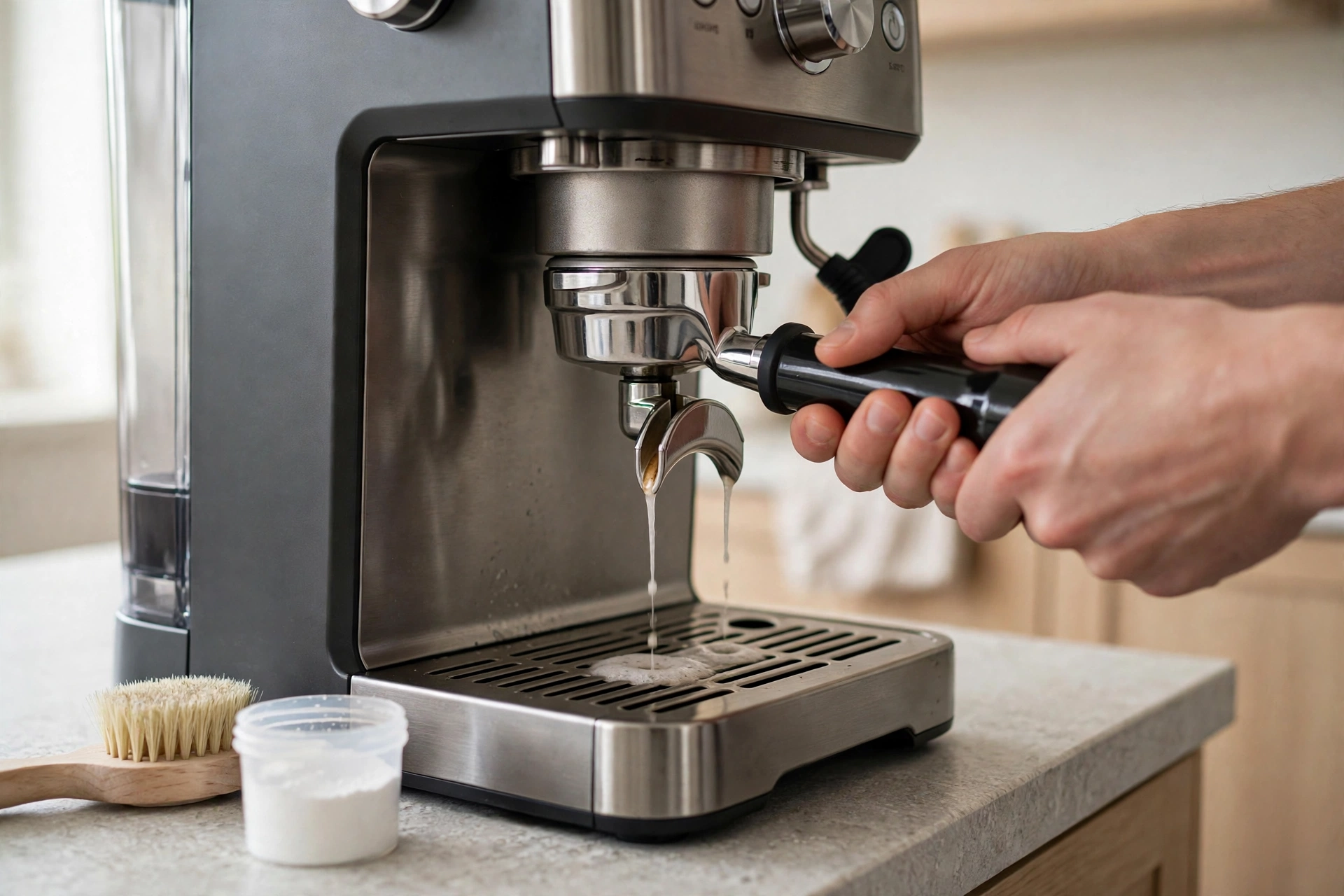
The short answer: backflushing pushes water backwards through the group head and the 3-way solenoid valve to strip out the rancid coffee oils that a normal forward flush never reaches. Do a water-only backflush after every session, and a detergent backflush every 1 to 2 weeks. But first check your machine has a 3-way valve — backflushing a machine without one can damage it.
Disclosure: we are an independent research desk and earn no commission on anything here. This page contains no affiliate links. See our disclosure policy for how we stay independent.
We are a research desk, not a test lab: we synthesize manufacturer specifications, owner reports, forum threads, and published guides rather than claiming hands-on testing we have not done.
What backflushing actually does
Every shot you pull leaves residue in two places you cannot see. Coffee oils coat the shower screen and the inside of the group head, and fine grounds get sucked up into the 3-way solenoid valve when the shot ends. A normal flush — running water through the open group head — rinses the screen, but it flows the wrong way to clean the valve: water follows the path of least resistance, straight down and out, and the valve’s internal passages never see a cleaning flow.
Backflushing reverses the flow. A blind basket — a solid basket with no holes — seals the portafilter, so when the pump runs, pressure has nowhere to go except backwards: up through the shower screen, into the group head, and through the 3-way valve. When you switch the pump off, the valve opens its third port and dumps that pressurized, dirty water into the drip tray. Each on-off cycle is a pressure pulse that scrubs the valve from the inside.
The mechanism matters because the valve is what makes the whole thing work. A 3-way solenoid valve has three ports: one from the pump, one to the group head, and one exhausting to the drip tray. During a shot it connects pump to group; the instant you stop, it closes the pump side and opens the exhaust, venting pressure so the puck dries out and lifts cleanly. That venting action is also what pulls dirty water and grounds back into the valve — which is exactly why it needs cleaning, and why the valve is the gatekeeper for whether your machine can be backflushed at all.
The enemy is coffee oil. Fresh oil is flavour; oil left in a hot valve for days oxidizes and turns rancid, and rancid oil is the stale, bitter, ashy note that creeps into shots from an uncleaned machine. Detergent backflushing dissolves that oil. Water alone cannot — it moves loose grounds and fresh residue, but baked-on oil needs a surfactant. That is the whole logic of the two routines below: water often, detergent regularly.
Can your machine be backflushed?
The only question that matters is whether your machine has a 3-way solenoid valve. If it does, backflush. If it does not, do not — running a pump against a sealed basket with nowhere for the pressure to go strains the pump and can blow a seal.
| Machine | Backflush? |
|---|---|
| Gaggia Classic Pro, Rancilio Silvia | Yes — both have a 3-way valve |
| Breville Barista Express, Barista Pro, Barista Touch, Dual Boiler | Yes — and they have a built-in cleaning cycle for it |
| E61 group machines (Rocket, ECM, Profitec, Lelit) | Yes — the E61 group has a 3-way valve by design |
| Breville Bambino (base model) | No — no 3-way valve |
| Breville Bambino Plus | Check your manual — published sources disagree on whether it has a 3-way valve |
| Super-automatics / bean-to-cup (Jura and similar) | No — use the machine’s own cleaning cycle with tablets |
| Manual lever machines (Flair and similar) | No — no pump and no solenoid valve to clean |
| De’Longhi Dedica and most entry-level thermoblock machines | Check your manual — many lack a 3-way valve |
If your machine is not on this list, the test is in the manual: look for “backflush” or “cleaning cycle” in the maintenance section. If the manual never mentions it, assume the answer is no. A second, weaker signal is the puck: after a shot, a machine with a 3-way valve leaves a dry puck that knocks out cleanly, because the valve vented the pressure. A wet, soupy puck that drips when you remove the portafilter usually means there is no valve venting anything — and therefore nothing to backflush through.
What you need
- A blind basket (backflush disc). A solid basket with no holes that replaces your brewing basket in the portafilter. Breville ships one with its machines and calls it a cleaning disc; Gaggia and most E61 machines include one too. If yours is missing, a standard 58mm blind basket costs a few dollars.
- Espresso machine cleaner. Urnex Cafiza or Puly Caff are the cafe standards, sold as powder or tablets. Powder dose is about a quarter to half a teaspoon per cycle; tablets are one per cycle. Either form works — tablets are pre-measured, powder is cheaper per cycle.
- A group-head brush. A stiff nylon brush for scrubbing the shower screen and gasket while the machine is open.
- A cloth. For wiping the group head and the portafilter between cycles.
Do not substitute dish soap or vinegar. Dish soap is designed to leave a film on surfaces, and that film survives inside channels you cannot reach or scrub — it will taint shots for days. Vinegar is an acid for dissolving mineral scale, not a solvent for coffee oils; it does the wrong job and attacks rubber gaskets while doing it.
The water-only backflush (after every session)
This is the two-minute habit that does most of the work. No detergent, no waiting — just clean water pulsed backwards through the valve while the machine is still hot.
- Leave the machine on and hot. Backflushing works best at brewing temperature, when oils are soft.
- Swap in the blind basket. Remove your brewing basket from the portafilter and fit the blind basket. No detergent.
- Lock in and pulse. Lock the portafilter into the group head. Run the pump for about 10 seconds, then switch it off. You will hear the valve release with a whoosh and see cloudy water discharge into the drip tray.
- Repeat 4 to 5 times. Each pulse pushes fresh water backwards and dumps the last cycle’s loosened grounds and oils. The discharge water should run progressively clearer.
- Remove, wipe, and flush forward. Take the portafilter out, wipe the group head with a cloth, and run a few seconds of water through the open group head to clear anything left on the screen.
That is the whole routine. Done after every session, it keeps fresh oils from baking on — and it is the difference between a detergent backflush that takes ten minutes and one that fights weeks of buildup.
The detergent backflush (every 1 to 2 weeks)
The detergent cycle is the same pulse pattern with cleaner added, and a longer rinse afterwards. It takes about ten minutes.
- Warm the machine fully. Same as above — hot water and hot oil clean better than cold.
- Add detergent to the blind basket. About a quarter to half a teaspoon of powder, or one tablet, in the blind basket. Fit it in the portafilter.
- Lock in and run the pulse cycle. Pump on for 10 seconds, off for 10 seconds, and repeat 5 times. The discharge water will come out brown and foamy at first — that is dissolved coffee oil leaving the valve. Let the machine rest a few seconds between cycles so the detergent has contact time. Never hold the pump against the blind basket for more than about 15 seconds at a stretch; the pump is pushing against a sealed system and prolonged strain overheats it.
- Rinse the portafilter. Remove it, rinse the blind basket and portafilter thoroughly under running water to remove all detergent.
- Rinse the machine with clean water. Lock the clean, empty blind basket back in and repeat the 10-second on/off pulse 5 to 10 times with plain water. Watch the drip tray: keep going until the discharge runs completely clear with no foam. This rinse is the step people skip, and it is the one that matters most for taste — detergent residue in the valve will ruin the next several shots.
- Scrub the shower screen and gasket. With the machine off, work the group-head brush around the rubber gasket and the underside of the shower screen to lift the grey paste that collects there. Wipe clean.
- Pull a sacrificial shot. Lock in your normal basket, pull a shot, and discard it. It clears any last trace of cleaner from the group head. Your next real shot should taste like coffee, not soap.
Breville’s automatic cleaning cycle
Breville machines with a 3-way valve — Barista Express, Barista Pro, Barista Touch, Dual Boiler — automate the detergent backflush. The machine tracks shot count and lights a “Clean Me” indicator after about 200 shots, which for most home users is roughly once a month.
The routine is the same chemistry with the machine doing the pulsing: insert the cleaning disc into the single-cup basket, drop in a cleaning tablet, lock the portafilter in, and start the cycle (on the Barista Express, hold 1 Cup, 2 Cup, and Power together; on the Barista Pro, select FLUSH from the menu; on the Barista Touch, select the cleaning cycle on screen). The cycle runs about five minutes. Afterwards, run a water-only cycle with no tablet to rinse.
One quirk to know: the “Clean Me” light resets if you switch the machine off at the wall, because the counter lives in volatile memory. If you always unplug your machine, the light may never come on — run the cycle monthly on a calendar reminder instead.
How often, by how much you brew
Frequency follows shot volume, not the calendar alone. More shots means more oil through the valve.
| Daily shots | Water-only backflush | Detergent backflush |
|---|---|---|
| 1 to 2 | After every session | Every 2 to 4 weeks |
| 3 to 5 | After every session | Every 1 to 2 weeks |
| 6 or more | After every session | Weekly, or twice a week |
| Breville auto-cycle machines | After every session | When the “Clean Me” light comes on, about every 200 shots |
The water-only habit is non-negotiable at every volume — it is two minutes and it prevents the buildup that makes the detergent cycle hard. The detergent interval is where volume matters: a household pulling one morning shot can stretch to a month, while a household pulling five shots a day will taste the difference within two weeks of skipping it.
Signs it is overdue
- Shots taste bitter, stale, or ashy despite fresh beans and a dialled-in recipe. Rancid oil in the valve is the classic cause of a bitterness that no grind change fixes — see our guide to espresso extraction too slow for how to rule out the puck first.
- Shot times creep longer with no change to grind or dose. Oil narrowing the valve and a screen clogged with grounds both restrict flow before water reaches the puck.
- The discharge water runs brown on the first water-only pulse. Clear water should stay clear. Brown means oil has been sitting in the valve.
- The puck stays wet and soupy after the shot. A 3-way valve clogged with oil vents slowly or not at all, so pressure stays trapped in the group head.
- The solenoid sounds different. A healthy valve releases with a sharp whoosh when the pump stops. A weak, delayed, or absent release means the valve is struggling.
Any one of these is a prompt to run a detergent backflush now, not at the next scheduled interval.
Mistakes that cause damage
- Backflushing a machine without a 3-way valve. The pump pressurizes a dead end. On a super-automatic or a valveless machine this can crack the pump or blow a seal — the most expensive mistake on this list, and entirely avoidable by checking the manual first.
- Holding the pump on too long. About 10 seconds per pulse is enough; never more than about 15. The pump is working against a sealed basket and heats up fast with nowhere for the water to go.
- Skipping the rinse. Detergent left in the valve does not just taste bad — it keeps working on internal parts and taints shot after shot. Rinse until the drip-tray water runs completely clear, then pull and discard a shot.
- Using dish soap or vinegar. Soap films survive the rinse; vinegar attacks gaskets and does not dissolve oil. Both are the wrong chemistry for this job.
- Backflushing a cold machine. Cold oil does not dissolve well, and the detergent cycle wastes most of its effect on oil that is still solid. Always backflush at brewing temperature.
- Treating backflush as a substitute for descaling. Backflushing removes coffee oils; descaling removes mineral scale from the boiler and pipes. They target different deposits in different parts of the machine — our guide to how often to clean and descale an espresso machine covers the descaling side.
Backflush vs. descale vs. daily cleaning
Beginners often treat these as one job. They are three jobs, targeting three different enemies:
| Job | Removes | With what | How often |
|---|---|---|---|
| Daily cleaning | Grounds, milk residue, drip-tray grime | Water, brush, cloth | Every session |
| Backflushing | Rancid coffee oils in the group head and 3-way valve | Blind basket + espresso machine detergent | Water-only daily, detergent every 1 to 2 weeks |
| Descaling | Mineral scale in the boiler, pipes, and valves | Acid descaling solution | Every 2 to 6 months, by water hardness |
Detergent does not dissolve minerals. Acid does not dissolve coffee oils. Running a descaler through the group head does not replace backflushing, and backflushing does not replace descaling. Do all three and the machine stays mechanically young for years — which is also why a clean machine holds its shot timing steady instead of drifting slower month by month.
The bottom line
Backflushing is the cheapest maintenance an espresso machine has: a blind basket, a pinch of cleaner, and ten minutes every week or two, in exchange for shots that taste like the beans instead of last month’s oils. The rule is simple — water-only after every session, detergent every 1 to 2 weeks, and only on a machine with a 3-way solenoid valve. If your manual does not mention backflushing, do not improvise: flush forward, scrub the screen, and let the machine’s own cleaning cycle do the rest.