
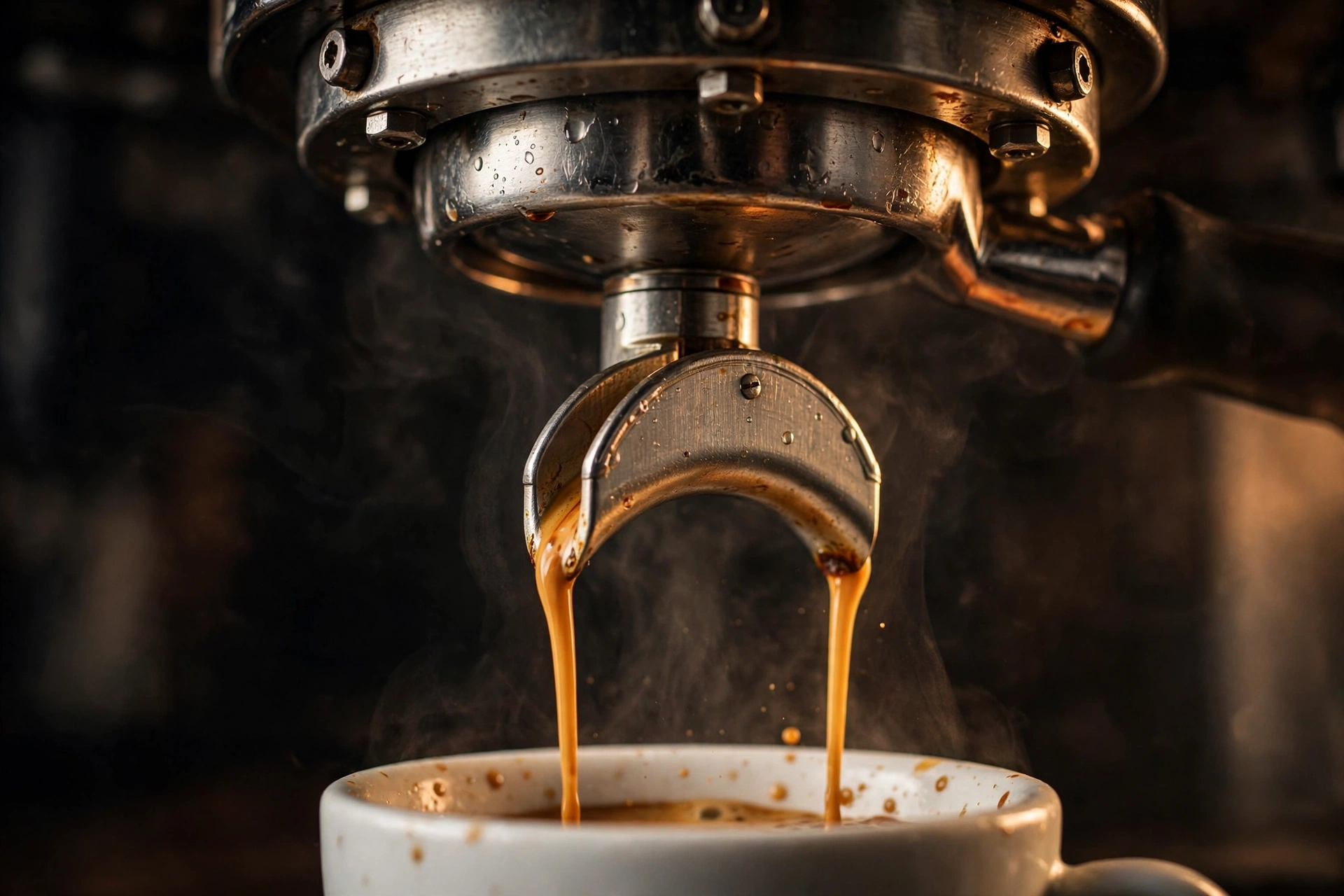
The short answer: an espresso machine heats water to 90–94°C, pressurizes it to about 9 bars, and forces it evenly through a compacted puck of finely ground coffee, extracting a concentrated shot in 25–30 seconds. Four subsystems do the work — heating, pressure, water delivery, and the puck itself — and nearly every feature on a machine’s spec sheet maps to one of them.
Why pressure changes everything
Start with the contrast. Drip coffee lets gravity pull hot water through grounds over several minutes. Espresso does the opposite: it uses pressure to force extraction to happen fast.
That speed matters because extraction is a race between desirable and undesirable compounds. In the first seconds, water pulls out acids and bright flavors; sweetness follows; bitter compounds come last. A 25–30 second shot captures the first two and mostly dodges the third. Pressure is what makes that window possible — it pushes water through a fine, dense puck fast enough to extract in half a minute what gravity would take minutes to do.
But pressure only works if the puck resists it. Too coarse a grind and water blasts through in 10 seconds: sour, watery under-extraction. Too fine and the puck chokes, pressure spikes, and you get bitter over-extraction — or nothing at all. The entire machine exists to hold its side of this bargain: steady heat, steady pressure, even water. The grinder handles the puck’s side.
Subsystem 1: heating the water
Espresso needs water at 90–94°C — just off boiling. A few degrees off noticeably changes the shot: cooler water under-extracts (sour, thin), hotter water over-extracts (bitter, harsh).
How machines heat water, from cheapest to best:
| Heating system | How it works | Typical machines | Temperature stability |
|---|---|---|---|
| Thermoblock / thermocoil | Water flashes through a heated metal block on demand | Entry-level (under ≈$400) | Weakest — can swing several degrees |
| Single boiler | One boiler for brewing and steaming | Mid-range | Good for brewing, but you wait between brewing and steaming |
| Heat exchanger (HX) | One steam-temperature boiler; brew water passes through a tube inside it | Prosumer ($1,000+) | Good once you learn the cooling-flush routine |
| Dual boiler | Separate boilers for brewing and steaming | Prosumer ($1,200+) | Best — each boiler holds its own temperature |
The pattern: you pay for stability, not heat. Any machine can reach 93°C; holding 93°C shot after shot is what costs money. A PID controller — a digital thermostat that constantly adjusts the heater — is the single most valuable temperature feature on a home machine. It turns a ±5°C swing into ±1°C, and it’s why a $450 machine with a PID can out-shoot a $700 machine without one.
Subsystem 2: building pressure
The famous number is 9 bars — roughly nine times atmospheric pressure, about 130 psi at the coffee puck.
Two components generate and regulate it:
The pump. Home machines use one of two types. Vibratory pumps are small electromagnetic pistons — loud (the classic espresso-machine buzz), cheap, and standard below ≈$1,000. Rotary pumps are motor-driven vanes — quiet, smooth, and long-lived, but bigger and pricier. Taste-wise they’re equivalent; you’re paying for noise and durability, not flavor.
The OPV (over-pressure valve). The detail most people miss: the pump doesn’t produce 9 bars. Most vibratory pumps generate up to 15 bars, and the OPV bleeds the excess back into the tank so the puck sees a steady ≈9. That’s why “15-bar pump” on a cheap machine’s box is marketing, not a feature — the OPV caps it at 9 anyway. What matters is that the valve holds pressure steady, not how high the pump can spike.
Why 9 bars and not 5 or 15? It’s the historical sweet spot inherited from the original lever machines: enough pressure to extract in ≈25 seconds through a fine puck, not so much that it blasts channels through the coffee. More pressure doesn’t mean more flavor — it means more channeling.
Subsystem 3: delivering the water evenly
Pressure is useless if water hits the puck unevenly. If one spot saturates first, water punches a channel through it — most of the flow rushes down that single path, over-extracting a tiny region and under-extracting the rest. The result is the worst of both worlds: sour and bitter in the same cup.
This is the group head’s job — the assembly the portafilter locks into:
- Dispersion / shower screen: a metal plate with tiny holes that spreads the incoming water jet across the whole puck surface instead of drilling one spot.
- Pre-infusion: many machines start with a few seconds of low pressure (or a timed pause) so dry grounds swell and saturate before full pressure hits. A swollen, evenly wet puck resists channeling far better than a dry one slammed with 9 bars instantly.
- Thermal mass: heavy brass group heads (like the well-known E61 design) hold heat between shots, keeping water at temperature as it travels from boiler to puck.
Pre-infusion deserves emphasis because it’s the most forgiving feature a beginner can have. It doesn’t fix bad technique, but it widens the margin — a slightly uneven tamp that would channel under instant full pressure often survives a gentle pre-infusion.
Subsystem 4: the puck
The machine controls three subsystems. The fourth — the coffee puck — is yours, and it’s where most shots are won or lost:
- Dose: ≈18g of coffee in a double basket is the standard starting point.
- Distribution and tamp: grounds must be level and evenly compressed. A tilted tamp or a clumpy mound creates a weak spot, and pressurized water will find it every time.
- Ratio: the classic starting recipe is 1:2 — 18g of coffee yielding ≈36g of espresso in 25–30 seconds. Weigh the output with a scale; eyeballing doesn’t work at this precision.
Notice the asymmetry: the machine’s three subsystems are fixed once you buy it. The puck is adjustable every single shot — and it’s adjusted through the grinder. That’s why experienced people say the grinder matters more than the machine: the machine holds its variables steady, and you tune the one variable through grind size.
A shot, second by second
Put it together and here’s what happens when you press the button:
- 0–5s — pre-infusion. Low-pressure water soaks the puck. The first dark drips appear.
- 5–10s — ramp-up. Pressure climbs toward 9 bars. The stream starts, dark brown and syrupy.
- 10–25s — extraction. Steady flow, gradually lightening from dark brown to caramel.
- 25–30s — stop. The stream turns pale and watery (“blonding”) — the signal that the good flavors are extracted and bitterness is next. Stop the shot.
Blonding is your built-in timer. Color beats the clock because every coffee extracts at a slightly different rate — but they all blonde when they’re done.
What this means when you’re buying
Every spec-sheet feature maps to a subsystem. Read machines this way:
| If you want… | Look for… | Subsystem |
|---|---|---|
| Consistent flavor shot to shot | PID temperature control | Heating |
| Forgiving, even extraction | Pre-infusion, good shower screen | Water delivery |
| Quiet operation and longevity | Rotary pump | Pressure |
| Room to grow your technique | 58mm portafilter, non-pressurized basket | The puck |
And the honest summary: a machine is a device for holding three variables steady — temperature, pressure, and water distribution — while you control the fourth through the grinder. Buy enough machine to hold its variables steady (a PID and a proper 9-bar OPV get you most of the way there), then spend the rest of your budget where the adjustable variable actually lives: the grinder.