
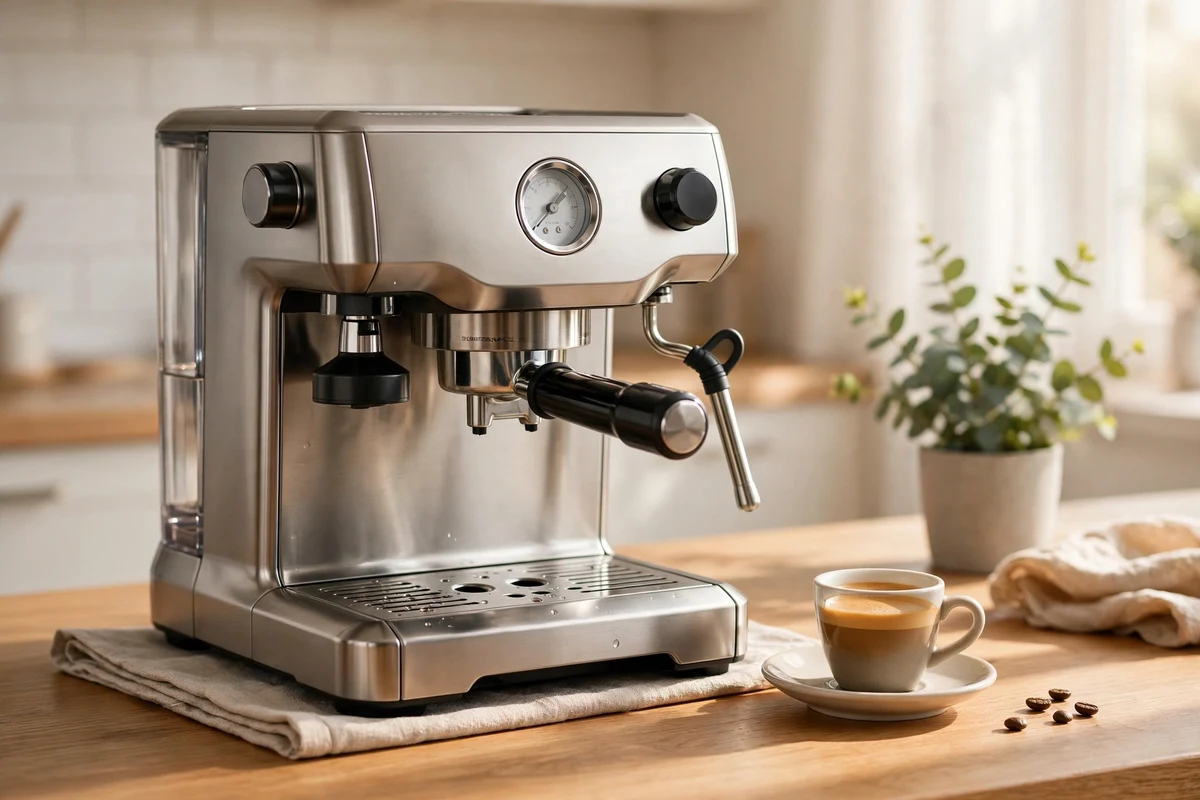
The short answer: most home espresso machines last 5 to 15 years, and where yours lands in that range depends less on the brand badge than on three things — how it handles heat, what water you feed it, and whether its worn parts can be replaced. A budget appliance machine often dies around year five because one sealed component fails and cannot be swapped. A prosumer machine built from standard plumbing and electrical parts can run for decades, because there is almost nothing on it that cannot be unbolted and replaced.
What “lasting” actually means
An espresso machine is not one object with one lifespan. It is a stack of systems, each aging on its own clock, bolted into the same box:
- The pump pushes water at about 9 bars. It is a mechanical device with moving parts, and it wears.
- The boiler or thermoblock heats the water. It lives under constant thermal stress and is where mineral scale does its damage.
- Gaskets and O-rings seal every joint. They are rubber or silicone, and heat slowly hardens them until they leak.
- The electronics — switches, thermostats, control boards — sit near all that heat and steam, which is exactly what electronics hate.
The machine “dies” when the first system that cannot be economically repaired gives up. On a well-built machine, that moment keeps getting pushed back because the failing system can be replaced. On a sealed appliance, the first serious failure is the end. So the real question is never “how long does this machine last?” It is “how long until something irreplaceable fails?”
The three forces that wear a machine out
Every espresso machine failure traces back to the same three forces. Understand them and the lifespan numbers below stop being mysterious.
1. Heat. A machine cycles from room temperature to brew temperature (about 93°C) and steam temperature (about 120°C or higher) every session. Materials expand when hot and contract when cool, so every cycle works every joint, seal, and solder connection back and forth. Rubber ages faster the hotter it sits — a gasket baked all day hardens in months instead of years. Heat is the background radiation of machine aging: always on, always cumulative.
2. Water and scale. Water carries dissolved minerals, and heating it forces those minerals out as limescale on hot surfaces. Scale insulates heating elements so they run hotter and burn out sooner, narrows the tiny passages in valves and jets, and eventually flakes off in chunks that jam moving parts. Scale is the single most preventable cause of early death — it is almost entirely determined by your water and your descaling habits, not by the machine.
3. Pressure cycles. Each shot is a pressure event: the pump ramps to about 9 bars, holds, and releases. Two shots a day is roughly 700 pressure cycles a year, plus steaming cycles that flex the boiler and its seals. Vibratory pumps, the small pumps in most home machines, have a finite cycle life and gradually lose pressure as they age. Rotary pumps in prosumer and commercial machines are built for far more cycles and can often be rebuilt.
Everything else — rust, limescale-clogged valves, dead boards — is one of these three forces working on a specific part.
Expected lifespan by machine type
Construction decides how those forces play out. Machines differ mainly in how much metal they contain, whether the water path uses standard fittings, and whether the maker stocks spare parts.
| Machine type | Typical lifespan | Why it ends there |
|---|---|---|
| Capsule machines | 3 to 5 years | Sealed plastic water path, proprietary parts, built as appliances — one pump or board failure ends it |
| Budget thermoblock machines | 5 to 7 years | Thin aluminum thermoblock scales up and corrodes, vibratory pump wears, few spares available |
| Entry semi-automatics (small single boiler) | 7 to 10 years | Real boiler and replaceable gaskets help, but small proprietary parts can become unavailable |
| Heat exchanger and dual boiler prosumer machines | 12 to 20 years | Copper or stainless boilers, standard fittings (E61 groups, 58mm parts), every wear part replaceable |
| Manual lever machines | 20+ years | Almost no electronics and few moving parts — little exists that can fail beyond seals and springs |
| Commercial machines | 15 to 25 years | Built for hundreds of shots a day and designed to be serviced in place, at commercial prices |
Notice the pattern: lifespan tracks repairability, not purchase price theater. A heavy machine lasts because its boiler is plumbed with fittings a technician can open, its group uses gaskets sold everywhere, and its pump is a standard part with a part number. A light machine dies young because its boiler, pump, and board were designed as one sealed unit.
The parts that actually wear out, and when
When owners say a machine “lasted ten years,” they usually mean ten years with a handful of part swaps. These are the swaps to expect:
| Part | Typical life | What failure looks like |
|---|---|---|
| Group head gasket | 1 to 2 years | Water leaking around the portafilter during a shot |
| Shower screen and dispersion parts | 2 to 5 years | Uneven flow, channeling, metallic taste |
| O-rings and boiler seals | 3 to 7 years | Slow drips, steam leaks, hissing |
| Vibratory pump | 5 to 10 years | Shots run slow, pressure fades, pump gets loud then quiet in the wrong way |
| Heating element | 7 to 15 years | Slow heat-up or none at all — often scale-accelerated |
| Solenoid valves | 7 to 15 years | Drip tray filling oddly, pressure not releasing after a shot |
| Manual lever seals and spring | 5 to 10 years (seals), 10+ (spring) | Crema fades, lever feels weak |
| Control board and displays | 8 to 15 years | Dead screen, erratic temperature, machine will not power on |
None of these, on a serviceable machine, is a death sentence. A gasket costs a few dollars and swaps in minutes. A vibratory pump is a modest part and an hour of work. Budget for this maintenance the way you would tires on a car: the machine “lasts” precisely because these parts do not have to.
How usage changes the number
Two identical machines can age a decade apart based on habits alone.
Shots per day sets the cycle count. A two-shot morning habit is gentle service. The same machine in a small office pulling twenty shots a day accumulates pump cycles, heat cycles, and scale ten times faster — expect the home lifespan figures to compress hard.
Hours left on matters as much as shots. A boiler sitting at steam temperature all day is aging its seals and precipitating scale for every one of those hours, whether or not coffee is made. Turning the machine off after the morning, or putting it on a timer, can add years to gasket and electronics life.
Water quality multiplies everything else. Hard water left undescaled can choke a thermoblock machine in three years. Soft or properly filtered water plus descaling every few months removes the leading cause of element and valve failure almost entirely.
Storage is the quiet killer. A machine put away wet — water sitting in the boiler for months — corrodes from the inside and grows stale seals, and often never works properly again. Drain the boiler before long storage.
Signs a machine is approaching the end
Machines rarely die without warning. The warnings, in rough order of seriousness:
- Longer heat-up and drifting temperature. Sour, inconsistent shots from a machine that used to be steady usually mean scale on the element or a tired thermostat.
- Fading pressure. Shots running fast and thin despite a fine grind point to a weakening pump or a leaking seal somewhere in the pressure path.
- Leaks that keep moving. One leak is a gasket. A new leak every month is generalized seal aging — fixable, but a sign the machine has entered its maintenance-heavy years.
- Electrical oddities. Tripped breakers, flickering displays, or a board that resets mid-shot are the most expensive warnings, because electronics are the least standard parts on the machine.
The first three are maintenance, not mortality, on a serviceable machine. The fourth is where repair bills start competing with replacement cost.
How to make yours last
Everything above reduces to a short list:
- Use decent water. Soft, filtered, or low-mineral water is the single biggest lifespan lever you control.
- Descale on a schedule matched to your water, before scale gets thick enough to flake.
- Backflush and clean weekly so coffee oils do not bake onto valves and seals.
- Replace the group gasket when it starts to weep, not after months of leaking onto hot electrics.
- Turn the machine off when you are done, or use a timer. Heat aging runs on hours, not shots.
- Fix small leaks immediately. Water inside the chassis corrodes everything it touches, including the board that ends the machine.
- Buy replaceable over sealed when you replace it. Standard group parts, a real boiler, and a maker that sells spares are worth more than features.
The bottom line
An espresso machine’s lifespan is not really a property of the machine — it is a property of the machine plus your water, your habits, and whether its wear parts unbolt. Treat 5 years as the floor for a sealed budget appliance, 7 to 12 years as normal for a mid-range boiler machine that gets descaled and re-gasketed, and 15 years or more as routine for a prosumer machine built from standard parts. Feed it soft water, keep scale out of it, turn it off between sessions, and replace the cheap rubber parts on time, and the machine will usually outlast your interest in upgrading it.