
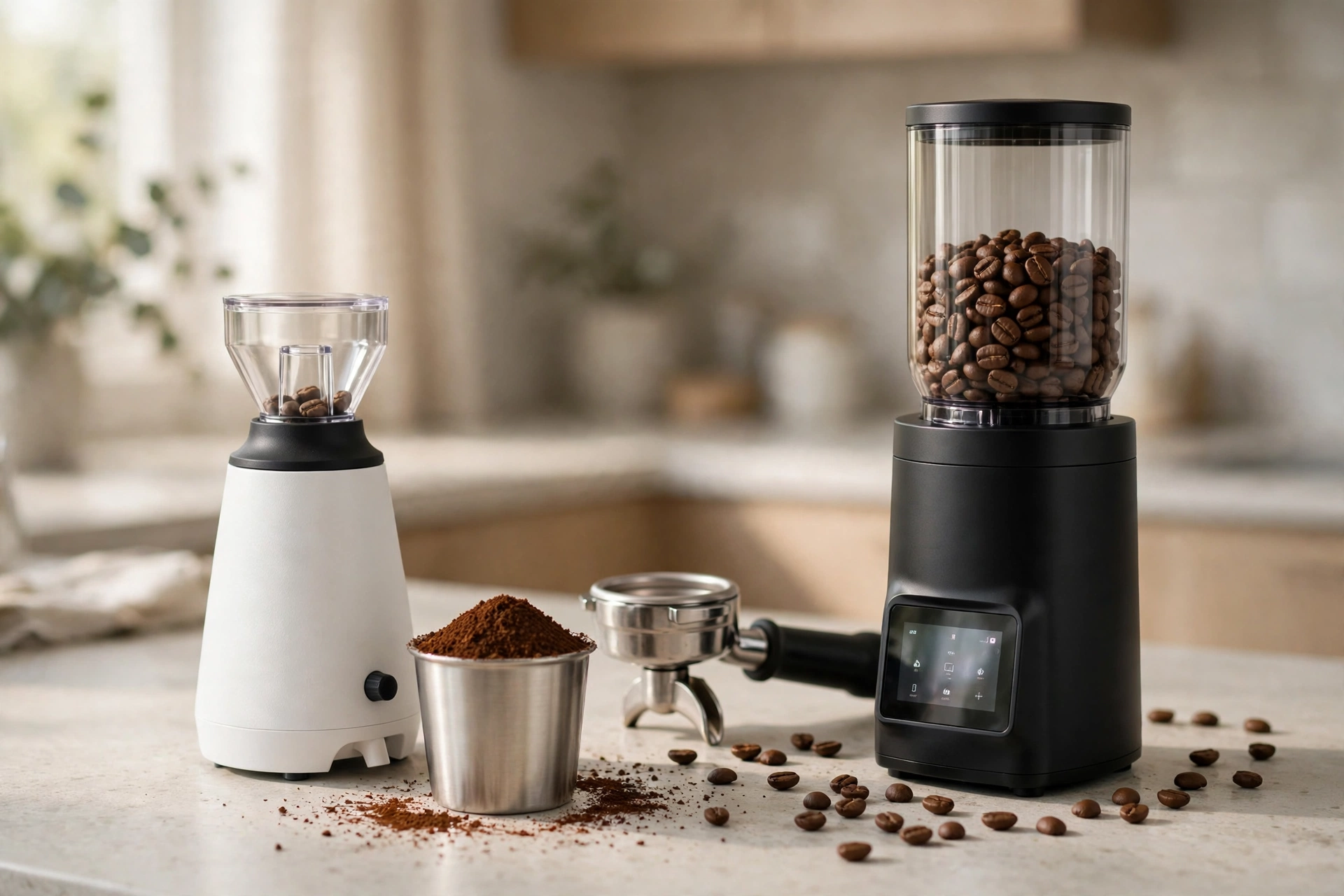
The short answer: buy the Niche Zero if you single-dose and rotate beans; buy the Eureka Mignon Specialita if you drink one coffee and want a quiet, one-button morning. The Niche Zero is $689 direct from Niche’s store in the US (£559 including VAT in the UK); the Specialita is $549 at Whole Latte Love and Clive Coffee — a $140 gap in the US. Both are stepless, both dial in espresso precisely, and on medium roasts the cups are hard to tell apart. What separates them is burr geometry and daily routine: 63mm conical burrs built around weighing every dose, against 55mm flat burrs built around a hopper and a touchscreen timer. Prices and specs checked 2026-11-15. Prices vary by retailer; where sources disagreed we used the manufacturer’s or a major retailer’s current price.
Disclosure: we are an independent research desk and earn no commission on anything here. Vendor links on this page are plain links to manufacturer and retailer pages — no affiliate tracking. See our disclosure policy for how we stay independent.
We are a research desk, not a test lab: we synthesize manufacturer specifications, owner reports, forum threads, and published reviews rather than claiming hands-on testing we have not done.
First, the naming: which Niche, and which Specialita
Two naming traps before any spec matters, because both lines have grown since the early comparisons.
On the Niche side, there are now two grinders. The Zero — the one in this comparison — is the 63mm conical single-dose grinder Niche has sold since 2018. The Duo is a newer, larger flat-burr model priced above it. The two look similar at a glance and share the single-dose workflow, but they are different burr platforms at different prices. If a listing says only “Niche” with no model name, or a price well above $689, confirm which one you are looking at.
On the Eureka side, the Specialita is the top of the Mignon line, but it has a shorter sibling: the Compatto variant, about 13 inches tall with cryo-treated Diamond Inside burrs, listed at $599. If vertical clearance under your cabinets is tight, that is the variant to price, not the standard $549 model. And note the price has moved on the Niche side too: earlier comparisons quoted the Zero at $599–$649 in the US; Niche’s store now lists $689 with US pricing selected (November 2026), while the UK price holds at £559 including VAT with free UK shipping. The $140 US gap to the Specialita is wider than it was a year ago, which makes the workflow question below more, not less, important.
First principles: burr shape is a tendency, retention is the workflow
These two grinders differ in two ways that matter, and it helps to separate them, because one is a flavour tendency and the other is a daily fact.
Burr shape is the flavour tendency. Conical burrs, like the Niche’s 63mm Mazzer Kony-derived set, produce a bimodal particle spread — a mix of fine and coarse particles. More fines in the puck means more body and sweetness, and a puck that braces itself: conical burrs are generally more forgiving of small puck-prep errors. Flat burrs, like the Specialita’s 55mm hardened steel set, produce a more uniform spread — fewer fines, more clarity and flavour separation, especially in light roasts — but a narrower dial-in window, because there are fewer fines holding the puck together. Treat this as a tendency, not a guarantee: roast, dose, and dial-in move the cup at least as much as burr geometry does, and on medium and medium-dark beans careful comparisons find the two grinders’ cups hard to distinguish blind. The burr difference shows up most on light roasts, where the Specialita’s clarity and the Niche’s sweetness pull in visibly different directions.
Retention is the workflow fact. Retention is the coffee left inside the grinder after a dose — in the burr chamber, the chute, the exit path. Retained grounds go stale, and the next dose pushes some of them out mixed with fresh coffee. The Niche is built to eliminate it: a straight-through grind path, a 50g funnel instead of a hopper, and a dosing cup that catches everything. Niche claims dose consistency within ±0.2g based on independent test data, and independent testing puts total retention around 0.5g or less. The Specialita attacks retention with compactness instead: a small 55mm burr chamber leaves little room for grounds to collect, and retailer measurements put it around 1.3g — genuinely low for a hopper grinder, but several times the Niche’s figure, and with no bellows to clear it.
The practical translation: if you drink one bean all week from a hopper, 1.3g of exchange is invisible. If you rotate single origins daily, it is a stale-coffee tax on every first shot of a new bag — and the Niche’s weigh-in, grind-out routine is the mechanism that removes it.
Comparison table
Prices and specs checked 2026-11-15. Prices vary by retailer; where sources disagreed we used the manufacturer’s or a major retailer’s current price.
| Spec | Niche Zero | Eureka Mignon Specialita |
|---|---|---|
| Current price | $689 direct from Niche’s store (US pricing); £559 inc. VAT direct in the UK, free UK shipping | $549 at Whole Latte Love and Clive Coffee ($499–$599 by colour at Whole Latte Love; $599 for the shorter Compatto variant) |
| Burrs | 63mm conical steel (Mazzer Kony-derived) | 55mm flat hardened steel |
| Adjustment | Stepless, infinite dial | Stepless micrometric dial |
| Motor | Geared motor, 150W | 260W (US) / 310W (EU), 1350 RPM |
| Grind speed | 1 g/sec; an 18g dose in ≈18 seconds | ≈1.4–2.5 g/sec; an 18g dose in ≈8–13 seconds |
| Dosing | Single-dose: weigh beans, grind into 58mm dosing cup | Hopper-fed: 300g hopper, touchscreen with two timed presets to 0.1-second precision plus continuous mode |
| Retention | Claimed near-zero; Niche cites dose consistency within ±0.2g; independent testing ≈0.5g or less | About 1.3g per retailer measurement |
| Noise | 72 dB during grinding (manufacturer figure) | Very quiet — sound-insulated Silent Technology body, listed below 60 dB |
| Grind range | Espresso to filter; dial switches methods in seconds | Espresso to filter; switching methods means re-dialing and re-timing |
| Cleaning | Top burr removes with the supplied socket driver; re-check the setting after reassembly | Upper burr removable without losing the dialed-in grind setting |
| Size | 122 × 211 × 311 mm (435mm with lid upright) | 120 × 180 × 350 mm (4.72 × 7.08 × 13.78 in) |
| Weight | 4.1 kg | 5.6 kg |
| Burr upgrade path | Closed platform; the 63mm conical set is the grinder | Closed platform; stock 55mm burrs only |
| In the box | 58mm grind cup, socket driver, cleaning brush, manual | Hopper, portafilter fork, brush |
| Warranty | 1 year (Niche direct) | 1 year |
| Availability note | Sold direct only, ships from the UK within 7 days; US buyers order the 110V variant | In current production; Compatto variant for low cabinets |
Grind quality: body and forgiveness against clarity and precision
Because both grinders are stepless, the espresso window itself is not the separator — both hold a dialed-in setting with fine granularity, and both reward the same dial-in routine. The separator is what each burr shape does with the same bean.
The Niche’s conical burrs lean toward body. The bimodal spread puts more fines in the puck, which reads in the cup as sweetness, texture, and a forgiving extraction: a slightly uneven tamp or a slightly fast shot still lands drinkable. That forgiveness is the Niche’s quiet advantage for anyone still developing puck prep, and it is why the grinder has a reputation for making good espresso easy. The cost is ceiling: on very light roasts, the extra fines can muddy the top-end aromatics that flat burrs separate more cleanly.
The Specialita’s flat burrs lean toward clarity. The uniform spread separates flavours — acidity reads brighter, individual notes are easier to pick out — and the effect grows as the roast gets lighter. The cost is a narrower window: with fewer fines bracing the puck, a sloppy distribution or a channel shows up faster in the cup. The Specialita compensates with timed dosing, which removes one variable (dose weight) from every shot — a real, daily forgiveness mechanism that partially offsets the flat burrs’ stricter demands.
One honest caveat on both claims: neither burr shape guarantees a flavour outcome. Roast level, dose, and dial-in move the cup at least as much, and on medium roasts the difference between these two grinders is small enough that blind comparisons struggle to call it. Buy the burr tendency that matches your beans — light-roast clarity favours the Specialita, medium-dark body favours the Niche — but buy the workflow first, because the workflow is what you live with twice a day.
Workflow and features: the Specialita’s home turf
This is where the Specialita earns its keep, and the gap is wide.
The Specialita is the set-and-forget machine. Fill the 300g hopper once, program two timed doses on the touchscreen — a single and a double, or two doubles for different baskets — and every morning is one button press. The touchscreen times to 0.1 seconds, the fork holds the portafilter, and the grinder stops itself. There is no scale, no weighing, no dosing-cup transfer. And it does all of this quietly: the sound-insulated body is the feature owners mention most after the grind quality itself, and it is the reason the Specialita is the default recommendation for households where someone else sleeps past the first shot.
The Niche is deliberately manual. Every dose is weighed, poured into the funnel, ground into the cup, and the cup is inverted into the portafilter. There is no timer, no hopper, no touchscreen — one dial, one switch, one cup. What the ritual buys is rotation: a new bean every day costs nothing in stale grounds or re-dialing a hopper, and the 50g funnel means there is never a half-bag of beans going stale in the machine. For single-origin drinkers, that is not inconvenience, it is the feature. For everyone else, it is friction twice a day.
Neither grinder is the wrong answer for filter-first brewing without qualification, but the Niche is clearly the better second job: one dial turn moves from espresso to filter in seconds, and single-dosing means no hopper to empty first. The Specialita grinds filter competently, but switching methods means re-dialing and re-timing, then dialing back — which gets old fast if filter is half your brewing.
Noise and speed: the morning test
Two numbers decide the morning, and they point opposite ways.
The Specialita is both quieter and faster: sub-60 dB against the Niche’s 72 dB, and ≈1.4–2.5 g/sec against the Niche’s 1 g/sec. An 18g double takes the Specialita roughly 8–13 seconds and the Niche roughly 18. Neither is slow in absolute terms — both are done before the machine finishes heating — but the Niche’s slower, louder grind is a real part of the ritual, and the Specialita’s quiet speed is a real part of its appeal. If your kitchen is shared with early sleepers, the Specialita wins this section outright. If you grind alone, the difference is a matter of seconds and decibels, not a decision-maker.
Build, longevity, and the platform bet
The Niche is a small, dense, deliberately simple machine. Aluminium body, real oak trim, a geared motor turning slowly, and almost nothing electronic to fail — one dial, one switch. The parts that wear are the burrs, and at home volumes a 63mm conical set lasts years. What the simplicity costs is repairability at the margins: cleaning means removing the top burr with the socket driver from the box, and the grind setting can drift on reassembly, so you re-check it after. The grinder is sold direct only, which means warranty and support run through Niche itself — consistently well-regarded by owners, but with shipping back to the UK if something goes wrong.
The Specialita is a finished Italian appliance. Hand-assembled in Florence, the fit and finish reflect the price, and the touchscreen and timed-dosing electronics are the parts most likely to matter in year five — they are also the parts no owner repairs at home. The warranty is likewise 1 year. What Eureka offers instead of repairability is a design that asks less of its parts: a compact, insulated, purpose-built espresso grinder that does one job and does it quietly, with an upper burr that lifts out for cleaning without losing the dialed-in setting.
Net: neither grinder offers an upgrade path — both are closed burr platforms, unlike the DF64 Gen 2, whose 64mm standard accepts aftermarket SSP burrs. Buy the Niche for the workflow and the build simplicity, the Specialita for the routine and the quiet — and if the upgrade path matters to you, our DF64 vs Niche Zero comparison covers the same question from the platform side.
The verdict
- Buy the Niche Zero if you single-dose, rotate beans, brew filter as well as espresso, or want the most forgiving puck in this price band. The near-zero retention, the weigh-in grind-out routine, and the dial that switches brew methods in seconds are a coherent package for the enthusiast who treats the grinder as a bench, not an appliance. Accept the $140 US premium, the 72 dB grind, and the manual routine as the price of the workflow.
- Buy the Eureka Mignon Specialita if you drink mostly one bean, value a quiet morning and a one-button dose, and want a hopper grinder that disappears into the routine. The timed touchscreen dosing, the sub-60 dB operation, and the low-for-a-hopper 1.3g retention make it the easier grinder to live with every day — and it costs $140 less in the US. If cabinets are low, price the Compatto variant instead.
- Either grinder outclasses the ≈$200 tier on grind quality — for the step up from there, our grinders under $500 roundup places both against the next tier, how much to spend on a grinder explains what each price band buys, and our Eureka Mignon vs Baratza Sette 270 comparison covers the Specialita’s line against a different rival.