
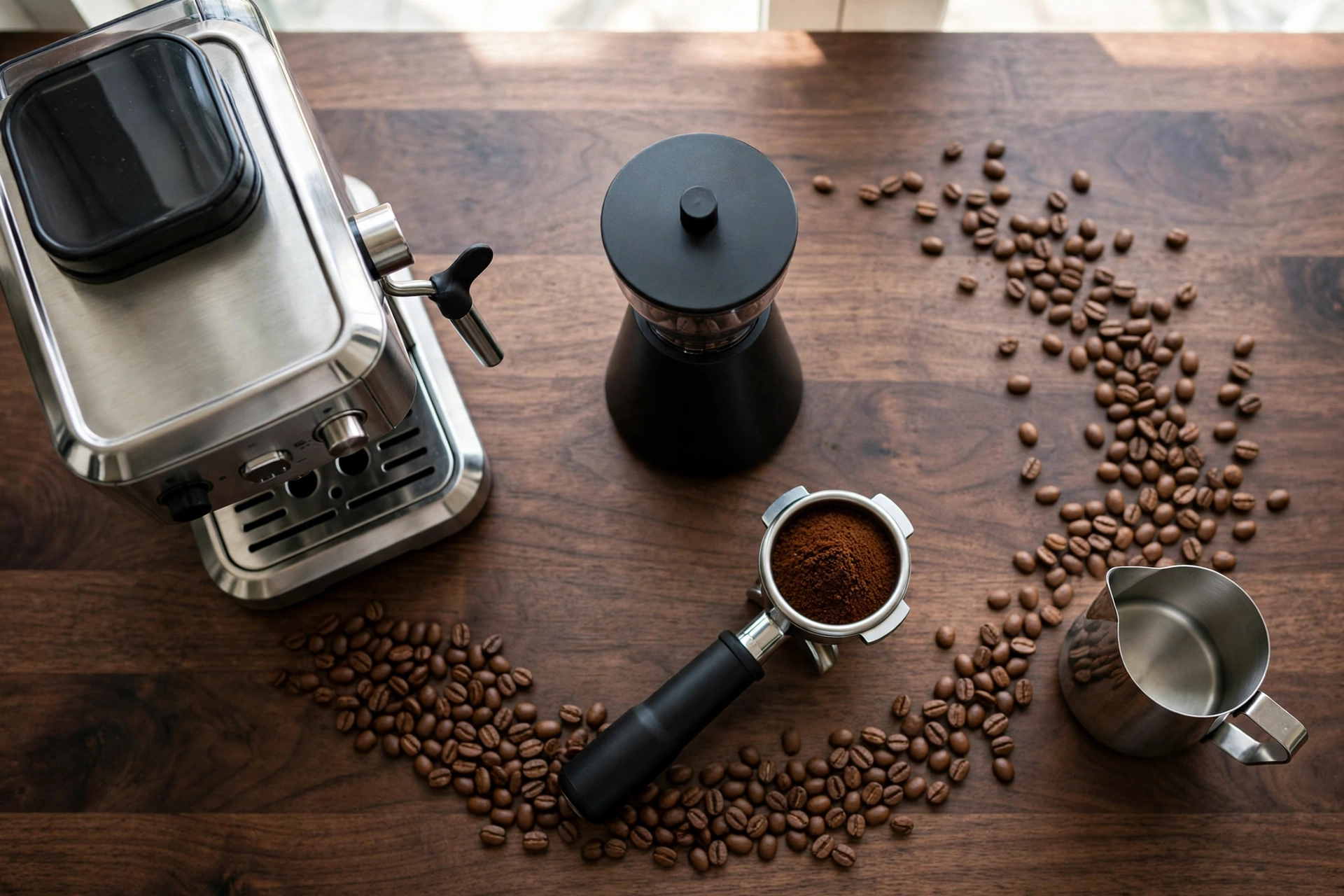
The short answer: the Baratza Encore ESP is the best grinder for the Breville Bambino for most owners, the Breville Smart Grinder Pro is the same-brand timed-dosing alternative at the same $199.95, and the MiiCoffee DF64 II is the flat-burr upgrade worth buying if you single-dose and want a grinder that outlasts the machine. The Bambino is a $299.95 machine with no grinder built in, and its best baskets demand fresh coffee ground fine — so the grinder is not an accessory, it is half the system. Prices and specs checked 2026-10-28. Prices vary by retailer; where sources disagreed we used the manufacturer’s current price.
Disclosure: we are an independent research desk and earn no commission on anything here. Vendor links on this page are plain links to manufacturer pages — no affiliate tracking. See our disclosure policy for how we stay independent.
We are a research desk, not a test lab: we synthesize owner reports, forum threads, published measurements, reviews, and teardowns rather than claiming hands-on testing we have not done.
First principles: what the Bambino asks of a grinder
The Bambino (BES450, $299.95 list) is a precision machine at a beginner price: ThermoJet heat-up in 3 seconds, low-pressure pre-infusion that wets the puck before full pressure, and a 54mm portafilter shipped with two basket systems. The dual-wall (pressurized) baskets forgive almost any grind, because a single tiny exit hole creates the back-pressure mechanically. The single-wall (non-pressurized) baskets — the ones that make the Bambino worth buying over a cheaper pressurized machine — forgive nothing: the puck itself must resist water at about 9 bars, which means the grind has to be fine, even, and adjustable in small steps.
That requirement breaks down into three properties, and every grinder below is judged against them first:
- Resolution at the fine end. A Bambino shot wants about 18g of coffee yielding about 36g of liquid in 25 to 35 seconds. A change of a few tens of microns swings that time by seconds, so the adjustment must move in steps small enough to land between “sour and fast” and “bitter and choked.” Stepped grinders need micro-steps in the espresso range; stepless grinders remove the problem entirely.
- Consistency (particle distribution). Burrs produce a spread around a target size, not one size. A tight spread extracts evenly; a wide spread over-extracts the fines (bitter) while under-extracting the boulders (sour) in the same cup. This is most of what you pay for as prices rise from $200 toward $400.
- Repeatability. The Bambino’s volumetric buttons stop the shot at a programmed volume, so a consistent dose and grind produce a consistent shot. Low retention — little old coffee held inside the grinder — and a dosing method you can repeat (timed, weighed, or single-dosed) keep shot two tasting like shot one.
A fourth property is Bambino-specific: 54mm dosing. The portafilter is 54mm, not the 58mm commercial standard, so a grinder that doses neatly into a 58mm portafilter may spill around a 54mm one. The picks below all handle 54mm gracefully — a 54mm dosing cup, a 50–54mm cradle, an espresso catch cup sized for 54mm, or a transfer cup that pours cleanly. Anything else is workflow friction every morning.
What the Bambino does not need
Two common overspends are worth ruling out before the picks. First, you do not need a grinder “made for Breville.” The Bambino has no proprietary interface with any grinder; the only fit questions are basket size and grind quality, and every serious grinder answers both. Second, you do not need to match the grinder’s price to the machine’s price. Grind quality sets the ceiling on extraction, and the machine cannot fix a bad grind — so a $399 grinder on a $300 machine is a rational system, while a $300 machine fed by pre-ground coffee is a wasted machine. The system budget, not the machine budget, is the number to plan around: $500 to $700 total.
What to avoid outright: blade grinders (no particle control at all), filter-only burr grinders whose finest setting is still too coarse for single-wall baskets, and general-purpose grinders with coarse steps that land either side of the ideal setting with no step in between. If a grinder cannot grind fine enough for the Bambino’s single-wall baskets, no other feature rescues it.
Comparison table
Prices and specs checked 2026-10-28. Prices vary by retailer; where sources disagreed we used the manufacturer’s current price.
| Grinder | Typical price | Burrs | Adjustment | Dosing | 54mm fit | Best for |
|---|---|---|---|---|---|---|
| Baratza Encore ESP | $199.95 | 40mm M2 conical steel | 40 steps (1–20 micro for espresso) | Manual, dosing cup included | 54mm dosing cup in the box | Best overall; repairable, one grinder for espresso and filter |
| Breville Smart Grinder Pro | $199.95 | 40mm conical steel | 60 settings, timed | Timed, Dosing IQ | 50–54mm cradle in the box | Same-brand timed dosing; hands-free mornings |
| Fellow Opus 2 | $199.95 | 48mm conical stainless | Stepless side dial | Single-dose, magnetic catch cups | Espresso cup fits 54mm and 58mm | Single-dosing, small counters, full brew range |
| 1Zpresso J-Ultra | $199 | 48mm titanium-coated conical | External dial, 8 microns per click | Hand-crank, single-dose | Catch cup transfers cleanly to 54mm | Best grind quality per dollar; travel and tiny kitchens |
| MiiCoffee DF54 | $229 | 54mm flat stainless | Stepless | Single-dose, bellows | Transfer cup; funnel recommended | Cheapest route to flat-burr clarity |
| Eureka Mignon Notte | $299 | 50mm flat steel | Stepless micrometric | Manual press-and-hold | Grind direct into 54mm portafilter | Hopper workflow; Italian metal build, no screen |
| MiiCoffee DF64 II (Turin DF64 Gen 2) | $399 | 64mm flat stainless | Stepless | Single-dose, bellows | Transfer cup; funnel recommended | Best upgrade; SSP-upgradeable flat platform |
The seven grinders, in depth
1. Baratza Encore ESP — the best Bambino grinder for most owners
The Encore ESP splits its 40 settings into two ranges: settings 1 to 20 make micro-steps sized for espresso, so one click changes shot time by a few seconds instead of ten; settings 21 to 40 make the larger steps filter brewing needs. That split is exactly what the Bambino’s single-wall baskets need — a setting that lands on the shot, not either side of it. You twist the hopper to adjust and grind into the included dosing cup, which is 54mm: the Bambino’s size, with a 58mm adapter ring in the box for other machines.
The 40mm M2 conical burrs are the same family Baratza uses in pricier grinders, the quick-release mount makes cleaning tool-free, and spare parts are sold widely — a grinder you can repair cheaply beats one you must replace, and at this price that repairability is a genuine Bambino advantage, since the grinder will likely outlast the machine. Compromises are noise, static many owners manage with a light water spritz, and a plastic body. Baratza lists the Encore ESP at $199.95; multiple retailers listed $199.95 when we checked. It is the default recommendation because it clears every Bambino requirement at the lowest price here, and its only real rivals are workflow preferences, not quality gaps. We compare it head-to-head with the Smart Grinder Pro in our Encore ESP vs Smart Grinder Pro comparison.
2. Breville Smart Grinder Pro — the same-brand timed-dosing pick
If keeping the counter matched matters, or you want timed dosing with a screen, the Smart Grinder Pro (BCG820) is the Bambino’s natural sibling. Its 60 settings cover espresso through French press, the Dosing IQ system adjusts grind time automatically when you change the setting so the dose stays consistent, and the included cradle fits 50–54mm portafilters — the Bambino locks straight in for hands-free grinding. The LCD shows setting, time, and shot count, which flattens the learning curve for a first grinder.
The trade against the Encore ESP is precision of return: stepped settings with a timer are repeatable, but a timer measures time, not weight, so bean density changes move the dose and you should still check it on a scale. The grinder is also loud, and its adjustment, while wide, is stepped rather than stepless. Breville’s US price is $199.95; Whole Latte Love and Abt listed $199.95 when we checked. Choose it over the Encore ESP if you value timed, hands-free mornings and the matched look, and you are happy to verify dose by weight. Choose the Encore ESP if repairability and micro-stepped return-to-setting matter more.
3. Fellow Opus 2 — stepless conical single-doser at $200
The Opus 2 replaces the original Opus’s two-part adjustment with a single stepless side dial, grows the burrs to 48mm conical stainless, and keeps the single-dose workflow: a 100g load bin, magnetic catch cups (the espresso cup fits 54mm and 58mm portafilters), grind guidance printed on the lid, and an ionizer plus internal impeller that hold retention near zero. An espresso dose grinds in about 9 seconds, and the footprint stays compact at about 5 inches wide — a good match for the Bambino, which is itself only just over 6 inches wide.
The Bambino case for the Opus 2 is the combination of stepless adjustment and single-dosing at $199.95: you weigh 18g, grind it all, and nothing stale sits in the grinder for tomorrow’s shot. The case against it is the same as any single-dose workflow — weighing every dose, every morning. Fellow lists the Opus 2 at $199.95. Choose it over the Encore ESP if you weigh each dose and switch beans or brew methods daily; choose the DF54 instead if flat-burr clarity, not conical convenience, is what you are spending for.
4. 1Zpresso J-Ultra — the $199 hand grinder that out-grinds electrics twice its price
The J-Ultra is the only pick here with no motor, and that is its advantage: every dollar goes into burrs and adjustment instead of a motor, a case, and electronics. Its external ring moves the 48mm titanium-coated conical burr in 8-micron steps — 100 clicks per full rotation, with a numbered dial you can read and return to — the finest stepped adjustment in its class. For a Bambino owner learning to dial in, that means a shot running 22 seconds can be nudged to 26, then 29, in successive mornings.
The trade is effort: grinding a double shot takes about 30 to 45 seconds of cranking, and the 35–40g magnetic catch cup holds one dose at a time, transferred to the 54mm portafilter. The grinder weighs about 700g, disassembles without tools, and arrives with a hard travel case. 1Zpresso lists the J-Ultra at $199. If you make one or two drinks a day, travel, or have almost no counter space — the Bambino already fills the small-counter niche, so a drawer grinder pairs well — this is the best grind quality per dollar here, and the honest test of whether you enjoy the ritual before spending electric money. Our best hand grinders roundup covers cheaper hand options.
5. MiiCoffee DF54 — flat burrs for $229
The DF54 compresses the DF64 Gen 2 formula into a smaller, cheaper body: custom 54mm stainless flat burrs, stepless adjustment with a chrome-wrapped dial and metal indicator, a plasma generator in the exit chute, an anti-popcorn disc, and bellows to clear the chamber. MiiCoffee states retention under 0.1g even before the bellows, and owners consistently report that weighed doses come back whole. The 150W motor at 1400 RPM is slower than the DF64’s, but the particle story is the same flat-burr story: tighter distribution, clearer separation, less of the conical burrs’ rounding body.
For the Bambino specifically, the DF54 is the cheapest grinder that changes the in-cup character rather than just refining it — the point where a Bambino owner who already dials in well starts tasting burr geometry instead of workflow. Dosing is by transfer cup, so a 54mm dosing funnel keeps the transfer tidy. MiiCoffee lists the DF54 at $229. It is the natural first upgrade for Encore ESP and Opus owners who single-dose already and want to know what flat burrs actually taste like.
6. Eureka Mignon Notte — hopper-fed flat burrs, no electronics
The Notte is the first dedicated espresso grinder on this list, and the difference shows in the mechanism. Its 50mm flat steel burrs produce a tighter particle distribution than the 40mm conicals, which is the main reason flat-burr shots are often described as clearer. Adjustment is stepless and micrometric, and Eureka’s bottom-burr design means you can open the grinder for cleaning without losing your setting — a small feature that saves real frustration and wasted coffee on a machine you dial in daily.
The trade-offs are workflow and focus. Dosing is manual (press the portafilter against the switch and hold), there is no timer and no display, and retention runs about 1 to 1.5g in owner reports. But the Bambino fit is direct: grind straight into the 54mm portafilter, no transfer cup, no funnel. The aluminium case is built in Florence, the hopper holds 5.5 oz, and grind speed is fast at about 12 seconds for 18g. Seattle Coffee Gear lists the Mignon Notte at $299. Choose the Notte if espresso is your primary brew method and you will weigh your dose or grind by time externally. If you want the same burr family with sound insulation and a timer, the Eureka Mignon Silenzio at $449 is the step up — but it belongs in a higher band than this roundup.
7. MiiCoffee DF64 II (Turin DF64 Gen 2) — the upgrade that outlasts the machine
The DF64 Gen 2 imports the 64mm flat-burr format — the size cafés and prosumer grinders standardised on — into a $399 single-dose body. The custom stainless 64mm burrs sit in a chamber stabilised by a three-position upper burr carrier with a wave spring, the exit chute carries a plasma generator, and an anti-popcorn disc keeps beans feeding evenly. Retention is stated under 0.1g, the aluminium dosing cup is 58mm (use a 54mm funnel for the Bambino transfer), and the stepless dial uses a metal indicator so a setting can be noted and returned to.
Two things separate it from the DF54 beyond burr diameter. The 250W motor holds speed under dense light roasts that slow the smaller grinder, and the 64mm format accepts aftermarket burrs, including SSP sets, so the grinder’s flavour profile can change without replacing the grinder. The costs are size (about 5 inches wide, 14 inches tall, 15 lbs), noise typical of a 1400 RPM AC motor, and a one-year warranty through the importer. MiiCoffee lists the DF64 II at $399; the official seller’s store listed $399 when we checked. If your budget reaches $400 and you single-dose, this is the default upgrade — the clearest shots here, on a platform that survives your next machine, Bambino or beyond. We compare it against the Niche Zero in our DF64 vs Niche Zero head-to-head.
Near misses worth knowing
The Baratza Sette 270 at $399.95 deserves a mention: its straight-through grind path holds retention near 1g and its timed dosing (0.1-second precision, three presets) grinds directly into the portafilter, which is a genuinely good Bambino workflow. It loses a pick here because it is the loudest grinder in its class, its plastic case feels cheaper than the DF64 II at the same money, and its conical burrs do not change the in-cup character the way the flat-burr picks do. If timed dosing matters more to you than flat-burr clarity, it is a defensible swap for the DF64 II.
Above $400, the Niche Zero (about $649) is the classic Bambino-plus upgrade: near-zero retention, single-dose, and a workflow owners love. It is not in the main picks because at more than twice the Bambino’s price it belongs to a different system budget — buy it when you know you will keep grinding long after the Bambino, not as a first pairing.
How to choose
- You want the simplest path to good Bambino shots at $200: Baratza Encore ESP. Micro-stepped espresso range, 54mm dosing cup in the box, repairable for years.
- You want timed, hands-free dosing and the matched Breville look: Breville Smart Grinder Pro. Dosing IQ and a 50–54mm cradle, at the cost of timer-based dosing you should verify on a scale.
- You single-dose, switch beans, or share the grinder with filter brewing: Fellow Opus 2 for stepless conical convenience, or MiiCoffee DF54 if you want flat-burr clarity for $30 more.
- You want the best grind quality per dollar and don’t mind cranking: 1Zpresso J-Ultra. The 8-micron external dial is the finest stepped control in the class, and it costs $199.
- You want hopper convenience and direct 54mm dosing without a screen: Eureka Mignon Notte. Stepless flat burrs and metal build; you supply the scale.
- You want the clearest shots here and a burr platform that can grow: MiiCoffee DF64 II. The only 64mm burr set here, and the only one that takes SSP upgrades later.
- Your counter is very small: Fellow Opus 2 (about 5 inches wide, shortest here), DF54 (about 4.5 inches wide), or the J-Ultra (no counter space at all — it lives in a drawer).
What to budget and learn beyond the grinder
Every grinder here still needs a 0.1g scale (about $15 to $25) unless you fully commit to timed dosing and verify it weekly, because dose errors look exactly like grind errors on the Bambino’s single-wall baskets. Budget a 54mm dosing funnel if you single-dose into a transfer cup, fresh beans weekly, and cleaning: a brush weekly, burr cleaning monthly, and grinder cleaner tablets as the manual directs. Expect to spend your first bag learning: change one variable at a time, write down dose, setting, and shot time, and taste every shot, including the bad ones. The Bambino’s pre-infusion forgives small distribution errors, but it does not forgive a wrong grind — that log teaches more in a week than any upgrade.
Meet the three conditions — fine enough resolution, a tight particle spread, and low, repeatable retention — and any of these seven makes real espresso on the Bambino. The pairing question is not which grinder is best in absolute terms, but which compromises you want to live with while you learn: steps or stepless, hopper or single-dose, conical or flat, motor or arm. Pick the one whose daily workflow you will still enjoy in month six; consistency of practice extracts more flavour than any burr upgrade. If you are still deciding how much a grinder should cost relative to the machine, how much to spend on a grinder explains the split, and our best grinders under $400 roundup shows the same field without the Bambino filter.