
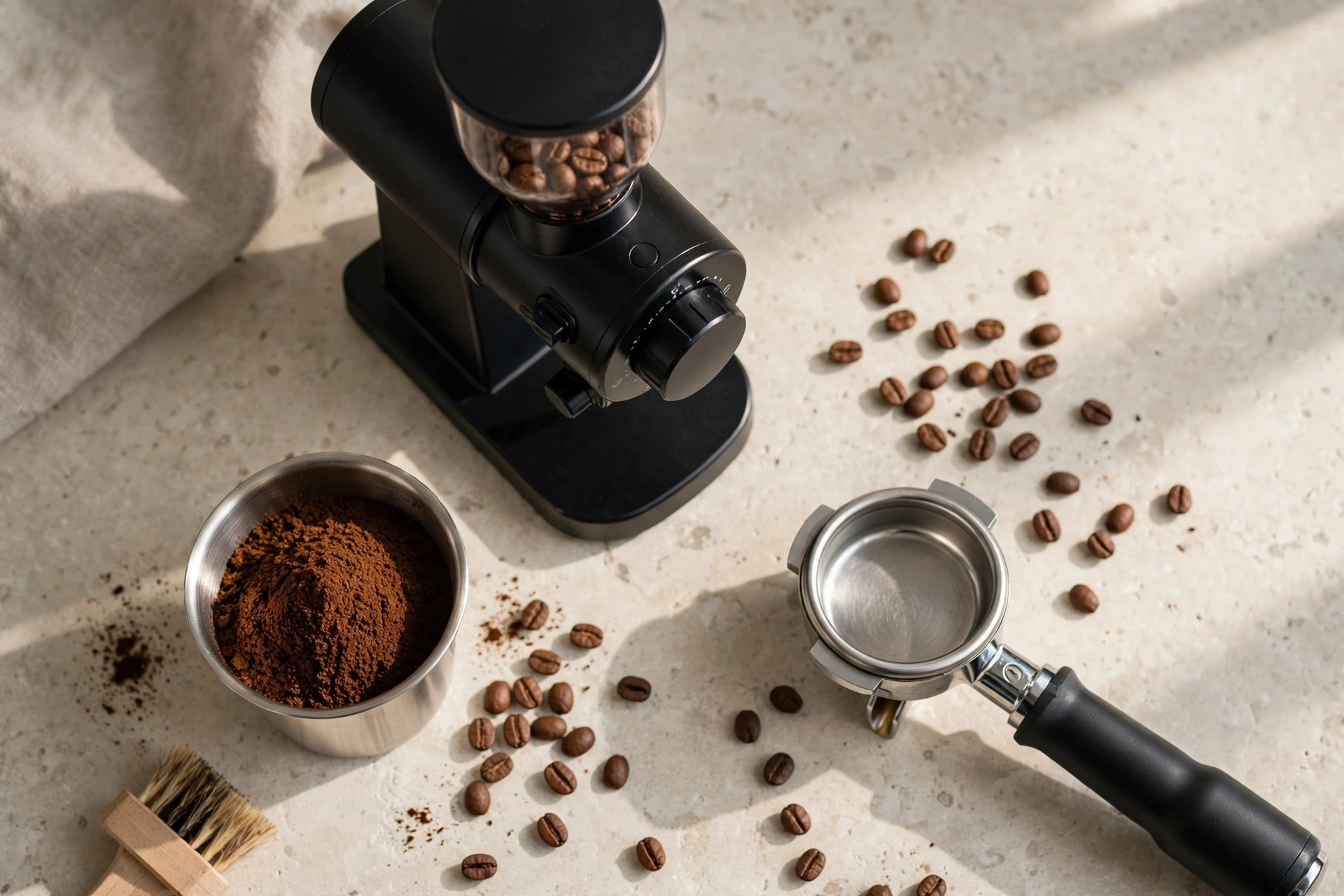
The short answer: the Baratza Sette 270 and the Eureka Mignon Specialita are two different answers to the same $400–$600 question. The Sette 270 is a $399.95 conical grinder built around speed and near-zero retention: a straight-through vertical grind path, timed dosing with three presets, and a macro/micro adjustment system that makes dialling in repeatable. The Mignon Specialita is an ≈$599 flat-burr grinder built around refinement: 55mm flat burrs, fully stepless micrometric adjustment, a touchscreen, and the quietest operation in its class, wrapped in a die-cast aluminium body. Both grind excellent espresso. Buy the Sette for speed, value, and a forgiving workflow; buy the Specialita for quiet, precise, buy-once build quality. Prices and specs checked 2026-10-30. Prices vary by retailer; where sources disagreed we used the most widely listed current price.
Disclosure: we are an independent research desk and earn no commission on anything here. Vendor links on this page are plain links to manufacturer and retailer pages — no affiliate tracking. See our disclosure policy for how we stay independent.
We are a research desk, not a test lab: we synthesize owner reports, forum threads, published measurements, reviews, and teardowns rather than claiming hands-on testing we have not done.
First principles: the price gap is a burr-geometry gap
As with every grinder comparison, start with the burrs, because everything else — flavour, forgiveness, noise, price — follows from that choice.
Conical burrs crush beans between a cone and an outer ring, producing a bimodal particle spread: a main peak at the target size plus a tail of very fine particles. Those fines build body and texture, make the puck more cohesive so it resists channelling, and forgive dial-in mistakes, because the fines slow the shot even when the main peak is slightly off. The cost is flavour separation: the wide spread merges delicate notes into one warm, integrated cup. That is the Sette 270’s 40mm Etzinger steel conical burrs, and it is the classic espresso profile — chocolate, nuts, caramel, syrup.
Flat burrs shear beans between two parallel rings, producing a unimodal, tighter spread with fewer fines. Tighter extraction means flavours land separately rather than merged — clarity, acidity, distinct fruit or floral notes. Light roasts, which are dense and extract stubbornly, are where flat burrs earn their reputation: the uniform grind lets you push extraction without the bitterness fines would bring. The cost is forgiveness: with no fines bracing the puck, a slightly-off grind shows up as channelling faster. That is the Specialita’s 55mm flat hardened steel burrs.
The Sette’s second design idea is just as important: its outer burr spins while the inner burr stays fixed, and grounds drop straight through the burrs into the portafilter or bin. There is almost no chute for grounds to hide in, which is why Baratza can claim roughly half a gram of retention and owners report the next dose tastes like the new coffee, not the last one. The Specialita takes the conventional route — a horizontal burr chamber with a chute — and manages retention with Eureka’s ACE anti-clumping and anti-static system plus a low-retention claim of under half a gram. Both end up low-retention; the Sette gets there by geometry, the Specialita by engineering around a conventional path.
Comparison table
Prices and specs checked 2026-10-30. Prices vary by retailer; where sources disagreed we used the most widely listed current price.
| Spec | Baratza Sette 270 | Eureka Mignon Specialita |
|---|---|---|
| Current price | $399.95 (1st in Coffee, Clive Coffee, Coffee Machine Depot) | ≈$599 at Whole Latte Love (marked down from $799); $549 at 1st in Coffee, $649 at Coffee Bros |
| Burrs | 40mm Etzinger steel conical (S1) | 55mm hardened steel flat (Diamond Inside treatment on some variants) |
| Adjustment | 31 macro steps + stepless micro ring (270 settings) | Fully stepless micrometric knob, no steps |
| Dosing | Timed, 3 programmable presets, 0.1 sec resolution | Timed touchscreen: single, double, or manual, adjustable in 0.1 sec steps |
| Grind speed | 2.9–4.0 g/sec (Baratza manual figures; some retailers quote up to 5.5 g/sec at coarse settings) | 1.4–1.8 g/sec for espresso |
| Retention | ≈0.5g claimed, straight-through path | Under 0.5g claimed, ACE anti-static system |
| Noise | Louder, higher-pitched; widely reported as one of the noisier grinders in its class | Silent Technology: anti-vibration mounts and gaskets, claimed ≈20 dB reduction; widely reported as near-silent |
| Hopper | 300g, with bean shut-off | 300g |
| Weight | 3.2 kg | 5.6 kg |
| Footprint | 13 x 25 x 41 cm | 12.7 x 17.8 x 35.6 cm (5 x 7 x 14 in) |
| Build | Plastic-heavy body, stainless burr housing | Die-cast aluminium body, stainless dosing chute |
| Grind range | Espresso through manual brew; coarse French press is a stretch | Espresso through brew; goes finer than the Sette at the bottom end |
| Warranty | 1 year (Baratza) | Varies by retailer/importer |
| Weight-based sibling | Sette 270Wi, $599.95, integrated Acaia scale to 0.1g | None in the Mignon line at this price |
Grind quality and flavour: body against clarity
The burr geometry section above is the flavour section, but here is how it lands in the cup.
Sette 270 (conical): body, sweetness, forgiveness. The bimodal spread gives medium and dark roasts a thick, sweet, integrated cup, and the fines brace the puck, so a new coffee dials in within a few shots and a slightly-off grind still pulls drinkably. Owners consistently describe the Sette’s espresso as rich and full-bodied, and its coarsest settings are among the most consistent in its class for manual brew. The trade is delicacy: fine floral or fruit detail in light roasts gets merged rather than separated.
Specialita (flat): clarity, separation, precision. The tighter spread keeps flavours distinct, acidity bright, and light-roast single origins clean. Owners describe the Specialita’s cup as sweet and clear, with the flat-burr definition that conical grinders blur. The trade is the narrower dial-in window: with fewer fines, channelling shows up sooner when the grind is off, and the stepless knob’s sensitivity means tiny turns move the shot noticeably — a quirk owners flag as the grinder’s main learning curve.
The practical translation: if your coffee is mostly medium and dark roasts and you want a forgiving morning routine, the Sette’s geometry flatters you. If you chase light-roast single origins and enjoy fine-tuning, the Specialita’s geometry rewards you. Neither makes a bad shot; they make different good ones.
Workflow: timed presets against a touchscreen
Both grinders dose by time, and both do it well — the difference is interface and speed.
The Sette 270’s digital panel holds three programmable timed presets adjustable to a tenth of a second, plus a manual mode, and it grinds fast: 2.9–4.0 g/sec by Baratza’s manual figures means an 18g dose in roughly 5–6 seconds. The convertible holder grinds directly into the portafilter, the grounds bin, or a brew device, and the hopper’s bean shut-off lets you swap beans without emptying it. The macro/micro adjustment is the workflow’s quiet strength: set a macro baseline, micro-tune between steps, and return to a known setting from the micro ring’s indicators — repeatability the Specialita’s unmarked stepless dial cannot match.
The Specialita’s colour touchscreen is the more modern interface: tap single or double, adjust time in tenths of a second, switch to manual mode by pressing both cup icons, and start grinding by pressing the portafilter against the microswitch. It is intuitive out of the box and, at 1.4–1.8 g/sec for espresso, an 18g dose takes roughly 10–13 seconds — about twice the Sette’s time. That is not a flaw (slower grinding means less heat), but it is a daily difference you will feel. The stepless knob is superbly fine and famously sensitive: small turns make large changes, so dialling in demands a light touch until the feel becomes second nature.
Retention is a wash in practice: both claim under or around half a gram, and both deliver a dose that tastes like the current coffee. The Sette’s straight-through path gets there with nothing to clean out; the Specialita’s ACE system keeps grounds clump-free and static-free in the chute. The Sette’s one workflow weakness is static and mess: its plastic-heavy grinding chamber generates more static than the Specialita’s metal path, and owners report more stray grounds to wipe up.
Size, build, and the kitchen question
The Specialita is the smaller, heavier, quieter object: 5 inches wide, under 14 inches tall with the hopper, 5.6 kg of die-cast aluminium that stays put and damps vibration. It fits under low cabinets, comes in several colours (black, white, chrome, red), and looks like a designed object rather than an appliance. Its weight is a feature — it does not walk across the counter while grinding.
The Sette 270 is taller (41 cm), lighter (3.2 kg), and narrower in feel, with a distinctive seven-shaped silhouette and a single silver-and-black colourway. It is compact on the counter but not small, and its plastic body is the visible cost saving: it looks modern, but it does not feel like the Specialita, and it is louder partly because plastic damps less vibration than aluminium. On a crowded counter both fit; the Specialita fits more gracefully and more quietly.
Longevity cuts both ways. The Specialita’s metal construction and commercial-grade components are built to last with minimal attention. The Sette’s plastic body is less reassuring, but Baratza’s parts availability and repairability are the best in home coffee — burrs, gearboxes, and holders are user-replaceable, so a worn part is a repair, not a replacement. Buy the Specialita for build you never think about; buy the Sette knowing you can fix what wears.
Price, value, and the 270Wi question
The pricing structure is the honest summary of the two philosophies.
- Sette 270: $399.95 at multiple US retailers. For that you get conical-burr espresso quality, the fastest grinding here, near-zero retention by design, and repeatable macro/micro adjustment. It is the value pick in this comparison by roughly $150–$250.
- Mignon Specialita: ≈$549–$649 depending on retailer ($599 at Whole Latte Love, marked down from $799). For the premium you get flat-burr clarity, near-silent operation, a touchscreen, and a die-cast aluminium body — refinement and build, not a better shot in absolute terms.
The 270Wi deserves a line because it erases the price gap: at $599.95 it costs what the Specialita costs, and its integrated Acaia scale doses to 0.1g directly into the portafilter — the most precise dosing of any grinder here. If you weigh every dose already, the Wi is the Sette family’s best argument; it removes the scale step entirely. If you dose by time, the standard 270 keeps the same burrs and adjustment for about $200 less, and the Specialita’s quiet and build become the better use of that $200.
The verdict
- Buy the Baratza Sette 270 if you want the best value in this comparison: the fastest grinding here, near-zero retention by design, repeatable macro/micro adjustment, and conical-burr body and forgiveness — for $399.95. Accept the louder motor, the plastic body, and a little more static mess as the price of the value.
- Buy the Eureka Mignon Specialita if you want the quieter, more refined grinder: flat-burr clarity for light roasts, fully stepless precision, a touchscreen, and a die-cast aluminium body that feels like a buy-once purchase. The ≈$150–$250 premium buys quiet, build, and flavour separation — worth it if any of those is what you are actually shopping for.
- Buy the Sette 270Wi if grind-by-weight dosing is the feature you want most. At $599.95 it matches the Specialita’s price and beats both grinders on dosing precision — but it does not make the Sette quiet or metal, so do not buy it as a Specialita substitute.
Both grinders justify their followings: the Sette 270 as the value and speed pick that made conical single-dose-adjacent grinding accessible, the Specialita as the quiet flat-burr standard for home espresso. Pick the burr geometry and the morning routine you will live with, because that — not the price — is the real decision. For the wider field, our best grinders under $500 roundup covers the Sette 270 against six others, our DF64 vs Niche Zero comparison covers the single-dose flat-versus-conical question at a higher price, and how much to spend on a grinder explains what each price band actually buys.