
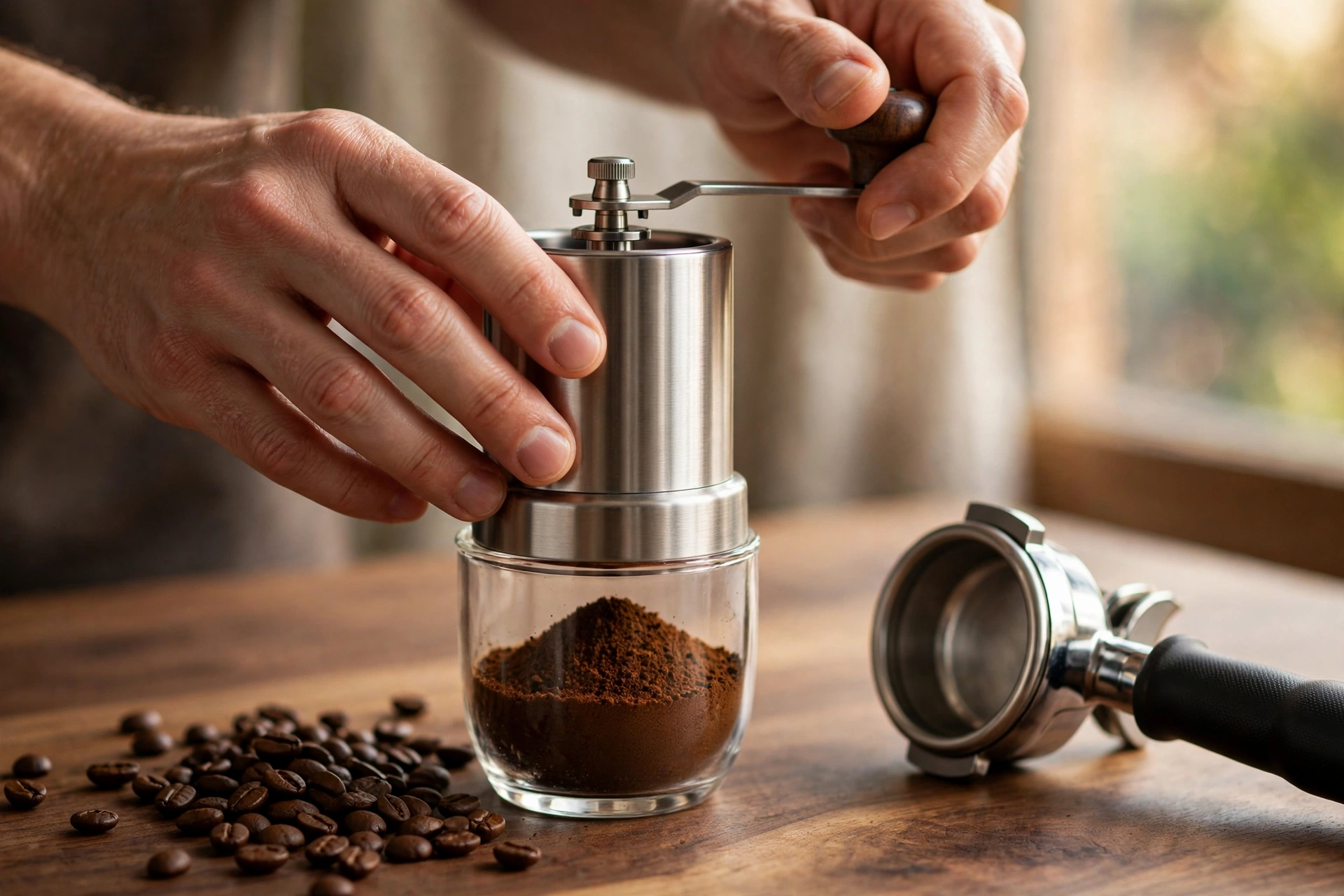
The short answer: the 1Zpresso J-Ultra is the best hand grinder for espresso, the KINGrinder K6 is the best value at about half its price, and the Timemore Chestnut C3 ESP is the cheapest hand grinder we would trust with a non-pressurised basket. Hand grinders win on grind quality per dollar and lose on effort — every pick below is really a decision about how much cranking your mornings can absorb. Prices and specs checked 2026-10-03. Prices vary by retailer; where sources disagreed we used the manufacturer’s current price.
We are a research desk, not a test lab: we synthesize owner reports, forum threads, published measurements, reviews, and teardowns rather than claiming hands-on testing we have not done.
First principles: what espresso asks of a hand grinder
Espresso is a flow-control problem. You push water at about 9 bars through a compacted puck and want about twice the dose’s weight in the cup in about 25 to 35 seconds. The puck’s resistance — and therefore the shot time — is set almost entirely by grind size. A few tens of microns finer and the shot chokes; a few tens coarser and it gushes sour. That sensitivity dictates the three properties that separate an espresso hand grinder from a travel filter grinder:
- Adjustment resolution at the fine end. The burr gap must change in small, repeatable increments where espresso lives. Manufacturers quote this as microns per click. About 16 microns per click or finer gives you landing room; 25 to 30 microns per click means the ideal setting regularly falls between clicks, and you fudge it with dose changes that alter flavour as well as flow. Stepless designs (the Kinu below) remove the problem entirely but make returning to a noted setting harder.
- Burr size, geometry, and alignment. The burrs produce a distribution of particle sizes, not one size. A tighter distribution extracts evenly; a wide one gives bitter fines and sour boulders in the same cup. In hand grinders this is mostly about burr diameter (38mm to 48mm in this class), burr geometry, and shaft stability. Dual bearings and rigid, all-metal frames keep the burr from wobbling under load, and wobble is what smears the distribution at fine settings.
- Retention and dosing honesty. Hand grinders are naturally single-dose machines with short grind paths, so retention is low — typically well under half a gram. What you weigh in is essentially what lands in the basket. That is a genuine advantage over hopper-fed electrics at this price, and it is why a hand grinder plus a scale is the cheapest accurate dosing system in espresso.
Everything else is ergonomics: crank effort, grip diameter, catch-cup attachment, and how pleasant the thing is to use half-awake. Ergonomics decides whether you still own the grinder in month six, so it matters — it just comes after the three mechanical requirements.
The trade you are making
A hand grinder converts money into effort at a favourable rate. Roughly $100 to $300 buys burr sets and build quality that electric grinders reach at $200 to $400 and beyond, because none of the budget goes to a motor, gearbox, or electronics. In exchange you supply the power: about a minute of firm cranking per double shot, more for dense light roasts, which resist cutting. Static is the other tax — fine grounds cling to catch cups, and most owners manage it with a drop of water on the beans before grinding.
Buy into that trade and a hand grinder is not a compromise purchase; it is arguably the rational one for one or two shots a day. Ignore it, and the grinder becomes an unused object within a month. Judge yourself honestly before judging the list.
Comparison table
Prices and specs checked 2026-10-03. Prices vary by retailer; where sources disagreed we used the manufacturer’s current price.
| Grinder | Typical price | Burrs | Adjustment | Capacity | Weight | Best for |
|---|---|---|---|---|---|---|
| 1Zpresso J-Ultra | $199 | 48mm titanium-coated conical | External dial, 8 microns per click | 35-40g | About 700g | Best overall; finest dial-in control |
| KINGrinder K6 | $129 (often $99 on Amazon US) | 48mm heptagonal stainless conical | External dial, 16 microns per click | 25-35g | 630g | Best value; espresso plus filter range |
| Timemore Chestnut C3 ESP | $99 | 38mm S2C stainless conical | Internal dial, 30 clicks per rotation (0.0233mm per click) | 25g | 530g | Cheapest credible espresso pick |
| Kinu M47 Phoenix | $219 | 47mm Black-Fusion conical | Stepless, divisions of about 5 microns | 40g | 780g | Stepless precision and premium build |
| Comandante C40 MK4 | $299 | 39mm Nitro Blade conical | Stepped, about 25-30 microns per click | 40-45g | About 740g | Filter-leaning all-rounder; espresso with caveats |
The five grinders, in depth
1. 1Zpresso J-Ultra — best hand grinder for espresso overall
The J-Ultra is built around one decision: put the finest adjustment in the class on the outside of the grinder. Its external ring moves the 48mm titanium-coated conical burr in 8-micron steps, 100 clicks per full rotation, with a numbered dial you can read and return to. In practice that means a shot running 22 seconds can be nudged to 26, then 29, in successive mornings — the exact behaviour espresso dialling-in requires, and the behaviour cheaper hand grinders cannot offer.
The rest of the design supports that brief. The magnetic catch cup holds 35 to 40g, the body is aluminium alloy at about 700g, the handle folds for storage, and the burr set removes without tools for cleaning without losing calibration. Owner reports consistently praise shot quality and consistently note the same two gripes: the magnetic cup can shift if you brace the grinder hard against your body mid-grind, and gripping too high on the body can nudge the dial. Both are technique problems, learnable in a week.
1Zpresso lists the J-Ultra at $199; Amazon US listed $199 when we checked. If espresso is the main event and the budget reaches $200, this is the hand grinder to buy — the adjustment resolution alone justifies it over everything below except the stepless Kinu.
2. KINGrinder K6 — best value
The K6 undercuts the J-Ultra by doing almost everything slightly less finely. You still get 48mm heptagonal stainless conical burrs and an external adjustment dial, but each click moves 16 microns rather than 8. That is still comfortably inside the workable range for espresso — two K6 clicks roughly equal the shot-time change you would split into four on the J-Ultra — and the same mechanism covers filter brewing well, which makes the K6 the better hybrid if pour-over shares equal billing.
The aluminium body weighs 630g, capacity is 25 to 35g, and the drive shaft accepts a standard hex bit, so a cordless drill can substitute for your arm on high-volume mornings. Owners rate grind quality well above the price and note a less premium finish and an uncalibrated zero point: your click count starts wherever assembly left it, so write settings down relative to your own zero.
KINGrinder’s list price is $129, and Amazon US has repeatedly sold it at $99 with an on-page coupon; Sigma Coffee UK listed £99 when we checked. At $99 to $129, nothing else new grinds espresso this well for less. Choose it over the J-Ultra if you brew filter as often as espresso or the budget stops at about $130.
3. Timemore Chestnut C3 ESP — the $99 floor
The C3 ESP is the entry point, and its spec sheet is honest about what $99 buys. The S2C stainless conical burrs are 38mm rather than 48mm, so grinding is slower and takes more turns; the adjustment is an internal dial with 30 clicks per rotation at 0.0233mm per click — about 23 microns, coarse enough that you will sometimes split the difference with dose. Against that, the all-metal body has no plastic internals, dual bearings keep the shaft stable, and the whole grinder weighs 530g with a 25g capacity: a true travel format.
The ESP variant is the one to buy — the standard C3’s coarser dial is not espresso equipment. Within the ESP version, owner reports are consistent: real espresso is achievable and repeatable once you accept longer grinding and the occasional between-clicks compromise. This is the grinder for a first non-pressurised setup, a travel kit, or a deliberate test of whether the hand-grinding ritual suits you before spending J-Ultra money.
Timemore lists the C3 ESP at $99 (list price $149); retailer pricing varied widely when we checked, so treat $99 as the price to beat rather than a given. If you find yourself grinding two light-roast doubles daily, you will outgrow it on effort rather than quality — plan the upgrade path rather than resenting the tool.
4. Kinu M47 Phoenix — stepless precision, premium build
The Phoenix removes the click entirely. Its adjustment is stepless micrometric with marked divisions of about 5 microns, so the burr gap lands exactly where the shot needs it, with no between-clicks gap to manage — the same reason prosumer electric grinders are stepless. The 47mm Black-Fusion-treated conical burrs sit in a stainless and ABS body whose burr alignment owners and reviewers have praised for years; four ball bearings across body and knob keep the crank action smooth at 780g, and the catch cup now attaches with a silicone O-ring.
The costs are literal and practical. At $219 the Phoenix is the second-priciest grinder here, and stepless adjustment means a setting is a position on a dial rather than a number: reproducible with care, slower to return to after switching brew methods. It also grinds with authority rather than speed — dense beans at espresso settings are a workout, as with every 47-48mm hand grinder.
Kinu lists the M47 Phoenix at $219 (reduced from $249); Sigma Coffee UK listed £189 when we checked. Choose it if you value stepless control and long-haul build over click-count convenience — it is the hand grinder least likely to be replaced, and the 5-year warranty backs that reading.
5. Comandante C40 MK4 — the famous name, with an espresso caveat
The C40 is the grinder most likely to be recommended to you by reputation, so the caveat matters: its standard stepped adjustment moves about 25 to 30 microns per click, which is coarse at espresso settings. Owners do pull good shots with it — the 39mm Nitro Blade burr set (high-nitrogen martensitic stainless, made in Germany) produces an admirably tight particle distribution — but dialling in often means accepting the nearer click and trimming dose. Comandante’s Red Clix accessory halves the step size and is effectively a required add-on for dedicated espresso use; budget for it.
What the $299 buys beyond the burrs is manufacturing quality and an ecosystem: stainless body, axle, and crank; wooden knob; two catch jars (amber glass and clear polymer) holding 40 to 45g; and spare parts with a long track record. As an all-rounder that leans toward filter and occasional espresso, little matches it. As a dedicated espresso grinder, the J-Ultra and Phoenix both out-spec it for less or similar money.
US retailer pricing clustered at $299 to $319 when we checked (EU pricing about €280). Choose it if filter coffee is your centre of gravity, espresso is the side interest, and you value the brand’s build and parts support. Espresso-first buyers should look higher up this list.
How to choose
- You want the best espresso results from a hand grinder: 1Zpresso J-Ultra. The 8-micron external dial is the finest stepped control in the class, and it costs $199.
- You want the best value across espresso and filter: KINGrinder K6 at $99 to $129. Sixteen-micron clicks, 48mm burrs, and a hybrid grind range nothing else matches at the price.
- Your budget stops at about $100: Timemore Chestnut C3 ESP — and only the ESP version. Accept slower grinding and some dose-trimming between clicks.
- You want stepless control and buy-once build: Kinu M47 Phoenix. Exact burr placement, premium construction, and a 5-year warranty for $219.
- You brew mostly filter and pull occasional espresso: Comandante C40 MK4, plus the Red Clix adapter in the budget from day one.
Living with a hand grinder
Budget for a 0.1g scale (about $15 to $25) alongside any pick here: single-dose grinding removes retention error, but dose error still masquerades as grind error, and only a scale separates them. Add a small brush for weekly cleaning and expect the first bag of coffee to be tuition — change one variable at a time, note dose, setting, and shot time, and taste the failures as well as the successes.
Match roast to reality. Dark and medium roasts grind markedly easier than dense light roasts; if your taste runs light and your mornings run to multiple drinks, either the drill-friendly K6 or an eventual move to electric will protect the habit. Keep the grinder dry (brush, never rinse, unless the manual allows it), store it out of steam’s path, and the burrs will outlast several espresso machines.
Meet the three mechanical conditions — fine enough resolution, a tight particle spread, and honest dosing — and a hand grinder stops being the budget option and becomes simply a different one: quieter, smaller, and cheaper per unit of grind quality than any motor. The question this list cannot answer for you is whether your arm agrees. One or two shots a day, and it almost certainly will.