
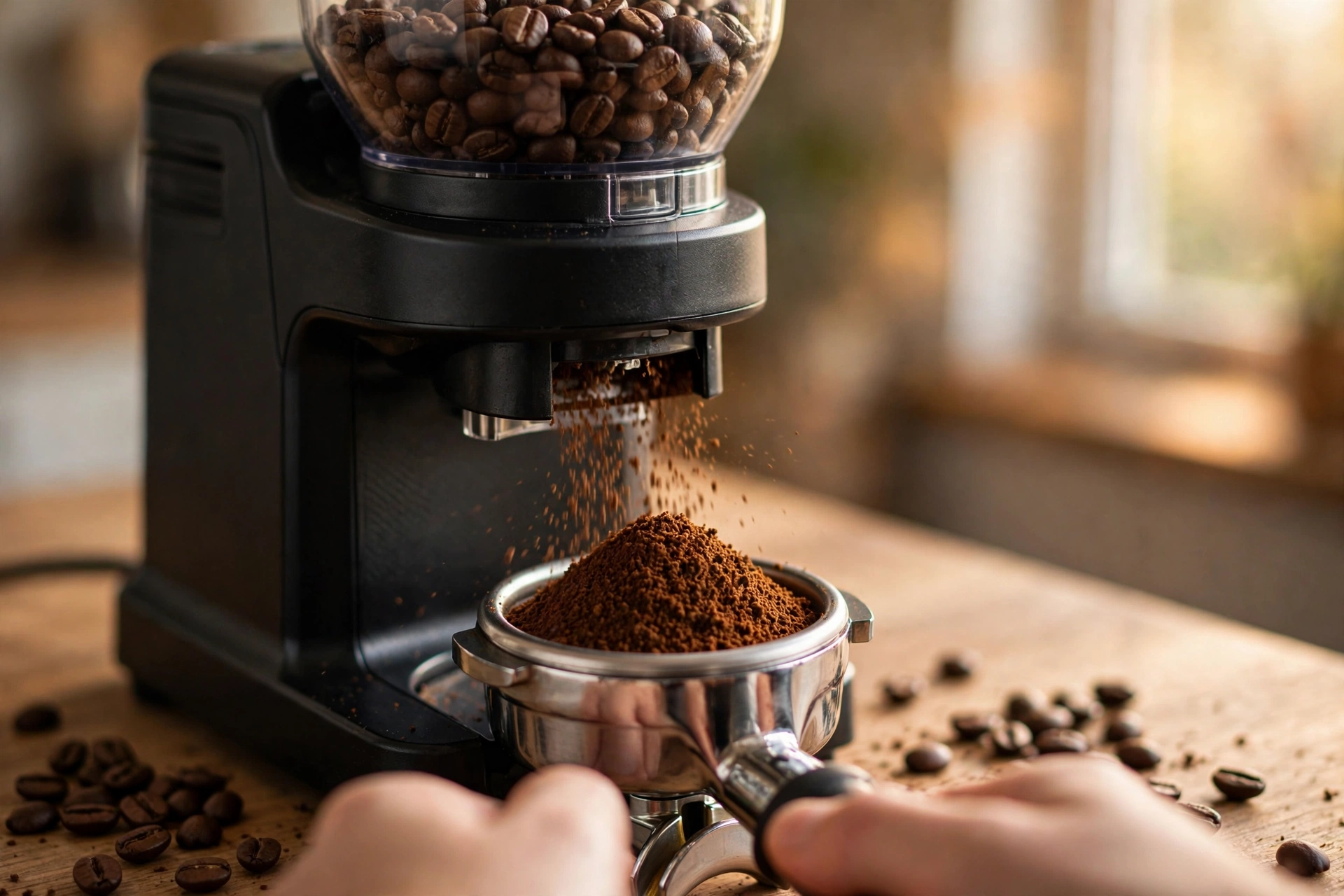
The short answer: these two cost exactly the same — $199.95 each, checked 2026-10-21 — so pick by what the grinder is for, not by the price tag. The Baratza Encore ESP is the espresso specialist: 20 dedicated micro settings for the fine end, toolless burr access, and Baratza’s repairability. The Breville Smart Grinder Pro is the convenience machine: Dosing IQ timed dosing, an LCD, a portafilter cradle, and 60 settings across every brew method — at the cost of steps that can feel too wide at espresso fineness. Prices and specs checked 2026-10-21. Prices vary by retailer; where sources disagreed we used the manufacturer’s current price.
Disclosure: we are an independent research desk and earn no commission on anything here. Vendor links on this page are plain links to manufacturer pages — no affiliate tracking. See our disclosure policy for how we stay independent.
We are a research desk, not a test lab: we synthesize manufacturer specifications, owner reports, forum threads, and published reviews rather than claiming hands-on testing we have not done.
First principles: at $200, the burr is not the decision — the adjustment is
Both grinders use 40mm conical steel burrs. At this price and size, the particle distributions are close enough that the cup does not separate them the way burr geometry separated our DF64 II vs Niche Zero comparison. What separates them is adjustment architecture: how the fine end of the grind range is divided, and what happens when you miss.
Dialing in espresso means finding the one setting where 18g of coffee extracts in the right time. The steps around that setting need to be small, because the difference between “choked” and “gushing” can be a few microns. A grinder that gives you twenty steps across the espresso band lets you land between adjacent positions. A grinder that spreads sixty steps across everything — espresso to French press — gives you fewer usable positions exactly where precision matters most. That is the whole comparison: the Encore ESP concentrates its resolution at the fine end; the Smart Grinder Pro spreads its resolution everywhere, and spends the difference on features.
Comparison table
Prices and specs checked 2026-10-21. Prices vary by retailer; where sources disagreed we used the manufacturer’s current price.
| Spec | Baratza Encore ESP | Breville Smart Grinder Pro (BCG820) |
|---|---|---|
| Current price | $199.95 (corroborated across retailers) | $199.95 (breville.com) |
| Burrs | 40mm M2 conical steel | 40mm stainless conical (per retailer specs) |
| Adjustment | 40 stepped settings: #1–20 fine micro-steps for espresso, #21–40 macro-steps for filter | 60 stepped settings, dial 1 (fine) to 60 (coarse); adjustable inner burr (factory at 6, lower = finer) |
| Dosing | Manual: pulse button or on/off knob, hands-free; no timer | Dosing IQ: precision digital timer, 0.2-second increments, programmable per brew (shots/cups), LCD display |
| Grinds into | 120g grounds bin + 54mm dosing cup (58mm adapter included) | Portafilter cradle (50–54mm and 58mm), grounds container with sealing lid, filter basket |
| Hopper | 300g | 18 oz (510g) |
| Motor | DC with gear reduction, 550 RPM; thermal overload protection | 165W AC |
| Static/retention | Reduced static via low RPM; retention typically 1–2g | Clumpier at espresso fineness; owner reports of materially higher retention |
| Cleaning | Quick-release toolless upper burr | Burr set removable for cleaning |
| Warranty | 1 year (US parts & labor, free ground shipping to repair facility) | 2 year limited |
| Repairability | Low-cost parts + self-help guides sold direct by Baratza | Plastic drive gear is the documented weak point; commonly cited lifespan 2–5 years of daily use |
| Size/weight | ≈13 × 15 × 34 cm, ≈7 lb | 8.5 × 6.3 × 15.3 in |
Grind quality and the espresso window
This section is the purchase decision, so read it slowly.
Encore ESP: the fine end is the whole point. Settings 1–20 are a dedicated espresso micro range, with the rest of the dial reserved for filter. In practice that means adjacent settings at espresso fineness are close together — the dial-in step that chokes versus the one that flows are distinct, landable positions. Owners consistently describe the ESP as espresso-capable out of the box, and retailers like Clive Coffee treat it as the entry point for dedicated espresso grinding. A shim kit ships with the grinder; each shim moves the whole range finer by about five settings’ worth, a real tuning option if your machine needs it.
Smart Grinder Pro: enough range, sometimes too coarse at the boundary. The 60 settings cover espresso to filter with no dedicated micro band, and this is where the trade bites. The documented owner complaint: at the fine end, one setting chokes the machine and the next one gushes the shot in ten seconds — no middle position exists. Breville’s answer is the adjustable inner burr: shipped at position 6, it can be turned tool-free to a lower number to shift the whole range finer, and that recovers a workable espresso window for most machines. It is an official fix, not a hack — but it is a fix the Encore ESP never asks you to make.
Clumps and retention go to the Breville’s disadvantage. Both grinders clump at espresso fineness and benefit from a WDT stir before tamping. The Smart Grinder Pro clumps more, and retention is its weakest number: one owner review measured only 16g of coffee reaching the cup from an 18g dose, with the rest held in the machine to go stale. The Encore ESP’s retention runs 1–2g, ordinary for a conical at this price, and the slow 550 RPM gear-reduced burrs keep static and heat down.
The practical translation: if your shots run through unpressurized baskets, the Encore ESP’s fine control is the feature that matters most in daily use. If you run pressurized baskets or switch constantly between brew methods, the Smart Grinder Pro’s range question disappears and its dosing features start counting.
Workflow and features: the Breville’s home turf
This is where the Smart Grinder Pro earns its half of the comparison.
Dosing IQ is a genuine system. The timer adjusts in 0.2-second increments, stores separate programs for espresso shots and for other brews, and shows the setting, grind time, and shots/cups selected on a clear LCD. Once you have dialed in a coffee, dosing becomes a one-touch repeat. The portafilter cradle grinds directly into the basket — small (50–54mm) and large (58mm) cradles included — which keeps the workflow compact for machines like the Bambino with its 54mm portafilter.
The Encore ESP is deliberately manual. There is no timer, no scale, no display: a pulse button (runs while held) and an on/off knob with hands-free operation. Dosing means weighing or watching. For espresso-purist workflows that single-dose with a scale anyway, this is not a loss — it is one less system to fight. For everyone else, it is the Encore ESP’s biggest daily inconvenience.
Both grinders are stepped, and both are ordinary in noise terms — the Encore ESP was the loudest unit in one blind five-grinder comparison test. Neither is a morning-stealth grinder.
Build, longevity, and the repairability gap
The two companies sell different promises about what happens in year three.
Baratza sells repairability as a feature. The company actively markets low-cost replacement parts and self-help guides from its own site, the burr set releases toollessly for cleaning, and the motor carries thermal overload protection. The warranty is short — 1 year, parts and labor with free ground shipping to the repair facility — but the expected life is long because a broken grinder can become a working one with a $15 part.
Breville sells a longer warranty on a sealed machine. Two years of coverage is the better paper promise. The documented weak point is a plastic drive gear, and owner-thread consensus puts typical lifespan at 2–5 years of daily use with several cups a day. There is no official parts channel comparable to Baratza’s, so a post-warranty failure is closer to a replacement event than a repair.
Net: the Breville is better protected in years one and two; the Baratza is more likely to still be grinding in year five. Which matters more depends on how you buy appliances — warranty math or repair math.
The verdict
- Buy the Baratza Encore ESP if your coffee is mostly espresso through unpressurized baskets. The 20-setting micro range is the single most useful espresso feature either grinder offers at this price, retention is low, and the repairability story means it is a purchase rather than a subscription. Accept manual dosing and no display as the price of the specialisation.
- Buy the Breville Smart Grinder Pro if you switch between brew methods, value one-touch timed dosing, and grind straight into a portafilter. Dosing IQ is a real workflow upgrade, and the LCD and cradle make it the friendlier household machine. Be ready to adjust the inner burr to get the fine end where you need it, and keep a WDT tool handy for the clumps.
- Either grinder pairs with a Bambino-class machine (our Dedica vs Bambino comparison covers that decision), but note the match-up: a pressurized-basket beginner gets more from the Breville’s convenience, while a non-pressurized dial-in devotee gets more from the Baratza’s fine control.
Both grinders justify their reputations at exactly the same price: the Encore ESP as the entry-level espresso specialist, the Smart Grinder Pro as the entry-level do-everything machine. Pick the brewing life you actually live. For the wider context, our grinders under $500 roundup places both against the next tier up, and how much to spend on a grinder explains what each price band buys.