
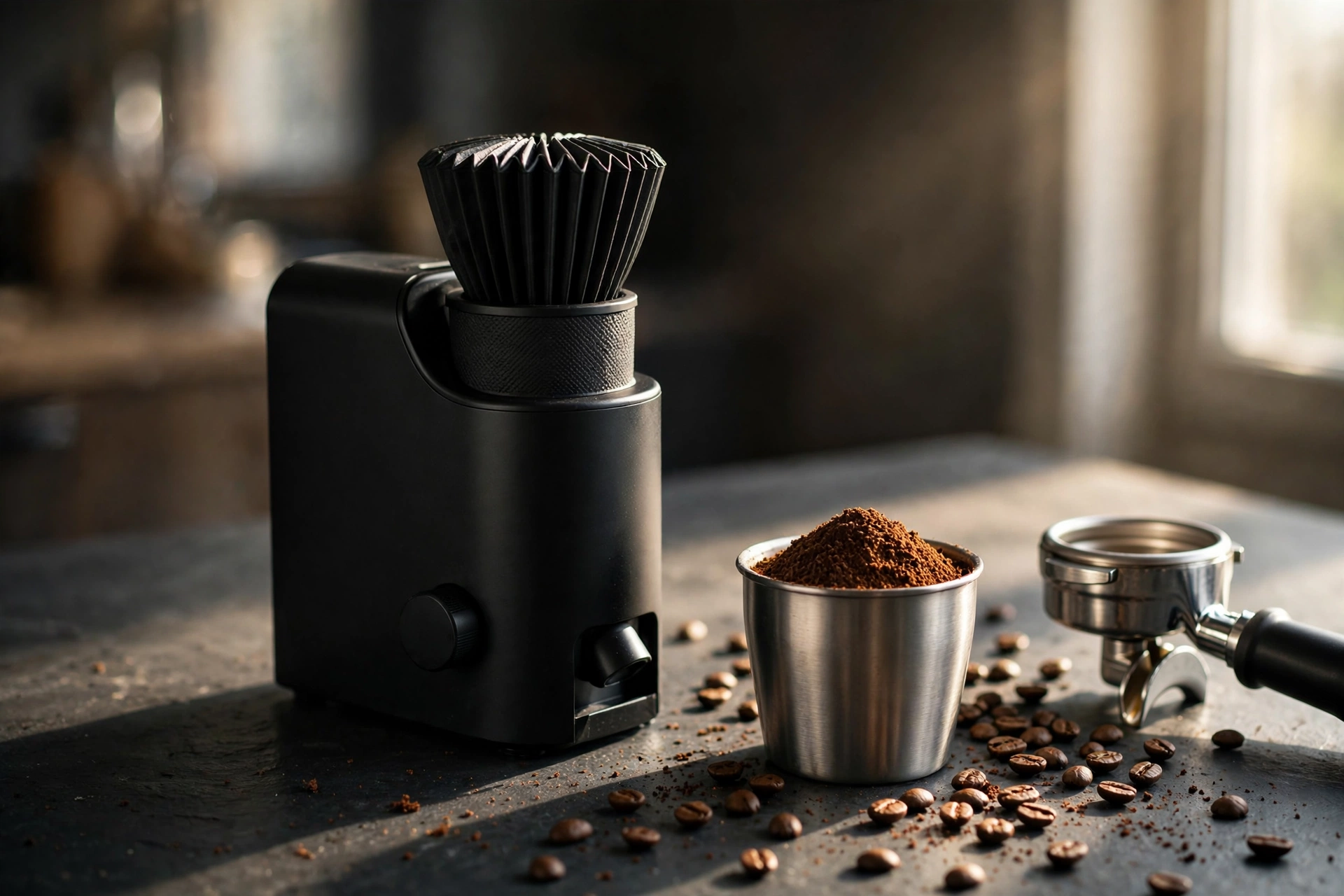
The short answer: buy the DF64 Gen 2 if you single-dose; buy the Eureka Mignon Specialita if you want a quiet hopper grinder with timed dosing. Both cost less than $600 — the DF64 Gen 2 at $399, the Specialita at $549 at a major US retailer at the time of writing — and both use flat steel burrs with stepless adjustment, so both can dial in espresso precisely. What separates them is not grind quality in the abstract but the daily routine each one is built around: weigh-every-dose versus fill-the-hopper, bellows versus touchscreen, upgrade platform versus finished appliance. Prices and specs checked 2026-11-04. Prices vary by retailer; where sources disagreed we used the manufacturer’s or a major retailer’s current price.
Disclosure: we are an independent research desk and earn no commission on anything here. This page contains no affiliate links. See our disclosure policy for how we stay independent.
We are a research desk, not a test lab: we synthesize manufacturer specifications, owner reports, forum threads, and published reviews rather than claiming hands-on testing we have not done.
Before you buy: check which DF64 generation a listing ships
The DF64 is sold under several names — MiiCoffee DF64 II in North America, Turin DF64 Gen 2 elsewhere — for the same 64mm flat-burr single-dose platform. Some sellers now list a Gen 2.7 configuration (same 250W motor and 64mm burrs, with an updated anti-popcorn blocker), and at least one lists it as a preorder. The comparison below covers the Gen 2 platform; a Gen 2.7 changes details, not the workflow verdict. On the Eureka side, note the Compatto variant: a shorter Specialita (about 13 inches tall) with cryo-treated Diamond Inside burrs, listed at $599 — if vertical clearance is tight, that is the variant to price, not the standard $549 model.
First principles: retention is the workflow decision
Both grinders use flat burrs, so the usual flat-versus-conical flavour argument does not apply here. What matters instead is what happens to yesterday’s grounds.
Retention is the coffee left inside the grinder after a dose — in the burr chamber, the chute, the exit path. Retained grounds go stale, and the next dose pushes some of them out mixed with fresh coffee. On a hopper grinder, retention is a background tax you mostly ignore: you grind from a full hopper, the dose is roughly consistent, and a gram or so of exchange matters less when every dose comes from the same bean. On a single-dose grinder, retention is the whole point of the design: you weigh 18g in, you want 18g out, and you want nothing from the previous bean in the cup.
That is why these two grinders, despite sharing a burr philosophy, are built so differently. The DF64 attacks retention with architecture: a straight, short grind path, a bellows on top of the hopper that you pump to blow the chamber clear, and a plasma ionizer in the chute to cut static so grounds do not cling. The claimed result is under 0.1g retained. The Specialita attacks retention with compactness: a small 55mm burr chamber leaves little room for grounds to collect, and retailer measurements put it around 1.3g — genuinely low for a hopper grinder, but an order of magnitude above the DF64’s claim, and with no bellows to clear it.
The practical translation: if you drink one bean all week from a hopper, 1.3g of exchange is invisible. If you rotate single origins daily, it is a stale-coffee tax on every first shot of a new bag — and the DF64’s bellows routine, annoying as it is, is the mechanism that removes it.
Comparison table
Prices and specs checked 2026-11-04. Prices vary by retailer; where sources disagreed we used the manufacturer’s or a major retailer’s current price.
| Spec | DF64 Gen 2 (MiiCoffee DF64 II / Turin) | Eureka Mignon Specialita |
|---|---|---|
| Current price | $399 | $549 at a major US retailer at time of writing ($599 for the shorter Compatto variant) |
| Burrs | 64mm stainless flat (Red Titanium coated option); accepts aftermarket SSP and other 64mm sets | 55mm flat steel (Diamond Inside cryo-treated burrs on the Compatto variant) |
| Adjustment | Stepless collar | Stepless micrometric dial |
| Motor | 250W AC, 1400 RPM | 1350 RPM (power not published as a headline figure) |
| Grind speed | About 1–2 g/sec; an 18g dose in under 10 seconds per one comparison | 1.8–2.5 g/sec for espresso, 2.5–3.5 g/sec for drip and pour-over; 18–20g in about 9–12 seconds |
| Dosing | Single-dose: weigh beans, grind into 58mm dosing cup, pump bellows to clear chamber | Hopper-fed: 300g hopper, touchscreen with two timed presets to 0.1-second precision plus continuous mode |
| Retention | Claimed under 0.1g with bellows technique | About 1.3g per retailer measurement |
| Static control | Plasma ion generator in the exit chute | Anti-static design via compact chamber; no ionizer |
| Anti-popcorning | Anti-popcorn disc | Not applicable — hopper-fed design |
| Noise | Ordinary single-dose grinder: louder, higher-pitched 1400 RPM motor | Very quiet — sound-insulated Silent Technology body, listed below 60 dB |
| Cleaning | Upper burr removable; grind setting shifts when burrs are removed for cleaning | Upper burr removable without losing the dialed-in grind setting |
| Size | About 10 × 5.2 × 12 in | About 12 × 18 × 35 cm, about 5.6 kg; Compatto variant about 13 in tall |
| Weight | About 15 lb (6.5–6.8 kg) | About 5.6 kg |
| Burr upgrade path | Full 64mm ecosystem; SSP sets about $185 | Closed platform; stock 55mm burrs only |
| In the box | 58mm aluminium dosing cup, bellows hopper, brush | Hopper, portafilter fork, brush |
| Warranty | 1 year (importer) | 1 year |
| Availability note | Sold as MiiCoffee DF64 II / Turin DF64 Gen 2; Gen 2.7 listings now appearing at some sellers — verify generation before buying | In current production; Compatto variant for low cabinets |
Grind quality: same philosophy, different headroom
Because both grinders are flat-burr and stepless, the espresso window itself is not the separator — both can hold a dialed-in setting with fine granularity, and both reward the same dial-in routine. The separator is headroom: what each grinder lets you change later.
The DF64’s headroom is its burr platform. The 64mm flat standard is the most-supported aftermarket size in home espresso. Stock stainless burrs give the classic flat profile — clarity, flavour separation, brighter acidity, especially with light roasts. SSP Multipurpose burrs (about $185) trade some of that edge for sweetness; High Uniformity burrs push clarity further. You are not buying one flavour profile, you are buying the option to change it. Our DF64 vs Niche Zero comparison covers the same upgrade argument against a conical rival.
The Specialita’s headroom is consistency, not changeability. Its 55mm burrs are smaller, so they spin faster per gram ground and run slightly hotter in theory — in practice, the 9–12 second grind for a double means heat is a non-issue at home volumes. What the smaller burr chamber buys is the low retention figure above and a compact body. What it costs is the upgrade path: there is no SSP equivalent for the Specialita, and no reason to want one — the grinder is sold as a finished, tuned appliance, and its owners generally treat it that way.
One honest caveat on the DF64’s clarity advantage: flat-burr clarity comes with a narrower dial-in window than conical burrs offer, because a tight particle spread has fewer fines bracing the puck. Both grinders here share that trait, so neither forgives a sloppy dial-in — but the Specialita’s timed dosing removes one variable (dose weight) from every shot, which partially compensates. If your puck prep is still developing, timed dosing is a real, daily forgiveness mechanism; if your prep is already consistent, the DF64’s burr options matter more.
Workflow and features: the Specialita’s home turf
This is where the Specialita earns its $150 premium, and the gap is wide.
The Specialita is the set-and-forget machine. Fill the 300g hopper once, program two timed doses on the touchscreen — say, a single and a double, or two doubles for different baskets — and every morning is one button press. The touchscreen times to 0.1 seconds, the fork holds the portafilter, and the grinder stops itself. There is no scale, no weighing, no bellows pumping, no dosing cup transfer. And it does all of this quietly: the sound-insulated body is the feature owners mention most after the grind quality itself, and it is the reason the Specialita is the default recommendation for households where someone else sleeps past the first shot.
The DF64 is deliberately manual. Every dose is weighed, poured into the bellows hopper, ground into a cup, and finished with a few pumps of the bellows to clear the chamber. The plasma ionizer keeps static down, but the routine is still a ritual — roughly five extra steps per dose versus the Specialita’s one button. What the ritual buys is rotation: a new bean every day costs nothing in stale grounds or re-dialing a hopper, and the 50g bellows hopper means there is never a half-bag of beans going stale in the machine. For single-origin drinkers, that is not inconvenience, it is the feature. For everyone else, it is friction twice a day.
Neither grinder is the right answer for filter-first brewing without qualification. The DF64 handles filter well and changes methods with a collar turn. The Specialita grinds filter competently but lives in an espresso workflow — switching methods means re-dialing a hopper grinder and re-timing doses, which gets old fast if filter is half your brewing.
Build, longevity, and the platform bet
The DF64 is an aluminium-bodied platform with importer support. The body is metal, the motor is a simple fixed-speed AC unit, and the parts that wear — burrs — are a standard size sold by many makers. The warranty is 1 year through the importer, and long-term ownership means leaning on the aftermarket community rather than a single manufacturer’s parts channel. That is a bet on a standard, and the 64mm standard is a safe one.
The Specialita is a finished Italian appliance. It is hand-assembled in Florence, the fit and finish reflect the price, and the touchscreen and timed-dosing electronics are the parts most likely to matter in year five — they are also the parts no owner repairs at home. The warranty is likewise 1 year. What Eureka offers instead of repairability is a design that asks less of its parts: slower effective wear from a compact, insulated, purpose-built espresso grinder that does one job and does it quietly.
Net: the DF64 is more likely to still be interesting in year five because you can change its burrs; the Specialita is more likely to still be doing exactly what it did on day one, quietly, with no intervention. Platform versus appliance is the real purchase, and it maps cleanly onto the workflow question: tinkerers buy platforms, routine drinkers buy appliances.
The verdict
- Buy the DF64 Gen 2 if you single-dose, rotate beans, brew filter as well as espresso, or want the 64mm burr upgrade path. The near-zero retention claim, the bellows workflow, and the SSP options are a coherent package for the enthusiast who treats the grinder as a bench, not an appliance. Accept the noise and the manual routine as the price of the platform.
- Buy the Eureka Mignon Specialita if you drink mostly one bean, value a quiet morning and a one-button dose, and want a hopper grinder that disappears into the routine. The timed touchscreen dosing, the sub-60 dB operation, and the low-for-a-hopper 1.3g retention make it the easier grinder to live with every day. If cabinets are low, price the Compatto variant instead.
- Either grinder outclasses the ≈$200 tier on grind quality — for the step up from there, our grinders under $500 roundup places both against the next tier, how much to spend on a grinder explains what each price band buys, and our Eureka Mignon vs Baratza Sette 270 comparison covers the Specialita’s line against a different rival.