
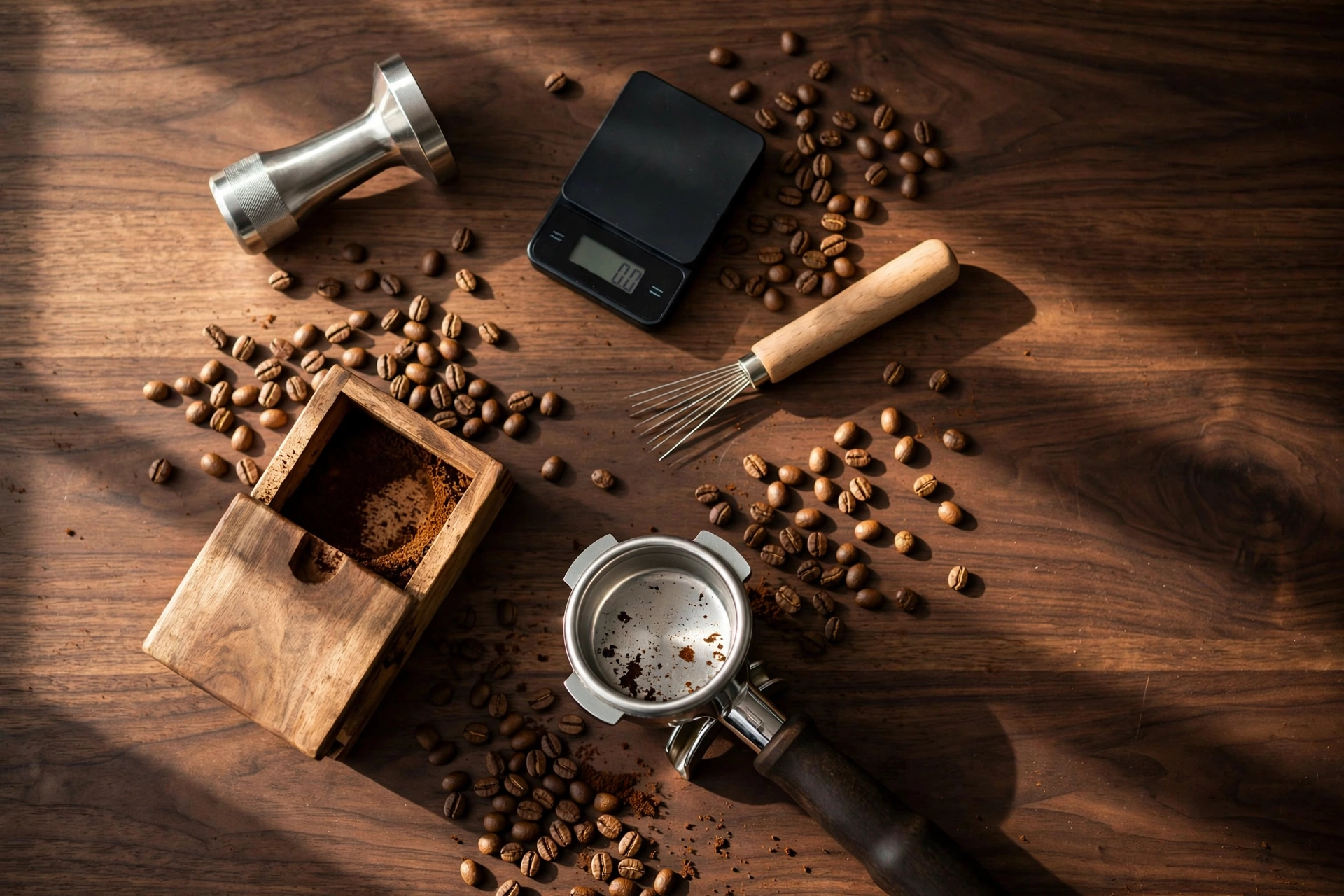
The short answer: a digital scale, a precision tamper, a WDT tool, and a knock box. That’s the complete beginner kit — four items. Everything else sold to espresso beginners is either a workflow luxury or a solution to a problem you don’t have yet. This isn’t minimalism for its own sake. It’s physics: espresso quality is decided by the puck — its density, uniformity, and evenness — and only a few accessories touch the puck. The rest touch your comfort.
Why accessories matter less than vendors claim
Here’s the mechanism that decides what accessories are worth buying. Espresso forces pressurized water through a compacted bed of grounds. If the bed has dense clumps, water takes the easy path around them — this is called channeling, and it produces a shot that’s simultaneously sour (under-extracted paths) and bitter (over-extracted paths). A perfect machine cannot fix a channelled puck. A mediocre machine can pull a decent shot from a well-prepared puck.
So the entire accessories game is really one question: does this tool make the puck more even? Tools that do — precision tamper, WDT tool, distribution aids — are worth owning. Tools that don’t touch puck uniformity — decorative cups, premium drip trays, fancy bean jars — are lifestyle purchases. Buy them when you want them, but don’t confuse them with quality.
The essential four
1. A digital scale (0.1 g precision)
This is the most important accessory you can buy, and it has nothing to do with “coffee culture.” Consistency is impossible without measurement. A good shot recipe is a ratio — say, 18 grams of coffee yielding 36 grams of espresso in 25–30 seconds. Without a scale, you’re guessing both numbers, which means you can’t tell whether a bad shot was the grind, the dose, or your technique. You can’t fix what you can’t measure.
What to get: any small digital scale with 0.1-gram precision, a capacity of at least 500 g, and a fast refresh rate. It needs to fit under your machine’s drip tray area to weigh shots as they pull, so check dimensions. A built-in timer is handy. You don’t need a premium brand — the difference between a budget scale and a fancy one is build quality and aesthetics, not measurement accuracy at this task.
2. A precision tamper (matched to your basket)
Most machines ship with a plastic tamper. Throw it in a drawer — it’s usually slightly too narrow for the basket, which leaves a ring of untamped grounds around the edge. That untamped ring is a channeling highway: water races around the edge and your shots run thin and sour.
A proper tamper is a flat (or very slightly convex) piece of machined metal that matches your basket diameter exactly — 58 mm for most standard machines, 54 mm for others. Check your basket before buying. Weight helps: a tamper in the 350–450 g range lets gravity do some of the pressing, which reduces hand pressure and makes tamping more repeatable. Level tamping (the tamper hitting the puck perfectly flat) matters more than pressure — an uneven tamp creates a tilted bed with thin spots, and water exploits them instantly.
| Basket size | Tamper diameter | Common with |
|---|---|---|
| Standard commercial | 58 mm | Most mid-range and prosumer machines |
| Compact consumer | 54 mm | Entry machines from major consumer brands |
| Small / capsule-style | Varies | Check your manual — don’t guess |
Measure, don’t assume. A “58 mm basket” sometimes actually takes a 58.4 mm tamper, and the difference between a good fit and a loose one is visible: the tamper should slide in with almost no side play.
3. A WDT tool
Grinders produce clumps — tiny fused balls of grounds, especially at espresso fineness. Clumps are density anomalies: the water flows around them instead of through them, creating local channels. The fix is mechanical: stir the grounds in the portafilter with thin needles before tamping, breaking the clumps into loose, even grounds. This is the Weiss Distribution Technique (WDT), and it’s one of the cheapest genuine improvements in all of espresso.
A WDT tool is just a handle with several thin metal needles (0.25–0.4 mm works best; thicker needles push grounds around rather than threading through them). Stir gently in a spiral from bottom to top of the portafilter — thirty seconds, done. Combined with a precision tamper, this two-step prep routine (distribute, then tamp) solves most of the consistency problems beginners blame on their machine or beans.
4. A knock box
After the shot, you need somewhere to dump the hot, wet puck. A knock box is a small bin with a padded bar — you knock the portafilter against the bar and the puck falls out. Without one, people improvise with trash cans (puck shatters everywhere, portafilter dents), the sink (wet grounds everywhere), or compost bins (still hot, messy). It’s a workflow item, not a quality item, but “workflow you dread” kills daily practice faster than bad beans do. Any solid knock box works; the only requirement is that the bar is padded so it doesn’t chip your portafilter.
What to buy next (in order)
Once the essential four are in place, these are the honest next tier — each solves a real, specific friction:
-
A tamping mat. A flat, stable silicone or rubber pad that sits under the portafilter while you tamp. It protects your counter, keeps the portafilter from sliding, and gives you a dedicated “prep zone” that keeps the ritual organized. Cheap, genuinely useful.
-
A dosing funnel. A ring that sits on top of the portafilter basket while you grind or WDT, catching the grounds that would otherwise spill off the edge. This matters most with WDT — stirring throws grounds outward — and it’s the difference between a clean counter and a daily sweeping ritual.
-
A milk pitcher (12 oz). Only if you make milk drinks. Smaller pitchers are easier to control for single servings; the standard 12-ounce size teaches basic steaming and pouring. Buy the fancy thin-spouted “latte art” pitcher only when your milk texture is already good — a better spout doesn’t fix bad microfoam.
-
Cleaning supplies: a brush and espresso machine cleaner. Backflushing with a dedicated cleaner keeps oils from going rancid in the group head (rancid oil in the shower screen is a bitterness source nobody can dial around). A small group brush for daily wiping and cleaner powder for weekly backflushes. This is maintenance, but it does touch cup quality.
-
A leveler / distributor (optional, debatable). A spinning tool that levels the grounds before tamping. It helps beginners who struggle with uneven distribution — but a good WDT routine mostly replaces it, and some argue it compresses the top layer unevenly. Buy one if your WDT + tamp routine still produces visibly uneven extractions; otherwise skip.
What to skip as a beginner
- Bottomless (naked) portafilters. Excellent diagnostic tool later — they reveal channeling in real time. But they’re messy (shots spray sideways when things go wrong, which is often at first) and add stress to learning. Revisit after month three.
- Precision baskets and shower screens. They refine an already-consistent process. When you’re still missing doses by a gram, a fancier basket is noise.
- Pressure-profiling gadgets and flow-control devices. Advanced technique modifiers. Learn to pull a consistent standard shot first; variables on top of inconsistency just create confusion.
- Premium versions of anything. A $30 tamper with the right diameter beats a $90 tamper with the wrong one. The accessory market has enormous margins and diminishing returns — “precision” is a spec, not a price tier.
- Espresso-specific cups. Beautiful, and they do keep the shot warm slightly better. They don’t change extraction. Buy for pleasure, not quality.
The purchase order that actually works
If you’re budgeting, buy in this order and stop when the money runs out:
- Scale (about the price of two bags of beans). Instantly makes every other purchase more valuable.
- Precision tamper (matched diameter). Fixes the biggest built-in flaw of entry machines.
- WDT tool (cheap). Fixes clumps, the most common beginner inconsistency.
- Knock box (cheap). Makes the daily ritual tolerable.
- Tamping mat + dosing funnel. Counter protection and cleanliness.
- Cleaning supplies. Start the habit early; it’s cheaper than descaling problems later.
Total for the essential four is modest — roughly the cost of a few weeks of café drinks — and each one addresses the puck, the scale, or the workflow. That’s the test for every accessory you ever buy: does it touch the puck, measure the process, or remove a daily friction? If it does none of the three, it’s decoration.